
CAN A PRESIDENTIAL REFERENCE CHANGE A JUDGMENT?
TOPIC: (GS2) INDIAN POLITY: THE HINDU
The President has sought the Supreme Court’s opinion on whether Governors and the President can be directed by courts to act within specific time limits on State Bills. This comes after a recent Supreme Court ruling enforcing time-bound action on such matters.
Background of the Reference
- The Tamil Nadu government had challenged the Governor’s delay in approving Bills.
- The Supreme Court’s April 8 ruling declared such inaction illegal and imposed time limits for constitutional action.
- Following this, President Droupadi Murmu submitted a Presidential Reference with 14 key legal questions.
What is a Presidential Reference?
- Under Article 143(1), the President can seek the Supreme Court’s advice on matters of public importance.
- The Court gives its opinion but is not bound to entertain every Reference.
- In past instances (e.g., Ayodhya case), the Court has refused to answer a Reference.
Are Advisory Opinions Binding?
- Advisory opinions under Article 143 are not binding, unlike judgments under Article 141.
- They carry persuasive value but don’t override previous judicial rulings.
- The April 8 decision, being a regular judgment, remains binding on all courts.
Can the Reference Overturn the April 8 Judgment?
- No, a Presidential Reference cannot reverse a past ruling.
- For changes to binding judgments, a review or curative petition is the appropriate method.
- However, the Court can use Article 143 to clarify or explain the law without affecting earlier decisions.
Past Examples
- In 1998, the Court used a Reference to revise collegium procedures without overturning the 1993 judgment.
- In the 2G case (2012), the Court restated legal principles without reversing prior rulings.
Conclusion:
While the Supreme Court can clarify constitutional questions through Presidential References, it cannot undo earlier binding judgments through this route. The April 8 ruling on time-bound action by constitutional authorities will remain valid unless reviewed through proper judicial channels.
RBI’S FINANCIAL INCLUSION INDEX (FI-INDEX)
TOPIC: (GS3) ECONOMY: THE HINDU
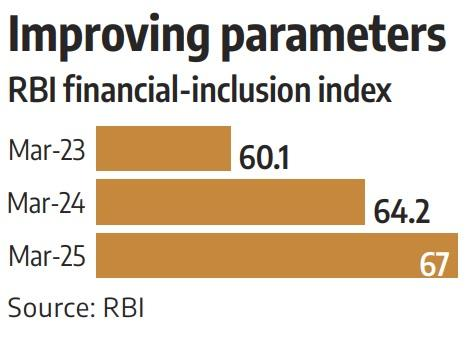
The Reserve Bank of India (RBI) released the latest Financial Inclusion Index (FI-Index) for FY 2024–25, which rose by 4.3% from the previous year. The index reflects wider and better access to financial services across India.
What is financial inclusion?
- Financial inclusion means ensuring easy and affordable access to useful financial products and services (like savings, loans, insurance, pensions) for all individuals and businesses.
- It plays a crucial role in supporting inclusive economic growth and reducing inequality.
What is the FI-Index?
- Introduced by RBI, it is a composite index measuring financial inclusion across banking, insurance, pensions, investments, and postal services.
- The index ranges between 0 and 100 — 0 shows no inclusion, 100 means complete inclusion.
It is based on 3 key parameters:
- Access (35%) – Availability of services (like bank branches, ATMs, etc.)
- Usage (45%) – How often and effectively people use these services.
- Quality (20%) – Measures financial literacy, service equality, and grievance redressal.
Recent Trends (FY 2024–25)
- FI-Index value rose from 64.2 to 67.
- Growth was driven by better usage of financial services and improvements in quality of service.
- Indicates deeper involvement of people in formal financial systems.
Significance
- Encourages entrepreneurship, boosts job creation, and promotes inclusive growth.
- Supports 7 out of 17 UN Sustainable Development Goals (SDGs).
- Improves women’s financial empowerment and strengthens resilience against economic shocks.
Government Initiatives Supporting Inclusion
- PM Jan Dhan Yojana: 54.5 crore bank accounts opened.
- Atal Pension Yojana: 7.3 crore enrolled.
- PMJJBY & PMSBY: Over 70 crore people covered under life and accident insurance.
- PM Mudra Yojana: ₹32.36 lakh crore loans given, mostly to women and SC/ST/OBC.
- Stand-Up India: ₹53,609 crore sanctioned to 2.36 lakh SC/ST and women entrepreneurs.
Challenges
- Gender gaps in access to accounts.
- Poor digital infrastructure and low financial literacy.
- Risks of fraud and misuse due to weak consumer protection.
Way Forward
- Strengthen digital infrastructure and literacy.
- Improve consumer protection and regulatory oversight.
- Ensure fair, safe, and inclusive financial services for all.
Conclusion:
The RBI’s Financial Inclusion Index reflects India’s steady progress in bringing more people into the formal financial system.
PLASTIC INDUSTRY INFLUENCING GREEN POLICIES?
TOPIC: (GS3) ENVIRONMENT: THE HINDU
Concerns are rising that the global plastic industry, supported by fossil fuel companies, is using misleading strategies to delay meaningful environmental regulations. India’s efforts to formalize informal waste workers and tackle plastic waste are also under review.
Plastic Industry’s Tactics, A Parallel to Tobacco:
- Blame-shifting: Just as tobacco companies blame individuals for smoking, plastic producers often shift the responsibility of pollution to consumers for not recycling.
- Misleading Science and PR: The industry promoted recycling as a solution despite internal studies showing it wasn’t practical or cost-effective.
- Greenwashing: Labels like “biodegradable” or “compostable” plastics often mislead consumers due to lack of standards and proper waste infrastructure.
Targeting the Global South
- With strict plastic regulations in developed nations, companies are turning to developing regions like Asia and Africa, where regulations are weaker.
- As per OECD’s 2022 report, plastic use could triple in Asia by 2060 compared to only 15% growth in Europe.
- Lobbyists from fossil fuel and chemical sectors have increased their presence in UN treaty negotiations on plastics, attempting to dilute global commitments.
India’s Response to Plastic Waste
- India’s informal sector handles around 70% of plastic recycling, but workers face unsafe and exploitative conditions.
- In 2024, the government launched the National Action for Mechanised Sanitation Ecosystem to:
- Provide protective equipment.
- Offer health insurance under Ayushman Bharat.
- Extend social security benefits.
- By May 2025, over 80,000 workers were registered under this scheme.
PLASTIC WASTE MANAGEMENT RULES, 2016
The Plastic Waste Management Rules, 2016 are rules notified by the Ministry of Environment, Forest and Climate Change (MoEFCC) to manage plastic waste in India in an environmentally sound way.
Key Purpose:
To reduce plastic pollution by regulating plastic use, encouraging recycling, and making producers responsible for the plastic they generate.
FEATURES:
- Extended Producer Responsibility (EPR):
Producers, importers, and brand owners must take responsibility for collecting and recycling the plastic they generate. - Ban on Certain Single-Use Plastics:
From July 1, 2022, specific single-use plastic items like straws, cutlery, and plastic sticks are banned. - Mandatory Plastic Waste Processing:
Local bodies and industries must ensure plastic waste is either recycled, co-processed in cement plants, or converted to energy/fuel. - Use of Recycled Plastic:
Companies must include a minimum percentage of recycled plastic in their packaging materials.
Conclusion:
The plastic industry’s tactics threaten genuine environmental progress. While India is improving waste worker welfare and enforcing producer responsibility, stronger implementation and global cooperation are essential to counter plastic pollution effectively.
KEY TAKEAWAYS FROM SWACHH SURVEKSHAN 2024-25
TOPIC: (GS2) GOVERNANCE: THE HINDU
The ninth edition of Swachh Survekshan, the world’s largest cleanliness survey, has highlighted major trends in urban sanitation, waste management, and citizen engagement. It offered fresh insights into decentralised cleanliness efforts and innovative waste reuse across cities.
Survey Structure and Growth
- Over 4,500 cities participated, compared to just 100 in 2016.
- The survey included third-party audits, public feedback (140 million responses), and 10 core parameters such as segregation, collection, disposal, and worker welfare.
- The new “Super Swachh League” allowed top-performing cities like Indore and Surat to mentor others.
- Swachh Survekshan 2024-25 has gone beyond rankings to reflect real changes in sanitation across Indian cities.
- It provided a strong assessment tool for urban cleanliness, public participation, and waste management efficiency.
Inclusive Competition Among Cities
- Rankings were done in five population categories (from below 20,000 to million-plus cities).
- Cities like Ahmedabad, Bhopal, and Lucknow broke into the top in the million-plus category.
- Odisha’s improvement is notable—Bhubaneswar rose from rank 34 to 9, and small towns like Aska and Chikiti also performed well.
South Indian and NCR Trends
- Southern cities made modest progress; Bengaluru lagged, while Tirupati, Hyderabad, and Mysuru showed potential.
- In the NCR, Noida and New Delhi Municipal Council led, while Delhi, Gurugram, and Ghaziabad showed improvements despite challenges.
Innovative Sanitation Practices
- Indore: Segregates waste into six categories at source.
- Surat: Earns revenue from treated sewage water.
- Pune: Empowers ragpickers through cooperatives.
- Visakhapatnam & Agra: Transformed dump yards into eco parks using bioremediation.
Theme of the Year – Reduce, Reuse, Recycle (RRR)
- The 2025 theme focuses on RRR, aiming to boost jobs, small enterprises, and self-help groups.
- There’s still untapped potential in the “waste-to-wealth” idea due to weak investor incentives and viability issues.
WHAT IS SWACHH SURVEKSHAN?
Swachh Survekshan is an annual cleanliness survey conducted by the Ministry of Housing and Urban Affairs (MoHUA) under the Swachh Bharat Mission (Urban) to rank Indian cities based on their sanitation, hygiene, and waste management performance.
Key Points:
- Started in 2016 to encourage cities to improve urban sanitation and involve citizens in the cleanliness drive.
- Cities are ranked based on factors like waste collection, processing, open defecation status, citizen feedback, and innovation.
- Awards are given to top-performing cities, states, and zones to foster healthy competition.
- Citizen participation plays a major role—through feedback, Swachhata App use, and awareness activities.
Conclusion:
Swachh Survekshan 2024-25 reveals that even lagging cities can transform with local innovation and citizen support. For long-term impact, stronger ULBs, behavioural change, and better waste processing systems are key.
SHIFT FROM ANIMAL TESTING TO BIOLOGICAL MODELS
TOPIC: (GS4) ETHICS: THE HINDU
Ethical concerns and scientific limitations around animal testing are gaining attention. Experts are urging the use of lab-grown biological models to replace live animals in experiments and testing.
Ethical Background of Animal Testing
- Animals have traditionally been used in scientific research, often without considering their suffering.
- Ethical arguments now call for respecting animals as sentient beings capable of pain and fear.
- Earlier, humans were also used in tests (e.g., food preservative trials in early 1900s America), proving that ethical standards were not always better in the past.
- Animal testing for scientific and medical purposes has long been questioned on ethical grounds.
- With advancements in tissue engineering, there’s now a strong case to replace animal experimentation with artificial biological systems.
Scientific Limitations of Animal Testing
- Research shows that animal responses do not always reflect how humans react to the same chemicals or drugs.
- Animal studies can give misleading or non-transferable results, reducing their reliability in human health research.
Advancements in Bioengineering
- Tissue engineering has enabled creation of artificial organs like skin, muscles, pancreas, heart, bladders, and blood vessels.
- These lab-grown tissues can mimic human biology and offer safer, more precise testing options.
- Using artificial models promotes both humane science and innovation in regenerative medicine.
Legal and Policy Suggestions
- Amend the Prevention of Cruelty to Animals Act, 1960, to recommend lab-based testing wherever possible.
- Make it a principle that all medical and pharmaceutical tests should prefer artificial biological models over animals.
Educational and Research Shift
- Many schools have stopped using real animals for dissection, replacing them with 2D and 3D visual tools.
- Research labs should also shift to bio-simulations and lab-grown models with support from tissue-engineering institutions.
Conclusion:
To build a compassionate and progressive scientific culture, India must reduce animal use in experiments. Legal reform, public awareness, and promotion of bio-models are key steps toward a more ethical and advanced research ecosystem.
INDIA WITNESSES RISE IN INTELLECTUAL PROPERTY (IP) FILINGS
TOPIC: (GS3) SCIENCE AND TECHNOLOGY: THE HINDU
Over the last five years, India has seen a 44% increase in the filing of Intellectual Property (IP) applications. This rise highlights the growing focus on innovation and legal protection of creative work in India.
What is Intellectual Property (IP)?
- IP refers to creations of the mind, such as inventions, artworks, symbols, names, and designs.
- It includes rights given to individuals or companies to safeguard their innovations or creative efforts.
Trends in IP Filings (2020–21 to 2024–25)
- Total filings rose from 4.77 lakh to 6.89 lakh, a 44% increase.
- GI filings saw the biggest jump at 380%.
- Design registrations grew by 266%.
- Patents increased by 180%.
- Copyrights grew by 83%.
- Trademarks rose by 28%.
- SICLD (Semiconductor Designs) filings rose by 20%.
Major Government Initiatives
- National IPR Policy (2016) – Created a single policy framework to manage and promote IPR in India.
- Startups Intellectual Property Protection (SIPP) – Provides free assistance to startups for patent and trademark filings.
- CIPAM – Cell for IPR Promotion and Management, set up for policy coordination.
- NIPAM – National IP Awareness Mission trains students and educators about IPR.
- AI/ML Tools – Introduced to make trademark searches faster and more accurate.
- Atal Innovation Mission (AIM) – Launched by NITI Aayog to support innovation through labs and incubators.
TYPES OF INTELLECTUAL PROPERTY RIGHTS (IPRS)
- Patents – For inventions and new technologies.
- Trademarks – For brand names, logos, or symbols.
- Copyrights – For literary, musical, and artistic works.
- Designs – For the shape, pattern, or look of products.
- Geographical Indications (GI) – For products linked to a specific region (e.g., Darjeeling tea).
- Layout Designs – For semiconductor integrated circuits.
- Plant Variety Protection – For new plant breeds.
- Trade Secrets – For confidential business information.
Conclusion
India’s sharp rise in IP filings shows a growing culture of innovation. This strengthens India’s legal protection of ideas and supports its journey towards an innovation-driven economy.
U.S. WITHDRAWAL FROM UNESCO
TOPIC: (GS2) INTERNATIONAL RELATIONS: THE HINDU
The U.S. government has announced its exit from the United Nations Educational, Scientific and Cultural Organization (UNESCO). This marks a return to its earlier position before it had rejoined the agency in 2023.
Reasons for U.S. Exit from UNESCO:
- Perceived Anti-Israel Bias: The U.S. believes UNESCO supports positions critical of Israel.
- Policy Misalignment: The agency’s goals are said to be at odds with the U.S.’s “America First” diplomatic strategy.
- Demand for Reforms: Washington argues that UNESCO needs significant internal reforms to remain effective and unbiased.
Implications of U.S. Withdrawal:
Financial and Program Impact:
- The U.S. is a major contributor to UNESCO’s budget.
- Its exit could lead to funding shortages for global programs in education, science, culture, and heritage protection.
Effect on U.S. Heritage Sites:
- The U.S. has 26 UNESCO World Heritage Sites (e.g., Grand Canyon, Statue of Liberty).
- These may lose technical and financial support and be excluded from future listings.
Geopolitical Shifts:
- Other countries, especially China, may fill the leadership vacuum.
- The move signals a retreat from multilateralism, possibly encouraging other countries to reduce participation in UN bodies.
About UNESCO:
- Founded: 1945; Headquarters: Paris
- Members: 194 nations (as of July 2025)
- Purpose: Promote peace and cooperation through education, science, culture, and communication.
Major Reports:
- Global Education Monitoring Report
- World Water Development Report
- UNESCO Science Report
- Global Ocean Science Report
Key Initiatives:
- World Heritage Convention (1972)
- Man and Biosphere Programme (1971)
- Creative Cities Network (UCCN)
- International Hydrological Programme (IHP)
India and UNESCO:
- Founding Member: Since 1946, with offices in New Delhi and regional units.
- World Heritage Sites (2025):
- Total: 44 (36 cultural, 7 natural, 1 mixed)
- Latest: Maratha Military Landscapes (12 forts)
- Intangible Heritage: Includes Yoga, Ramlila, Vedic chanting, Durga Puja, and Garba.
- Creative Cities Network: Cities like Varanasi, Jaipur, Chennai, Hyderabad, and Kozhikode are recognized.
- Biosphere Reserves: 18 in total, with 12 internationally recognized under UNESCO’s MAB Programme.
Conclusion:
The U.S. exit from UNESCO is a significant global development with political, financial, and cultural implications. It also underlines the shifting nature of global influence and challenges multilateral cooperation in education and culture.
SHARP DECLINE IN NET FDI IN MAY 2025
TOPIC: (GS3) ECONOMY: THE HINDU
India’s net Foreign Direct Investment (FDI) dropped drastically to just $35 million in May 2025, a fall of 98% from the previous year, mainly due to reduced inflows and a sharp rise in repatriation of funds by foreign firms.
What is Net FDI?
- Net FDI = Gross FDI Inflows – (Repatriation + Outward FDI).
- It represents the actual investment retained in the country after accounting for money sent abroad.
Key Data Highlights (May 2025)
- Net FDI: Just $35 million, compared to:
- $2.2 billion in May 2024 (↓98%)
- $3.9 billion in April 2025 (↓99%)
- Gross FDI Inflows:
- $7.2 billion in May 2025
- Down 18% from April 2025 and 11% from May 2024
Reasons for Decline
- Lower Inflows: Investors are holding back due to global economic uncertainty, policy concerns, or domestic challenges.
- Higher Repatriation: $5 billion withdrawn by foreign companies in May 2025 Over 200% increase from April and 24% higher than May 2024
- Outward FDI by Indian Firms: At $2.1 billion, down 34% from April, but 18.5% higher than May 2024
What is FDI (Foreign Direct Investment)?
FDI (Foreign Direct Investment) refers to investment made by a company or individual from one country into business interests located in another country.
In Simple Terms: When a foreign company invests money to set up a business or buy a share in an existing company in another country (like India), it is called FDI.
Key Features:
- Long-term Investment: Unlike short-term portfolio investments, FDI involves long-term interest and control in the business.
- Active Management: The foreign investor often participates in the management and operations of the business.
- Ownership Stake: Typically involves acquiring 10% or more of the voting power in a company.
- Sectors: Common sectors include infrastructure, manufacturing, services, retail, etc.
Conclusion:
The steep drop in net FDI reflects both reduced investor confidence and increasing capital repatriation. India needs to address policy bottlenecks and improve the investment climate to attract and retain long-term foreign capital.