
RESPECT THE HEALTH RIGHTS OF INDIA’S CHILDREN
TOPIC: (GS1) SOCIAL ISSUES: THE HINDU
The death of 25 children in Madhya Pradesh due to contaminated cough syrup has raised major concerns about the safety of paediatric medicines in India.
Background
- Children form 39% of India’s population, yet their health rights often remain neglected.
- India has multiple child protection laws, like the National Policy for Children (1974) and the India Newborn Action Plan (2014), but few focus specifically on safe medicines for children.
Key Issues
Weak Drug Regulation
- India’s drug regulation is divided between:
- Central Drugs Standard Control Organisation (CDSCO) – oversees large manufacturers and exports.
- State Drug Controllers – handle smaller firms, distribution, and sales.
- Coordination gaps and weak enforcement allow unsafe or contaminated drugs to reach children.
Lack of Paediatric Pharmacovigilance
- Children react differently to medicines than adults; they are not “small adults.”
- Drug trials are mostly done on adults, so paediatric dosages are often extrapolated, increasing overdose or toxicity risks.
- India lacks specific legislation for child-safe medicines, unlike:
- EU’s Paediatric Use Marketing Authorisation (PUMA)
- U.S. Best Pharmaceuticals for Children Act (BPCA)
Essential Medicines and Affordability
- The Essential Medicines List (EML) ensures affordable access to key drugs.
- The WHO’s Essential Medicines List for Children (EMLc) guides countries, but India updates its EMLc irregularly.
- Affordable and quality medicines are crucial as medical costs push poor families deeper into poverty.
Over-the-Counter (OTC) Drug Misuse
- OTC cough and cold syrups are often misused, especially in urban areas.
- Caregivers and pharmacists need constant awareness and training to ensure correct dosage and monitoring for side effects.
- Zero tolerance is required against substandard or substitute medicines.
Need for Indian Data and Policy Reform
- India must base paediatric health policy on Indian genetic and health data, not foreign studies.
- “Off-label” use of adult medicines for children should be strictly avoided.
- Malnutrition and environmental factors can worsen drug toxicity — policies must consider such vulnerabilities.
Conclusion
The use of unsafe medicines for children violates their constitutional right to health (Article 39(f)). India urgently needs a robust child-focused drug safety framework, national-level pharmacovigilance, and public awareness to ensure that no child suffers due to preventable medical negligence.
SANCTIONING RUSSIA
TOPIC: (GS3) SCIENCE AND TECHNOLOGY: THE HINDU
The Trump administration has introduced new sanctions against Russia to pressure President Vladimir Putin into halting the war in Ukraine. The sanctions primarily target Russian oil companies (Rosneft and Lukoil) and also affect major importers such as India and China.
Background
- The Russia–Ukraine conflict continues despite several international mediation attempts.
- Oil exports have been a crucial revenue source for Moscow, enabling it to sustain military operations.
- The U.S. and European Union (EU) have repeatedly imposed sanctions to restrict these financial flows.
Key Highlights of the New Sanctions
Targeting Russian Energy Sector
- The U.S. has imposed fresh punitive measures on Rosneft and Lukoil, two of Russia’s largest oil producers.
- These sanctions aim to reduce Moscow’s ability to finance the war through oil revenues.
Impact on India and China
- India and China, as major buyers of Russian crude, have been indirectly affected.
- India now faces a 25% additional tariff on Russian oil imports (beyond the existing 25% base rate).
- Several Chinese oil firms have suspended Russian oil purchases, while Indian refineries are considering reducing their imports.
Diplomatic Objective
- The sanctions seek to force Russia to negotiate a ceasefire and eventual peace settlement.
- Despite earlier talks in Alaska and planned discussions in Budapest, efforts have failed.
- The goal is to pressure Putin into concessions regarding:
- Ending active hostilities
- The Donbas region’s control
- The extent of NATO’s influence near Russian borders
Challenges and Limitations
- Sanctions’ success depends on strict enforcement and preventing loopholes or black-market trade.
- Moscow might still find alternate buyers or discount-based strategies to maintain exports.
- Past experience shows that economic pressure alone rarely leads to quick political outcomes.
Conclusion
The new sanctions reflect Washington’s attempt to break Russia’s strategic endurance rather than merely restrict its economy. Their effectiveness will depend on global coordination, especially with the EU’s 19th sanctions package also targeting energy and technology sectors.
THE MIRAGE OF PORT-LED DEVELOPMENT IN GREAT NICOBAR
TOPIC: (GS3) ECONOMY: THE HINDU
The proposed Mega Port Project at Galathea Bay, Great Nicobar Island, has come under scrutiny due to environmental concerns, threats to indigenous tribes, and doubts about its economic feasibility.
Background
- The project aims to build a transshipment port capable of handling 16 million Twenty-foot Equivalent Units (TEUs) annually.
- It is part of India’s port-led development vision to reduce dependence on foreign ports like Colombo and Singapore for container handling.
Key Issues and Criticism
Faulty Economic Rationale
- The belief that building a mega port automatically attracts traffic is misguided.
- Successful transshipment hubs need: Strong feeder networks, Steady cargo base, Carrier partnerships and cost efficiency
- The Vallarpadam Port experience in Kerala shows that even advanced infrastructure fails without network support.
Structural and Geographical Challenges
- Galathea Bay lacks a hinterland, industries, or urban support system.
- Every shipment must be imported or exported, increasing costs.
- The island is 1,200 km from mainland India, making feeder operations expensive and logistically unviable.
- Its remote location limits its chances to compete with established hubs like Colombo or Singapore.
Strategic Arguments Overstated
- Supporters cite the port’s strategic value for India’s maritime security.
- However, India already has INS Baaz, a naval air station on Great Nicobar, which supports surveillance.
- There is no clear need for a commercial port to enhance military operations.
- If strategic goals are prioritized, they should be transparent, not disguised as economic development.
Unrealistic Maritime Linkages
- The claim that Vizhinjam (Kerala), Vadhavan (Maharashtra), and Great Nicobar will form a connected “maritime arc” is impractical.
- These ports operate in different maritime zones and serve distinct markets.
- Vizhinjam may succeed due to proximity to major shipping routes, but Nicobar lacks such locational advantage.
Lessons from Other Indian Ports
- Krishnapatnam Port had to abandon container services in 2024 due to high costs and poor integration.
- Even Vizhinjam’s early success depends largely on one major shipping company (MSC) rather than organic trade growth.
- Without long-term carrier commitments, Nicobar port risks becoming underutilized.
GREAT NICOBAR DEVELOPMENT PROJECT
The Great Nicobar Development Project has gained media attention due to concerns over its environmental, economic, and strategic implications.
- The project proposes a mega port, airport, and urban infrastructure in Galathea Bay, Great Nicobar, aiming to boost India’s maritime and economic presence.
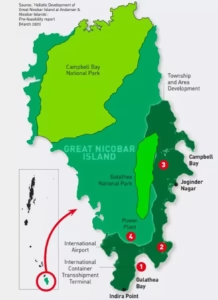
Project Overview
- Location: Galathea Bay, Great Nicobar Island, Andaman & Nicobar Islands.
- Components:
- Mega transshipment port.
- Airport expansion for commercial and strategic purposes.
- Urban and logistics infrastructure to support the port and economic activities.
- Strategic Rationale:
- Strengthen India’s maritime security in the eastern Indian Ocean.
- Reduce reliance on foreign ports like Colombo and Singapore for transshipment.
Arguments in Favor
- Potential to transform India into a regional hub for trade and security.
- Could integrate with Vizhinjam (Kerala) and Vadhavan (Maharashtra) ports, forming a maritime trade arc.
- Opportunity for economic development in the Andaman & Nicobar Islands.
Challenges and Concerns
Economic and Logistical Limitations
- No existing industrial base or urban centre nearby to support cargo operations.
- Isolation: 1,200 km from the Indian mainland increases operational costs.
- Network connectivity with shipping lines is limited, making it difficult to attract regular traffic.
Conclusion
The Great Nicobar Port Project appears ambitious but economically fragile. Lacking connectivity, cargo base, and ecological balance, it risks becoming a symbol of misplaced development. India’s maritime strategy should focus on sustainable, demand-based, and environment-friendly growth, not on grand but impractical ventures.
GYAN BHARATAM MISSION TO INK PACT WITH INSTITUTES
TOPIC: (GS1) INDIAN ART AND CULTURE: THE HINDU
The Ministry of Culture will sign MoUs with about 20 institutes across India under the Gyan Bharatam Mission for the preservation, digitisation, and promotion of India’s manuscript heritage. Around 30 more institutions are expected to join the initiative soon.
About Gyan Bharatam Mission
- Gyan Bharatam Mission is a flagship programme of the Union Ministry of Culture, launched in Union Budget 2025, to safeguard India’s ancient manuscript wealth.
- The mission aims to identify, document, conserve, digitise, preserve, and promote India’s vast collection of manuscripts — a vital part of its cultural legacy.
Key Objectives
- Preservation and Protection – Ensure safe conservation of old and fragile manuscripts.
- Digitisation and Accessibility – Create a digital repository for easy access and global sharing.
- Promotion and Awareness – Encourage research, translation, and public engagement to revive traditional knowledge systems.
- Collaboration and Capacity Building – Build partnerships with academic, linguistic, and cultural institutions across India.
National Digital Repository (NDR)
- A dedicated online platform will be set up to store and showcase digitised manuscripts.
- It will serve as a central archive for India’s manuscript heritage and enable scholars and citizens worldwide to access it.
Partnership with Institutions
- The mission will partner with institutes such as Asiatic Society (Kolkata), University of Kashmir, Hindi Sahitya Sammelan (Prayagraj), and Government Oriental Manuscript Library (Chennai).
- Institutions are classified as:
- Cluster Centres – Handle activities for their own and up to 20 partner centres.
- Independent Centres – Manage their own manuscript collections independently.
Implementation Framework
- Each centre will create a Gyan Bharatam Cell for coordination and voluntary service.
- Activities supported include:
- Survey and cataloguing
- Conservation and training
- Technology and digitisation
- Linguistics, translation, research, and outreach
Funding and Monitoring
- The Culture Ministry will provide financial and technical support based on approved work plans.
- Funds will be released in two phases: 70% initially upon approval of annual budget 30% after submission of progress and financial reports with utilisation certificates
Conclusion
The Gyan Bharatam Mission marks a major step in preserving India’s intangible cultural heritage through digital innovation and institutional collaboration. By linking tradition with technology, it aims to make India’s ancient manuscripts a living, accessible source of knowledge for the world.
RBI MAY LIMIT BANKS’ MARKET EXPOSURE
TOPIC: (GS3) ECONOMY: THE HINDU
The Reserve Bank of India (RBI) has released a draft circular proposing limits on how much banks can lend to the capital market and for corporate acquisitions. This aims to prevent overexposure and financial risk while keeping India’s banking sector stable.
Background
- Recently, RBI relaxed rules to allow banks to fund mergers and acquisitions (M&A), and increased limits for lending against shares and securities.
- However, to maintain financial discipline, the central bank now plans to impose caps on how much banks can lend for such activities.
Key Proposals by RBI
Exposure Limits
- Banks’ total direct exposure to the capital market and acquisition financing should not exceed 20% of their Tier-1 capital.
- Combined capital market exposure (direct + indirect) must not exceed 40% of Tier-1 capital.
- Exposure to acquisition finance alone should be capped at 10% of Tier-1 capital.
Tier-1 Capital:
- Tier-1 Capital: The core capital of a bank that can absorb losses without requiring the bank to stop operations. Includes: Equity capital, retained earnings, and other core reserves.
Acquisition Finance Rules
- Banks can finance up to 70% of an acquisition deal.
- The remaining 30% must come from the acquiring company’s own funds.
- Loans are allowed only for listed, profitable companies with a strong net worth.
- Such loans must be secured by the target company’s shares.
NBFC Exposure
- RBI also proposed to revise risk-weight norms for NBFCs’ infrastructure loans, which may reduce capital requirements for banks lending to stable infrastructure projects.
Reasons for the Move
- To prevent excessive lending to volatile sectors like the stock market.
- To avoid systemic risk that could threaten bank stability.
- To ensure balanced growth of credit in productive sectors of the economy.
Impact
- Encourages responsible lending by banks.
- Limits speculative or risky financial exposure.
- Could moderately slow down large corporate buyouts funded by bank loans.
- Strengthens financial prudence and market confidence in India’s banking system.
Way Forward
- RBI should ensure consistent monitoring of banks’ exposure levels.
- Promote diversified lending to productive areas like MSMEs, infrastructure, and green finance.
- Maintain a balance between growth support and risk control.
- Gradual implementation to avoid disrupting legitimate corporate funding needs.
Conclusion
The RBI’s proposal is a preventive step to ensure that Indian banks remain resilient amid rising exposure to capital markets and acquisitions. By capping lending limits and tightening norms, the central bank aims to protect the financial ecosystem from instability while encouraging sustainable credit expansion.
SC TO HEAR CONTEMPT PLEA OVER LAWYER’S ATTACK ON CJI BENCH
TOPIC: (GS2) INDIAN POLITY: THE HINDU
The Supreme Court will hear a petition by the Supreme Court Bar Association (SCBA) seeking criminal contempt action against advocate Rakesh Kishore, who attempted to attack Chief Justice of India (CJI) B. R. Gavai in court on October 6, 2025.
Background
- The incident involved Mr. Kishore hurling a rolled-up sheaf of papers at the CJI during court proceedings.
- Reports suggest he also removed his shoes and attempted to throw them, escalating the severity of the act.
- The Bar Council of India (BCI) issued an interim suspension under the Advocates Act, 1961, citing violations of professional standards and conduct rules.
Key Details
Contempt Petition
- The SCBA filed the petition seeking criminal contempt proceedings against the advocate.
- The petition will be heard by a Supreme Court Bench of Justices Surya Kant and Joymalya Bagchi.
- SCBA will be represented by President and senior advocate Vikas Singh.
Judicial Reactions
- Chief Justice Gavai described the incident as inconsequential and a “forgotten chapter.”
- Justice Surya Kant previously suggested that the matter should not consume judicial time.
- However, some voices within the judiciary emphasized that the act undermines the dignity of the court and deserves strict action.
Role of Bar Council of India
- BCI suspended Mr. Kishore pending investigation.
- The action was based on Bar Council of India Rules on Standards of Professional Conduct and Etiquette.
- The suspension targets behavior that violates courtroom discipline and legal ethics.
Significance
- Highlights the importance of judicial authority and decorum in courts.
- Reinforces the principle that lawyers must uphold professional ethics under the Advocates Act, 1961.
- Raises debate on balance between freedom of expression and courtroom discipline.
Way Forward
- The Supreme Court may decide on contempt proceedings against the advocate.
- Strengthening awareness about professional conduct for lawyers can prevent such incidents.
- Judicial and administrative measures may ensure respect and safety of the judiciary in courtrooms.
Conclusion
The case underscores the seriousness of threats to judicial dignity. Ensuring strict adherence to professional norms is essential for maintaining public trust in the judicial system.
200 YEARS OF KITTUR RANI CHENNAMMA’S VICTORY
TOPIC: (GS1) INDIAN MODERN HISTORY: THE HINDU
The Ministry of Culture is commemorating 200 years of Rani Chennamma’s victory over the British, highlighting her as a pioneer in early Indian resistance against colonial rule.
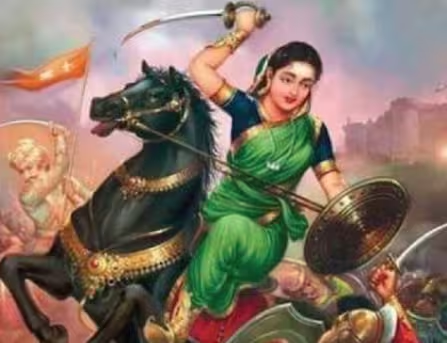
Who was Rani Chennamma?
Early Life
- Born on 23 October 1778 in Kakati village, Belagavi, Karnataka, into a Lingayat family known for bravery.
- Married Raja Mallasarja Desai of Kittur at the age of 15.
Rise to Power
- Became ruler of Kittur after her husband’s death in 1816.
- Adopted Shivalingappa as her heir after the death of her only son to secure the throne.
Conflict with the British
- The British refused to recognize her adopted son under the Doctrine of Lapse and attempted to annex Kittur.
- Battle of Kittur (1824): Rani Chennamma personally led her army against 20,000 British troops. Killed the British officer John Thackery in battle.
- Used guerrilla tactics, mobilizing local soldiers and villagers for resistance.
Defeat and Legacy
- British reinforcements captured Kittur Fort; Rani Chennamma was imprisoned at Bailhongal Fort.
- Died in 1829.
- Recognized as India’s first female freedom fighter, her revolt predates the 1857 Revolt, symbolizing early resistance to colonial annexation.
Doctrine of Lapse
- Introduced by Lord Dalhousie, Governor-General (1848–1856).
- Any princely state without a natural male heir would be annexed; adopted heirs were ignored.
- Justified British expansion under the pretext of good governance.
- Applied to states like Satara, Sambalpur, Udaipur, Jhansi, Nagpur.
- Contradicted Indian customs of adoption and hereditary succession, causing resentment among rulers.
- Major cause of anger leading to the First War of Independence (1857).
- Abolished in 1859 after the end of East India Company rule.
Significance
- Rani Chennamma’s revolt represents courage, leadership, and early anti-colonial struggle.
- Highlights the role of women in India’s freedom movement.
- Serves as a symbol of resistance against unjust colonial policies, inspiring later uprisings.
Conclusion:
Rani Chennamma’s revolt symbolizes bravery and early resistance against colonial domination, laying the foundation for India’s later freedom struggles. Her legacy continues to inspire courage and the spirit of defiance among generations.
CENTRAL ASIAN MAMMALS INITIATIVE (CAMI)
TOPIC: (GS3) ENVIRONMENT: THE HINDU
Central Asian countries have approved a new six-year Work Programme (2025–2031) under the Central Asian Mammals Initiative (CAMI).
About CAMI
Origin and Launch
- Established in 2014 at COP11 of the Convention on the Conservation of Migratory Species (CMS) in Quito, Ecuador.
- Designed to halt population decline and ensure long-term survival of migratory mammals in Central Asia’s steppes, deserts, and mountains.
Participating Countries
- Involves 14 range states: Afghanistan, Bhutan, China, India, Iran, Kazakhstan, Kyrgyzstan, Mongolia, Nepal, Pakistan, Russia, Tajikistan, Turkmenistan, Uzbekistan.
Species Covered
- Focuses on 17 migratory mammals, including: Argali sheep, Asiatic cheetah, snow leopard, saiga antelope, wild yak, wild camel, Przewalski’s horse, Bukhara deer.
Work Programme (2025–2031)
- Adopted at Tashkent, Uzbekistan.
- Priorities:
- Protect key landscapes and ecological corridors.
- Community-based conservation and coexistence strategies.
- Science-driven policies and cross-border collaboration.
Key Partners
- Supported by IUCN, WWF, CMS Secretariat, and national agencies.
- Promotes ecosystem connectivity and mitigates threats like poaching, habitat loss, climate change, and migration barriers.
CMS
- Convention on Migratory Species (CMS): Global treaty to protect migratory species and their habitats.
- Signed in 1979 (Bonn, Germany); entered into force in 1983.
- Mandates science-based conservation via Agreements, MoUs, and COP decisions.
- Over 130 member countries; aligns with SDG-15 (Life on Land) and CBD goals.
- Next COP (COP15): March 23–29, 2026, Brazil, to review frameworks like CAMI.
Significance
- Strengthens transboundary wildlife protection in Central Asia.
- Supports biodiversity conservation, climate resilience, and sustainable livelihoods.
- Enhances regional cooperation in managing migratory species.