

Table of Contents
ToggleJan Dhan Yojana: Transforming Financial Democracy in India
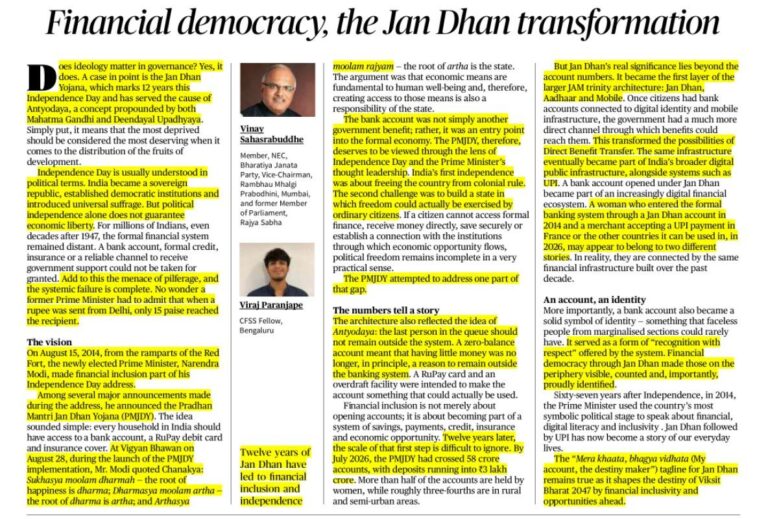
The Pradhan Mantri Jan Dhan Yojana (PMJDY) has emerged as one of India’s most significant financial inclusion initiatives, transforming the way citizens interact with the formal financial system. Launched in 2014, the scheme aimed to ensure that every household had access to a bank account, enabling people to participate in economic growth and access government services.
The journey of Jan Dhan reflects the broader idea of financial democracy, where access to banking becomes a tool for empowerment, dignity, and inclusive development.
Financial Inclusion as a Foundation of Democracy
Beyond Political Freedom
India’s independence created democratic institutions and political rights, but economic participation remained a challenge for millions. Lack of access to banking, credit, insurance, and formal financial systems prevented many citizens from fully benefiting from development opportunities.
Financial inclusion addresses this gap by ensuring that ordinary citizens can access:
- Savings facilities
- Digital payments
- Insurance schemes
- Credit opportunities
- Direct government benefits
Vision Behind Pradhan Mantri Jan Dhan Yojana
Building an Inclusive Financial System
The PMJDY was launched in August 2014 with the objective of providing universal access to banking services.
The scheme focused on:
- Zero-balance bank accounts
- RuPay debit cards
- Overdraft facilities
- Linking financial services with digital infrastructure
It became a crucial pillar of the JAM Trinity (Jan Dhan–Aadhaar–Mobile), enabling efficient delivery of government benefits directly to beneficiaries.
Jan Dhan and Digital Transformation
From Bank Accounts to Digital Empowerment
Jan Dhan accounts created a foundation for India’s digital financial ecosystem. Combined with platforms such as UPI and Aadhaar authentication, they enabled citizens to participate in a rapidly expanding digital economy.
The scheme helped:
- Reduce leakages in welfare delivery
- Improve transparency
- Expand access to formal financial services
- Encourage digital transactions
Impact on Marginalised Communities
Bringing People into the Economic Mainstream
Jan Dhan accounts became a symbol of inclusion for people who were previously outside formal banking systems.
The initiative especially benefited:
- Rural households
- Women
- Low-income communities
- Small entrepreneurs
For many citizens, owning a bank account represented recognition, dignity, and participation in the nation’s economic journey.
Challenges and Way Forward
Despite major achievements, challenges remain, including:
- Financial literacy gaps
- Limited usage of accounts
- Digital access issues
- Need for greater credit availability
The next phase should focus on converting account ownership into meaningful financial empowerment.
Conclusion
The Pradhan Mantri Jan Dhan Yojana represents a major step towards financial democracy in India. By connecting millions of citizens with banking and digital systems, it has strengthened inclusion, transparency, and economic participation. The true success of Jan Dhan lies not only in opening accounts but in ensuring that every citizen can use financial tools to improve their lives.
Vocabulary
1. Financial Inclusion – Access to formal financial services
2. JAM Trinity – Jan Dhan–Aadhaar–Mobile
3. DBT – Direct Benefit Transfer
4. Antyodaya – Welfare of the last person
5. Financial Democracy – Broad and equitable financial access
Frequently Asked Questions (FAQs)
What is Pradhan Mantri Jan Dhan Yojana (PMJDY)?
PMJDY is a financial inclusion scheme launched in 2014 to provide universal access to banking services. It enables citizens to access bank accounts, RuPay cards, insurance, and digital financial services.
How has Jan Dhan Yojana promoted financial inclusion?
The scheme brought millions of previously unbanked citizens into the formal financial system by providing bank accounts and connecting them with digital payment infrastructure.
What is the role of Jan Dhan in Direct Benefit Transfer (DBT)?
Jan Dhan accounts, along with Aadhaar and mobile connectivity, form the JAM Trinity, which helps transfer government benefits directly to beneficiaries and reduce leakages.
How does Jan Dhan Yojana contribute to women empowerment?
By providing women with independent bank accounts, Jan Dhan has improved their financial access, decision-making ability, and participation in the formal economy.
What are the challenges associated with Jan Dhan Yojana?
Major challenges include limited financial literacy, inactive accounts, digital access barriers, and the need to ensure that banking access translates into meaningful economic empowerment.
Source From : The Hindu
Nationalism in India: Balancing Pride, Identity and Constitutional Values
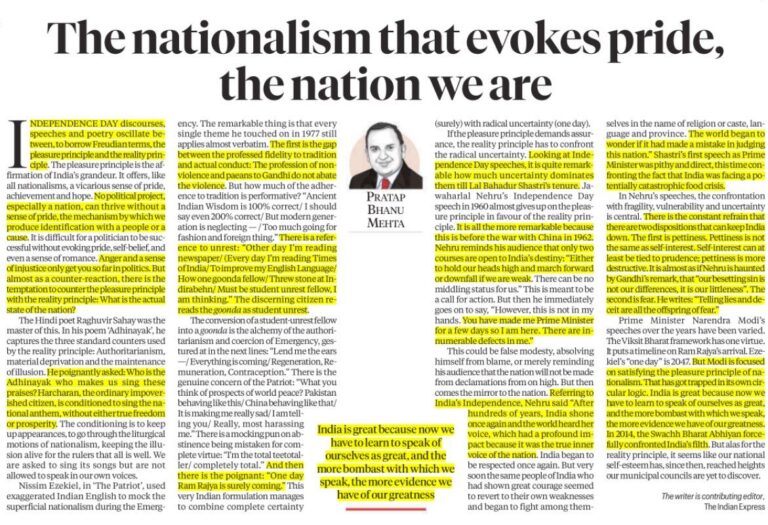
Nationalism in India has always been a complex idea shaped by freedom struggle, constitutional values, cultural diversity, and democratic aspirations. The debate around nationalism is not merely about expressing pride in the nation but also about understanding the relationship between patriotism, citizens’ rights, and social responsibility.
A healthy nationalism should inspire confidence and unity while encouraging citizens to critically engage with the nation’s challenges.
Understanding the Idea of Nationalism
Pride and Reality Principle
Nationalism often works through two important ideas:
- Pleasure principle: Celebrating national achievements, history, culture, and collective identity.
- Reality principle: Recognising challenges, weaknesses, and areas requiring improvement.
A mature nationalism requires a balance between pride in achievements and honesty about shortcomings.
Nationalism During India’s Freedom Movement
From Colonial Resistance to Nation Building
Indian nationalism emerged as a movement against colonial rule and united people across regions, languages, and communities.
Leaders of the freedom struggle emphasised:
- Unity in diversity
- Democratic values
- Social justice
- Non-violence and constitutionalism
The aim was not only political independence but also creating a society based on dignity and equality.
Challenges of Modern Nationalism
Avoiding Excessive or Superficial Nationalism
The article highlights concerns that nationalism can become problematic when it is reduced to:
- Mere slogans and symbolic expressions
- Intolerance towards criticism
- Exclusion based on identity
True nationalism should allow citizens to question, debate, and contribute to improving the nation.
Nationalism and Democratic Citizenship
Role of Citizens in Nation Building
A strong nation is built not only through government action but also through responsible citizenship.
Citizens contribute by:
- Upholding constitutional values
- Protecting social harmony
- Participating in democratic processes
- Working towards inclusive development
National pride becomes meaningful when it translates into public responsibility.
Contemporary Debate: Viksit Bharat and National Pride
Linking Aspirations with Achievement
The idea of a developed India requires confidence and ambition. However, national progress depends on addressing challenges such as inequality, social divisions, and institutional strengthening.
A constructive nationalism should combine:
- Pride in achievements
- Commitment to reforms
- Respect for diversity
- Faith in democratic institutions
Conclusion
Indian nationalism is best understood as a balance between pride and self-reflection. It should inspire citizens to celebrate the nation while also encouraging them to work towards a more just, inclusive, and democratic India.
A nationalism rooted in constitutional values can become a powerful force for national development and social unity.
Vocabulary
1. Nationalism – Identification with and commitment to the nation
2. Patriotism – Devotion to one’s country
3. Bombast – Exaggerated, grandiose rhetoric
4. Self-reflection – Critical examination of oneself
5. Dissent – Expression of disagreement
Frequently Asked Questions (FAQs)
What is the meaning of nationalism?
Nationalism refers to a sense of belonging, pride, and commitment towards one’s nation. In a democratic society, it should promote unity, responsibility, and respect for constitutional values.
How is Indian nationalism different from narrow nationalism?
Indian nationalism is based on pluralism, diversity, and inclusive citizenship rather than exclusion based on religion, language, caste, or region. It emphasises unity among different communities.
What is the difference between healthy and excessive nationalism?
Healthy nationalism encourages citizens to contribute towards national progress while accepting criticism. Excessive nationalism may discourage debate and create intolerance towards differing opinions.
How did the freedom struggle shape Indian nationalism?
The freedom movement transformed nationalism into a collective struggle against colonial rule, promoting ideas of self-rule, equality, non-violence, and democratic participation.
Why is constitutional nationalism important in India?
Constitutional nationalism connects national pride with the values of justice, liberty, equality, and fraternity, ensuring that patriotism supports democracy and social harmony.