

Table of Contents
ToggleTransparency in Healthcare: Building Trust in Medicine
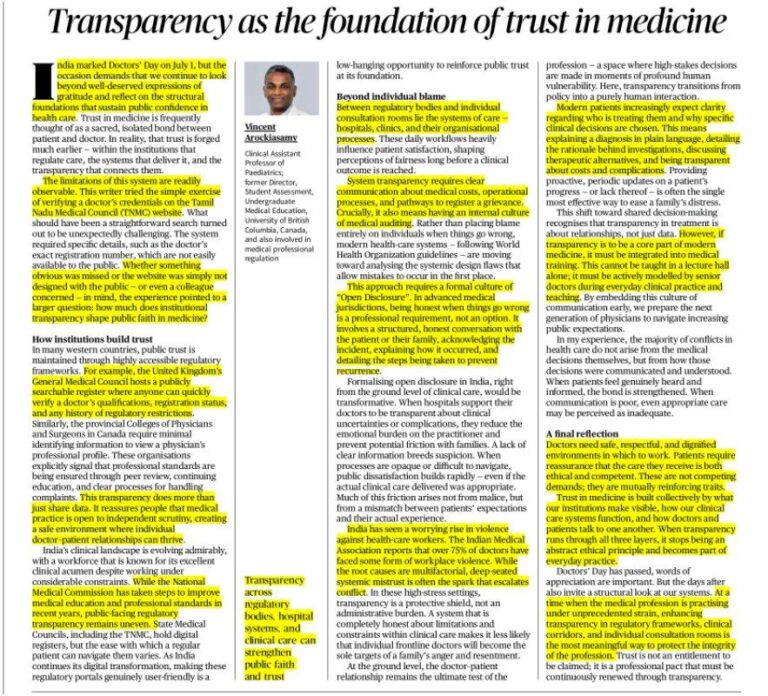
India’s healthcare system depends not only on medical expertise but also on the trust between doctors, patients and institutions. The article highlights that transparency must become a structural foundation of healthcare rather than being limited to individual doctor-patient interactions. Clear information, accountable systems and honest communication can strengthen public confidence in the medical profession.
Why Transparency Matters in Healthcare
Patients often find it difficult to verify a doctor’s qualifications, registration status and professional credentials. While the National Medical Commission (NMC) has taken steps to improve medical education and professional standards, public-facing regulatory transparency remains essential.
The article points to international examples such as the United Kingdom’s General Medical Council, which provides searchable information about doctors’ qualifications and registration status. Similar accessible systems can help patients make informed decisions and strengthen institutional trust.
Transparency Beyond Individual Doctors
Healthcare outcomes are influenced by much more than individual doctors. Hospital procedures, staffing patterns, referral systems, grievance mechanisms and organisational processes also shape patient experiences.
Therefore, transparency should include:
- Clear communication regarding diagnosis and treatment
- Explanation of risks, costs and complications
- Accessible grievance-redressal mechanisms
- Transparent hospital procedures
- Institutional accountability for medical errors
The article stresses that blame should not automatically fall on individual healthcare workers when systemic shortcomings contribute to an adverse outcome.
Open Disclosure and Patient Communication
A major recommendation is the adoption of “Open Disclosure” practices in healthcare institutions. When unexpected complications or errors occur, doctors and hospitals should communicate honestly with patients and families, explain what happened and discuss steps to prevent recurrence.
Such communication can reduce misunderstandings, prevent mistrust and improve the overall doctor-patient relationship.
Transparency and Violence Against Healthcare Workers
The article also connects poor communication and lack of transparency with rising conflict in healthcare settings. An Indian Medical Association survey cited in the article found that around 75% of doctors had experienced workplace violence.
Transparent systems, realistic expectations and better communication can help reduce conflict and protect both patients and healthcare professionals.
Medical Education and Institutional Reform
Transparency should also be integrated into medical education and clinical training. Future doctors must learn not only medical science but also communication, accountability and ethical disclosure as part of everyday clinical practice.
Conclusion
Transparency in healthcare is not merely an administrative reform; it is essential for patient safety, professional integrity and public trust. India needs transparent regulatory systems, accountable hospitals, open communication and stronger medical training.
A healthcare system built on clarity and accountability can create safer institutions, strengthen doctor-patient relationships and ensure that trust in medicine is continuously reinforced.
Vocabulary
1. Open Disclosure – Honest communication about medical errors
2. Shared Decision-Making – Patient participation in treatment choices
3. Medical Audit – Systematic review of clinical practices
4. Regulatory Transparency – Public accessibility of oversight information
5. Institutional Trust – Confidence in healthcare systems
Frequently Asked Questions (FAQs)
Why is transparency important in healthcare?
Transparency improves patient trust, safety and accountability. Clear information about doctors, treatments, risks and hospital procedures helps patients make informed healthcare decisions.
What is Open Disclosure in healthcare?
Open Disclosure is the practice of honestly informing patients and families when medical errors or unexpected complications occur. It includes explaining what happened and what steps will prevent recurrence.
How can transparency strengthen doctor-patient relationships?
Clear communication about diagnosis, treatment options, costs, risks and complications reduces misunderstanding. It also improves trust between patients, doctors and healthcare institutions.
What role do regulatory bodies play in healthcare transparency?
Regulatory bodies should provide accessible information about doctors’ qualifications, registration status and professional credentials. Publicly searchable systems can strengthen confidence in the medical profession.
How can transparency reduce violence against healthcare workers?
Better communication, realistic expectations and transparent hospital procedures can reduce conflict and mistrust. Strong grievance mechanisms also help resolve disputes before they escalate.
Source From : The Hindu
Supreme Court and Environmental Law in India: Evolution, Principles and Current Concerns
The Supreme Court of India has played a defining role in shaping environmental law, especially at a time when the Constitution originally contained no explicit provision on environmental protection. Over the decades, judicial interpretation, constitutional amendments and landmark judgments transformed environmental protection into an important part of Indian constitutional governance.
Constitutional Foundation of Environmental Protection
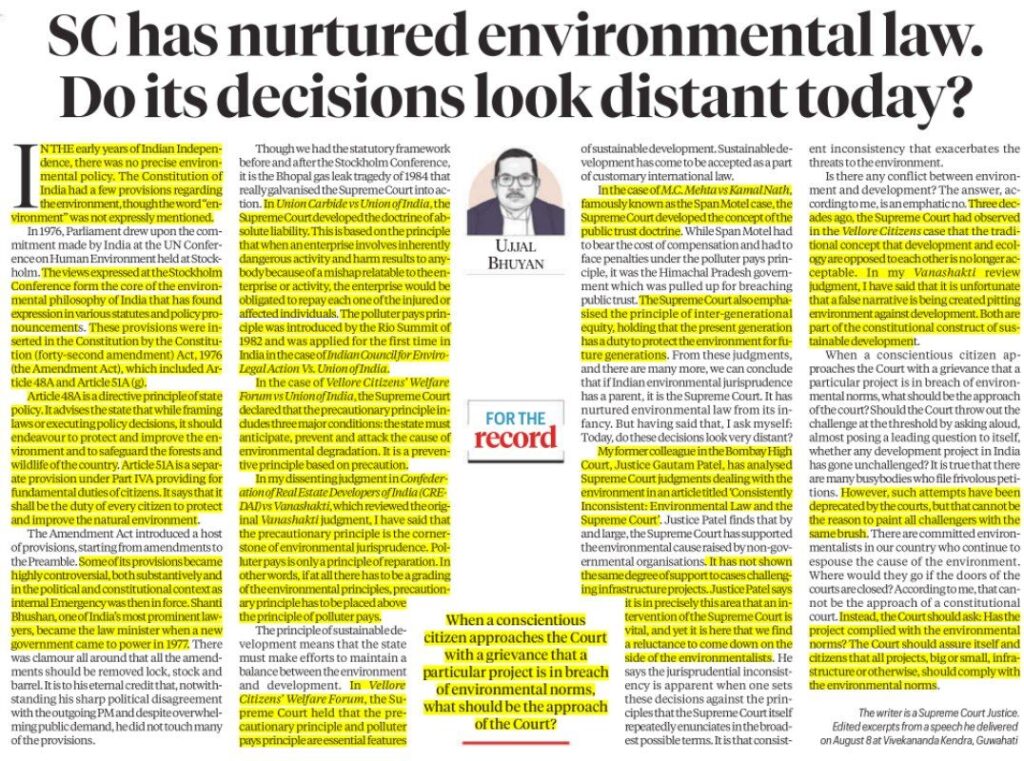
The 42nd Constitutional Amendment Act, 1976 inserted Article 48A, directing the State to protect and improve the environment and safeguard forests and wildlife. It also introduced Article 51A(g), making environmental protection a fundamental duty of citizens.
These provisions, along with judicial interpretation of Article 21, helped strengthen environmental jurisprudence in India.
Key Environmental Principles Developed by the Supreme Court
The Supreme Court introduced several globally recognised environmental principles through landmark cases.
In Union Carbide v. Union of India, the Court developed the doctrine of absolute liability for enterprises engaged in inherently hazardous activities.
In Vellore Citizens Welfare Forum v. Union of India, the Court recognised the Precautionary Principle and Polluter Pays Principle as essential elements of environmental law.
Similarly, in M.C. Mehta v. Kamal Nath, the Court strengthened the Public Trust Doctrine, holding that natural resources must be protected by the State for public use and future generations.
Sustainable Development and Inter-Generational Equity
Indian environmental jurisprudence has also recognised sustainable development, which seeks to balance economic development with ecological protection.
The Supreme Court has emphasised inter-generational equity, highlighting the responsibility of the present generation to preserve the environment for future generations.
Are Recent Supreme Court Decisions Distant from Environmental Protection?
The article raises concerns that some recent judgments involving infrastructure projects may reflect a perceived inconsistency in environmental adjudication.
However, it argues that courts should neither automatically oppose development nor support environmental objections without examination. The key judicial question should be whether a proposed project complies with existing environmental laws, procedures and safeguards.
Conclusion
The Supreme Court’s environmental jurisprudence has been instrumental in creating principles such as absolute liability, precaution, polluter pays and public trust. Going forward, courts must maintain a careful balance between development and environmental protection.
Sustainable development requires that economic progress takes place within the framework of environmental laws, ensuring that present development does not compromise the ecological rights of future generations.
Vocabulary
1. Precautionary Principle – Prevent harm before it occurs
2. Polluter Pays Principle – Polluter bears environmental costs
3. Absolute Liability – Strict liability for hazardous activities
4. Public Trust Doctrine – State holds natural resources in trust
5. Inter-generational Equity – Protecting resources for future generations
Frequently Asked Questions (FAQs)
How has the Supreme Court shaped environmental law in India?
The Supreme Court has expanded environmental protection through landmark judgments and by linking it with Article 21. It has also developed key principles such as absolute liability, polluter pays and precaution.
Which constitutional provisions support environmental protection in India?
The 42nd Constitutional Amendment, 1976 introduced Article 48A and Article 51A(g). These provisions place duties on the State and citizens to protect and improve the environment.
What is the Precautionary Principle?
The Precautionary Principle requires preventive action when an activity may cause serious environmental harm, even if full scientific certainty is lacking. It was recognised by the Supreme Court in Vellore Citizens Welfare Forum v. Union of India.
What is the Public Trust Doctrine?
The Public Trust Doctrine holds that natural resources are held by the State in trust for the public. The Supreme Court strengthened this principle in M.C. Mehta v. Kamal Nath.
How should courts balance development and environmental protection?
Courts should ensure that development projects comply with environmental laws, procedures and safeguards. The objective is sustainable development, balancing economic growth with ecological protection for present and future generations.