Table of Contents
Toggle44th Constitutional Amendment Act 1978
- The 44th Constitutional Amendment Act 1978 is a milestone corrective law in Indian Polity UPSC that restored democratic checks, judicial review, and civil liberties curtailed during the 1975–77 National Emergency.
- Enacted through the 45th Amendment Bill, 44th Amendment Act UPSC preparation focuses on how the 44th Amendment of Indian Constitution dismantled arbitrary executive authority while strengthening Constitutional Safeguards During Emergency.
- For Important Constitutional Amendments UPSC and Emergency Provisions UPSC revision, mastering 44th Constitutional Amendment Features clarifies how India rebalanced fundamental rights with parliamentary oversight.
Historical Background
- During the 1975–77 Internal Emergency, the 42nd Constitutional Amendment Act, 1976 concentrated power in the executive, extended legislative terms, and restricted judicial remedies.
- Following the 1977 general elections and the findings of the Shah Commission, the Janata government enacted the 44th Constitutional Amendment Act 1978 to prevent any future abuse of National Emergency in India.
- Built on broad cross-party consensus in Parliament, the Act systematically corrected Emergency-era distortions while preserving constructive socio-economic additions.
Major Objectives
- A primary goal of the 44th Amendment of Indian Constitution was Restoration of Fundamental Rights and Protection of Civil Liberties, ensuring life and personal liberty can never be suspended during a crisis.
- It sought to tighten Article 352 Emergency Provisions so a proclamation cannot be issued lightly or on vague domestic grounds.
- It also aimed to restore the five-year tenure of legislatures, revive High Court and Supreme Court powers, and resolve property litigation via the Right to Property Constitutional Amendment.
Major Provisions of the 44th Constitutional Amendment Act
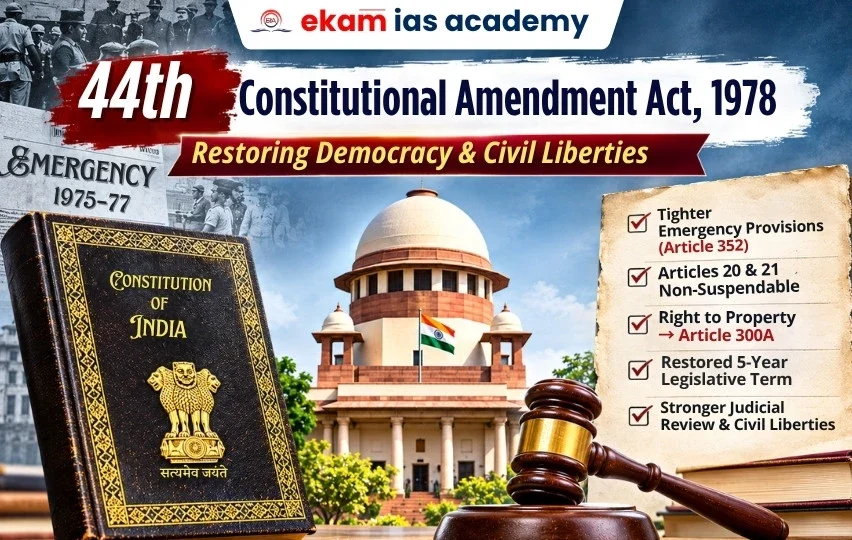
- Under Right to Property Constitutional Amendment, it repealed Articles 19(1)(f) and 31, converting property from a Fundamental Right into a legal/constitutional right under Article 300A while protecting minority educational institutions under Article 30(1A).
- Under 44th Amendment Key Provisions for Article 352 Emergency Provisions, it replaced “internal disturbance” with “armed rebellion”, mandated a written recommendation of the Union Cabinet, required special-majority parliamentary approval within one month and renewal every six months, and allowed one-tenth of Lok Sabha members to requisition a special sitting to disapprove the proclamation.
- For Protection of Civil Liberties, it amended Article 359 so Articles 20 and 21 can never be suspended during an emergency, restricted automatic suspension of Article 19 under Article 358 only to war or external aggression, restored the five-year term of the Lok Sabha and State Assemblies, allowed the President to return Cabinet advice once under Article 74(1), and protected true parliamentary press reporting under Article 361A.
42nd Amendment vs 44th Amendment
← Swipe left or right to view the full comparison →
| Comparison Feature | 42nd Amendment Act, 1976 | 44th Amendment Act, 1978 |
|---|---|---|
| Legislative Tenure | Extended the normal terms of the Lok Sabha and State Assemblies from five to six years. | Restored the normal terms to five years. |
| National Emergency | Enabled an Emergency proclamation for part of India's territory. The existing “internal disturbance” ground continued. | Replaced “internal disturbance” with “armed rebellion” under Article 352. |
| Presidential Advice | Made the Council of Ministers' advice binding on the President. | Allowed the President to seek reconsideration once. Reconsidered advice remains binding. |
| High Court Powers | Restricted High Court writ jurisdiction under Article 226. | Reversed further restrictions on High Court jurisdiction, following the judicial reforms of the 43rd Amendment. |
| Legislative Quorum | Provided for removing constitutional quorum requirements. | Reversed those changes and preserved constitutional quorum requirements. |
| Preamble, Duties & DPSPs | Added “Socialist”, “Secular” and “Integrity” to the Preamble, introduced Fundamental Duties, and added Directive Principles. | Retained these additions, including Article 51A and the additional Directive Principles. |
Significance of the 44th Amendment
- Constitutional Safeguards During Emergency transformed National Emergency in India from an executive-dominated instrument into a tightly regulated, parliament-supervised mechanism.
- Making Articles 20 and 21 non-suspendable fortified Protection of Civil Liberties and overturned the vulnerability exposed during ADM Jabalpur (1976).
- Reclassifying property under Article 300A reduced land-reform gridlock while keeping deprivation subject to authority of law.
Limitations and Challenges
- Although Right to Property Constitutional Amendment streamlined land acquisition, removing property from Part III meant citizens could no longer move the Supreme Court directly under Article 32 for property disputes.
- Provisions restricting Article 356 (President’s Rule) extensions beyond one year still required vigilant judicial and federal scrutiny in practice.
- Effective operation of Constitutional Safeguards During Emergency continues to rely on cabinet accountability, parliamentary vigilance, and press freedom.
Important Supreme Court Judgments
- In ADM Jabalpur v. Shivkant Shukla (1976), the majority upheld suspension of habeas corpus during the Emergency—a precedent directly countered by the 44th Constitutional Amendment Act 1978 making Articles 20 and 21 non-suspendable (and later overruled in K.S. Puttaswamy v. Union of India, 2017).
- In Minerva Mills Ltd. v. Union of India (1980), the Supreme Court struck down residual unrepealed clauses of the 42nd Amendment, reinforcing the 44th Amendment of Indian Constitution‘s commitment to limited amending power and judicial review.
- In K.T. Plantation Pvt. Ltd. v. State of Karnataka (2011), the Supreme Court held that Article 300A embodies the rule of law and fair procedure when the State deprives any person of property.
Conclusion
- The 44th Constitutional Amendment Act 1978 stands as a cornerstone of Restoration of Fundamental Rights and democratic resilience in Indian Polity UPSC.
- By tightening Article 352 Emergency Provisions, safeguarding Articles 20 and 21, and enacting the Right to Property Constitutional Amendment, 44th Amendment Key Provisions institutionalized lasting Constitutional Safeguards During Emergency.
- A thorough command of 44th Amendment Act UPSC, 42nd vs 44th Constitutional Amendment, and Emergency Provisions UPSC equips aspirants to excel across Prelims and Mains.
UPSC Prelims: PYQs & Practice Questions
Previous Year Questions (Prelims)
Q: What was the exact constitutional status of India on 26th January, 1950?
(a) A Democratic Republic
(b) A Sovereign Democratic Republic
(c) A Sovereign Secular Democratic Republic
(d) A Sovereign Socialist Secular Democratic Republic
Answer: (b) A Sovereign Democratic Republic
Explanation:
On 26th January 1950, the Preamble described India as a
Sovereign Democratic Republic. The terms
Socialist, Secular, and
Integrity were inserted later by the
42nd Constitutional Amendment Act, 1976, and were intentionally retained by the
44th Constitutional Amendment Act, 1978 even as it reversed Emergency-era distortions.
Q: With reference to the Right to Property in India, consider the following statements:
1. The Right to Property is a legal right available to any person, and not merely to citizens of India.
2. Under Article 300A of the Constitution of India, no person shall be deprived of his property save by authority of law.
Which of the statements given above is/are correct?
(a) 1 only
(b) 2 only
(c) Both 1 and 2
(d) Neither 1 nor 2
Answer: (c) Both 1 and 2
Explanation:
Both statements are correct. The
44th Constitutional Amendment Act, 1978 repealed
Articles 19(1)(f) and 31 from Part III and placed the
Right to Property in Part XII under
Article 300A, which protects every
"person" (both citizens and non-citizens) against deprivation of property without authority of law.
Practice Questions
Q: With reference to the safeguards introduced under Article 352 by the 44th Constitutional Amendment Act, 1978, consider the following statements:
1. The President can proclaim a National Emergency only after receiving a written recommendation from the Union Cabinet.
2. A resolution approving the proclamation of a National Emergency must be passed by both Houses of Parliament within one month by a special majority.
3. The Lok Sabha can pass a resolution by a special majority to disapprove the continuance of a National Emergency.
Which of the statements given above is/are correct?
(a) 1 and 2 only
(b) 2 and 3 only
(c) 1 and 3 only
(d) 1, 2 and 3
Answer: (a) 1 and 2 only
Explanation:
Statements 1 and 2 are correct. Under the
44th Constitutional Amendment Act, 1978, a written Cabinet recommendation
is mandatory, and parliamentary approval requires a special majority within
one month (and every six months for renewal).
Statement 3 is incorrect because the Lok Sabha can disapprove/revoke a National Emergency
by a simple majority (not a special majority).
Q: Consider the following statements regarding Fundamental Rights during a National Emergency after the 44th Constitutional Amendment Act, 1978:
1. The enforcement of Fundamental Rights guaranteed under Articles 20 and 21 cannot be suspended by a Presidential Order under Article 359.
2. Under Article 358, the six freedoms under Article 19 are automatically suspended even when a National Emergency is declared solely on the ground of armed rebellion.
Which of the statements given above is/are correct?
(a) 1 only
(b) 2 only
(c) Both 1 and 2
(d) Neither 1 nor 2
Answer: (a) 1 only
Explanation:
Statement 1 is correct because the
44th Constitutional Amendment Act, 1978 amended
Article 359 so that Articles 20 and 21 remain enforceable
even during an Emergency.
Statement 2 is incorrect because amended Article 358 restricts automatic
suspension of Article 19 strictly to emergencies proclaimed on grounds of
war or external aggression, excluding armed rebellion.
UPSC Mains – Previous Year & Practice Questions
Mains Previous Year Questions
Question: Parliament's power to amend the Constitution is a limited power and it cannot be enlarged into absolute power. In the light of this statement explain whether Parliament under Article 368 of the Constitution can destroy the Basic Structure of the Constitution by expanding its amending power. (Mains 2019)
Question: Under what circumstances can the Financial Emergency be proclaimed by the President of India? What consequences follow when such a declaration remains in force? (Mains 2018)
Question: To what extent, in your view, is the Parliament able to ensure accountability of the executive in India? (Mains 2017)
Question: Starting from inventing the Basic Structure doctrine, the judiciary has played a highly proactive role in ensuring that India develops into a thriving democracy. In light of the statement, evaluate the role played by judicial activism in achieving the ideals of democracy. (Mains 2014)
Question: Discuss the role of constitutional safeguards and legislative oversight in preventing executive overreach during extraordinary situations in India. (Mains – GS Paper II)
Mains Practice Questions
[10 Marks | 150 Words]
Question: Examine how the 44th Constitutional Amendment Act, 1978 transformed Article 352 from an executive-driven power into a parliament-supervised mechanism.
[15 Marks | 250 Words]
Question: Analyze the rationale and constitutional impact of shifting the Right to Property from Part III to Article 300A via the 44th Constitutional Amendment Act, 1978.
[10 Marks | 150 Words]
Question: Why was making Articles 20 and 21 non-suspendable during an Emergency a turning point for Indian civil liberties? Discuss with reference to ADM Jabalpur (1976) and the 44th Amendment.


44th Constitutional Amendment Act 1978-FAQs
Why is the 44th Constitutional Amendment Act, 1978 important?
It restored democratic safeguards weakened during the Emergency, strengthened judicial review and civil liberties, and tightened the constitutional procedure for proclaiming a National Emergency.
What major change did the 44th Amendment make to Fundamental Rights?
It removed the Right to Property from the list of Fundamental Rights by repealing Articles 19(1)(f) and 31, and inserted Article 300A, making it a constitutional/legal right.
How did the 44th Amendment change Article 352?
It replaced “internal disturbance” with “armed rebellion”, required written Cabinet advice, and strengthened parliamentary approval and continuation requirements for a National Emergency.
Which Fundamental Rights cannot be suspended during an Emergency after the 44th Amendment?
The amendment ensured that the rights under Articles 20 and 21 cannot be suspended even during a National Emergency, strengthening protection of life and personal liberty.
How did the 44th Amendment differ from the 42nd Amendment?
The 44th Amendment reversed several Emergency-era changes of the 42nd Amendment, including restoring the five-year legislative term, strengthening judicial safeguards, and placing tighter controls on Emergency powers.