Table of Contents
ToggleSwaraj Party
The Swaraj Party holds a paramount place in Modern Indian History UPSC preparation. Established in 1923, it was formed to fill the political vacuum created by the sudden suspension of the Non-Cooperation Movement and provided a fresh strategic direction to the Indian National Movement.
Historical Background
Following Mahatma Gandhi’s decision to call off the Non-Cooperation Movement in 1922, a debate arose within the Indian National Congress regarding future political action under the Government of India Act 1919. This led to a split between those advocating for council entry and those favoring constructive work.
Formation of the Swaraj Party
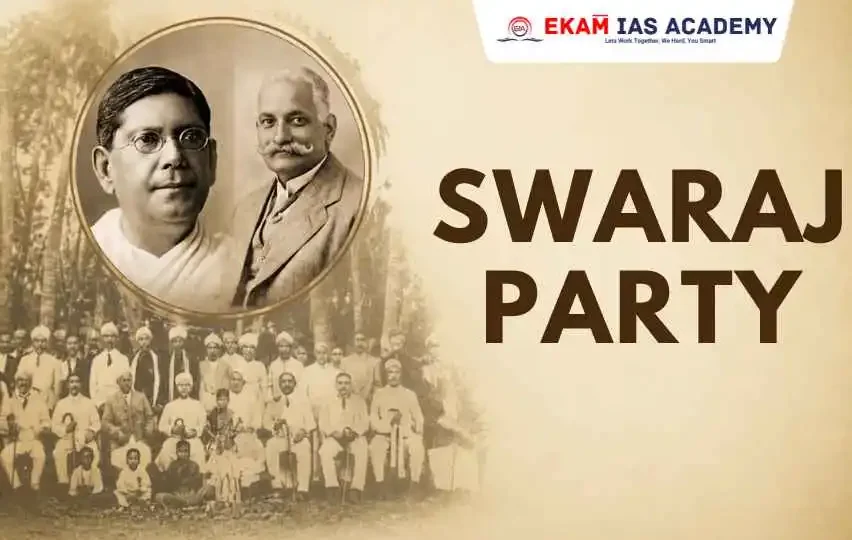
At the Gaya Session of the Congress (1922), the proposal for council entry was defeated. Consequently, leaders led by C R Das (Chittaranjan Das) and Motilal Nehru resigned from their positions and formed the Congress Khilafat Swarajya Party, popularly known as the Swaraj Party 1923.
Ideology and Objectives
The primary Swaraj Party objectives centered on the Council Entry Programme. Key goals included:
- Wrecking the colonial legislature from within through continuous obstruction.
- Endorsing national demands for self-governance inside the Legislative Councils.
- Preventing non-nationalists from filling political seats.
Programme and Activities
The Swarajists contested elections in late 1923, winning significant seats in the Central Legislative Assembly and Provincial Councils. They used parliamentary tactics to reject budget demands and expose imperial policies.
Major Leaders of the Swaraj Party
Prominent Swaraj Party founders and leaders included:
- C R Das (President)
- Motilal Nehru (Secretary)
- Vithalbhai Patel, Hakim Ajmal Khan, and N.C. Kelkar.
Achievements of the Swaraj Party
Notable Swaraj Party achievements included:
- Winning 42 out of 101 elected seats in the Central Legislative Assembly (1923).
- Electing Vithalbhai Patel as the first Indian Speaker (President) of the Central Legislative Assembly in 1925.
- Defeating crucial repressive government measures, such as the Public Safety Bill (1928).
Challenges and Decline
The party faced internal divisions, including a split between “Responsivists” (who wanted to cooperate with the government) and “Non-Responsivists.” The death of C.R. Das in 1925 weakened the organizational hierarchy, leading to its eventual decline.
Significance of the Swaraj Party
The Swaraj Party significance lies in keeping nationalist enthusiasm alive during a period of political apathy, preventing total political demoralization across the nation.
Swaraj Party vs No-Changers
The debates between No Changers vs Swarajists defined Congress politics:
- Swarajists: Favored council entry to obstruct colonial administration.
- No-Changers (C. Rajagopalachari, Vallabhbhai Patel): Focused on constructive work, village upliftment, and Charkha.
Timeline of Important Events
- December 1922: Gaya Session defeated Council Entry.
- January 1, 1923: Formation of the party.
- 1925: Election of Vithalbhai Patel as Assembly Speaker; passing of C.R. Das.
Conclusion
In conclusion, studying the Swaraj Party is essential for mastering UPSC History Notes. By taking the freedom struggle inside the legislative chambers, the Swarajists demonstrated administrative acumen while challenging imperial authority.
UPSC Prelims: PYQs & Practice Questions
Previous Year Questions (Prelims)
Q: The Swarajya Party was formed following the failure of which of the following movements?
(a) Non-Cooperation Movement
(b) Civil Disobedience Movement
(c) Quit India Movement
(d) Swadeshi Movement
Answer: (a) Non-Cooperation Movement
Explanation:
The Swarajya Party, formally known as the
Congress-Khilafat Swarajya Party, was formed in
January 1923 by
Chittaranjan Das and Motilal Nehru.
Its formation followed the abrupt suspension of the
Non-Cooperation Movement in February 1922 after the
Chauri Chaura incident.
The withdrawal of the movement created a temporary political vacuum and led to a debate within the Congress over whether nationalists should enter the legislative councils.
Q: Who among the following was elected as the President of the Central Legislative Assembly in 1925?
(a) Motilal Nehru
(b) C.R. Das
(c) Vithalbhai Patel
(d) Vallabhbhai Patel
Answer: (c) Vithalbhai Patel
Explanation:
In 1925,
Vithalbhai Patel, a prominent leader associated with the
Swarajya Party, was elected as the first Indian President of the
Central Legislative Assembly.
His election was regarded as an important parliamentary victory for the Swarajists, who sought to obstruct colonial governance and expose the limitations of the British legislative system from within.
Practice Questions
Q: With reference to the Swaraj Party formed in 1923, consider the following statements:
1. C.R. Das served as its President, while Motilal Nehru served as one of its Secretaries.
2. The Swaraj Party functioned as a completely independent political party outside the Indian National Congress.
3. The party opposed entering the legislative councils and advocated purely for constructive work in rural areas.
Which of the statements given above is/are correct?
(a) 1 only
(b) 1 and 2 only
(c) 2 and 3 only
(d) 1, 2 and 3
Answer: (a) 1 only
Explanation:
Statement 1 is correct. C.R. Das was elected President of the Swaraj Party, while
Motilal Nehru served as one of its Secretaries.
Statement 2 is incorrect. The Swarajists did not completely separate from the
Indian National Congress. After the compromise reached at the
Delhi Special Session of 1923, they continued to function as a distinct group within the Congress.
Statement 3 is incorrect. The Swaraj Party supported
entry into the legislative councils with the objective of obstructing colonial governance and
“wrecking the Constitution from within.”
The leaders who preferred constructive work outside the councils were known as the
No-Changers, including C. Rajagopalachari and Vallabhbhai Patel.
Q: Which of the following were major achievements of the Swarajists in the Central Legislative Assembly during the 1920s?
1. Defeat of the repressive Public Safety Bill in 1928.
2. Successful obstruction and rejection of government budgetary demands.
3. Passage of the resolution repealing the Rowlatt Act.
Select the correct answer using the code given below:
(a) 1 and 2 only
(b) 2 and 3 only
(c) 1 and 3 only
(d) 1, 2 and 3
Answer: (a) 1 and 2 only
Explanation:
Statements 1 and 2 are correct. The Swarajists repeatedly opposed and rejected
government budgetary demands, forcing the colonial government to rely on the Governor-General’s certification powers.
They also played an important role in defeating the
Public Safety Bill in 1928. The ruling delivered by
Vithalbhai Patel, the President of the Central Legislative Assembly, became a notable parliamentary victory.
Statement 3 is incorrect. The
Rowlatt Act was repealed in 1922 on the recommendations of the Repressive Laws Committee, before the Swaraj Party was formed in 1923.
UPSC Mains – Previous Year & Practice Questions
Mains Previous Year Questions
[10 Marks | 150 Words]
Question: What was the rationale behind the formation of the Swaraj Party? How far did it succeed in achieving its stated objectives?
[10 Marks | 150 Words]
Question: Evaluate the contribution of the Swarajya Party in keeping the nationalist movement alive during the period 1923–1928. (UPSC CSE Mains 2003)
[15 Marks | 250 Words]
Question: Discuss the debate between the Pro-Changers and No-Changers within the Indian National Congress following the withdrawal of the Non-Cooperation Movement. (UPSC CSE Mains 1995)
[10 Marks | 150 Words]
Question: Examine the parliamentary performance and constitutional tactics adopted by the Swarajists in the Central Legislative Assembly. (UPSC CSE Mains 1988)
[10 Marks | 150 Words]
Question: Analyze the causes behind the division of the Swaraj Party into Responsivists and Non-Responsivists, and examine the reasons for its eventual decline. (UPSC CSE Mains 1982)
Mains Practice Questions
[15 Marks | 250 Words]
Question: “The Swaraj Party’s strategy of ‘obstruction from within’ demonstrated that constitutional agitation and mass struggle could complement each other in the Indian freedom struggle.” Critically evaluate.
[10 Marks | 150 Words]
Question: Analyze the role played by Vithalbhai Patel as the President of the Central Legislative Assembly in strengthening parliamentary democracy and anti-colonial resistance in India.
[15 Marks | 250 Words]
Question: Assess the ideological differences and strategic convergence between Mahatma Gandhi and the Swarajists during the period 1923–1925.



Swaraj Party-FAQs
What was the Swaraj Party?
The Swaraj Party was a nationalist political group formed in 1923 to enter legislative councils and obstruct colonial rule from within.
Who founded the Swaraj Party?
The Swaraj Party was founded by C. R. Das and Motilal Nehru after the Gaya Session of Congress in 1922.
What was the main objective of the Swaraj Party?
Its main objective was to enter colonial legislatures and wreck them from within through obstruction, debate and budget rejection.
What was the Council Entry Programme?
The Council Entry Programme aimed to use legislative councils as platforms to expose colonial policies and demand self-government.
Why did the Swaraj Party decline?
It declined due to internal divisions between Responsivists and Non-Responsivists, the death of C. R. Das in 1925 and changing Congress strategy.