

Table of Contents
ToggleKERALA’S CRACKDOWN ON ILLEGAL GEOTAGGING IN FORESTS
TOPIC: (GS1) GEOGRAPHY: THE HINDU
The Kerala Forest Department has initiated steps to remove illegally geotagged locations from online maps, citing risks to human safety, wildlife corridors, and fragile ecosystems.
What is Geotagging?
- Attaching geographical coordinates (latitude, longitude, altitude, date, time) to digital content such as photos, videos, or social media posts.
- Uses: navigation, disaster management, environmental monitoring, land records, tourism, logistics, and social media sharing.
- Concerns: privacy violations, stalking, exposure of military bases, misuse by criminals, and ecological risks.
Illegal Geotagging Explained
- Unauthorized tagging of sensitive ecological zones or strategic installations.
- Examples:
- Trekking routes inside Silent Valley National Park appearing on Google Maps.
- Uploading photos of military bases or nuclear plants.
- Publishing exact locations of individuals without consent.
- In India, while no standalone law bans geotagging, it becomes illegal under:
- Official Secrets Act, 1923.
- Bharatiya Nyaya Sanhita, 2023.
- Digital Personal Data Protection Act, 2023.
Why Kerala is Acting Now
- Human safety: Many tagged spots lie in landslideprone mountains, especially risky during monsoons.
- Wildlife protection: Public exposure of elephant and tiger corridors increases humananimal conflict.
- Unauthorized tourism: Visitors are being misdirected into restricted forest zones, disturbing fragile habitats.
- Local concerns: Kozhikode forest officials earlier flagged Google Maps entries inside reserve forests.
Process of Removal
- Forest Department’s IT wing identifies illegally tagged locations.
- A list is prepared and submitted to map platforms for removal.
- Individuals responsible for uploading such geotags may face legal action.
- Forest teams will also engage with local communities near sensitive zones to prevent future violations.
Way Forward
- Awareness campaigns: Educating trekkers, tourists, and social media users.
- Legal clarity: Strengthening provisions under IT Act and Wildlife laws.
- Community participation: Involving local panchayats and NGOs in monitoring.
- Tech collaboration: Partnering with platforms like Google Maps for proactive filtering.
- Disaster preparedness: Integrating forest mapping with NDMA guidelines to prevent accidents.
Conclusion
Kerala’s move to erase illegal geotags reflects the urgent need to safeguard fragile ecosystems from digital exposure, setting a precedent for ecosensitive governance across India.
TAXATION AND OTHER LAWS (AMENDMENT) BILL, 2026
TOPIC: (GS3) ECONOMY: THE HINDU
The Government has introduced the Taxation and Other Laws (Amendment) Bill, 2026, aiming to simplify tax rules, attract foreign investment, and strengthen sectors like electronics, data centres, and diamond trading.
Background
- India has been reforming tax laws to boost global fund management and domestic manufacturing.
- Industry stakeholders highlighted restrictive conditions under the Incometax Act that discouraged offshore funds and created uncertainty for multinational firms.
- The new Bill seeks to align India’s tax framework with global practices, improve ease of doing business, and support initiatives like Make in India and Digital India.
Key Highlights of the Bill
Relaxation for Offshore Funds
- Earlier: Offshore funds had to meet 13 conditions to avoid being taxed in India.
- Now: 8 conditions removed, leaving only 5 core requirements (e.g., fund not resident in India, Indian investment ≤ 5%).
- Expected outcome: Greater uniformity with International Financial Services Centre (IFSC) norms, encouraging global fund managers to operate from India.
Incentives for Electronics Manufacturing
- Tax exemptions for foreign suppliers of machinery/tools to Indian contract manufacturers extended till 204041.
- New exemption for foreign firms storing components in customsbonded warehouses and selling to Indian manufacturers.
- Aim: Strengthen India’s role in electronics supply chains and provide longterm policy certainty.
Relief for Data Centres
- Expanded definition of eligible data centres to include leased facilities.
- Removed need for separate government notification for foreign companies using Indian data centres.
- Supports India’s digital infrastructure growth, aligning with the National Digital Communications Policy.
Diamond Trade Incentives
- 15year tax holiday (till 2041) for foreign companies in notified diamond trading zones.
- Covers mining firms, brokers, aggregators, and auction entities.
- Strengthens India’s position as a global diamond hub, complementing Surat’s cutting and polishing industry.
Replacement of Ordinance (June 2026)
- Incorporates earlier relief for Foreign Portfolio Investors (FPIs):
- Exemption on capital gains from government securities.
- Removal of withholding tax.
- Objective: Stabilize markets during external shocks and encourage foreign capital inflows.
Significance
- Enhances India’s attractiveness for global fund management.
- Provides longterm certainty for electronics and digital infrastructure investors.
- Strengthens competitiveness of IFSC and India’s role in global value chains.
- Supports government missions: Make in India, Digital India, Ease of Doing Business.
- Encourages diversification of investment into manufacturing, mining, and financial services.
Conclusion
The 2026 Taxation Amendment Bill marks a decisive step in aligning India’s tax regime with global standards, boosting investment, and reinforcing India’s position in emerging sectors of the world economy.
NOTTO’S NATIONAL ORGAN TRANSPLANT PORTAL
TOPIC: (GS2) POLITY: THE HINDU
The National Organ and Tissue Transplant Organisation (NOTTO) has launched a realtime national portal and mobile app to unify waiting lists, ensure transparent organ allocation, and strengthen India’s organ donation ecosystem.
Significance of the Portal
- Creates a national waiting list to reduce delays in transplantation.
- Ensures transparent and traceable allocation across hospitals and states.
- Expands swap donor matching nationwide, improving chances for kidney recipients.
- Records posttransplant health outcomes, aiding research and policy.
- Promotes Aadhaarlinked pledges, boosting donor clarity and trust.
- Strengthens CentreState coordination and cooperative federalism.
- Aligns with Digital Health Mission and Universal Health Coverage goals.
Key Features
- Unified waiting list: Hospital, state, regional, and national lists generated automatically.
- Realtime allocation: Digital management of intrahospital, interstate, and national transfers.
- Swap donor matching: Expands paired kidney exchange across India’s nearly 1 lakh patients.
- Outcome registry: Hospitals upload followup data, creating a national database for monitoring.
- Digital alerts: Automated notifications replace manual calls.
- Regulatory functions: Online registration and monitoring of transplant centres and statutory committees.
Organ Allocation Process
- Donor hospital gets first priority for its registered patients.
- If unmatched → organ moves to State Pool → Regional Pool → National Pool.
- Kidney allocation: One kidney stays with donor hospital; the other goes to nearest government hospital with a match, else moves up the allocation chain.
Current Status of Transplants
- Delhi: Highest overall transplants – 4,564.
- Tamil Nadu: Highest deceased donor transplants – 266.
- India still faces low deceased donation rates compared to global standards.
Challenges
- Different state policies:
- Telangana, Maharashtra, Gujarat → scorebased allocation.
- West Bengal, Karnataka, Kerala → priority by registration date.
- Tamil Nadu → zonal system.
- MP & Chhattisgarh → preference for patients without living donors.
- Policy harmonisation needed: Healthcare is a State Subject, requiring consensus.
- Phased rollout: Full functionality expected within two months after testing.
Broader Dimensions
- Governance: Enhances transparency and accountability in healthcare.
- Technology: Integrates with Ayushman Bharat Digital Mission.
- Ethics: Aadhaarlinked pledges reduce disputes over consent.
- Global comparison: Similar to UNOS (USA) and NHS Blood & Transplant (UK).
- Public health: Builds trust, encourages donations, and improves equity in access.
Conclusion
The NOTTO portal is a landmark in India’s healthcare digitisation, but its success will depend on harmonised policies, strong CentreState cooperation, and greater public awareness to boost organ donation.
NATIONAL PLAN FOR THE VESSEL COMMUNICATION AND SUPPORT SYSTEM (VCSS)
TOPIC: (GS3) SCIENCE AND TECHNOLOGY: THE HINDU
The Union Department of Fisheries has approved the nationwide implementation of the Vessel Communication and Support System (VCSS) under the Pradhan Mantri Matsya Sampada Yojana (PMMSY) to enhance safety and communication for marine fishers.
About the VCSS
- Satellitebased twoway communication system for fishing vessels.
- Covers 1 lakh mechanized and motorized boats across 13 coastal states and Union Territories.
- Provides realtime alerts on weather, “No Fishing Zones,” and International Maritime Boundary Line (IMBL) through geofencing.
- Integrated with Nabhmitra App, developed by ISRO, available in regional languages.
- Transponders supplied free of cost to eligible fishers.
Financial & Institutional Framework
- Costsharing model: 60:40 between Centre and States.
- Union Territories: 100% central funding.
- Nodal Ministry: Ministry of Fisheries, Animal Husbandry & Dairying.
- Technical support: Indian Space Research Organisation (ISRO).
Key Features of Nabhmitra App
- Position reporting and twoway messaging.
- Emergency SOS alerts for distress situations.
- Geofencing warnings when crossing IMBL.
- Weather and cyclone advisories with automatic alerts.
- Potential Fishing Zone (PFZ) information to guide fishers.
- Navigational assistance and trip declaration system (eToken).
Significance of the Rollout
- Safety & security: Protects fishers from accidents, hostile waters, and natural disasters.
- Economic benefits: PFZ advisories improve catch efficiency, reducing fuel costs.
- Governance: Strengthens CentreState coordination in fisheries management.
- Technology adoption: Promotes digital inclusion in coastal communities.
- Strategic importance: Helps monitor IMBL, reducing risks of crossborder fishing incidents.
Broader Dimensions
- Social impact: Enhances livelihood security for fishing communities.
- Environmental angle: “No Fishing Zone” alerts support sustainable fishing practices.
- Disaster management: Complements NDMA’s early warning systems during cyclones.
- Global comparison: Similar vessel monitoring systems exist in Japan, USA, and EU, ensuring compliance with international maritime laws.
- Policy linkage: Supports Blue Economy goals, Sagarmala Programme, and PMMSY objectives.
Way Forward
- Capacity building: Training fishers to use digital tools effectively.
- Community awareness: Campaigns to encourage adoption of Nabhmitra App.
- Data integration: Linking VCSS data with coastal security agencies and marine research institutes.
- Sustainability: Using collected data for longterm fisheries resource planning.
Conclusion
The national rollout of VCSS represents a landmark in combining technology, safety, and sustainability for India’s marine fishers, strengthening both livelihoods and national security.
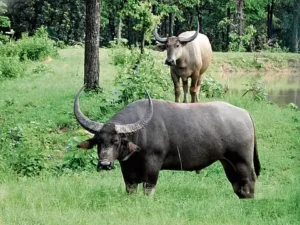
ASIATIC WILD BUFFALO
TOPIC: (GS3) ENVIRONMENT: THE HINDU
The Chhattisgarh Forest Department has announced plans to translocate Asiatic wild buffaloes from Assam to enclosures in Pamed Wildlife Sanctuary, Udanti Sitanadi Tiger Reserve, and Indravati Tiger Reserve, aiming to revive dwindling populations in central India.
About the Species
- Largest wild bovine in the world.
- Other names: Wild water buffalo, Asian buffalo, Wild Asian buffalo.
- Habitat: Swamps, flooded grasslands, wetlands, alluvial plains, and river valleys with dense vegetation.
- Distribution: Southern Nepal, eastern & central India, southern Bhutan, western Thailand.
- India’s population: Over 90% of global numbers (3,500–3,700), mostly in Assam (3,000–3,500). Smaller groups in Meghalaya, Chhattisgarh, and Maharashtra’s Kolamarka forests.
- Behaviour: Active both day and night; males mature at 1.5 years, females at 3 years.
- Diet: Herbivorous – grasses, aquatic plants, crops, herbs, leaves, and tree bark.
Conservation Status
- IUCN Red List: Endangered.
- Wildlife Protection Act, 1972: Schedule I species (highest protection).
- Global importance: India holds the majority of the remaining population, making its conservation critical for species survival.
Major Threats
- Habitat loss: Conversion of wetlands and grasslands for agriculture and development.
- Diseases & parasites: Transmission from domestic cattle.
- Hunting & poaching: For meat and horns.
- Genetic dilution: Interbreeding with domestic buffalo reduces purity of wild gene pool.
- Humanwildlife conflict: Crop raiding leads to retaliatory killings.
Significance of Translocation
- Revival of populations: Helps restore numbers in Chhattisgarh where wild buffaloes are critically low.
- Genetic diversity: Assam’s stronger population can strengthen central Indian herds.
- Ecological role: As large grazers, they maintain grassland ecosystems and support preypredator balance.
- Conservation precedent: Similar efforts have been made for Asiatic lions (Gir to Kuno) and barasingha translocation in Kanha.
Conclusion
The translocation of Asiatic wild buffaloes is a crucial step to secure India’s ecological heritage, ensuring that this endangered species survives as a symbol of wetland and grassland resilience.
POWERBANK50
TOPIC: (GS3) SCIENCE AND TECHNOLOGY: THE HINDU
Hyderabadbased spacetech startup TakeMe2Space announced that its PowerBank50 satellite battery pack has earned the prestigious ‘flight heritage’ status after performing successfully on Skyroot Aerospace’s Vikram1 rocket (Mission Aagaman).
About PowerBank50
- Developed indigenously by TakeMe2Space, marking India’s first satellite battery to achieve flight heritage.
- Successfully powered Cosmoserve Space’s payload aboard Vikram1 at 450 km altitude.
- Operated reliably under vacuum, radiation, and extreme temperature variations.
Features
- Compact lithiumion battery pack designed for small satellites.
- Weight: 380 grams, size comparable to a paperback book.
- Energy capacity: 50 Wh.
- Equipped with:
- Intelligent battery management system.
- Onboard heaters for thermal regulation.
- Aluminium flight enclosure for durability.
- Multiple units can be stacked to power CubeSats and microsatellites.
- Operational life: up to 5 years in Low Earth Orbit (LEO).
Why Flight Heritage Matters
- In satellite industry, flight heritage is the toughest credential.
- Launch providers and insurers avoid untested components due to risk of mission failure.
- Batteries face the highest scrutiny, Operate reliably through hot and cold orbital cycles.
- Achieving heritage status makes PowerBank50 a trusted product for future missions, opening global market opportunities.
Significance for India
- Strengthens India’s private space ecosystem postspace reforms.
- Complements Skyroot’s achievement of becoming the first private Indian company to reach orbit.
- Reduces dependence on imported satellite subsystems.
- Positions Indian startups in global satellite supply chains.
Conclusion
PowerBank50’s flight heritage milestone showcases India’s growing capability in space hardware innovation, reinforcing the country’s ambition to be a global leader in the new space economy.
DIKHOW RIVER
TOPIC: (GS1) GEOGRAPHY: THE HINDU
Flash floods from the Dikhow River recently submerged Nepali Khuti village in Assam, destroying homes, livestock, and livelihoods within hours.
About Dikhow River
- Important south bank tributary of the Brahmaputra River.
- Origin: Zunheboto district, Nagaland.
- Course: Enters Assam plains via Naginimara (Sivasagar district) → flows through Sivasagar → joins Brahmaputra at Dikhowmukh.
- Length: 236 km.
- River basin boundaries:
- North – Brahmaputra River.
- East – Buridihing basin.
- West – Jhanji basin.
- South – Naga Hills.
- Leaves behind 15+ abandoned channels, forming oxbow lakes in Assam plains.
Ecological & Social Importance
- Supports wetland ecosystems and biodiversity.
- Provides irrigation and fisheries for local communities.
- Oxbow lakes act as natural reservoirs and habitats for migratory birds.
- Plays a role in cultural identity of Sivasagar region.
Flood Concerns
- Sudden flash floods cause loss of life, property, and livestock.
- Vulnerability increases during monsoon season due to heavy rainfall and sediment load.
- Example: Nepali Khuti village devastation highlights risks to selfreliant dairy communities.
- Floods also disrupt transport, agriculture, and rural economy.
Broader Dimensions
- Disaster management: Need for early warning systems using IMD and ISRO satellite data.
- Climate change: Intensifies rainfall variability, raising flood frequency.
- River morphology: Frequent channel shifts and oxbow lake formation complicate flood control.
- Policy linkage: Aligns with National Disaster Management Authority (NDMA) guidelines and Assam’s flood resilience plans.
- Community resilience: Requires ecofriendly embankments, relocation strategies, and livelihood diversification.
Conclusion
The Dikhow River embodies both ecological richness and flood vulnerability, demanding integrated disaster management and sustainable river basin planning for Assam’s resilience.