Table of Contents
ToggleThe relationship between humans and nature has shifted from sustainable coexistence to aggressive dominance. Driven by industrialization, population expansion, and unsustainable consumption, the cumulative effects of human activities on environment systems have disrupted the delicate ecological balance. This change threatens both the global biosphere and the future of human society.
Understanding Environmental Degradation
Environmental degradation UPSC notes define the concept as the deterioration of the environment through the depletion of natural assets such as air, water, and soil. It includes the destruction of ecosystems, habitat fragmentation, and the extinction of wildlife. When an ecosystem’s baseline carrying capacity is compromised, its ability to self-regulate and provide critical ecosystem services (such as carbon sequestration and water purification) collapses.
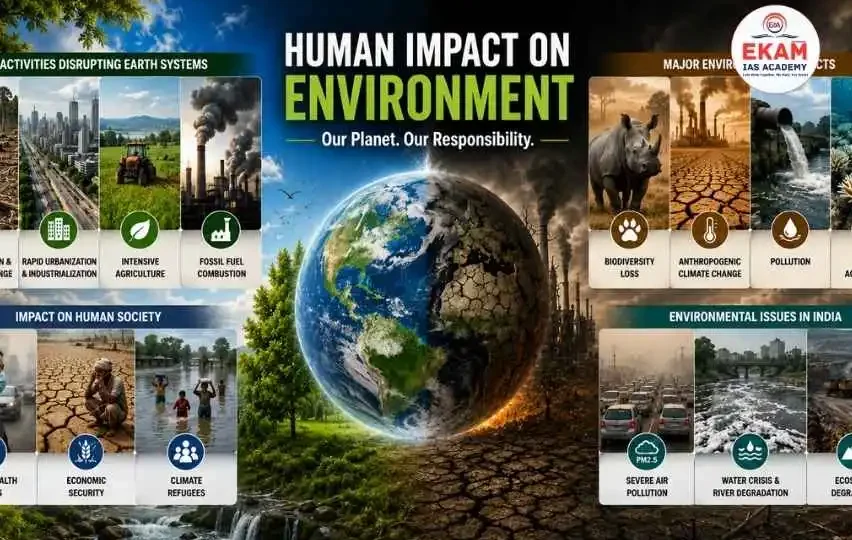
Human Activities Disrupting Earth Systems
Humanity alters the planet through several primary channels:
- Deforestation and Land Use Change: Converting pristine forests into agricultural fields and pasture lands destroys natural carbon sinks and causes severe habitat loss.
- Rapid Urbanization and Industrialization: Expanding concrete landscapes creates urban heat islands, while factories release untreated toxic effluents and heavy metals into local river basins.
- Intensive Agriculture: The heavy use of chemical fertilizers (NPK) and synthetic pesticides leads to soil acidification, kills beneficial soil microbes, and causes eutrophication in nearby water bodies.
- Fossil Fuel Combustion: Burning coal, oil, and natural gas releases vast amounts of greenhouse gases (GHGs) like $CO_2$ and $CH_4$, driving global climate change.
Major Environmental Impacts
These activities trigger severe, interconnected environmental consequences:
- Biodiversity Loss: Species extinction rates are currently hundreds of times higher than natural background rates, leading to a modern Sixth Mass Extinction.
- Anthropogenic Climate Change: Rising global temperatures accelerate arctic ice-sheet melting, cause sea levels to rise, and increase the frequency of extreme weather events like prolonged droughts and severe flash floods.
- Pollution: Microplastics have contaminated the entire food chain, appearing everywhere from deep marine trenches to human tissue, while ambient air pollution blankets entire cities.
- Ocean Acidification: Excess atmospheric $CO_2$ dissolves into the oceans, forming carbonic acid. This process lowers oceanic pH and causes widespread coral bleaching, threatening marine food webs.
Impact on Human Society
Environmental neglect directly harms human well-being:
- Public Health Crises: Chronic exposure to poor air quality ($PM_{2.5}$ and $PM_{10}$) leads to widespread cardiovascular and respiratory illnesses.
- Economic Security: Land degradation and unpredictable monsoon patterns reduce agricultural yields, threatening global food security and causing economic instability in climate-dependent nations.
- Climate Refugees: Extreme weather, rising sea levels, and desertification force communities to abandon their homes, creating millions of environmental displaced persons and escalating geopolitical resource conflicts.
Environmental Issues in India
India faces distinct challenges due to its high population density and rapid economic development:
- Severe Air Pollution: The Indo-Gangetic Plain consistently records some of the highest air pollution levels globally, aggravated by seasonal stubble burning, vehicular emissions, and industrial dust.
- Water Crisis and River Degradation: Major river systems like the Ganga and Yamuna suffer from heavy pollution caused by untreated municipal sewage and industrial waste, while over-extraction for irrigation rapidly depletes groundwater aquifers.
- Ecosystem Degradation: Intensive mining operations in the biologically rich Western Ghats and Central Indian forests cause widespread habitat fragmentation and increase human-wildlife conflict.
Conservation and Government Initiatives in India
India uses a combination of legislative frameworks and targeted national missions to address environmental degradation:
A. Statutory Frameworks
- The Environment (Protection) Act, 1986: Serves as the umbrella legislation empowering the central government to coordinate state actions, set environmental quality standards, and regulate industrial operations.
- The Air (Prevention and Control of Pollution) Act, 1981 and The Water (Prevention and Control of Pollution) Act, 1974: Provide the legal basis for the Central Pollution Control Board (CPCB) to monitor pollution and enforce industrial compliance.
B. Core National Missions
- National Action Plan on Climate Change (NAPCC): Consists of eight dedicated core missions, including the National Solar Mission, National Mission for Enhanced Energy Efficiency, and the National Mission for a Green India.
- National Clean Air Programme (NCAP): A targeted time-bound strategy aiming for a significant reduction in particulate matter concentration across non-attainment cities.
- Lifestyle for Environment (LiFE) Movement: A global citizen-centric initiative launched by India that encourages individuals to adopt sustainable consumption habits and eliminate thoughtless resource waste.
International Environmental Concerns
Addressing global degradation requires coordinated multilateral diplomacy under several key frameworks:
- United Nations Framework Convention on Climate Change (UNFCCC): Coordinates global carbon reduction strategies, with recent focus on implementing the Paris Agreement to limit global warming to well below $2^\circ\text{C}$.
- Convention on Biological Diversity (CBD): Focuses on preserving genetic and ecosystem diversity, guided by global frameworks like the Kunming-Montreal Global Biodiversity Framework.
- United Nations Convention to Combat Desertification (UNCCD): Drives international efforts to restore degraded land and achieve global Land Degradation Neutrality (LDN).
Conclusion
Analyzing the human impact on environment UPSC syllabus highlights that sustainable development is a necessity, not an option. Reversing environmental degradation requires moving away from exploitative economic models toward a circular economy that prioritizes resource conservation. By strengthening domestic environmental laws, investing in green technologies, and promoting eco-conscious individual lifestyles, society can mitigate anthropogenic harm and safeguard a balanced, resilient biosphere for future generations.
UPSC Prelims: PYQs & Practice Questions
Previous Year Questions (Prelims)
UPSC CSE Prelims 2019
Q: Why is there a great concern about the ‘microbeads’ that are released into the environment?
(a) They are considered harmful to marine ecosystems.
(b) They are felt to cause skin cancer in children.
(c) They are small enough to be absorbed by crop plants in irrigated fields.
(d) They are often found to be used as food adulterants.
Answer: (a) They are considered harmful to marine ecosystems.
Explanation:
Microbeads are manufactured solid plastic particles of less than
five millimeters. They do not easily degrade or dissolve in water and are commonly used in cosmetics, exfoliants, and toothpastes.
Due to their tiny size, they can bypass wastewater filtration systems and enter rivers and oceans. Marine organisms may mistake them for food, allowing toxic chemicals to enter the marine food web and cause bioaccumulation. This reflects the harmful impact of human activities on environmental systems through synthetic pollution.
UPSC CSE Prelims 2014
Q: With reference to the Global Environment Facility (GEF), which of the following statements is/are correct?
1. It serves as a financial mechanism for the
Convention on Biological Diversity and the
United Nations Framework Convention on Climate Change.
2. It undertakes scientific research on environmental issues at global level.
3. It is an organ of the OECD which facilitates the transfer of technology and funds to underdeveloped countries.
Select the correct answer using the code given below:
(a) 1 only
(b) 2 and 3 only
(c) 1 and 2 only
(d) 1, 2 and 3
Answer: (a) 1 only
Explanation:
Statement 1 is correct. The
Global Environment Facility (GEF) acts as a designated financial mechanism for major international environmental conventions, including the
CBD, UNFCCC, UNCCD, the Stockholm Convention on Persistent Organic Pollutants, and the Minamata Convention on Mercury.
Statements 2 and 3 are incorrect. The GEF is an independent financial organization that provides grants and funding support for environmental projects. It does not directly conduct global scientific research and is not an organ of the OECD.
Practice Questions
Q: In the context of global environmental degradation, consider the following statements regarding Ocean Acidification:
1. It is driven primarily by the anthropogenic emission of
sulfur dioxide (SO2), which dissolves into upper marine layers to form sulfuric acid.
2. The process leads to a significant decrease in the concentration of
carbonate ions (CO32−), severely impeding the ability of calcifying marine organisms to build shells and skeletons.
Which of the statements given above is/are correct?
(a) 1 only
(b) 2 only
(c) Both 1 and 2
(d) Neither 1 nor 2
Answer: (b) 2 only
Explanation:
Statement 1 is incorrect. Ocean acidification is mainly driven by the excess absorption of atmospheric
carbon dioxide (CO2), not sulfur dioxide. CO2 reacts with seawater to form
carbonic acid.
Statement 2 is correct. As seawater absorbs more carbon dioxide, hydrogen ion concentration increases. These hydrogen ions combine with available carbonate ions, reducing carbonate ion availability. This directly affects corals, mollusks, pteropods, and other calcifying organisms that require carbonate ions for shell and skeleton formation.
Q: The term “Anthropocene”, frequently appearing in contemporary ecological discourse, refers to which of the following concepts?
(a) A newly proposed geological epoch characterized by dominant human influence over Earth’s ecosystems and atmospheric systems.
(b) An international treaty designed to restrict human demographic expansion inside biodiversity hotspots.
(c) A localized ecological collapse triggered exclusively by nuclear waste mismanagement.
(d) The biological threshold where artificial intelligence replaces natural photosynthetic mechanisms.
Answer: (a) A newly proposed geological epoch characterized by dominant human influence over Earth’s ecosystems and atmospheric systems.
Explanation:
The Anthropocene is a widely used term in environmental studies to describe the present period in which
human activities have become the dominant force shaping Earth’s climate, biodiversity, landforms, oceans, and atmospheric systems.
Processes such as global warming, massive plastic pollution, deforestation, urban expansion, industrial emissions, and rapid biodiversity loss indicate that humanity has pushed Earth systems away from the relatively stable conditions of the Holocene epoch.
UPSC Mains – Previous Year & Practice Questions
Mains Previous Year Questions
Mains 2023
Question: Identify the main causes of the loss of
biodiversity in India.
(Requires detailing anthropogenic drivers like habitat fragmentation, deforestation, and industrial pollution.)
Mains 2020
Question: How does the draft
Environment Impact Assessment (EIA) Notification differ from the existing
EIA Notification, 2006?
(Tests how balancing human economic growth with environmental safeguards is managed in policy.)
Mains 2019
Question: Coastal regions of India are prone to cyclones.
Discuss the role of mangroves in reducing the impact of such disasters.
(Can discuss how destroying mangroves for human aquaculture compromises natural bio-shields.)
Mains 2014
Question: Enumerate the
indirect services provided by an ecosystem.
How do wetlands act as “Earth’s Kidneys”?
(Can contrast this with how urban encroachment destroys wetland filtration services.)
Mains 2018
Question: How does
biodiversity vary in India? How is the
Biological Diversity Act, 2002 helpful in conservation of flora and fauna?
(Can be linked with legal safeguards against human-induced ecological degradation.)
Mains Practice Questions
[15 Marks | 250 Words]
Question: Discuss the concept of Planetary Boundaries. Analyze how human economic activities have crossed critical ecological thresholds, leading to irreversible global environmental degradation.
[15 Marks | 250 Words]
Question: Evaluate the effectiveness of the Environment (Protection) Act, 1986 as India’s umbrella environmental law. To what extent has it been successful in regulating industrial pollution and urban waste management?
[10 Marks | 150 Words]
Question: Anthropogenic climate change is shifting from a purely ecological issue to a severe human crisis. Discuss the economic and geopolitical challenges India faces due to the rise of Climate Refugees and regional water stress.



Human Impact on the Environment-FAQs
Link between intensive agriculture and eutrophication?
Excess fertilizers rich in nitrates and phosphates are washed into water bodies. This causes algal blooms, oxygen depletion, and fish deaths due to hypoxic conditions.
How does CPCB track air pollution?
CPCB monitors air pollution through NAMP and CAAQMS. These systems track pollutants like PM2.5, PM10, SO₂, NO₂ and convert data into the Air Quality Index.
Difference between Bioaccumulation and Biomagnification?
Bioaccumulation is toxin buildup within one organism over time. Biomagnification is toxin concentration increasing at higher levels of the food chain.
What is India’s LiFE movement?
Mission LiFE promotes environment-friendly lifestyles and responsible consumption. It encourages habits like saving water, reducing plastic, cutting food waste, and using energy-efficient products.
What is Land Degradation Neutrality and India’s target?
LDN means maintaining or improving the quality and quantity of healthy land. India aims to restore 26 million hectares of degraded land under UNCCD commitments.