

A massive dust storm in Churu, Rajasthan recently impacted several districts, highlighting the Aravalli range’s protective role and emphasising deforestation, and urbanisation are steadily weakening this ecological shield,
Aravalli Range
- Oldest mountain system: The Aravalli range is among the world’s oldest fold mountains, dating back billions of years.
- Geographic role: Acts as a natural barrier between the Thar Desert and the IndoGangetic plains, intercepting dustladen winds.
- Protection of population centres: Shields densely populated regions like Delhi, Haryana, Punjab, and Uttar Pradesh from desert dust storms.
- Dust interception: Winds lose speed when hitting the range, depositing sand on western slopes, preventing dust from reaching urban centres.
- Vegetation cover: Tree belts and natural flora act as a scrubbing effect, reducing dust movement and stabilising dunes.
Dust Storms
- Seasonal phenomenon: Occur during April–June due to intense heat, dry conditions, and strong westerly winds.
- High frequency zones: IMD data (1981–2010) shows northwest India records 0.89–1.55 dust storm days annually.
- Delhi’s exposure: In June, Delhi faces 2.5 dust storm days, the highest in India.
- Impact of Aravalli degradation: As gaps widen, dust storms penetrate deeper into the plains.
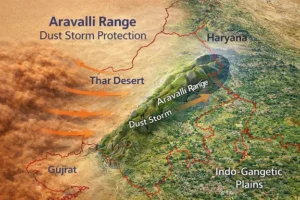
Aravalli Range – Natural Dust Shield
- Geographic barrier: Blocks winds from the Thar Desert and Middle East, reducing dust inflow.
- Obstacle dunes: Sand deposits on western slopes prove its filtering role.
- Vegetation effect: Tree cover creates a scrubbing effect, trapping dust particles.
State of Degradation
- Disappearing hills: FSI (2018) found 31 of 128 hills vanished in Rajasthan.
- Causes: Mining of minerals, deforestation, urbanisation, landuse change, and overgrazing.
- Wildlife Institute study: Identified 12 gaps in the range, now expanded, allowing dust corridors.
Consequences of Aravalli Degradation
- Increased dust storms: Higher frequency in Delhi, Punjab, and UP.
- Air pollution: Dust worsens PM2.5 and PM10 levels, aggravating respiratory diseases.
- Rainfall disruption: Loss of forest cover alters precipitation patterns.
- Solar radiation changes: Dust scattering affects temperature, agriculture, and health.
Way Forward
- Strict mining regulation and enforcement of bans on illegal extraction.
- Afforestation drives with droughtresistant species to restore vegetation.
- Urban planning reforms to prevent encroachments and landuse change.
- Scientific monitoring of dust load and storm frequency for policy action.
Conclusion
The Aravalli range’s weakening shield is a pressing ecological challenge, demanding urgent restoration to safeguard air quality, climate stability, and human health.
Recent remarks by Nepal Prime Minister Balendra Shah on alleged border encroachments have reignited debate on the India–Nepal boundary dispute.
About India–Nepal Boundary
- Shared border length: India and Nepal share an open border of approximately 1,850 km, spanning Uttarakhand, Uttar Pradesh, Bihar, West Bengal, and Sikkim.
- Boundary status: Most of the boundary has been demarcated and mutually accepted, but a few sensitive stretches remain disputed.
- Historical origin: The dispute traces back to the Treaty of Sugauli (1816) between the East India Company and Nepal, which defined the Kali (Mahakali) River as Nepal’s western boundary.
- Core issue: The disagreement arises from different interpretations of the river’s source, leading to overlapping territorial claims.
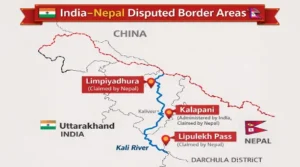
Major Disputed Areas
- Kalapani: Near the India–Nepal–China trijunction. Administered by India (Uttarakhand), claimed by Nepal (Darchula district).
- Lipulekh Pass: Key route for Kailash Mansarovar Yatra and trade with Tibet. Claimed by Nepal as sovereign territory.
- Limpiyadhura: Nepal argues Kali River originates here, which would place Kalapani and Lipulekh within Nepalese territory. India disputes this interpretation.
Recent Developments
- 2020 Map Issue: Nepal released a new political map including Kalapani, Lipulekh, and Limpiyadhura. India rejected it as unilateral and inconsistent with historical facts.
- Diplomatic Note (2026): Nepal formally raised concerns with India; India responded positively, agreeing to pursue dialoguebased solutions.
- PM’s Remarks: Shah suggested both sides may have encroached, urging joint verification by historians, surveyors, and boundary experts.
- ThirdParty Reference: Nepal mentioned discussions with China and the UK, citing colonial origins. India maintains boundary issues must be resolved bilaterally.
Mechanisms for Resolution
- Bilateral dialogue through diplomatic channels.
- Joint boundary committees for survey and mapping.
- Expert examination using historical and cartographic evidence.
- Commitment to peaceful resolution reiterated by both governments.
Implications for Bilateral Relations
- Political sensitivity: Remarks may fuel domestic debate in Nepal and complicate diplomacy.
- Religious routes: Nepal’s objection to Lipulekh route affects cultural exchanges.
- Strategic dimension: Proximity to China makes the dispute geopolitically significant.
- Peopletopeople ties: Open border facilitates trade, migration, and cultural exchange, making resolution vital for stability.
Conclusion
The India–Nepal boundary issue reflects historical complexities and strategic sensitivities, requiring dialogue, factual clarity, and mutual trust for resolution.
The Union Minister recently stated that India’s Design Linked Incentive (DLI) scheme under the Semicon India Programme is showing positive results as a major step in building India’s fabless semiconductor design ecosystem.
Design Linked Incentive (DLI) Scheme
- Flagship initiative: Launched by the Ministry of Electronics and IT (MeitY) under the Semicon India Programme.
- Strategic aim: Strengthen India’s role in the global semiconductor value chain.
- Import reduction: Designed to reduce dependence on imports and build domestic capacity.
- Innovation support: Encourages domestic innovation in semiconductor design and development.
- Startups and MSMEs: Provides targeted support to startups and MSMEs engaged in chip design.
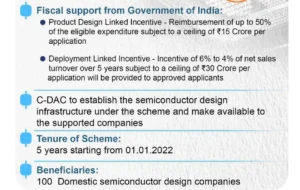
Features of the Scheme
- Objective: Build fabless design capability, enhance supply chain resilience, and increase domestic value addition.
- Eligibility: Startups, MSMEs, and domestic companies engaged in semiconductor design.
- Scope: Supports design lifecycle — ICs, chipsets, SoCs, systems, and IP cores.
- Nodal Agency: Centre for Development of Advanced Computing (CDAC).
Financial Incentives
- Product Design Linked Incentive: Up to 50% reimbursement of eligible expenditure. Cap of ₹15 crore per application.
- Deployment Linked Incentive: 4% incentive on net sales turnover for 5 years. Cap of ₹30 crore per application. Minimum cumulative sales: ₹1 crore (startups/MSMEs), ₹5 crore (others).
Significance
- Encourages domestic chip design startups.
- Reduces reliance on imported semiconductors.
- Aligns with Atmanirbhar Bharat and Digital India.
- Strengthens India’s role in the global electronics supply chain.
Conclusion
The DLI scheme is a strategic push for India’s semiconductor selfreliance, fostering innovation and reducing import dependence.
The Prime Minister recently paid tributes to Lokmata Ahilyabai Holkar on her birth anniversary (31 May).
Ahilyabai Holkar, Legacy of a Philosopher Queen
- Birth and background: Born in 1725 at Chondi village, Ahmednagar (Maharashtra), she was later married to Khanderao Holkar, son of Malhar Rao Holkar.
- Titles and recognition: Revered as Punyashlok (pure as sacred chants) and described by historian John Keay as the Philosopher Queen.
- Rise to power: After the deaths of her husband (1754), fatherinlaw (1766), and son (1767), she ascended the throne of Malwa in 1767, ruling until 1795.
- Capital shift: Made Maheshwar (Madhya Pradesh) the capital of the Holkar dynasty, turning it into a hub of culture and administration.
- Governance style: Known for progressive governance, justice, and welfare measures that ensured stability and prosperity in her kingdom.
- Temple restoration: Rebuilt and renovated major temples including Kashi Vishwanath (1780), Somnath, Dwarka, and Gaya, while also constructing ghats, wells, and dharmashalas for pilgrims.
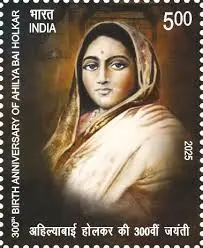
Key Contributions
Administrative and Social Reforms
- Good governance: Ensured justice, welfare, and efficient revenue administration.
- Women’s empowerment: Formed a women’s army, trained in selfdefense and administration.
- Education: Established gurukuls and schools to promote learning.
Religious and Cultural Patronage
- Temple restoration: Rebuilt Kashi Vishwanath temple (1780) and renovated shrines across India (Somnath, Gaya, Dwarka, Ujjain).
- Pilgrimage infrastructure: Constructed ghats, rest houses, wells, and dharmashalas for pilgrims.
- Support to scholars: Patronised poets like Moropant, Shahir Ananta Gandhi, and Sanskrit scholar Khushali Ram.
Economic and Craft Promotion
- Textile industry: Established weaving centres in Maheshwar, leading to the famous Maheshwari sarees.
- Encouraged local artisans and traders, strengthening Malwa’s economy.
Legacy and Recognition
- Remembered as Lokmata (Mother of the People) for her compassion and reforms.
- Her reign is often cited as a model of ethical leadership and inclusive governance.
- Modern India honours her through statues, memorials, and tributes, with Maheshwar still reflecting her cultural vision.
Conclusion
Ahilyabai Holkar exemplified progressive leadership, cultural revival, and social justice, leaving behind a legacy of compassionate governance and enduring heritage.
Recently, NASA’s James Webb Space Telescope (JWST) captured the weather patterns of an exoplanet nearly 700 lightyears away.
James Webb Space Telescope
- Launch and collaboration: Launched in December 2021, jointly developed by NASA, European Space Agency (ESA), and Canadian Space Agency (CSA).
- Largest observatory: Recognised as the world’s most powerful space telescope, surpassing Hubble in capability.
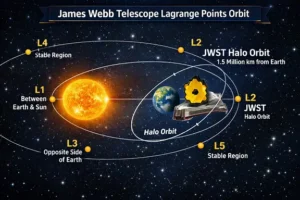
- Orbit location: Positioned at the L2 Lagrange Point, about 1.5 million km from Earth, ensuring stability for deepspace observations.
- Infrared operations: Specialises in the infrared spectrum, allowing study of early galaxies, star formation, and exoplanet atmospheres.
- Significance: Offers unprecedented clarity in cosmic observations, strengthens knowledge of universe origins, and complements the Hubble Telescope.
Key Components
- Optical Telescope Element (OTE) – Collects light from distant celestial objects.
- Integrated Science Instrument Module (ISIM) – Houses cameras and scientific instruments.
- Sunshield – Protects instruments from solar radiation and maintains low temperatures.
- Spacecraft Bus – Provides operational support including power, communication, and propulsion.
Objectives
- Early galaxies: Observe galaxies formed soon after the Big Bang.
- Galaxy evolution: Trace how galaxies evolved from their origin to the present.
- Star formation: Examine stages of stellar birth and planetary system development.
- Exoplanet studies: Investigate atmospheres, chemical composition, and potential habitability of planets.
Significance
- Provides unprecedented clarity in observing distant galaxies and exoplanets.
- Strengthens understanding of cosmic origins and planetary habitability.
- Complements the Hubble Space Telescope, extending research into the infrared spectrum.
Conclusion
JWST is a gamechanging observatory, unlocking secrets of the universe from its earliest galaxies to distant exoplanets.