Table of Contents
ToggleTransportation is the structural backbone of modern globalization, linking raw materials, industrial hubs, and consumer markets. However, moving goods and people across the planet creates a massive ecological deficit. The cumulative effects of transportation on environment systems have evolved from localized urban smog into a major driver of global atmospheric and terrestrial degradation.
Transportation Activities and Their Multi-Modal Importance
Modern society relies on a diverse grid of logistics pathways to support global trade and rapid urbanization:
- Road Transport: The primary vehicle for domestic logistics, carrying massive volumes of passenger and freight traffic.
- Railways: A highly energy-efficient mode of mass transit, though it still requires significant land transformation.
- Aviation: Essential for high-speed global connectivity, but carries an incredibly intense, high-altitude emissions footprint.
- Maritime Shipping: Handles over 80% of global trade by volume, presenting unique risks to marine biology.
Environmental Effects of Transportation Activities
- The core dynamics of the transportation and pollution UPSC module focus on how burning fossil fuels degrades different spheres of the earth:
                        ┌──> Air: Tailpipe emissions (PM2.5, NOx, SO2)
                        │
[Transport Sector] ─────┼──> Climate: High greenhouse gas (CO2) accumulations
  Ecological Pressures  │
                        ├──> Land: Linear infrastructure & habitat fragmentation
                        │
                        └──> Marine: Oil spills, ballast discharge, & acoustic noise
A. Impact on Air Quality and Pollution
Internal combustion engines emit massive quantities of hazardous primary and secondary pollutants:
- Particulate Matter (PM2.5) and (PM10): Tailpipe emissions and tire wear generate fine particles that deeply degrade ambient air quality.
- Nitrogen Oxides (NOx) and Volatile Organic Compounds (VOCs): These compounds react under sunlight to form toxic ground-level ozone (O3), a severe threat to agricultural yields and human lungs.
B. Impact on Climate Change
The transportation sector is one of the fastest-growing sources of global carbon emissions. Burning petroleum-based fuels releases immense volumes of carbon dioxide (CO2), while aircraft emit water vapor and nitrous oxides at high altitudes, forming contrails that trap additional thermal radiation in the atmosphere.
C. Impact on Biodiversity and Ecosystems
Building highways and railway lines leads directly to habitat fragmentation. These long, linear infrastructure corridors cut through pristine forests, isolating wildlife gene pools, blocking natural migration routes, and triggering a sharp rise in animal-vehicle collisions (roadkill). In the oceans, massive container ships release contaminated ballast water, introducing invasive alien species that destabilize native marine food webs.
Social, Health, and Domestic Realities in India
India faces distinct demographic and spatial challenges within the transportation paradigm:
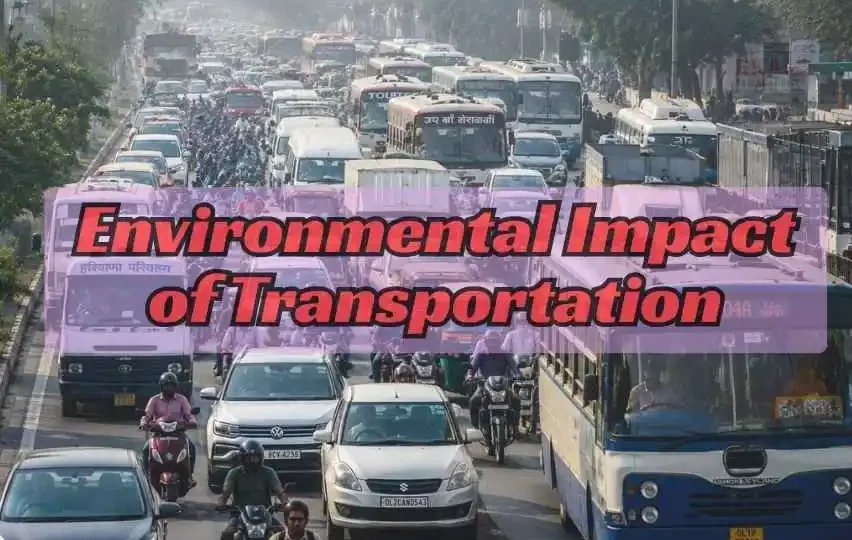
- The Urban Air Crisis: Rapid vehicle growth has turned major metros like Delhi, Mumbai, and Bengaluru into hotspots for chronic respiratory illnesses, such as asthma and bronchitis.
- Acoustic Pollution: Unregulated honking and heavy freight movement generate continuous noise pollution, disrupting human mental health and interfering with wildlife acoustic communication.
Sustainable Transportation Solutions and Government Initiatives
- Mitigating the environmental impacts of transport sector requires a structural shift toward green mobility, cleaner fuel technologies, and smarter urban planning.
Key Sustainable Solutions:
- The Avoid-Shift-Improve Framework: Avoiding unnecessary travel through compact urban design; shifting transit from private cars to public mass systems; and improving vehicle efficiency through advanced tech.
- Adopting a Circular Mobility Model: Mass-scale deployment of electric vehicles (EVs), scaling up hydrogen fuel-cell commercial trucks, and mandating strict vehicle-scrapping policies.
Core Government Initiatives in India:
- FAME India Scheme (Faster Adoption and Manufacturing of Hybrid and Electric Vehicles): A flagship financial incentive program designed to rapidly scale up the manufacturing and adoption of electric two-wheelers, cars, and public buses.
- Bharat Stage VI (BS-VI) Emission Norms: A historic regulatory step where India skipped BS-V entirely to mandate BS-VI standards nationwide, dramatically lowering the permissible sulfur and NOx content in vehicular fuels.
- National Biofuels Policy: Drives the mandatory blending of ethanol into petrol and biodiesel into diesel, reducing crude oil import dependency and lowering net carbon emissions.
- National Hydrogen Energy Mission: Focuses on producing and utilizing green hydrogen to power heavy-duty, long-haul commercial logistics and shipping fleets.
- The PM GatiShakti National Master Plan: An integrated digital platform designed to optimize multimodal connectivity, reducing logistics inefficiencies and lowering fuel waste across the country.
International Efforts
On the global stage, international bodies are implementing strict sector-specific mandates. The International Maritime Organization (IMO) enforces caps on sulfur emissions from ship fuels, while the International Civil Aviation Organization (ICAO) manages the CORSIA (Carbon Offsetting and Reduction Scheme for International Aviation) framework to achieve carbon-neutral growth in global flight networks.
Conclusion
In conclusion, analyzing the transportation and pollution UPSC syllabus underscores that economic growth must be decoupled from environmental damage. Transitioning away from fossil-fueled mobility toward clean, public electric transit is no longer optional. By strictly enforcing BS-VI protocols, scaling up green hydrogen infrastructure, and investing in comprehensive public transit networks, India can expand its physical economy while safeguarding public health and honoring its international climate commitments.
UPSC Prelims: PYQs & Practice Questions
Previous Year Questions (Prelims)
UPSC CSE Prelims 2024
Q: Consider the following statements regarding the Bharat Stage VI (BS-VI) emission norms in India:
1. They mandate a significant reduction in
particulate matter (PM2.5) emissions from diesel vehicles compared to BS-IV norms.
2. Under BS-VI norms, the permissible sulfur content in both petrol and diesel is capped at a maximum of
10 ppm.
Which of the statements given above is/are correct?
(a) 1 only
(b) 2 only
(c) Both 1 and 2
(d) Neither 1 nor 2
Answer: (c) Both 1 and 2
Explanation:
Both statements are correct. India skipped the
BS-V norms entirely and transitioned directly from
BS-IV to BS-VI.
Under BS-VI, particulate matter emissions from diesel engines are reduced substantially, while nitrogen oxide (NOx) emissions are also controlled. The sulfur content in petrol and diesel was reduced from 50 ppm under BS-IV to an ultra-low level of 10 ppm.
This makes BS-VI a major intervention to reduce the environmental impacts of transport sector operations, especially urban air pollution.
UPSC CSE Prelims 2016
Q: With reference to the Initiative for Sustainable Landscapes (ISLA), launched under global environmental partnerships, consider the following statements:
1. It aims to promote sustainable landscape management by integrating
agricultural production, biodiversity conservation, and
green logistics.
2. It is an initiative managed and funded exclusively by the
World Bank.
Which of the statements given above is/are correct?
(a) 1 only
(b) 2 only
(c) Both 1 and 2
(d) Neither 1 nor 2
Answer: (a) 1 only
Explanation:
Statement 1 is correct. The
Initiative for Sustainable Landscapes promotes integrated landscape management by linking sustainable agriculture, biodiversity conservation, green supply chains, and logistics planning.
Statement 2 is incorrect. ISLA is not an exclusive World Bank project. It involves multi-stakeholder partnerships, including IDH or the Sustainable Trade Initiative, international NGOs, private corporate coalitions, and other sustainability actors.
The initiative is important because transport, logistics, agriculture, and land-use change are deeply connected to deforestation, habitat fragmentation, and long-term environmental degradation.
Practice Questions
Q: In the context of the effects of transportation on environment systems, consider the following statements regarding aviation emissions:
1. Contrails are artificial clouds formed when water vapor emitted by aircraft engines condenses around soot particles in freezing, high-altitude air layers.
2. Persistent contrails exert a net cooling effect on the planet by reflecting incoming solar radiation back into deep space during daytime operations.
Which of the statements given above is/are correct?
(a) 1 only
(b) 2 only
(c) Both 1 and 2
(d) Neither 1 nor 2
Answer: (a) 1 only
Explanation:
Statement 1 is correct.
Contrails, or condensation trails, are lines of ice crystals formed when jet engine exhaust mixes with cold and humid high-altitude air.
Statement 2 is incorrect. Persistent contrails may spread into thin artificial cirrus clouds. These clouds often trap outgoing longwave infrared radiation from the Earth’s surface, producing a net warming effect or positive radiative forcing instead of cooling the planet.
Q: The international offset framework known as CORSIA, which frequently appears in multilateral environmental negotiations, is designed to regulate emissions from which sector?
(a) Transboundary freight train networks across Central Asia
(b) International civil aviation networks
(c) Deep-sea oil tankers operating under flag-of-convenience rules
(d) Urban battery-swapping public transport systems
Answer: (b) International civil aviation networks
Explanation:
CORSIA stands for
Carbon Offsetting and Reduction Scheme for International Aviation.
It was developed by the International Civil Aviation Organization (ICAO) as a global market-based mechanism to stabilize and offset the net carbon dioxide emissions generated by international flights. It ensures that the aviation sector contributes to global climate action through emission reduction and offset measures.
UPSC Mains – Previous Year & Practice Questions
Mains Previous Year Questions
Mains 2023
Question: Identify the main causes of the loss of
biodiversity in India.
(Requires detailing how building linear highways and railway tracks cuts through pristine forests, causing severe habitat fragmentation.)
Mains 2022
Question: Clean energy is the order of the day.
Describe briefly India’s changing policy towards climate change in various international fora in the context of
COP-26.
(Directly involves discussing the FAME scheme and the transition of public transit fleets to electric platforms.)
Mains 2021
Question: Explain the purpose of the
Green Grid Initiative —
One Sun One World One Grid (OSOWOG) launched at the World Leaders’ Summit of the
COP26 Climate Conference.
(Useful for linking renewable power integration with low-carbon transport and charging infrastructure.)
Mains 2016
Question: Major cities of India are becoming vulnerable to
flood conditions. Discuss.
(Can discuss how covering cities with asphalt roads and parking lots increases surface runoff, exacerbating urban floods.)
Mains 2020
Question: How does the draft
Environment Impact Assessment (EIA) Notification differ from the existing
EIA Notification, 2006?
(Crucial for discussing how linear infrastructure projects like highways get environmental clearances.)
Mains Practice Questions
[15 Marks | 250 Words]
Question: Analyze the ecological consequences of expanding linear infrastructure corridors, such as highways and railways, through India’s protected forests. Suggest structural measures to mitigate human-wildlife conflict along these routes.
[15 Marks | 250 Words]
Question: The international shipping and aviation sectors are often described as “hard-to-abate” sectors in climate negotiations. Examine the challenges and global regulatory frameworks designed to curb emissions from these fields.
[10 Marks | 150 Words]
Question: Evaluate the “Avoid-Shift-Improve” framework as a tool for sustainable urban transit planning in India. How can the integration of the FAME scheme and PM GatiShakti optimize India’s transport sector?



Environmental Impact of Transportation-FAQs
What is Habitat Fragmentation?
Habitat fragmentation means breaking a large continuous habitat into smaller isolated patches. Highways and railways act as barriers, causing roadkills, blocked migration, and reduced genetic diversity.
How does vehicle pollution create Ground-Level Ozone?
Ground-level ozone forms when vehicle pollutants like NOx and VOCs react with sunlight. It creates urban smog, harms lungs, and reduces crop productivity.
What is Ballast Water Discharge?
Ships use seawater as ballast for stability and release it at destination ports. This can introduce foreign marine organisms, causing invasive species and food-web disruption.
What is Avoid-Shift-Improve approach?
Avoid unnecessary travel, Shift to public transport/cycling, and Improve vehicles through cleaner fuels and EVs. It reduces transport-related pollution.
How do Eco-Ducts reduce highway impacts?
Eco-ducts are wildlife overpasses or underpasses built across highways. They allow animals to cross safely, reduce roadkills, and reconnect fragmented habitats.