Table of Contents
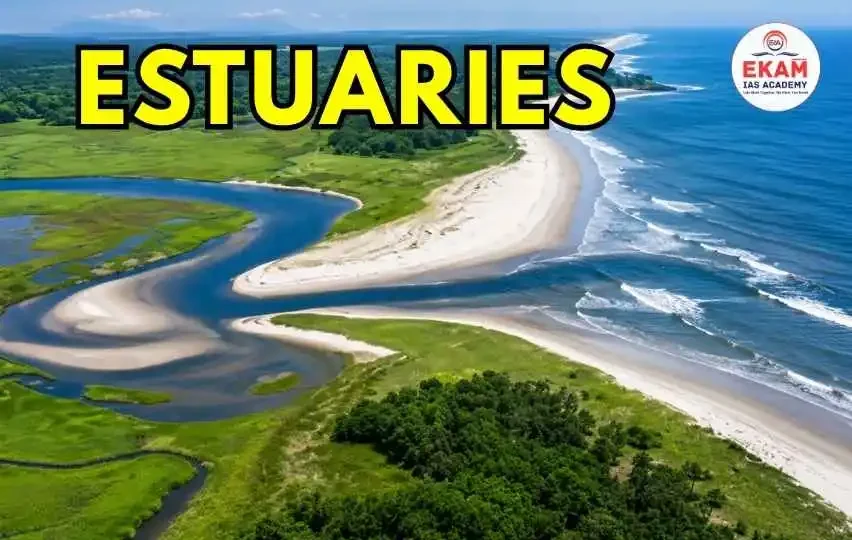
ToggleAn estuary is a partially enclosed coastal body of water where freshwater from rivers and streams mixes with salty ocean water. This mixing zone forms a unique transition area between terrestrial, freshwater, and marine ecosystems. Unlike open coastlines, estuaries are sheltered from the full force of ocean waves, winds, and storms by barrier islands, reefs, or strips of land.
Formation and Types of Estuaries
The formation of estuaries is tied closely to historical changes in global sea levels. Most modern estuaries formed during the Holocene epoch when rising sea levels flooded low-lying river valleys. Based on their geological origin, they are classified into four main types:
- Coastal Plain Estuaries (Drowned River Valleys): Formed when rising sea levels flood existing river valleys (e.g., the Chesapeake Bay).
- Tectonic Estuaries: Created when land sinks due to faulting or volcanic activity, allowing the sea to rush in (e.g., San Francisco Bay).
- Bar-Built Estuaries: Formed when sandbars or barrier islands build up parallel to the coastline, cutting off shallow water from the open ocean.
- Fjord Estuaries: Deep, U-shaped valleys carved out by moving glaciers that later filled with seawater.
Core Characteristics and Estuary Ecology
The unique dynamics of estuary ecology UPSC profiles evaluate revolve around continuous physical and chemical fluctuations:
                        ┌──> Salinity: Highly variable "brackish water" stratification
                        │
[Estuarine Ecosystem] ──┼──> Nutrients: High organic load from upstream river runoff
  Physical Dynamics     │
                        ├──> Substrate: Fine, nutrient-rich mudflats and silt deposits
                        │
                        └──> Energy: Driven by tidal cycles that flush the system daily
- Brackish Water: The water in estuaries is neither fully fresh nor fully marine. Its salinity changes constantly with the daily rhythm of high and low tides, as well as seasonal variations in river flow.
- High Nutrient Levels: Rivers carry rich organic matter and sediment from upstream. As these movements slow down upon entering the sheltered estuary, nutrients settle to the bottom, creating a fertile environment for plant and animal growth.
Ecological Components and the Importance of Estuaries
The high productivity of an estuarine ecosystem supports unique communities of plants and animals specially adapted to handle changing salinity levels.
A. Ecological Importance
- Critical Nurseries of the Sea: Many species of ocean fish, crabs, and shrimp lay their eggs or spend the early stages of their lives in estuaries. The calm, nutrient-rich waters offer plentiful food and excellent protection from large open-ocean predators.
- Natural Carbon Sinks: Estuarine plants, such as those in salt marshes and mangrove forests, capture and store large amounts of atmospheric carbon dioxide, playing a vital role in global climate regulation.
B. Economic Importance
- Supporting Coastal Fisheries: Because they serve as vital nursery grounds, the health of estuaries directly sustains commercial and regional coastal fisheries.
- Natural Protection Barriers: Estuarine wetlands act as natural shock absorbers. Their dense vegetation slows down storm surges and dissipates wave energy, protecting coastal cities from severe flooding and erosion.
Major Estuaries in India
Unlike deltas, which form when rivers deposit large amounts of sediment at their mouths, estuaries typically form where fast-flowing rivers enter the sea along steep coastlines, preventing sediment buildup.
The geography of estuaries in India shows a clear distinction between coasts:
| Coastal Zone | Key Characteristics | Prominent Examples |
| West Coast Estuaries | Fast-flowing, seasonal rivers rushing down the Western Ghats; minimal sediment deposition leads to classic, deep estuaries. | Narmada Estuary, Tapi Estuary, Mandovi and Zuari Estuaries (Goa). |
| East Coast Estuaries | Most east-flowing rivers form vast deltas due to flat terrain, but tidal action creates significant estuarine stretches near river mouths. | Hooghly Estuary (West Bengal), Mahanadi Estuary (Odisha). |
Threats, Conservation, and Government Initiatives
Despite their high importance of estuaries, these transitional zones face severe ecological pressure from human activities:
- Industrial and Agricultural Pollution: Untreated industrial effluents and chemical fertilizers drain into estuaries from upstream, causing severe nutrient overload (eutrophication) and creating toxic “dead zones.”
- Coastal Sprawl and Land Reclamation: Clearing mangrove forests and salt marshes for ports, aquaculture ponds, and urban resorts directly causes severe habitat loss.
Institutional Safeguards in India:
- Coastal Regulation Zone (CRZ) Notifications: India’s primary legal framework that restricts unregulated construction and industrial activity within sensitive coastal and estuarine zones.
- National Coastal Mission: A key initiative aimed at mapping coastal vulnerabilities, protecting marine biodiversity, and restoring degraded estuarine ecosystems.
Conclusion
Analyzing estuaries UPSC study modules highlight demonstrates that these coastal biomes are essential ecological and economic assets, not just scenic waterways. Protecting them requires moving away from short-term coastal exploitation toward integrated river basin management. By strictly enforcing CRZ regulations, reducing upstream agricultural runoff, and restoring native mangrove forests, India can protect its productive fisheries and build resilient coastal communities capable of weathering a changing climate.
UPSC Prelims: PYQs & Practice Questions
Previous Year Questions (Prelims)
UPSC CSE Prelims 2013
Q: Which one of the following terms describes not only the physical space occupied by an organism, but also its functional role in the community of organisms?
(a) Ecotone
(b) Ecological niche
(c) Habitat
(d) Home range
Answer: (b) Ecological niche
Explanation:
An ecological niche describes the functional role and position of a species within its ecosystem. It includes how the organism uses resources, survives, reproduces, and interacts with other organisms.
An ecotone is the transition zone between two or more ecosystems. An estuary is a classic example of a highly productive ecotone where freshwater and marine ecosystems merge.
Therefore, for estuary ecology UPSC preparation, understanding both niche and ecotone is important.
UPSC CSE Prelims 2011
Q: What is the difference between a Delta and an Estuary?
1. A delta is formed when a river moves slowly and deposits its heavy load of sediment at its mouth, whereas an estuary is a drowned river valley where a fast-moving river meets the sea along a steep coast, preventing sediment buildup.
2. Deltas are highly suitable for large-scale agricultural cultivation, whereas estuaries are highly productive nursery grounds for marine organisms and coastal fisheries.
Which of the statements given above is/are correct?
(a) 1 only
(b) 2 only
(c) Both 1 and 2
(d) Neither 1 nor 2
Answer: (c) Both 1 and 2
Explanation:
Both statements are correct. A
delta forms where a river slows down near its mouth and deposits large quantities of sediment, creating fertile alluvial land.
In contrast, an estuary generally forms where a river valley is drowned by the sea and the river enters the ocean along a steeper coast, limiting sediment deposition.
In India, many east-flowing rivers such as the Ganga and Godavari form deltas, while west-flowing rivers such as the Narmada and Tapi form estuaries.
Deltas support intensive agriculture, while estuaries act as productive nursery grounds for marine organisms and coastal fisheries.
Practice Questions
Q: In the context of the hydrodynamic properties of an estuarine ecosystem, consider the following statements regarding Salt Wedge stratification:
1. It occurs in highly stratified estuaries where a powerful, high-volume river discharge pushes back the ocean tide, causing fresh water to flow rapidly over a dense, wedge-shaped layer of salt water beneath it.
2. The boundary between the fresh water and salt water layers is extremely sharp, with minimal vertical mixing occurring between the two zones.
Which of the statements given above is/are correct?
(a) 1 only
(b) 2 only
(c) Both 1 and 2
(d) Neither 1 nor 2
Answer: (c) Both 1 and 2
Explanation:
Both statements are correct. A
salt wedge estuary, also called a highly stratified estuary, forms where
river discharge dominates tidal action.
Since fresh water is less dense than saline sea water, it flows rapidly over the heavier salt water. The sea water remains below and moves inland along the bottom as a distinct wedge-shaped layer.
The boundary between these two layers is called the halocline. It remains sharp because there is very little vertical mixing between fresh water and saline water.
Q: In India, commercial construction and industrial processing units are strictly restricted along sensitive estuarine shorelines under which regulatory framework?
(a) Wildlife Protection Act, 1972
(b) Coastal Regulation Zone (CRZ) Notifications issued under the Environment (Protection) Act, 1986
(c) Public Liability Insurance Act, 1991
(d) National Forest Policy, 1988
Answer: (b) Coastal Regulation Zone (CRZ) Notifications issued under the Environment (Protection) Act, 1986
Explanation:
The Coastal Regulation Zone (CRZ) Notifications regulate and restrict industrial activity, construction, urban expansion, and waste dumping along fragile coastal zones.
These regulations apply to ecologically sensitive coastal features such as creeks, bays, seas, and estuaries.
Many estuarine ecosystems fall under high-protection categories such as CRZ-I due to their ecological importance. Hence, CRZ regulation is a vital pillar for estuaries UPSC notes and coastal ecosystem governance.
UPSC Mains – Previous Year & Practice Questions
Mains Previous Year Questions
Mains 2024
Question: Discuss the ecological and economic importance of
wetlands in India. What are the major threats faced by them?
(Estuaries function as highly sensitive tidal wetlands, making them directly relevant here.)
Mains 2019
Question: Coastal regions of India are prone to
cyclones. Discuss the role of
mangroves in reducing the impact of such disasters.
(Requires explaining how mangrove-fringed estuaries absorb storm surges.)
Mains 2023
Question: Identify the main causes of the loss of
biodiversity in India.
(Can involve analyzing how industrial discharges destroy brackish water species.)
Mains 2015
Question: Discuss the
Namami Gange and
National Mission for Clean Ganga (NMCG) programmes and causes of mixed results from the previous schemes.
(Directly impacts downstream estuarine health, such as the Hooghly estuary.)
Mains 2014
Question: Enumerate the
indirect services provided by an ecosystem. How do
wetlands act as
“Earth’s Kidneys”?
(Can contrast with how estuaries filter land-based pollution before it hits the open ocean.)
Mains Practice Questions
[10 Marks | 150 Words]
Question: An estuarine ecosystem represents a dynamic ecotone featuring unique physical and chemical properties. Discuss the adaptive challenges faced by biota living in these brackish water zones.
[15 Marks | 250 Words]
Question: Account for the structural differences between the western and eastern coastlines of India regarding the formation of estuaries and deltas. Evaluate the economic importance of estuaries to coastal communities.
[15 Marks | 250 Words]
Question: Examine how dams, irrigation diversions, and upstream industrial effluents degrade downstream estuarine ecology. Suggest conservation measures within the Coastal Regulation Zone (CRZ) framework.



Esturaries-FAQs
Why are estuaries called Ecotones?
Estuaries are transition zones between rivers and oceans. Their high productivity comes from nutrient-rich sediments, shallow sunlight, and tidal mixing that support plankton, fish, mangroves, and wetlands.
What is Brackish Water?
Brackish water has salinity between freshwater and seawater. Estuarine species survive through adaptations like salt tolerance, osmoregulation, and adjusting body salinity.
How do upstream dams threaten estuaries?
Dams trap sediments and reduce freshwater flow. This causes silt starvation, salinity intrusion, loss of mangroves, and damage to estuarine species.
Why do Narmada and Tapi form estuaries, while Mahanadi and Godavari form deltas?
Narmada and Tapi flow through steep, narrow valleys with less sediment, forming estuaries. Mahanadi and Godavari carry heavy sediment across plains, forming deltas.
How do estuarine wetlands store carbon?
Mangroves, salt marshes, and seagrasses store Blue Carbon. Their waterlogged soils slow decomposition and lock carbon in mud for centuries.