Table of Contents
ToggleEcomark Scheme: Strengthening Eco-Label Certification
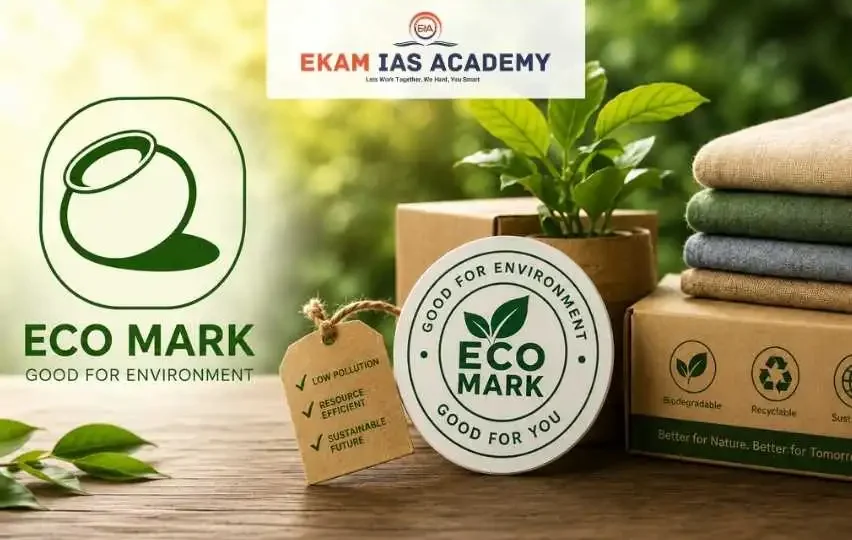
The original Ecomark Scheme was rolled out by the Government of India in 1991 as a voluntary certification system to help consumers easily identify environmentally friendly consumer goods. However, over three decades, the initiative faced low adoption rates due to complex dual-testing procedures and an evolving industrial landscape.
Background, Evolution, and Ecomark Rules 2024
To fix these structural gaps, the Ministry of Environment, Forest and Climate Change (MoEFCC) notified the official Ecomark Rules 2024 on September 26, 2024. This updated framework completely replaces the old 1991 program, modernizing the certification lifecycle, increasing transparency, and building a stronger statutory framework to prevent greenwashing.
Objectives and Institutional Framework
The upgraded framework operates with several clear operational goals:
- Preventing Greenwashing: Ensuring clear labeling to protect consumers from misleading or exaggerated environmental claims.
- Driving Resource Efficiency: Encouraging manufacturers to adopt green technologies that lower energy use and support a circular economy.
The Two-Tier Regulatory Architecture:
MoEFCC: Policy & Steering Committee Oversight
│
▼
CPCB: Primary Implementing & Granting Authority
│
▼
BIS: Standards Co-ordination & Quality Testing Baseline
Under the revised rules, the Central Pollution Control Board (CPCB) serves as the primary implementing agency responsible for verifying data, managing registrations, and granting the Ecomark. The CPCB Ecomark framework operates in close partnership with the Bureau of Indian Standards (BIS). To be eligible for the mark, a product must first hold a valid license or certificate of conformity under the BIS Ecomark Certification process or adhere to central Quality Control Orders (QCOs).
Eligibility, Certification Process, and Product Categories
To secure the eco-label, products must pass a clear verification process managed via a centralized web portal.
Environmental Criteria for Ecomark:
- Waste Minimization: The manufacturing workflow must reduce pollution by lowering emissions and waste generation.
- Circular Material Use: The product must be highly recyclable, made from recycled materials, or both.
- Resource Conservation: The process must reduce reliance on non-renewable energy and natural raw materials.
Once independent verifiers complete the cross-checks, the CPCB issues the Ecomark, which remains valid for a period of three years. To maintain accountability, companies must submit an online annual compliance report by May 31 every year.
Broad Product Categories Covered:
The scheme covers a wide range of everyday consumer goods, including:
- Soaps, detergents, and cosmetics.
- Edible oils, tea, and coffee.
- Textiles, paper, and architectural paints.
- Electrical and electronic appliances.
Significance, Benefits, and Alignment with Mission LiFE
The revamped Ecomark UPSC dimension holds immense strategic value for India’s climate goals. It is designed to act as a practical extension of Mission LiFE (Lifestyle for Environment), an initiative launched to encourage sustainable individual and collective actions. By standardizing eco-labels, the rules make it easier for consumers to choose eco-friendly items, turning sustainable consumption into a mass movement.
Key Benefits of Certification:
- Market Differentiation: Grants certified businesses a distinct competitive edge in an increasingly eco-conscious consumer market.
- Global Export Alignment: Harmonizing local standards with international frameworks allows Indian businesses to access strict western green markets more easily.
Challenges, Limitations
A persistent challenge for the updated scheme is balancing affordability with compliance. Small and Medium Enterprises (SMEs) often struggle with the compliance costs needed to re-engineer production processes and secure the required BIS Ecomark Certification. Additionally, general consumer awareness about eco-labels remains low compared to international benchmarks like the European Union’s EU Ecolabel or Germany’s Blue Angel.
Way Forward
To maximize impact, the government should look to provide target subsidies or technical support for compliance to help smaller businesses transition to green manufacturing. Alongside financial aid, launching public awareness campaigns and establishing green public procurement mandates—where government agencies give preference to Ecomark-certified products—will help secure the scheme’s long-term success.
Conclusion
The transition from the old 1991 guidelines to the Ecomark Rules 2024 represents a vital upgrade for India’s environmental policy. By assigning clear regulatory roles to the CPCB and BIS, India has built a transparent framework to verify eco-friendly products, reduce greenwashing, and support sustainable industrial growth. If backed by strong public awareness and steady industry support, this initiative will play a vital role in advancing a clean, resource-efficient, and circular economy across the nation.
UPSC Prelims: PYQs & Practice Questions
Previous Year Questions (Prelims)
UPSC CSE Prelims 2012
Q: The Ecomark is given by the Government of India to a product which is:
A. Rich in protein
B. Environment friendly
C. Economically viable
D. Pure and unadulterated
Answer: B. Environment friendly
Explanation:
The Ecomark is India's official national eco-labeling symbol. It is awarded to consumer goods that meet specific environmental criteria throughout their lifecycle — from raw material extraction and manufacturing to usage and disposal — making them less harmful to the ecosystem than comparable products.
UPSC CSE Prelims 2015
Q: With reference to the Bureau of Indian Standards (BIS), consider the following statements:
1. It is the National Standards Body of India established under an Act of Parliament.
2. It is responsible for the final granting of the Ecomark certification to eco-friendly products in India.
Which of the statements given above is/are correct?
A. 1 only
B. 2 only
C. Both 1 and 2
D. Neither 1 nor 2
Answer: A. 1 only
Explanation:
Statement 1 is correct. BIS is a statutory body established under the Bureau of Indian Standards Act. Statement 2 is incorrect under the updated framework. While BIS quality standards may provide baseline certification parameters, the Ecomark Rules 2024 designate the Central Pollution Control Board (CPCB) as the apex implementing agency responsible for issuing, managing, and granting the final Ecomark certification.
Practice Questions
Q: Under the newly notified Ecomark Rules 2024, which of the following statements accurately describes the updated institutional framework?
1. The rules completely replace the legacy 1991 scheme to target greenwashing and align with Mission LiFE objectives.
2. The Central Pollution Control Board (CPCB) acts as the primary authority to grant the Ecomark, while products must maintain valid BIS standard conformity.
3. Once granted, the Ecomark certification remains valid for a lifetime, subject to random inspections.
Select the correct answer using the code given below:
(a) 1 and 2 only
(b) 2 and 3 only
(c) 1 and 3 only
(d) 1, 2 and 3
Answer: (a) 1 and 2 only
Explanation:
Statements 1 and 2 are correct. The Ecomark Rules 2024 modernize the earlier 1991 scheme, strengthen safeguards against greenwashing, and align with Mission LiFE. The CPCB functions as the primary authority for granting the Ecomark, while products must also maintain valid BIS conformity. Statement 3 is incorrect because the Ecomark is not valid for a lifetime; it is granted for a fixed tenure of three years, with annual compliance reporting required by May 31.
Q: The structural criteria for evaluating a product under the CPCB Ecomark framework evaluates which of the following environmental parameters?
1. Use of recycled or recyclable raw materials.
2. Direct reduction in energy consumption and carbon emissions during manufacturing.
3. Complete elimination of plastic packaging for international export.
Select the correct answer using the code given below:
(a) 1 and 3 only
(b) 1 and 2 only
(c) 2 and 3 only
(d) 1, 2 and 3
Answer: (b) 1 and 2 only
Explanation:
The Ecomark evaluation framework focuses on resource conservation, waste minimization, and circular material use. Therefore, statements 1 and 2 are correct. Statement 3 is incorrect because although eco-friendly and minimal packaging is encouraged, the rules do not mandate a complete ban on plastic packaging for exports as a compulsory condition for certification.
UPSC Mains – Previous Year & Practice Questions
Mains Previous Year Questions
Mains 2024
Question: Discuss the significance of behavioral changes in achieving climate targets. How does India's Mission LiFE address this dimension?
Directly connects to how the Ecomark scheme provides the labeling infrastructure to make Mission LiFE actionable.
Mains 2022
Question: What is a circular economy? Discuss how effective plastic and e-waste management rules can accelerate India's transition toward it.
Can be linked to how Ecomark Rules prioritize products using circular and recycled materials.
Mains 2019
Question: Enumerate the major challenges faced by India in balancing industrial growth with environmental commitments under the Paris Agreement.
Mains 2016
Question: Environmental degradation cannot be tackled by state regulations alone; it requires corporate environmental accountability and green consumerism. Elaborate.
Directly maps to the core utility of eco-labeling in India.
Mains 2013
Question: What do you understand by Sustainable Development? Suggest a path forward to achieve economic growth without compromising resource availability for future generations.
Mains Practice Questions
[15 Marks | 250 Words]
Question: The revised Ecomark Rules 2024 mark a major shift from an opaque, low-adoption system to a transparent, data-driven framework. Analyze how this updated regulatory architecture can effectively counter corporate greenwashing in India.
[10 Marks | 150 Words]
Question: While eco-labeling promotes resource efficiency, the structural costs of securing BIS Ecomark Certification can create heavy compliance burdens for Small and Medium Enterprises (SMEs). Suggest policy remedies to make green certifications more accessible to smaller manufacturers.
[15 Marks | 250 Words]
Question: Analyze the potential of Green Public Procurement — where government bodies give preference to Ecomark-certified products — in creating a robust domestic market for sustainable goods in India.



Ecomark Scheme-FAQs
What are Ecomark Rules 2024?
Ecomark Rules 2024 are India’s updated eco-labelling rules notified by the Ministry of Environment, Forest and Climate Change to certify environmentally friendly products and prevent greenwashing.
What is the Ecomark Scheme in India?
The Ecomark Scheme is a voluntary certification system that helps consumers identify products that are environmentally friendly, resource-efficient, recyclable, and compliant with prescribed quality standards.
Who grants Ecomark certification in India?
Under the Ecomark Rules 2024, the Central Pollution Control Board is the primary implementing authority responsible for verifying applications, managing registrations, and granting the Ecomark.
How long is Ecomark certification valid?
Ecomark certification is valid for three years. Certified companies must also submit an annual compliance report online by May 31 every year.
Why are Ecomark Rules 2024 important for UPSC?
Ecomark Rules 2024 are important for UPSC because they connect with environment governance, greenwashing, Mission LiFE, circular economy, sustainable consumption, CPCB, BIS, eco-labelling and resource efficiency.