Table of Contents
ToggleThe Disruptive Rise of India’s New Political Generation
India’s political landscape is witnessing a major shift as young voters are no longer passive recipients of political messaging. They are actively shaping elections, influencing public discourse and redefining how politics is communicated. This new political generation is digitally connected, issue-aware and less dependent on traditional party structures.
Youth as Political Actors
From Listeners to Participants
Earlier, political communication in India was largely top-down. Leaders spoke from public platforms and citizens listened. Today, young citizens participate through social media, podcasts, memes, livestreams, online campaigns and digital communities.
This shift has created a new political language based on accessibility, humour, responsiveness and transparency.
New Political Communication
Rise of Digital Platforms
Platforms such as Instagram, YouTube and X have become major spaces for political discussion. Meme culture, satire, short videos and online commentary now influence how young people understand political events.
Political leaders who adapt to this language are able to connect better with younger voters. Those who rely only on traditional speeches and party machinery risk becoming irrelevant.
From Protest to Participation
India’s youth politics is no longer limited to campus elections or street protests. Digital mobilisation has enabled young citizens to build narratives, organise campaigns and demand accountability.
The article highlights that young voters are not necessarily anti-democratic or anti-institutional. Instead, they seek greater honesty, participation and responsiveness from political institutions.

Challenge for Political Parties
Need for Internal Reform
Political parties often speak about youth participation but rarely share real power with younger voices. The challenge is not just to attract young voters through social media, but to open leadership pathways, decentralise candidate selection and include young citizens in policy-making.
Conclusion
India’s new political generation is reshaping democracy through digital participation, political awareness and demand for accountability. Political parties that adapt to this shift will remain relevant, while those that ignore youth voices may face declining trust. For UPSC aspirants, this topic is important under democracy, political participation, youth empowerment, elections, governance and digital politics.
Vocabulary Boost
• Political Mobilisation → Organising people for political action.
• Political Socialisation → Process of developing political values.
• Decentralisation → Distribution of decision-making power.
• Participatory Democracy → Greater citizen involvement in governance.
• Digital Ecosystem → Online platforms shaping public discourse.
Frequently Asked Questions (FAQs)
What is the article mainly about?
The article discusses how India’s youth are reshaping politics through digital platforms, new communication styles and greater political participation.
Why are young voters becoming important in Indian politics?
Young voters are important because they influence elections, public opinion and political narratives through social media, memes, videos and online discussions.
How has political communication changed in India?
Political communication has shifted from traditional speeches and rallies to digital content, podcasts, livestreams, satire and interactive online engagement.
Are young voters anti-democratic?
No. The article argues that young voters are not anti-democratic; they demand transparency, accountability, participation and responsiveness from political institutions.
Why is this topic important for UPSC?
It is important for UPSC under democracy, political participation, youth empowerment, elections, governance, digital media and Indian polity.
Source From : The Hindu
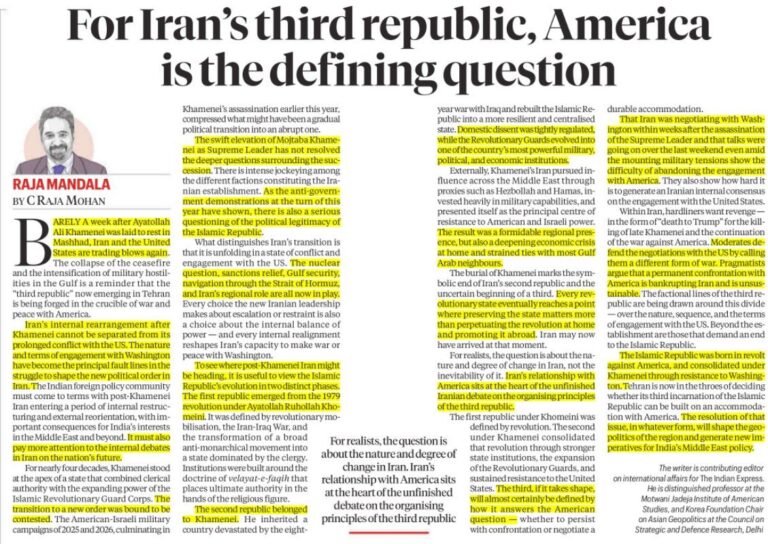
For Iran’s Third Republic, America Is the Defining Question
Iran is passing through a crucial political moment after the reported rise of Mojtaba Khamenei as Supreme Leader. The article argues that Iran’s future political direction cannot be separated from its long and difficult relationship with the United States. The central question before Iran’s emerging “third republic” is whether it will continue confrontation with America or move towards some form of negotiated accommodation.
Iran’s Political Transition
From Revolution to Uncertainty
Iran’s first republic emerged from the 1979 Islamic Revolution under Ayatollah Ruhollah Khomeini. It was shaped by revolutionary ideology, clerical authority and resistance to Western influence.
The second republic under Ali Khamenei consolidated the power of the Revolutionary Guards, expanded Iran’s regional influence and maintained a strong anti-American posture.
Now, with a new leadership phase emerging, Iran faces deeper questions about legitimacy, economic crisis, sanctions, public protests and the future of its political system.
America as the Central Question
Conflict or Engagement
The article highlights that Iran’s relationship with the United States lies at the heart of its domestic and foreign policy choices. Nuclear negotiations, sanctions relief, Gulf security, Strait of Hormuz, regional diplomacy and Iran’s economic recovery are all linked to Washington.
Hardliners may continue the politics of resistance, viewing America as a threat. Moderates and pragmatists may push for engagement, arguing that permanent confrontation has weakened Iran’s economy and global position.
Regional and Global Implications
Impact on West Asia
Iran’s future policy will directly affect West Asian geopolitics. Its ties with Hezbollah, Hamas, Iraq, Syria and Gulf countries remain central to regional stability. Any shift in Iran-U.S. relations can influence oil markets, maritime security, nuclear diplomacy and India’s energy interests.
For India, Iran remains important due to connectivity, Chabahar Port, energy security and access to Central Asia. Hence, India must carefully observe Iran’s internal transition.
Conclusion
Iran’s third republic will be shaped by how it answers the American question. A continued confrontation may deepen instability, while pragmatic engagement could open space for economic recovery and regional diplomacy. For UPSC aspirants, this topic is important under international relations, West Asia, India-Iran relations, energy security, geopolitics and global diplomacy.
Vocabulary Boost
• Political Transition → Transfer or restructuring of political power.
• Strategic Engagement → Diplomacy to advance long-term interests.
• Regional Security → Stability and peace within a region.
• Sanctions Relief → Removal of economic restrictions.
• Geopolitics → Influence of geography on international politics.
Frequently Asked Questions (FAQs)
What is the article mainly about?
The article explains how Iran’s emerging “third republic” will be shaped by its future relationship with the United States.
Why is America called the defining question for Iran?
Because Iran’s nuclear policy, sanctions relief, economy, regional strategy and domestic legitimacy are closely linked to its relations with the U.S.
What challenges does Iran face internally?
Iran faces economic crisis, sanctions pressure, public protests, legitimacy concerns and political uncertainty after leadership transition.
Why is Iran important for India?
Iran is important for India’s energy security, Chabahar Port, access to Central Asia, regional connectivity and West Asian diplomacy.
Why is this topic important for UPSC?
It is important for UPSC under international relations, West Asia geopolitics, India-Iran relations, energy security and global diplomacy.