Table of Contents
ToggleEchoes of Karbala, Iran Beyond the Shadows of War
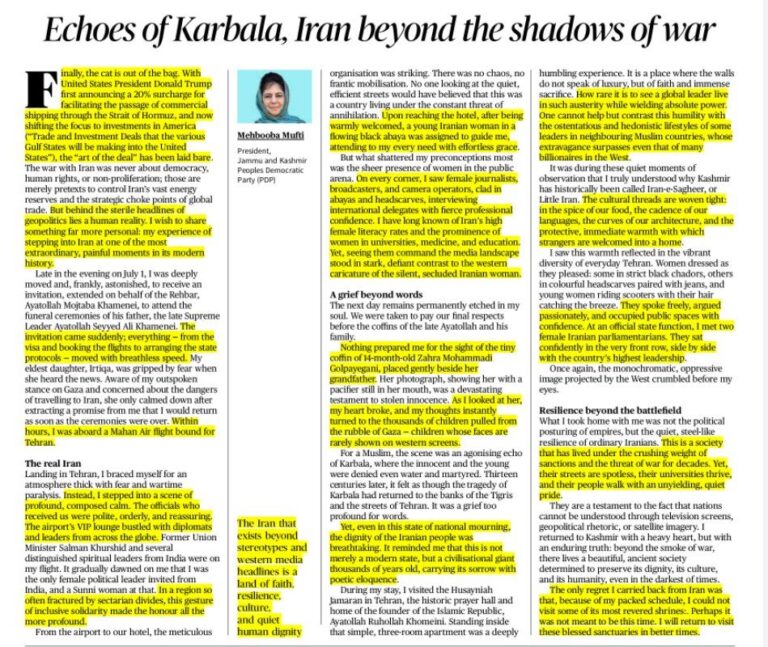
The article presents a personal account of Iran beyond the usual images of war, sanctions and geopolitical confrontation. It argues that Iran cannot be understood only through Western media narratives or strategic calculations. Beneath the shadow of conflict lies a society shaped by faith, culture, resilience, dignity and historical memory.
Iran Beyond Stereotypes
A Society of Order and Grace
The writer describes Iran as a country marked by discipline, hospitality and quiet dignity. Despite living under constant geopolitical pressure, Iranian society appears organised, calm and deeply rooted in cultural confidence.
The article challenges the common perception of Iran as only a conflict zone. It highlights the human side of the country — its people, streets, public life, religious devotion and everyday resilience.
Women and Public Life in Iran
Beyond Western Caricatures
The article also reflects on Iranian women’s presence in public spaces. It notes that women were visible as journalists, broadcasters, officials, students and professionals. This challenges oversimplified portrayals of Iranian women as voiceless or invisible.
While Iran has its own internal contradictions, the writer argues that external narratives often ignore the complexity, education and agency of Iranian women.
Karbala and Collective Memory
Symbolism of Suffering and Resistance
The reference to Karbala highlights the deep emotional and spiritual memory within Iranian society. Karbala represents sacrifice, suffering, injustice and resistance. The article connects this memory with Iran’s present-day experience of war, sanctions and external pressure.
The mourning rituals are shown not merely as religious events but as expressions of collective identity and resilience.
Lessons for India
Seeing Iran with Nuance
For India, Iran is important not only because of energy security, Chabahar Port and connectivity with Central Asia, but also because of civilisational ties and people-to-people warmth. The article suggests that India must look at Iran beyond global power politics and understand its cultural and social depth.
Conclusion
Iran’s story is not only about war, sanctions or confrontation. It is also about civilisation, resilience, faith and human dignity. For UPSC aspirants, this topic is important under international relations, West Asia, India-Iran relations, cultural diplomacy, energy security and geopolitics.
Vocabulary Boost
• Resilience → Ability to withstand adversity.
• Civilisational State → State rooted in ancient cultural continuity.
• Sectarianism → Division based on religious sects.
• Karbala → Symbol of sacrifice in Shia tradition.
• Cultural Affinity → Shared cultural and historical connections.
Frequently Asked Questions (FAQs)
What is the article mainly about?
The article presents Iran beyond war and sanctions, highlighting its culture, faith, resilience, hospitality and human dignity.
Why is Karbala important in the article?
Karbala symbolises sacrifice, suffering, resistance and collective memory, which deeply shapes Iranian society and identity.
How does the article challenge stereotypes about Iran?
It shows Iran as an organised, culturally rich and resilient society, rather than only a conflict-ridden or isolated country.
Why is Iran important for India?
Iran is important for India’s energy security, Chabahar Port, connectivity to Central Asia, civilisational ties and West Asian diplomacy.
Why is this topic important for UPSC?
It is important for UPSC under international relations, West Asia, India-Iran relations, cultural diplomacy, geopolitics and energy security.
Source From : The Hindu
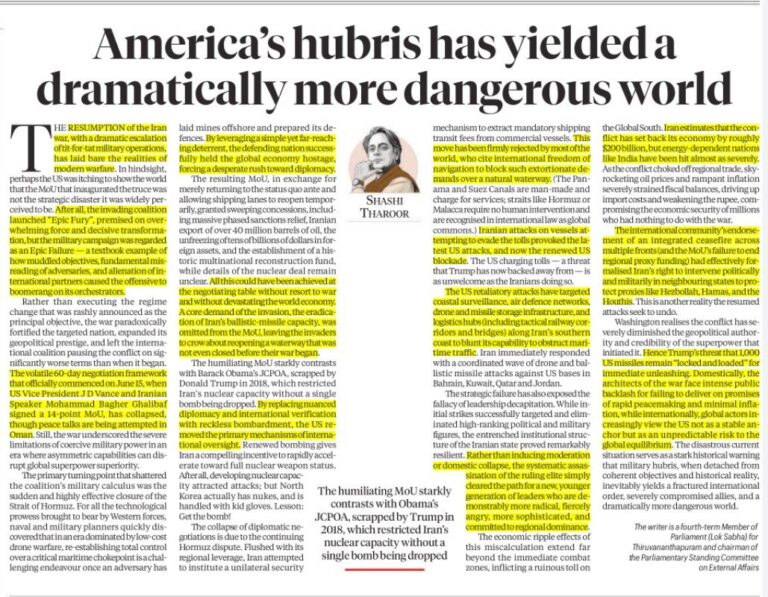
America’s Hubris Has Yielded a Dramatically More Dangerous World
The article argues that America’s military adventurism and overconfidence have made the world more unstable, especially in the context of renewed tensions with Iran. Instead of achieving strategic dominance, coercive actions have created wider insecurity, economic disruption and diplomatic setbacks.
Failure of Military Coercion
Limits of Hard Power
The article highlights that military campaigns often promise quick victory but fail to deliver long-term peace. In the Iran context, the use of force did not create a stable outcome. Rather, it deepened hostility, strengthened Iran’s resistance and exposed the limitations of American power.
The author suggests that overwhelming military superiority does not automatically translate into political success.
Iran’s Strategic Resilience
Survival Despite Pressure
Despite sanctions, military threats and international pressure, Iran has shown resilience. The article notes that Iran’s ability to withstand pressure has challenged assumptions that coercion alone can force regime change or complete surrender.
Iran’s strategic geography, especially its proximity to the Strait of Hormuz, gives it significant leverage in global energy security and maritime trade.
Global Economic Impact
Energy and Trade Disruptions
The crisis has affected oil prices, shipping routes, insurance costs and global supply chains. Energy-dependent economies, including India, face higher import costs and inflationary pressure when West Asia becomes unstable.
The article argues that conflicts in one region can create economic shocks across the world, especially for the Global South.
Decline of American Credibility
Diplomatic Consequences
The article criticises America’s abandonment of earlier diplomatic frameworks and argues that inconsistent policy weakens trust in international agreements. When diplomacy is replaced by force, global institutions and negotiated settlements lose credibility.
This creates a more fragmented and dangerous international order.
Relevance for India
India must carefully balance its relations with the United States, Iran and Gulf countries. West Asian instability affects India’s energy security, diaspora interests, trade routes and strategic connectivity through projects such as Chabahar Port.
Conclusion
The article concludes that American hubris has not produced stability. Instead, it has created a more dangerous world marked by military escalation, economic uncertainty and weakened diplomacy. For UPSC aspirants, this topic is important under international relations, West Asia geopolitics, India-Iran relations, energy security, maritime security and global governance.
Vocabulary Boost
• Hubris → Excessive pride or overconfidence.
• Coercive Diplomacy → Using threats or force to secure concessions.
• Asymmetric Warfare → Conflict between unequal military powers.
• Strategic Miscalculation → Error in assessing risks and outcomes.
• Global Commons → Shared spaces such as international sea routes.
Frequently Asked Questions (FAQs)
What is the article mainly about?
The article argues that America’s overconfidence and military actions have made the world more unstable, especially in relation to Iran and West Asia.
Why does the article criticise American foreign policy?
It criticises the U.S. for relying too much on military power instead of diplomacy, which has increased tensions and weakened global stability.
Why is Iran strategically important?
Iran is important because of its location near the Strait of Hormuz, influence in West Asia and role in global energy security.
How does West Asian instability affect India?
It affects India through higher oil prices, trade disruption, inflation, diaspora security and challenges to connectivity projects like Chabahar Port.
Why is this topic important for UPSC?
It is important under international relations, West Asia geopolitics, India-Iran relations, energy security, maritime security and global governance.