
...
Daily Current affairs 20 July 2026

Daily Current Affairs 20-July-2026

Share this Post

INDIA’S TEXTILE INDUSTRY AND GLOBAL APPAREL TRADE

TOPIC: (GS3) ECONOMY: THE HINDU

India’s textile sector, despite being one of the largest globally, has seen stagnant apparel export share compared to rapid growth in Bangladesh and Vietnam.

Global Apparel Market

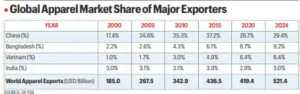
  • China’s Dominance: China’s share peaked at 37.6% in 2015, but declined to 31.9% in 2020 due to rising costs and diversification of supply chains.
  • Bangladesh & Vietnam Rise: Bangladesh grew from 2.6% (2000) to 6.9% (2020); Vietnam from 0.9% to 6.4% in the same period, driven by low costs and trade agreements.
  • India’s Stagnation: India’s share remained around 3%, despite having a fully integrated textile industry from fibre to fashion.
  • World Market Expansion: Global apparel exports rose from USD 185 billion (2000) to USD 514 billion (2020), showing opportunities India has not fully tapped.
Indias Textile Industry and Global Apparel Trade

India’s Textile Strengths

  • Integrated Value Chain:
    • India is unique in having the entire textile chain cotton cultivation, spinning, weaving, garmenting, and retail.
    • India is the largest producer of cotton (approx. 6 million tonnes annually, 23% of global output) and the secondlargest producer of polyester and silk.
    • This integration reduces dependence on imports and supports a strong domestic supply base.
  • Employment Intensity:
    • The textile and apparel sector employs ~45 million people directly and 60 million indirectly, making it the secondlargest employer after agriculture.
    • Women constitute nearly 70% of the workforce in garmenting and handloom sectors, contributing to social empowerment.
    • Accounts for ~2.3% of India’s GDP and 12% of manufacturing output.
  • Policy Support:
    • PM MITRA Parks (2021): 7 mega parks planned, expected to attract ₹70,000 crore investment and create 20 lakh jobs.
    • PLI Scheme (2021): Focus on manmade fibres and technical textiles, with ₹10,683 crore outlay.
    • RoDTEP & RoSCTL: Refunds embedded taxes to keep exports competitive.
    • Samarth Scheme: Skill development for 10 lakh workers in textiles and apparel.
  • Major Textile Centres:
    • Cotton & Spinning: Coimbatore (Tamil Nadu), Ahmedabad (Gujarat), Nagpur (Maharashtra).
    • Silk: Mysuru (Karnataka), Bhagalpur (Bihar), Murshidabad (West Bengal).
    • Woollens: Ludhiana (Punjab).
    • Handlooms: Varanasi (Uttar Pradesh), Pochampally (Telangana), Chirala (Andhra Pradesh).
    • Garments & Exports: Tiruppur (Tamil Nadu), Bengaluru (Karnataka), Noida (Uttar Pradesh).

Challenges

  • High Logistics Costs: India’s logistics costs are 13–14% of GDP, compared to 8–9% in competitors.
  • Trade Agreements: Lack of preferential trade access to EU and US markets, unlike Bangladesh (EU GSP) and Vietnam (CPTPP, RCEP).
  • Productivity Issues: Smaller factory sizes and outdated technology reduce efficiency.
  • Compliance & Sustainability: Global buyers demand ecofriendly production, where India lags behind.

Way Forward

  • FTA Negotiations: Secure trade deals with EU and UK to expand market access.
  • Infrastructure Push: Operationalise MITRA mega textile parks for scale and efficiency.
  • Skill Development: Train workers in modern apparel manufacturing and sustainability standards.
  • Innovation & Branding: Promote “Made in India” textiles with focus on design, ecofashion, and digital retail.

Government Schemes for Textile Industry

  • PM MITRA Parks: Provides worldclass infrastructure, plugandplay facilities, and aims to attract ₹70,000 crore investment and generate 20 lakh jobs.
  • Production Linked Incentive (PLI) Scheme: Focuses on manmade fibres (MMF) and technical textiles. Expected to bring in ₹19,000 crore investment and enhance exports.
  • RoDTEP & RoSCTL Schemes: Remission of Duties and Taxes on Exported Products (RoDTEP) and Rebate of State and Central Taxes and Levies (RoSCTL) reduce cost burdens on exporters.
  • Samarth Scheme: A skill development initiative to train 10 lakh workers in textile and apparel sectors. Focuses on women, rural youth, and weaker sections to enhance employability in garment manufacturing.

Conclusion:

India’s textile sector must transform from costbased competition to innovationdriven exports, ensuring it captures a larger share of the expanding global apparel market.

RBI’S MONETARY POLICY

TOPIC: (GS3) ECONOMY: THE HINDU

The Reserve Bank of India’s Monetary Policy Committee (MPC) has decided to keep the repo rate unchanged at 6.25%, maintaining a neutral stance.

What is Monetary Policy Committee (MPC)

  • The Monetary Policy Committee (MPC) is India’s statutory body within the Reserve Bank of India (RBI) that decides the country’s benchmark interest rate (repo rate) to manage inflation and support economic growth.
  • It was created in 2016 under amendments to the RBI Act, 1934, to bring transparency and collective decisionmaking in monetary policy.

Inflation Trends

  • Headline Inflation: Projected at 5.6% in H2 2026, up from 4.6% in H1, driven by food and manufactured goods.
  • Core Inflation: Sustained low levels suggest weak demand pressures despite RBI’s optimism on consumption.
  • Manufactured Products: Prices rose by 1.5% in Q1, reflecting costpush factors.

Composition of MPC

  • Members: Six members three from RBI (including the Governor as Chairperson) and three external experts nominated by the Government of India.
  • Voting: Decisions are taken by majority vote; the RBI Governor has a casting vote in case of a tie.
  • Tenure: External members serve for four years and are not eligible for reappointment immediately.

Role and Functions

  • Inflation Targeting: Current mandate: maintain 4% CPI inflation with a tolerance band of 2%–6% (till March 2026).
  • If inflation stays outside this band for three consecutive quarters, RBI must explain reasons, corrective steps, and timeline to the Government.
  • Repo Rate Decisions: MPC fixes the repo rate, which influences borrowing costs, liquidity, and overall demand in the economy.
  • Meeting Frequency: Meets at least four times a year (once every quarter). Decisions are published with individual member statements for transparency.
  • Balancing Growth & Stability: Ensures price stability while keeping in mind growth objectives a dual mandate.

Growth Outlook

  • GDP Forecast: RBI expects growth to slow from 7.2% (202223) to 6.6% (202324), citing resilience but acknowledging moderation.
  • Private Consumption: RBI highlights resilience, but subdued inflation indicates demand weakness.
  • Investment Trends: Fixed investment shows momentum, yet corporate investment in new projects has declined, lowering the investmenttoGDP ratio.

Three Stances of Monetary Policy

Accommodative Stance:

    • Adopted when the MPC wants to support growth.
    • Repo rate may be reduced or kept low to encourage borrowing, investment, and consumption.
    • Example: During the COVID19 pandemic (2020), RBI cut repo rate to 4% to stimulate demand.

Neutral Stance:

    • Indicates flexibility MPC can either raise or cut rates depending on inflation and growth trends.
    • Neither strongly progrowth nor antiinflation, but balanced.
    • Example: In 2024–25, RBI maintained a neutral stance while inflation was moderate but growth showed signs of slowing.

Hawkish (Tightening) Stance:

    • Focused on controlling inflation even if growth slows.
    • Repo rate is raised to reduce liquidity and demand.
    • Example: In 2022–23, RBI raised repo rate multiple times (up to 6.5%) to curb inflation after global commodity price shocks.

Conclusion:

RBI’s cautious stance reflects the delicate balance between inflation control and growth support, underscoring the complexity of monetary policy in a globally interconnected economy.

INDIA’S DYSLIPIDEMIA BURDEN

TOPIC: (GS2) POLITY: THE HINDU

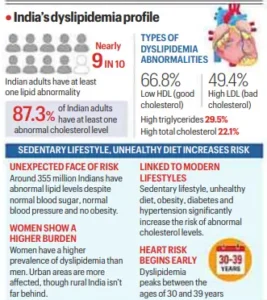
A recent study has revealed that nearly 9 out of 10 Indian adults suffer from at least one lipid abnormality. Low levels of HDL (good cholesterol) are the most common issue, raising concerns about cardiovascular health.

Key Findings

  • Prevalence: Around 87.3% of Indian adults have abnormal cholesterol levels.
  • Profile:
    • Low HDL: 66.8%
    • High LDL: 49.4%
    • High Triglycerides: 28.5%
    • High Total Cholesterol: 22.1%
  • Population Impact: Nearly 353 million Indians are affected, with higher prevalence among women and younger adults (30–39 years).
Indias Dyslipidemia Burden

Causes and Risk Factors

  • Lifestyle: Sedentary habits and lack of physical activity.
  • Diet: High intake of processed foods, trans fats, and low consumption of fruits/vegetables.
  • Genetics: Family history of lipid disorders increases risk.
  • Urbanization: Rapid lifestyle changes in cities contribute to rising cases.

Public Health Implications

  • Cardiovascular Disease: Dyslipidemia is a major risk factor for heart attacks, strokes, and hypertension.
  • Economic Burden: Rising healthcare costs due to chronic disease management.
  • Policy Linkages: Aligns with National Health Policy 2017 and Ayushman Bharat focus on noncommunicable diseases (NCDs).

Way Forward

  • Awareness Campaigns: Promote healthy diets and physical activity through national programmes.
  • Screening: Regular lipid profile checks, especially for highrisk groups.
  • Preventive Health: Integrate lifestyle counselling in Health and Wellness Centres.
  • Global Comparison: India’s prevalence is higher than many countries, highlighting urgent need for intervention.

Conclusion:

Dyslipidemia has emerged as a silent epidemic in India, demanding lifestyle changes, preventive care, and policy focus to safeguard cardiovascular health.

RIVER REVIVAL PLANS IN CHHATTISGARH

TOPIC: (GS3) ENVIRONMENT: THE HINDU

The Chhattisgarh government has initiated geotagging of river origin points and prepared districtwise River Revival Plans. This effort aims to restore rivers like Hasdeo, Shivnath, and Kharun, with scientific monitoring and institutional support.

Key Features of the Initiative

  • Geotagging of Origins: Mapping river sources to monitor discharge, groundwater levels, and water quality.
  • Scientific Support: Technical expertise from IIT Roorkee and NIT Raipur for hydrological studies.
  • District Plans: Each district prepares tailored strategies for river restoration.
  • Legal Oversight: Chhattisgarh High Court and State Level Committee ensure accountability and compliance.

Objectives

  • Pollution Control: Reduce industrial effluents and urban sewage entering rivers.
  • Groundwater Recharge: Improve aquifer levels by reviving natural flow.
  • Community Participation: Involve local communities in monitoring and conservation.
  • Sustainable Development: Align river revival with climate resilience and biodiversity protection.

Broader Significance

  • Environmental Angle: Healthy rivers support ecosystems, fisheries, and agriculture. Links to SDG6 (Clean Water) and SDG15 (Life on Land).
  • Economic Impact: Revived rivers enhance irrigation, drinking water supply, and tourism potential.
  • Policy Linkages: Connects with National River Conservation Plan (NRCP) and Namami Gange Mission.
  • Comparative Example: Similar to Thames River revival in UK and Rhine restoration in Europe, showing global best practices.

Causes of River Pollution

  • Urban Sewage: 70–80% of river pollution comes from untreated municipal wastewater.
  • Industrial Effluents: Textile, paper, chemical, and tannery industries discharge toxic waste.
  • Agricultural Runoff: Fertilizers and pesticides contaminate rivers, raising nitrate levels.
  • Solid Waste: Dumping of plastics and garbage worsens water quality.

RIVER POLLUTION IN INDIA

Extent of Pollution:

    • 296 polluted stretches identified in 2025 across 271 rivers.
    • Improvement from 351 stretches in 2018, showing partial success of river rejuvenation efforts.

Critical Stretches:

    • 37 Priority I stretches (most polluted, BOD > 30 mg/L).
    • Examples: Yamuna (Delhi), Sabarmati (Gujarat), Musi (Hyderabad), Chambal (Madhya Pradesh).

State Data:

    • Maharashtra: 54 polluted stretches (highest).
    • Kerala: 31 stretches.
    • Madhya Pradesh: 18 stretches.

Monitoring Network:

    • CPCB monitors water quality at 4,922 locations, including 2,260 river sites.
    • Biochemical Oxygen Demand (BOD) is the key parameter used to classify pollution.

Key Initiatives

  • Namami Gange Mission: Flagship programme launched in 2014 to rejuvenate the Ganga and its tributaries through sewage treatment plants, riverfront development, and afforestation.
  • National River Conservation Plan (NRCP): Covers rivers beyond the Ganga, funding pollution abatement projects like interception and diversion of drains.
  • River Rejuvenation Committees (RRCs): Mandated by NGT in 2018, requiring states to prepare action plans for polluted river stretches with districtlevel monitoring.
  • AMRUT & Smart Cities Mission: Urban sewerage and drainage projects reduce untreated sewage entering rivers, integrating riverfront development.

Conclusion:

Chhattisgarh’s river revival initiative demonstrates how science, governance, and community action can converge to restore lifelines of ecology and economy.

KEN–BETWA LINK PROJECT

TOPIC: (GS1) GEOGRAPHY: THE HINDU

The Ken–Betwa Link Project has triggered protests in Madhya Pradesh, where activists demand fair compensation and rehabilitation. Police recently detained protest leader Amit Bhatnagar, who was on a 14day fast, along with several demonstrators.

Project Overview

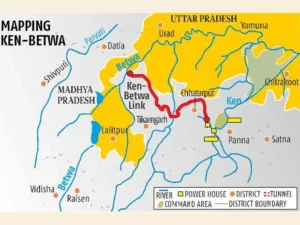
  • Ken–Betwa Link: First river interlinking project under the National Perspective Plan.
  • Objective: Transfer surplus water from Ken River (Madhya Pradesh) to Betwa River (Uttar Pradesh) for irrigation, drinking water, and hydropower.
  • Scale: Estimated cost ₹44,605 crore; aims to irrigate 10.6 lakh hectares, provide drinking water to 62 lakh people, and generate 103 MW hydropower.
Ken-Betwa Link Project

Protest Issues

  • Land Acquisition: Farmers allege irregularities in compensation and rehabilitation packages.
  • Environmental Concerns: Project may submerge parts of Panna Tiger Reserve, affecting biodiversity.
  • Social Impact: Displacement of local communities without adequate resettlement.
  • Legal Oversight: High Court and committees monitoring compliance with environmental and social safeguards.

Government Stand

  • Development Benefits: Project seen as crucial for Bundelkhand region, which faces chronic droughts.
  • Policy Linkages: Part of India’s larger river interlinking programme to address water scarcity.
  • Institutional Support: Implemented by National Water Development Agency (NWDA) with state governments.

Way Forward

  • Integrated Planning: Mandate Environmental Impact Assessments (EIA) and GIS mapping before approving large projects to avoid ecological damage.
  • Sustainable Infrastructure: Promote ecofriendly construction and renewable energy; India targets 500 GW renewable capacity by 2030.
  • Community Participation: Empower local communities in conservation and rehabilitation, as seen in Joint Forest Management (JFM).
  • Technology & Innovation: Use AI, sensors, and bioremediation for pollution control; example: realtime monitoring in Namami Gange Mission.
  • Policy & Legal Framework: Strengthen compliance with Wildlife Protection Act, Environment Protection Act, and NGT directives.
  • Global Best Practices: Learn from Thames River revival (UK) and Rhine restoration (Europe) to replicate successful models in India.

RIVER LINKING PROJECT:

A largescale water management initiative that connects rivers through canals, reservoirs, and dams to transfer water from surplus basins to deficit basins.

  • Objective: Ensure equitable distribution of water for irrigation, drinking, hydropower, and flood control.
  • Implemented under the National Perspective Plan (1980) by the National Water Development Agency (NWDA).

India’s Plans

  • India envisions 30 major river link projects, divided into Himalayan and Peninsular components.
  • Aim: Address recurring droughts, floods, and regional water imbalances.
  • Priority links are being fasttracked with central and state cooperation.

Examples:

  • Godavari–Krishna Link: Transfers surplus water from Godavari basin to Krishna basin.
  • Par–Tapi–Narmada Link: Planned in Gujarat and Maharashtra.

Conclusion:

The Ken–Betwa project reflects India’s development–environment dilemma, where water security goals must be balanced with ecological protection and social justice.

INDIA’S NUCLEAR ENERGY EXPANSION AND URANIUM SUPPLY CHALLENGES

TOPIC: (GS3) ECONOMY: THE HINDU

India plans to expand its nuclear power capacity to 100 GWe by 2047, but domestic uranium reserves are insufficient. Recent discussions highlight the need for international uranium imports and strategic partnerships to fuel this ambition.

Domestic Uranium Reserves

  • Resource Base: India has about 4.34 lakh tonnes of uranium oxide reserves spread across seven states (Jharkhand, Andhra Pradesh, Meghalaya, Rajasthan, Chhattisgarh, Karnataka, Telangana).
  • Current Requirement: For existing 21 reactors (7 GWe capacity), annual uranium demand is 2.4 GWe equivalent.
  • Deficit: Domestic production meets only part of the requirement, leading to reliance on imports.

International Partnerships

  • Australia: Civil nuclear cooperation agreement signed in 2014, supplies uranium for Indian reactors.
  • Kazakhstan & Uzbekistan: Longterm contracts for uranium imports.
  • Canada: Came into effect after India joined the NSG waiver (2008).
  • Russia: Assists in building reactors (Kudankulam) and supplies uranium fuel.

Strategic Importance

  • Energy Security: Nuclear power is crucial for reducing dependence on coal and meeting climate commitments.
  • Climate Goals: Supports India’s pledge for netzero emissions by 2070.
  • Base Load Power: Provides reliable electricity compared to intermittent renewables.

Challenges

  • Import Dependence: Heavy reliance on foreign suppliers raises strategic vulnerability.
  • Environmental Concerns: Mining in states like Jharkhand faces opposition due to displacement and ecological risks.
  • Technology Limitations: India’s threestage nuclear programme (PHWR → Fast Breeder → Thorium reactors) is still evolving.
  • Global Politics: Access to uranium depends on India’s diplomatic relations and NSG membership debates.

What is Uranium?

Uranium is a naturally occurring radioactive metal, crucial for nuclear energy and defence. In India, uranium is classified as a “Prescribed Substance” under the Atomic Energy Act, 1962, and its mining is strictly regulated by the government.

India has limited reserves, concentrated mainly in Jharkhand and Andhra Pradesh, and supplements domestic production with imports from countries like Australia, Kazakhstan, and Canada.

Isotopes:

    • U238 (99.27%): nonfissile, cannot sustain chain reactions directly.
    • U235 (0.72%): fissile, sustains nuclear chain reactions, used in reactors and weapons.

Uses:

    • Fuel for nuclear power plants (Pressurised Heavy Water Reactors in India).
    • Raw material for nuclear weapons.
    • Medical isotopes and scientific research.

Important Uranium Mines in India

  • Jaduguda Mine, Jharkhand: India’s first uranium mine, operational since 1967.
  • Narwapahar & Bhatin Mines, Jharkhand: Part of the Singhbhum belt managed by Uranium Corporation of India Ltd (UCIL).
  • Turamdih & Banduhurang Mines, Jharkhand: Banduhurang is India’s first opencast uranium mine.
  • Tummalapalle Mine, Andhra Pradesh: Located in Kadapa district, one of the world’s largest uranium reserves.

Conclusion:

India’s nuclear future hinges on balancing domestic resource development with global uranium partnerships, ensuring energy security while meeting climate goals.

NATIONAL MARITIME HERITAGE COMPLEX AT LOTHAL

TOPIC: (GS1) INDIAN ART AND CULTURE: INDIAN EXPRESS

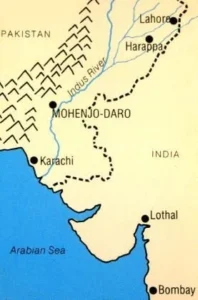
The Government of India is building a National Maritime Heritage Complex (NMHC) near Lothal, Gujarat, with a lifesize recreation of a Harappan town.

Features of the Complex

  • Recreation of Harappan Town: Streets, dockyards, civic spaces, and markets will be reconstructed to give visitors an immersive experience of the Indus Valley Civilization.
  • Museums and Galleries: First phase worth ₹775 crore includes six museums, galleries, and maritime artifacts spanning ancient to modern times.
  • Modern Attractions: Lighthouse museum, 5D theatre, children’s galleries, promenades, ecoresorts, and interactive exhibits.
  • Educational Value: Combines archaeology with maritime history, offering insights into trade, shipbuilding, and cultural exchanges of Harappans.
National Maritime Heritage Complex at Lothal  Significance for India

  • Cultural Heritage: Highlights India’s maritime legacy, connecting ancient Harappan dockyards with modern naval strength.
  • Tourism Boost: Expected to attract domestic and international tourists, strengthening Gujarat’s cultural tourism profile.
  • Economic Angle: Supports local employment, ecoresorts, and heritagebased economy.
  • Global Context: Comparable to maritime heritage centres in Athens, Alexandria, and Venice, positioning India on the global heritage map.
  • UPSC Linkages: Connects with Maritime India Vision 2030, SAGAR doctrine, and UNESCO heritage preservation goals.


Lothal Site Features

Dockyard:

    • The most famous structure at Lothal is its rectangular dockyard (214 × 36 m), connected to the Sabarmati river through channels.
    • It is considered one of the world’s earliest dockyards, showing Harappans’ advanced maritime trade.

Town Planning:

    • The settlement was divided into citadel and lower town, with gridpattern streets and drainage systems.
    • Houses were built with mud bricks, often with private wells and bathing platforms.

Industrial Area:

    • Evidence of beadmaking workshops, shellworking, and metallurgy.
    • Lothal was a major centre for semiprecious stone beads (carnelian, agate), exported to Mesopotamia.

Artifacts:

    • Discovery of seals, weights, terracotta figurines, and pottery.
    • Unique cylinder seals indicate trade links with West Asia.
    • Presence of rice husk remains shows agricultural diversity beyond wheat and barley.

Burial Practices:

    • Evidence of joint burials (male and female together), suggesting social or ritual significance.

Conclusion:

The NMHC at Lothal will be a living bridge between India’s Harappan past and maritime future, reinforcing cultural pride and global recognition.

NATIONAL COMMISSION FOR MINORITIES (NCM)

TOPIC: (GS2) POLITY: THE HINDU

The Centre has appointed Harjit Singh Grewal as the new Chairperson of the National Commission for Minorities (NCM). This highlights the role of NCM in protecting and promoting the welfare of minority communities in India.

Origin and Background

  • Establishment: Set up in 1978 as Minorities Commission.
  • Statutory Status: Became a statutory body under the National Commission for Minorities Act, 1992.
  • Ministry: Functions under the Ministry of Minority Affairs.

Minority Communities Notified

  • Initially: Muslims, Christians, Sikhs, Buddhists, Parsis (Zoroastrians).
  • Later: Jains (2014 notification).

Composition

  • Structure: Chairperson, ViceChairperson, and five Members.
  • Nomination: Appointed by the Central Government from eminent persons.
  • Representation: At least five members, including Chairperson, must belong to minority communities.
  • Tenure: Three years.

Functions

  • Advisory Role: Guides Centre and states on minority welfare policies.
  • Monitoring Safeguards: Reviews constitutional and legal protections for minorities.
  • Complaint Redressal: Investigates cases of rights deprivation and discrimination.
  • Research & Studies: Conducts socioeconomic and educational studies on minority issues.
  • Recommendations: Suggests measures for effective implementation of safeguards.
  • Reports: Submits periodic and special reports to the Government of India.

Conclusion:

The NCM acts as a watchdog for minority rights, ensuring inclusive governance and strengthening India’s democratic fabric.

Write a Review

Your email address will not be published. Required fields are marked *

Seraphinite AcceleratorOptimized by Seraphinite Accelerator
Turns on site high speed to be attractive for people and search engines.