Table of Contents
ToggleConstituent Assembly
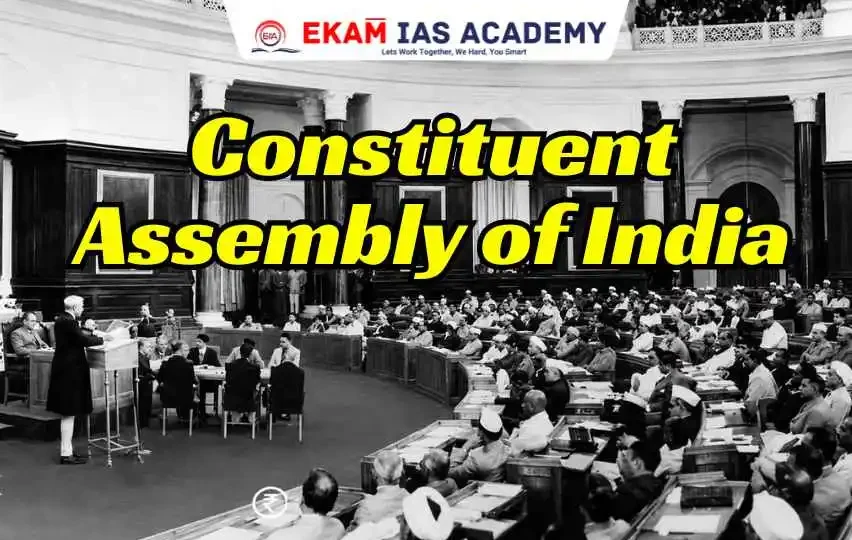
The Constituent Assembly of India remains the founding sovereign body responsible for the Framing of Indian Constitution. For civil services aspirants, mastering Constituent Assembly Notes is essential for Constituent Assembly UPSC preparation, as it covers the Making of Indian Constitution and foundational historical developments in Indian Polity Notes.
What is the Constituent Assembly
The Constituent Assembly was a representative body indirectly elected by the provincial legislative assemblies to draft a constitution for independent India. First proposed by M.N. Roy in 1934, it served as India’s first interim parliament during the Constitution Making Process.
Formation of the Constituent Assembly
The Formation of Constituent Assembly took place under the Cabinet Mission Plan 1946:
- Composition of Constituent Assembly: Total strength was set at 389 members (296 for British India, 93 for Princely States).
- Constituent Assembly Members: Seats were allocated based on population, divided among Muslims, Sikhs, and General categories through proportional representation.
Important Sessions of the Constituent Assembly
- First Meeting: Held on December 9, 1946; Dr. Sachchidananda Sinha served as temporary President.
- Dr. Rajendra Prasad: Elected permanent President on December 11, 1946.
- Objectives Resolution: Moved by Jawaharlal Nehru on December 13, 1946, setting forth the philosophy of the Constitution (adopted January 22, 1947).
Major Committees of the Constituent Assembly
The Assembly appointed eight major committees to draft specific provisions:
- Union Powers Committee (Jawaharlal Nehru)
- Steering Committee (Dr. Rajendra Prasad)
- Provincial Constitution Committee (Sardar Patel)
Drafting Committee
Chaired by Dr B R Ambedkar Constituent Assembly, the 7-member Drafting Committee was appointed on August 29, 1947. It synthesized recommendations from various committees to prepare the initial legal draft.
Key Features of the Constitution Framed
- Lengthiest written constitution balancing rigidity and flexibility.
- Establishment of a secular, democratic republic featuring universal adult franchise.
Contributions of the Constituent Assembly
Enacted national symbols, adopted the National Flag (July 22, 1947), and ratified Commonwealth membership (May 1949).
Criticism of the Constituent Assembly
Critics argued it was not a fully representative body due to indirect elections, was dominated by the Congress party, and was a “lawyer-politician dominated” assembly.
Significance of the Constituent Assembly
The Constituent Assembly Debates provided invaluable insights into legislative intent, establishing a robust framework for democratic governance.
Timeline of the Constituent Assembly
- 1934: Idea suggested by M.N. Roy.
- Dec 9, 1946: First sitting.
- Nov 26, 1949: Constitution adopted (takes 2 years, 11 months, 18 days).
- Jan 26, 1950: Full enforcement.
Conclusion
Studying the History of Constituent Assembly clarifies how democratic values were embedded in the Constituent Assembly Indian Constitution, making it an indispensable topic for polity preparation.
UPSC Prelims: PYQs & Practice Questions
Previous Year Questions (Prelims)
Q: Who was the Provisional President of the Constituent Assembly before Dr. Rajendra Prasad took over?
(a) C. Rajagopalachari
(b) Dr. B.R. Ambedkar
(c) T.T. Krishnamachari
(d) Dr. Sachchidananda Sinha
Answer: (d) Dr. Sachchidananda Sinha
Explanation:
The Constituent Assembly held its first meeting on
9 December 1946. Following the French convention of appointing the oldest member as the temporary presiding officer,
Dr. Sachchidananda Sinha was appointed as its provisional President.
On 11 December 1946, Dr. Rajendra Prasad was elected as the permanent President of the Constituent Assembly.
Q: With reference to the Indian Constituent Assembly, consider the following statements:
1. The scheme for the Constituent Assembly was formulated under the Cabinet Mission Plan, 1946.
2. The members of the Constituent Assembly were directly elected by the people of India on the basis of universal adult franchise.
Which of the statements given above is/are correct?
(a) 1 only
(b) 2 only
(c) Both 1 and 2
(d) Neither 1 nor 2
Answer: (a) 1 only
Explanation:
Statement 1 is correct. The Constituent Assembly was constituted in
November 1946 under the scheme formulated by the
Cabinet Mission Plan, 1946.
Statement 2 is incorrect. The Constituent Assembly was a
partly elected and partly nominated body. Representatives of British Indian provinces were indirectly elected by the provincial legislative assemblies through proportional representation, while representatives of the Princely States were nominated by their rulers.
Practice Questions
Q: Which of the following functions were performed by the Constituent Assembly of India in addition to drafting the Constitution?
1. Ratification of India’s membership in the Commonwealth
2. Adoption of the National Flag and National Anthem
3. Enactment of ordinary laws as India’s provisional Parliament
Select the correct answer using the code given below:
(a) 1 and 2 only
(b) 2 and 3 only
(c) 1 and 3 only
(d) 1, 2 and 3
Answer: (d) 1, 2 and 3
Explanation:
Apart from framing the Constitution, the
Constituent Assembly also performed several legislative and symbolic functions.
It ratified India’s membership in the Commonwealth in May 1949, adopted the
National Flag on 22 July 1947, and adopted the
National Anthem and recognized the National Song on 24 January 1950.
The Assembly also functioned as the
provisional Parliament of India and enacted ordinary laws. Its legislative proceedings were presided over by
G.V. Mavlankar.
Q: Consider the following pairs of Committees of the Constituent Assembly and their respective Chairmen:
1. Steering Committee — Dr. Rajendra Prasad
2. Provincial Constitution Committee — Sardar Vallabhbhai Patel
3. Union Powers Committee — Jawaharlal Nehru
Which of the pairs given above is/are correctly matched?
(a) 1 and 2 only
(b) 2 and 3 only
(c) 1 and 3 only
(d) 1, 2 and 3
Answer: (d) 1, 2 and 3
Explanation:
All three pairs are correctly matched.
The Steering Committee was chaired by
Dr. Rajendra Prasad.
The Provincial Constitution Committee was chaired by
Sardar Vallabhbhai Patel.
The Union Powers Committee was chaired by
Jawaharlal Nehru.
These committees were constituted to divide the complex work of constitution-making among specialized bodies.
UPSC Mains – Previous Year & Practice Questions
Mains Previous Year Questions
[15 Marks | 250 Words]
Question: Analyze the role of the Drafting Committee headed by Dr. B.R. Ambedkar in synthesizing different socio-political visions into the Indian Constitution. (UPSC CSE Mains 2022, GS Paper II)
[10 Marks | 150 Words]
Question: Discuss the significance of the Objectives Resolution moved by Jawaharlal Nehru in 1946 and explain how its principles are reflected in the Preamble. (UPSC CSE Mains 2018, GS Paper II)
[15 Marks | 250 Words]
Question: Evaluate the criticism that the Constituent Assembly was not a fully representative body. How far did its extensive debates and deliberations compensate for the absence of direct election? (UPSC CSE Mains 2016, GS Paper II)
[10 Marks | 150 Words]
Question: “The Indian Constituent Assembly functioned both as a constitution-making body and as a provisional Parliament.” Discuss the dual role performed by the Assembly. (UPSC CSE Mains 2014, GS Paper II)
[15 Marks | 250 Words]
Question: To what extent did the Constituent Assembly incorporate features from the Government of India Act, 1935, while maintaining an original democratic and constitutional vision? (UPSC CSE Mains 2013, GS Paper II)
Mains Practice Questions
[15 Marks | 250 Words]
Question: “The Constituent Assembly Debates serve as an indispensable tool for the judicial interpretation of constitutional provisions.” Discuss with relevant judicial precedents and legal examples.
[15 Marks | 250 Words]
Question: Examine the mechanisms adopted by the Constituent Assembly to accommodate diverse regional, linguistic and minority concerns during the constitution-making process.
[10 Marks | 150 Words]
Question: Critically analyze the major criticisms levelled against the Constituent Assembly, particularly with regard to its duration, expenditure and party representation.



Constituent Assembly-FAQs
What was the Constituent Assembly of India?
The Constituent Assembly of India was the representative body that drafted and adopted the Constitution of India.
When was the first meeting of the Constituent Assembly held?
The first meeting was held on December 9, 1946, with Dr. Sachchidananda Sinha as temporary President.
Who was the permanent President of the Constituent Assembly?
Dr. Rajendra Prasad was elected as the permanent President on December 11, 1946.
Who chaired the Drafting Committee?
Dr. B. R. Ambedkar chaired the Drafting Committee, which was appointed on August 29, 1947.
Why is the Constituent Assembly important for UPSC?
It is important because it explains the making of the Constitution, major committees, debates, constitutional values and the foundation of Indian Polity.