

Daily Current Affairs 29-July-2026

Share this Post

SUPREME COURT ON STUDENT PROTESTS AND CIVIL LIBERTIES

TOPIC: (GS2) SOCIAL JUSTICE AND HEALTH: THE HINDU

The Supreme Court of India directed the release of minors detained during recent student protests. The Court also considered an independent probe into police excesses, stressing accountability and fair investigation.

Judicial Observations

  • Chief Justice Surya Kant stated: “Whosoever has committed excess, committed atrocities on innocent people, the law will take care of them.”
  • Emphasised that probes must be independent and meaningful, with responsibility fixed.
  • Directed police to avoid coercive action against students while allowing states to continue lawful investigations.

Right to Protest – Constitutional Context

  • Article 19(1)(a) and 19(1)(b) guarantee freedom of speech and peaceful assembly.
  • Courts have repeatedly upheld protest as a democratic tool but stressed it must remain nonviolent.
  • Justice Joymalya Bagchi highlighted that state convenience cannot override citizens’ rights.

Concerns on Police Action

  • Allegations of excessive force and arbitrary detentions during protests.
  • Judiciary underscored need for proportional response in crowd control.
  • Recommended standardised procedures for handling protests, including documentation and independent inquiries into serious injuries.

Accountability Measures

  • Independent investigation mechanisms to ensure fairness and transparency.
  • Importance of fixing responsibility on officials for excesses.
  • Suggested use of technology and video documentation for crowd management.

Broader Significance

  • Reinforces judiciary’s role in safeguarding civil liberties.
  • Highlights balance between law and order and democratic freedoms.
  • Sets precedent for protecting minors and vulnerable groups during mass movements.
  • Encourages trust in institutions by ensuring accountability in governance.

Conclusion:

The Supreme Court’s directive on student protests reaffirms that democracy thrives when rights are protected and accountability enforced, ensuring justice even in times of dissent.

POLICE RESPONSE TO PROTESTS AND CIVIL LIBERTIES

TOPIC: (GS1) SOCIAL ISSUES: THE HINDU

Recent student and political protests have reignited debate on police use of force and accountability. Data from the Status of Policing in India Report 2025 and NCRB statistics highlight public perceptions and institutional challenges.

Public Perceptions of Police Action

  • Use of Force: 26% strongly agree police should use force without fear of punishment. 45% somewhat agree, while 26% disagree.
  • Arrest Powers: 79% support police detaining suspects without prior court investigation.
  • Friendly Policing: 41% consider it very important that police act as a friendly force, not instill fear.

Crime Control Measures – Police Views

  • Foot Patrols: 48% police personnel rated them very useful.
  • CCTV & Surveillance: 46% found them highly effective.
  • Increasing Manpower: 44% supported more personnel and stations.
  • Indicates preference for visible presence and technologydriven monitoring.
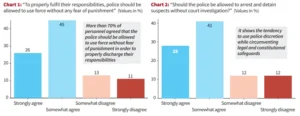
Police Response to Protests and civil Liberties

Data on Protest Injuries

  • Civilians injured during riots/protests:
    • 2020: 76%
    • 2021: 70%
    • 2022: 20%
    • 2023: 22%
    • 2024: 24%
  • Shows declining trend postpandemic, but concerns remain about excessive force.

Judicial and Constitutional Context

  • Article 19: Guarantees freedom of speech and peaceful assembly.
  • Courts emphasise protests as a democratic right, but must remain nonviolent.
  • Judiciary has stressed proportional response and accountability in crowd control.

Challenges

  • Balancing Rights and Order: Police must maintain public order while respecting constitutional freedoms under Article 19, often creating tension.
  • Absence of Standard Protocols: India lacks uniform guidelines for crowd control, leading to inconsistent practices across states.
  • Independent Oversight: Serious injuries during protests require impartial inquiries to ensure accountability.
  • Public Trust Deficit: Allegations of bias and excessive force erode citizens’ confidence in law enforcement agencies.

Significance

  • State vs Citizen Rights: Demonstrates the delicate balance between government authority and democratic freedoms.
  • Demand for Accountability: Reinforces the need for transparent policing practices and stronger accountability frameworks.
  • Modernisation of Policing: Encourages adoption of technology, documentation, and communitybased policing to reduce confrontation and build trust.

Conclusion:

Effective policing must balance public order with democratic freedoms, ensuring accountability and trust while respecting the constitutional right to protest.

BEYOND NATIONAL INTEREST IN GLOBAL POLITICS

TOPIC: (GS4) ETHICS: THE HINDU

Recent debates on the Israel–Palestine conflict and global protests have highlighted how ethics and collective emotions shape foreign policy decisions. 

Traditional View of International Relations

  • Dominated by realism and power politics: focus on military strength, deterrence, balance of power, and national interest.
  • Common vocabulary in diplomacy: strategic autonomy, security, alliances.
  • Often sidelines ethical and humanitarian considerations.

Influence of Western Traditions

  • Western intellectual traditions shaped modern IR theory.
  • Emphasis on realism and state sovereignty.
  • Liberal traditions introduced ideas of human rights, democracy, and collective security.
  • Example: PostWorld War II institutions like UN, NATO reflected both strategic and ethical concerns.

Political Legitimacy in Global Affairs

  • Legitimacy is not only about state power but also about public acceptance and moral justification.
  • Protests worldwide (e.g., solidarity marches for Palestine) show how citizen emotions influence foreign policy debates.
  • Governments risk losing credibility if policies ignore ethical dimensions.

Ethical Concerns in Globalisation

  • Globalisation has raised questions of equity, justice, and fairness.
  • Economic integration often benefits elites, while marginalised groups face exploitation.
  • Ethical debates include:
    • Climate justice – responsibility of developed nations.
    • Humanitarian interventions – balancing sovereignty with human rights.
    • Technology and AI governance – ensuring fairness and accountability.

Contemporary Relevance

  • Israel–Palestine conflict shows how public emotions and moral outrage shape global narratives.
  • Ethical considerations influence sanctions, humanitarian aid, refugee policies.
  • India’s foreign policy too balances strategic autonomy with moral positions (e.g., support for Palestine, climate commitments, disaster relief diplomacy).

Conclusion:

World politics is not driven solely by national interest and power; ethics, legitimacy, and collective emotions increasingly shape decisions, reminding nations that moral responsibility is integral to global leadership.

K RADHAKRISHNAN COMMITTEE AND TRANSPARENT EXAM REFORM IN INDIA

TOPIC: (GS2) POLITY: THE HINDU

The government introduced the Public Examinations (Prevention of Unfair Means) Amendment Bill in Lok Sabha to strengthen antileak safeguards. the Centre highlighted the earlier K Radhakrishnan Committee report (2024) as a reform blueprint. The same day, Background

  • Formed in 2024 after the NEETUG paper leak controversy.
  • Headed by Dr K Radhakrishnan, former ISRO Chairman.
  • Report submitted in October 2024 after 23 sittings and 37,000+ public responses via MyGov.
  • Vision: Transform NTA into a “zeroerror, adaptive and integrative” testing agency.

Mandate

  • Initial: Strengthen exam processes, data security, and NTA’s functioning.
  • Expanded (SC directions): Exam security, technology safeguards, policy reforms, international collaboration, staff training, and student mental health.

Key Findings

  • Paper leaks not isolated → vulnerabilities across the entire testing life cycle.
  • NTA conducted 240+ exams for 5.4 crore candidates, but lacked adequate capacity.
  • Needed stronger institutional expertise and reduced dependence on outsourced agencies.

Technological Recommendations

  • Computerassisted Secure PenandPaper Testing (CPPT): Encrypted papers transmitted electronically, printed just before exams. Eliminates risks in longdistance transport of question papers.
  • DIGIEXAM Framework: Aadhaar, biometrics, AI analytics for multistage candidate authentication. Inspired by Digi Yatra model.

Institutional & Centre Reforms

  • Recast NTA Governing Body as an empowered Apex Body led by a Director General.
  • Create 10 verticals (Testing Infrastructure, Info Security, Vigilance, R&D).
  • Establish 1,000 secure testing centres at reputed institutions.
  • Mobile testing buses for underserved regions (~150 candidates each).
  • Multisession testing with transparent score normalisation.
  • Longterm shift to Computer Adaptive Testing.

Student Welfare Measures

  • Dedicated mentalhealth cell, helplines, counselling services.
  • Oversight of coaching institutes to reduce stress and financial burden.
  • AI/MLbased grievance redressal chatbots in multiple languages.

Implementation Mechanism

  • Proposed a highpowered steering committee under Ministry of Education.
  • Missionmode execution with regular progress reports to avoid reform stagnation.

Conclusion:

The K Radhakrishnan Committee offered a comprehensive lifecycle blueprint for exam reforms, but its limited implementation highlights India’s recurring challenge visionary reports often falter due to weak execution.

NUMBER OF ₹100 CRORE INCOME EARNERS AND RISING INEQUALITY

TOPIC: (GS2) POLITY: THE HINDU

The Government informed Parliament that 576 individuals declared gross income above ₹100 crore in AY 202526, a fourfold rise in five years.

Background

  • Data shared in Lok Sabha by the Ministry of Finance in response to a question on rising billionaires.
  • Clarification: No statutory definition of “billionaire” in Indian tax law; instead, figures are based on gross income declared in ITRs.
  • Parallel effort: MoSPI’s National Household Income Survey (202627) aims to provide comprehensive household income data.

Key Highlights of Government Data

  • Sharp Increase: 576 individuals reported ₹100 crore+ income in AY 202526. 39% rise over previous year. More than 4x increase since AY 202122.
  • Assessment Year Clarification: AY 202526 corresponds to FY 202425 (income earned April 2024–March 2025).
  • No Wealth Database: Government tracks declared income, not aggregate wealth.

Income Inequality Debate

  • Government Position:
    • HCES 202324: Gini Coefficient declined (0.237 rural, 0.284 urban) → lower consumption inequality.
    • Labour Market: Unemployment fell from 3.6% (2022) to 3.1% (2025).
    • Measures: Progressive taxation, food security, health & education spending, housing, social security expansion.
  • Independent Estimates (World Inequality Report 2026):
    • Top 10% earn ~58% of national income.
    • Bottom 50% earn ~15%.
    • Richest 10% own ~65% of wealth; top 1% alone ~40%.
    • India among the most unequal societies globally.

Significance

  • Rising number of ultrahighincome taxpayers reflects changing income distribution.
  • Highlights importance of ITR data as one of the few official sources on high incomes.
  • Reinforces need for household income surveys to complement tax data.
  • Raises policy questions on balancing economic growth with inclusive development.

Conclusion:

The surge in ₹100 crore income earners signals India’s growing economic concentration; bridging this with inclusive reforms and reliable income statistics will be vital for equitable growth.

BLUE STRAGGLER STARS

TOPIC: (GS3) SCIENCE AND TECHNOLOGY: THE HINDU

Indian astronomers, with international collaborators, have recently reported the rare discovery of a Blue Straggler Star (BSS). These stars are unusual because they appear hotter, brighter, and more massive than their peers in old star clusters.

About Blue Straggler Stars

  • Found in globular clusters, dwarf galaxies, and dense stellar systems.
  • Appear on the main sequence extension in the colourmagnitude diagram.
  • Stand out as bluer and brighter compared to the normal turnoff stars of the cluster.
  • Represent a different evolutionary path than expected for stars of similar age.
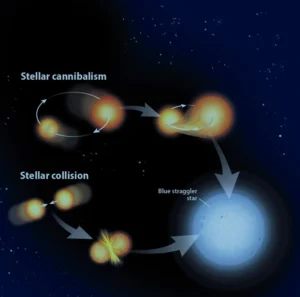
Blue Straggler Stars

How They Differ

  • Normally, stars in clusters cool and expand into red giants.
  • Blue stragglers instead grow hotter and brighter, showing a blue colour.
  • They “lag behind” in evolution compared to their peers, hence termed stragglers.

Possible Explanations

  1. External Origin: They may not belong to the cluster originally.
  2. Mass Transfer: A straggler draws matter from a giant companion star → becomes hotter and more massive, while the donor evolves into a white dwarf.
  3. Triple Star Interaction: A third star may facilitate mass transfer between binary companions, creating the anomaly.

Scientific Significance

  • Provide insights into stellar evolution and dynamics in dense clusters.
  • Help astronomers understand binary and multiple star interactions.
  • Offer clues about mass transfer processes and longterm stability of star systems.
  • Important for studying galactic archaeology, since globular clusters are among the oldest structures in the universe.

Indian Contribution

  • Discovery highlights India’s growing role in global astrophysics research.
  • Builds on earlier work by Indian observatories in studying stellar populations and cluster dynamics.

Conclusion:

Blue Straggler Stars challenge conventional models of stellar evolution, reminding us that the universe often defies simple rules their study deepens our understanding of stellar life cycles and cosmic mysteries.


ATAL BEEMIT VYAKTI KALYAN YOJANA (ABVKY)

TOPIC: (GS3) ECONOMY: PIB

The Employees’ State Insurance Corporation (ESIC) has extended the Atal Beemit Vyakti Kalyan Yojana (ABVKY) from July 1, 2026 to June 30, 2027. The scheme provides financial relief to insured workers who lose employment.

About the Scheme

  • Launch: Introduced on July 1, 2018 by ESIC.
  • Nature: Unemployment relief scheme under the ESI Act, 1948.
  • Objective: Provide temporary financial support to insured persons during job loss.

Benefits

  • Relief equals 50% of average daily earnings (calculated over the last 4 contribution periods).
  • Payable for a maximum of 90 days of unemployment.
  • Benefit available once in a lifetime for the insured person.

Eligibility

  • Must be covered under Section 2(9) of the ESI Act.
  • Minimum two years of insurable employment.
  • Contribution of at least 78 days in each of the four contribution periods.
  • Aadhaar and bank account linkage mandatory.

Exclusions

  • Not admissible during lockouts, illegal strikes, voluntary retirement, or disciplinary dismissal.
  • Ineligible if reemployed elsewhere, on superannuation, or less than two years of contributory service.
  • Relief ceases on the death of the insured person.

Claim Process

  • Claim must be filed within one year of unemployment.
  • Submitted directly by the insured person to ESIC.

Conclusion:

ABVKY is a crucial safety net for ESIcovered workers, ensuring income security during unemployment and reinforcing India’s commitment to social protection.

ATMANIRBHAR PANCHAYAT PROGRAMME

TOPIC: (GS2) GOVERNANCE: PIB

The Union Minister of Panchayati Raj recently launched the Atmanirbhar Panchayat Programme along with the SAMARTH Panchayat Portal. Both initiatives aim to enhance the financial independence and digital capacity of Gram Panchayats.

About Atmanirbhar Panchayat Programme

  • Initiative: Unique programme of the Ministry of Panchayati Raj to empower local bodies.
  • Objective: Enable Gram and Block Panchayats to identify local assets/opportunities and convert them into bankable, revenuegenerating projects.
  • Financing Mechanisms:
    • PublicPrivate Partnerships (PPP).
    • Corporate Social Responsibility (CSR) contributions.
    • Convergence with other government schemes.
    • Bank finance with NABARD and HUDCO as institutional partners.
  • Target: 350 projects in 4 years (50 in Year 1, 100 each in next 3 years).
  • Eligibility:
    • Gram Panchayats with minimum Own Source Revenue (OSR) of ₹50 lakh.
    • Block Panchayats with minimum OSR of ₹1 crore.
    • Relaxed thresholds for Special Category States.

About SAMARTH Panchayat Portal

  • Digital Platform: Firstofitskind initiative to strengthen Panchayat finances through technologyenabled OSR management.
  • Functions:
    • Taxpayer registration.
    • Demand generation.
    • Online payments and collection.
    • Realtime monitoring of revenue.
  • Design: Unified, configurable national platform.
  • Implementation: Already onboarded in Chhattisgarh and Himachal Pradesh.

Significance

  • Promotes financial selfreliance of Panchayats.
  • Reduces dependence on state/central grants.
  • Encourages local entrepreneurship and resource mobilisation.
  • Strengthens grassroots governance and accountability.
  • Supports Digital India by integrating technology into Panchayat administration.

Challenges Ahead

  • Ensuring capacity building of Panchayat officials for project design and digital management.
  • Mobilising adequate private investment and CSR funds.
  • Addressing disparities between wealthier and poorer Panchayats.
  • Sustaining longterm revenue generation while maintaining social equity and inclusivity.
  • Need for community awareness and participation to ensure transparency.

Conclusion:

The Atmanirbhar Panchayat Programme, supported by the SAMARTH Portal, is a step toward financially empowered and digitally enabled Panchayats, crucial for building resilient grassroots governance in India.

Write a Review

Your email address will not be published. Required fields are marked *