

Table of Contents
ToggleTHE PREVENTION OF INSULTS TO NATIONAL HONOUR (AMENDMENT) BILL, 2026
TOPIC: (GS2) POLITY: THE HINDU
The Rajya Sabha passed the Prevention of Insults to National Honour (Amendment) Bill, 2026 through a voice vote, despite opposition walkouts.
What is a Bill?
- A Bill is a draft proposal for a law presented before Parliament. It can be introduced in either House (Lok Sabha or Rajya Sabha).
- Once passed by both Houses and assented to by the President, it becomes an Act of Parliament.
- Bills may be Government Bills (introduced by ministers) or Private Members’ Bills (introduced by MPs not in government).
Prevention of Insults to National Honour (Amendment) Bill, 2026
- Protection of National Song – Vande Mataram: The Bill criminalises intentional disruption or prevention of singing Vande Mataram, giving it legal sanctity equal to the national anthem Jana Gana Mana.
- Dr. Rajendra Prasad in the Constituent Assembly (1950) had stated that Vande Mataram should be treated on par with the anthem.
- Punishment Provisions: Offenders can face up to 3 years imprisonment, or fine, or both.
- This aligns with the 1971 Prevention of Insults to National Honour Act, which already protects the flag, Constitution, and anthem.
Process of Passing a Bill in Parliament
- First Reading: Introduction of the Bill in either House.
- Second Reading: Detailed discussion, clausebyclause consideration, and possible amendments.
- Committee Stage: Sometimes referred to a Standing Committee for scrutiny.
- Third Reading: Final debate and voting.
- Other House: The Bill is sent to the other House for the same process.
- Presidential Assent: Once both Houses pass it, the President’s approval makes it law.
Drafting → Introduction → Debate → Committee → Voting → Other House → Presidential Assent → Act of Parliament
Respecting National Symbols
- Cultural Heritage: Vande Mataram, composed by Bankim Chandra Chatterjee in 1870, was a rallying cry during the freedom struggle. Respecting it honors sacrifices of leaders like Subhas Chandra Bose, who included it in Azad Hind Fauj’s anthem.
- National Unity: Symbols like the flag, anthem, and song transcend regional and linguistic divides, fostering collective identity.
- Legal Sanctity: The 1971 Prevention of Insults to National Honour Act already protects the flag and Constitution; extending protection to Vande Mataram strengthens this framework.
- Global Practice: Many nations criminalize disrespect to their national symbols (e.g., US Flag Code, France’s anthem laws), reinforcing dignity and pride.
Conclusion:
The 2026 Amendment Bill underscores that respecting national symbols is not just about law but about collective memory and identity. By protecting Vande Mataram alongside the anthem and flag, India reaffirms its cultural heritage and strengthens national pride.
THE CAUVERY WATER DISPUTE
TOPIC: (GS2) POLITY: THE HINDU
Karnataka CM D. K. Shivakumar announced that the state will appeal against the CWRC order before the Cauvery Water Management Authority (CWMA).
What is the Cauvery Water Dispute?
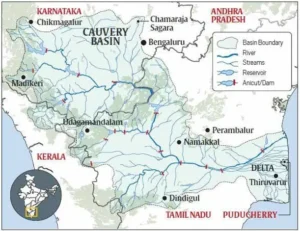
- The Cauvery water dispute remains one of India’s most contentious inter-state conflicts, with Karnataka and Tamil Nadu clashing over water releases amid poor rainfall.
- Inter-state conflict over sharing Cauvery waters among Karnataka, Tamil Nadu, Kerala, and Puducherry.
- Originates from 1892 and 1924 colonial agreements between Mysore and Madras Presidency.
- Dispute intensified post-1956 state reorganization, leading to demands for fair allocation.
- Tamil Nadu depends heavily on Cauvery delta irrigation, while Karnataka cites rising urban and industrial needs (e.g., Bengaluru).
Tribunal Order
- Cauvery Water Disputes Tribunal (CWDT) set up in 1990 under the Inter-State River Water Disputes Act, 1956.
- Final Award (2007): Allocated 740 tmc ft annually among states:
- Tamil Nadu – 404.25 tmc ft
- Karnataka – 284.75 tmc ft
- Kerala – 30 tmc ft
- Puducherry – 7 tmc ft
- Environmental flows – 10 tmc ft
- Supreme Court (2018): Slightly modified allocations, granting Bengaluru 4.75 tmc ft for drinking water.
What are Tribunals?
- Constitutional Basis: Tribunals are provided under Articles 323A and 323B of the Constitution, enabling Parliament and State Legislatures to establish them for specific disputes.
- QuasiJudicial Nature: They function as specialized adjudicatory bodies, combining judicial and administrative expertise to deliver faster justice in technical matters.
- Judicial Review: Though tribunal awards are binding, their decisions remain subject to Supreme Court and High Court review, ensuring constitutional supremacy.
- InterState River Water Disputes Act, 1956: This Act specifically empowers the Union Government to set up tribunals for resolving river water conflicts between states, making them crucial instruments of federalism.
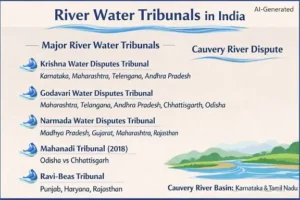
Other River Water Tribunals in India
- Krishna Water Disputes Tribunal: Karnataka, Maharashtra, Telangana, Andhra Pradesh.
- Godavari Water Disputes Tribunal: Maharashtra, Telangana, Andhra Pradesh, Chhattisgarh, Odisha.
- Narmada Water Disputes Tribunal: Madhya Pradesh, Gujarat, Maharashtra, Rajasthan.
- Mahanadi Tribunal (2018): Odisha vs Chhattisgarh.
- Ravi-Beas Tribunal: Punjab, Haryana, Rajasthan.
Status of Present Tribunals
- Cauvery Tribunal: Award implemented via CWMA (2018), but disputes persist during drought years.
- Krishna Tribunal: Reconstituted in 2020; disputes ongoing after Telangana’s formation.
- Godavari Tribunal: Award largely settled, but operational issues remain.
- Mahanadi Tribunal: Proceedings ongoing; Odisha alleges reduced flow due to Chhattisgarh dams.
- Narmada Tribunal: Award implemented; Narmada Control Authority oversees compliance.
Conclusion
The Cauvery dispute exemplifies India’s broader challenge of balancing equitable water sharing with ecological sustainability, making inter-state tribunals vital yet politically sensitive instruments of federalism.
INDIA’S SERVICES SECTOR AND CHALLENGES AHEAD
TOPIC: (GS3) ECONOMY: THE HINDU
The Ministry of Statistics and Programme Implementation (MoSPI) released the Experimental Index of Services Production (ISP) showing that India’s services sector growth halved in May 2026, dropping from 20.5% in April to nearly 10% in May.
What are Services?
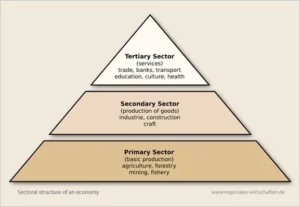
- Services include IT & ITenabled services, banking, transport, retail trade, tourism, telecom, education, healthcare, and professional services.
- Unlike goods, services are intangible but form the largest part of modern economies.
- In India, services are knowledgeintensive and digitally delivered, making them globally competitive.
services sector Contribution to Economy
- According to the Economic Survey 202526, services contributed a record 56.4% of GVA and grew at 9.1% in FY26, cementing India’s position as the world’s seventhlargest exporter of services.
- Exports: USD 863 billion in 202526; India’s share in global services trade rose to 4.3% in 2024 from 2% in 2005.
- FDI Inflows: Services attracted 80.2% of total FDI (FY23FY25), mainly in IT, finance, and professional services.
Challenges
- Growth Slowdown: As seen in May 2026 ISP data, services growth halved from 20.5% in April to ~10% in May, with IT, retail, and transport showing sharp declines.
- Employment Quality: Gig work and informal contracts dominate, raising concerns about job security and inequality.
- Infrastructure Gaps: Transport and logistics remain costly, limiting competitiveness.
- Global Risks: Rising protectionism and geopolitical tensions threaten crossborder services trade.
- Digital Divide: Unequal access to digital infrastructure restricts rural participation.
Way Forward
- Boost Productivity: Invest in skill development and vocational training to sustain competitiveness.
- Diversify Services: Expand into sunrise sectors like media, entertainment, space technologies, and ocean commercialisation.
- Strengthen Infrastructure: Improve transport, logistics, and digital connectivity to support service delivery.
- Inclusive Growth: Formalise gig work and extend social protection to service workers.
- Global Integration: Deepen trade agreements and digital partnerships to expand India’s services exports.
Conclusion:
India’s services sector is the engine of growth, contributing more than half of GVA and driving exports and FDI. However, sustaining this momentum requires tackling employment quality, infrastructure bottlenecks, and global risks.
DELIMITATION AND EXPANSION OF LOK SABHA
TOPIC: (GS2) POLITY: THE HINDU
The government has proposed expanding the Lok Sabha to 848–850 seats after the 2026 delimitation exercise.
What is Delimitation?
- Redrawing boundaries of parliamentary and assembly constituencies based on latest Census.
- Constitutional Basis: Articles 82 and 170 mandate delimitation after every Census.
- Past Freezes: 42nd Amendment (1976) froze delimitation till 2001; 84th Amendment extended it till 2026.
- Objective: Ensure equal representation by adjusting seats to population changes.
Recent Concerns Against Delimitation Proposals
- Southern States’ Fear: Population control success may reduce their seats, while northern states gain due to higher fertility.
- Governance Efficiency: Oversized Lok Sabha may dilute debate; MPs risk becoming “silent backbenchers.”
- Fiscal Federalism: States contributing more taxes may lose political weight, raising equity concerns.
- Comparative Perspective: US House has 435 members for 330 million people; India may have 850 for 1.4 billion, raising questions of manageability.
Balance of Representation
- Representation must align with demographic realities but also protect states that invested in population control and social development.
- A fair system ensures both equity and efficiency, preventing political marginalisation of progressive states.
Way Forward
- Balanced Representation: Consider weighted formula combining population, fiscal contribution, and governance efficiency.
- Strengthen Institutions: Empower committees and parliamentary procedures to prevent dilution of scrutiny.
- Federal Dialogue: Build consensus among states to avoid regional imbalance.
- Technology Use: Digital platforms can enhance participation and reduce inefficiency in a larger House.
Conclusion:
Delimitation is essential for democratic fairness, but unchecked expansion of Lok Sabha risks weakening accountability. India must balance population representation with federal equity, ensuring Parliament remains a forum of genuine debate and scrutiny.
SAINT RAVIDAS AND VISION FOR INCLUSIVE GOVERNANCE
TOPIC: (GS2) POLITY: THE HINDU
The Saint Ravidas’s philosophy of Begumpura highlights how Bhakti movement ideals influence contemporary welfare governance and social inclusion policies.
Who Was Saint Ravidas?
- Saint Ravidas, a 15thcentury Bhakti saint was a spiritual reformer from Varanasi, belonging to a marginalized community.
- He preached equality, dignity of labour, and universal brotherhood, rejecting caste hierarchies.envisioned a society free from caste oppression and inequality.
- His concept of Begumpura (“city without sorrow”) reflects a timeless aspiration for egalitarian governance and social justice values central to India’s constitutional ethos.
- His teachings influenced Guru Nanak, Kabir, and other Bhakti saints, shaping India’s social reform tradition.
- Ravidas’s verses in the Guru Granth Sahib emphasize devotion through service and compassion rather than ritualism.
Philosophy of Begumpura
- Begumpura, meaning “city without sorrow,” symbolizes a utopian society where there is no discrimination, fear, or exploitation.
- It represents freedom from social and economic bondage, aligning with modern ideas of inclusive development.
- Ravidas’s vision resonates with Article 14 (Equality before Law) and Article 38 (Social Order for Welfare) of the Constitution.
- His idea of governance was rooted in moral leadership, justice, and collective welfare — principles echoed in Antyodaya and Sabka Saath, Sabka Vikas.
Governance Perspective
- Good Governance in Ravidas’s philosophy emphasizes ethical leadership, social harmony, and empowerment of the weakest.
- His teachings align with Gandhian Sarvodaya, Ambedkar’s social justice, and modern welfare state ideals.
- The Bhakti movement can be seen as an early form of participatory governance, where spiritual equality translated into social empowerment.
- Ravidas’s message supports inclusive policy frameworks like PMAwas Yojana, Skill India, and Social Justice Ministry initiatives.
BHAKTI MOVEMENT:
- Origin and Spread: Began between the 7th–17th centuries CE, first in South India with saints like Appar, Sambandar, and Alvars, later spreading north through Kabir, Mirabai, Tulsidas, and Ravidas, emphasizing personal devotion over ritualism.
- Social Reform Impact: Challenged caste hierarchy and priestly dominance, promoting equality, unity, and vernacular literature; it democratized religion and inspired later reform movements like Arya Samaj and Brahmo Samaj.
- Political and Cultural Significance: Strengthened HinduMuslim cultural synthesis through SufiBhakti interactions, influencing regional languages, art, and governance ethics that valued compassion and inclusivity — key ideals reflected in modern Indian secularism.
Conclusion
Saint Ravidas’s vision of Begumpura remains a guiding light for ethical, inclusive, and peoplecentric governance, reminding policymakers that true progress lies in creating a society without sorrow, inequality, or exclusion.
ANDROMEDA GALAXY
TOPIC: (GS3) SCIENCE AND TECHNOLOGY: THE HINDU
A new study using NASA’s Hubble Space Telescope has revealed that star formation in the Andromeda Galaxy has been declining for the past 500 million years.
About Andromeda Galaxy
- The Andromeda Galaxy (M31), our nearest major galactic neighbour, offers astronomers a natural laboratory to study stellar evolution.
- Recent observations highlight its transition from an active starforming system to a calmer, middleaged galaxy.
- Location: Situated ~2.5 million light years away in the constellation Andromeda.
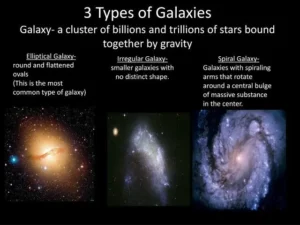
- Structure: A barred spiral galaxy, comparable in size to the Milky Way.
- Visibility: Bright enough to be seen with the naked eye under clear skies.
- Dynamics: Moving towards the Milky Way at ~110 km/s, predicted to merge in ~4 billion years.
- Evolution: Currently in “middle age,” shifting from vibrant star formation to a quieter state.
HUBBLE SPACE TELESCOPE
HighResolution Imaging: Captures ultraclear images of galaxies, nebulae, and stars by avoiding atmospheric distortion, enabling astronomers to study cosmic structures in detail.
Spectral Observations: Observes in ultraviolet, visible, and nearinfrared wavelengths, allowing analysis of stellar birth, death, and chemical composition of celestial bodies.
Cosmological Discoveries: Provided evidence for the accelerating expansion of the universe (dark energy) and mapped distant galaxies through “Deep Field” surveys.
Exoplanet Studies: Detected atmospheres of exoplanets, identifying elements like sodium and water vapour, advancing planetary science beyond our solar system.
Global Collaboration: Operated jointly by NASA and ESA, it supports international research, inspires missions like India’s Astrosat, and complements newer observatories like the James Webb Space Telescope.
Conclusion
The Andromeda Galaxy’s slow decline in star formation is a reminder that even vast cosmic structures evolve — offering humanity a glimpse into the future destiny of our own Milky Way.
PITHORA PAINTING
TOPIC: (GS1) INDIAN ART AND CULTURE: THE HINDU
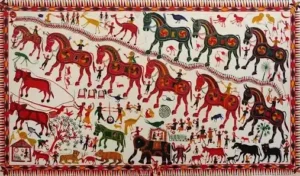
The Pithora painting, a centuriesold tribal wall art of Gujarat’s Rathwa community, has been awarded a Geographical Indication (GI) tag in 2026, recognizing its cultural and economic significance.
Origins & Cultural Significance
- Emerged in tribal regions of Panchmahal and Chhota Udaipur around the 13th century.
- Named after Pithora De, the tribal deity linked to marriage, prosperity, and wellbeing.
- Traditionally painted during life events like weddings, births, and festivals to invoke blessings.
Community & Ritual Process
- Practiced by Rathwa, Bhil, and Bhilala tribes, reflecting their deep bond with nature and spirits.
- Executed by ritual painters called Lakharas, under guidance of a priest known as Badwa.
- Walls prepared with cow dung and clay, symbolizing purity and connection to earth.
Artistic Features
- Uses natural pigments from minerals and plants; common colors are red, yellow, green, and blue.
- Tools include bamboo sticks, cotton, and wooden stencils.
- Themes: tribal and Hindu deities, horses, farming, hunting, and dancing scenes, preserving oral traditions.
Modern Adaptations
- Earlier confined to house walls, now extended to paper and canvas for commercial sale.
- Provides livelihood opportunities while keeping tribal heritage alive.
- GI tag ensures authenticity, protection, and market recognition for tribal artisans.
Conclusion:
The GI recognition of Pithora painting highlights India’s commitment to preserving tribal heritage while empowering artisans, making it a living bridge between tradition and modernity.

YOUTH MOVEMENTS IN SOUTH ASIA AND DEMOCRATIC ACTIVISM
TOPIC: (GS2) POLITY: THE HINDU
Recent Gen Zled protests in India have resonated across South Asia, with similar youth movements emerging in Bangladesh, Nepal, Pakistan, and Sri Lanka, highlighting the role of social media and generational change in shaping democratic activism.
Nature of Youth Activism
- Digital Mobilisation: Social media platforms like Instagram, X, and YouTube have become tools for organising protests and spreading awareness.
- Generational Identity: Gen Z emphasizes issues of climate change, unemployment, gender equality, and democratic accountability.
- CrossBorder Solidarity: Movements in one country inspire others, creating a regional wave of activism.
Regional Examples
- India: Student protests on education reforms and unemployment.
- Bangladesh: Youth mobilisations against corruption and governance failures.
- Nepal: Campaigns for climate justice and political transparency.
- Pakistan: Digital activism on women’s rights and press freedom.
- Sri Lanka: Youth played a central role in the 2022 economic crisis protests.
Democratic Dimensions
- Voice of Accountability: Youth movements challenge entrenched political elites and demand transparency.
- Participation Gap: Traditional parties often fail to represent young voters, creating space for activism.
- Global Context: Similar youthdriven protests seen in Hong Kong, Chile, and the US, showing a worldwide trend.
Challenges
- State Response: Crackdowns, censorship, and restrictions on digital platforms.
- Fragmentation: Lack of unified leadership weakens longterm impact.
- Institutional Barriers: Electoral systems and party structures limit youth representation.
- Risk of Cooption: Political parties may absorb movements without addressing core demands.
Way Forward
- Institutional Inclusion: Lowering age barriers for candidacy and strengthening youth wings in parties.
- Policy Engagement: Governments must address youth concerns in education, jobs, and climate policy.
- Digital Safeguards: Protect online spaces to ensure free expression.
- Regional Cooperation: South Asian nations can share best practices for youth participation in governance.
Conclusion:
Gen Z activism across South Asia signals a new democratic energy, demanding accountability and inclusivity. Harnessing this momentum into institutional reforms can strengthen democracy and ensure youth voices shape the region’s future.