Table of Contents
ToggleCitizenship in India
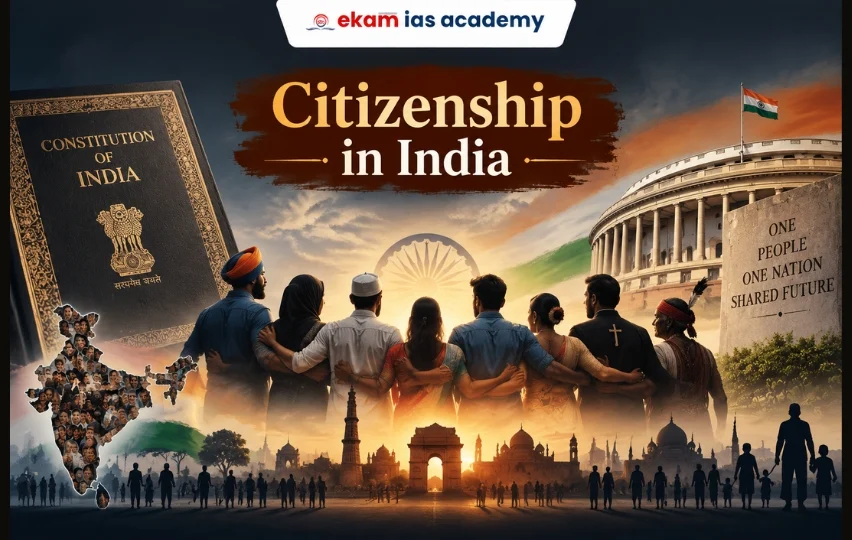
Citizenship in India defines the legal relationship between the individual and the State, granting civil and political rights. Governed by Articles 5 to 11 under Part II of the Constitution and the Citizenship Act 1955
What is Citizenship
Citizenship denotes full and equal membership of a political community. Unlike aliens, citizens enjoy all fundamental rights (including Articles 15, 16, 19, 29, and 30) and hold civil and political responsibilities under Citizenship under Indian Constitution.
Constitutional Provisions Related to Citizenship
The Constitutional Provisions on Citizenship explicitly addressed citizenship at the commencement of the Constitution (January 26, 1950):
- Article 5: Citizenship by domicile.
- Article 6: Rights of persons who migrated from Pakistan.
- Article 7: Rights of migrants to Pakistan who subsequently returned.
- Article 8: Rights of persons of Indian origin residing outside India.
- Article 9: Automatic termination upon voluntarily acquiring foreign citizenship.
- Article 10: Continuation of citizenship rights subject to parliamentary laws.
- Article 11: Empowers Parliament to regulate citizenship by law.
Citizenship Act, 1955 and Modes of Acquiring Citizenship
The Citizenship Act 1955 outlines five statutory Modes of Acquiring Citizenship:
Citizenship by Birth: Based on jus soli (soil right), subject to parental status amendments.
Citizenship by Descent: Based on jus sanguinis (blood right) for persons born outside India.
Citizenship by Registration: Available to Persons of Indian Origin (PIO) residing in India for specified periods.
Citizenship by Naturalisation: Granted to foreigners fulfilling residency and character conditions.
Citizenship by Incorporation of Territory: Applied when a new territory becomes part of India.
Loss of Citizenship
The Citizenship Act UPSC specifies three statutory grounds for Loss of Citizenship:
- Renunciation: Voluntary surrender by a citizen.
- Termination: Automatic loss upon voluntarily acquiring foreign nationality.
- Deprivation: Compulsory termination by the Central Government due to fraud, disloyalty, or illegal acts.
Single Citizenship in India
Unlike federations such as the USA, the Constitution establishes Single Citizenship in India to foster national unity and eliminate regional division, guaranteeing equal rights across all States.
Overseas Citizen of India (OCI), CAA, and NRC
- Overseas Citizen of India: The OCI Card offers lifelong visa-free travel and economic rights, distinct in the OCI vs NRI vs PIO framework.
- Citizenship Amendment Act: The CAA UPSC provisions fast-track citizenship for persecuted minorities from specified neighboring countries.
- National Register of Citizens: The NRC UPSC seeks to identify legally recognized citizens and detect illegal migration.
Constitutional Significance, Challenges, and Way Forward
Understanding Indian Constitution Citizenship connects Fundamental Rights and Citizenship directly. Striking a balance between national security concerns and humanitarian obligations remains vital. Streamlining legal processes through transparent administrative frameworks ensures smooth Constitutional Governance for all UPSC Polity Notes requirements.
Conclusion
Studying Indian Citizenship under Indian Constitution Notes provides clarity on rights, liabilities, and constitutional mechanisms, making it an indispensable part of Citizenship UPSC preparation.
UPSC Prelims: PYQs & Practice Questions
Previous Year Questions (Prelims)
Q: With reference to India, consider the following statements:
1. There is only one citizenship and one domicile.
2. A citizen by birth only can become the Head of State.
3. A foreigner once granted citizenship cannot be deprived of it under any circumstances.
Which of the statements given above is/are correct?
(a) 1 only
(b) 2 only
(c) 1 and 3 only
(d) 2 and 3 only
Answer: (a) 1 only
Explanation:
Statement 1 is correct. India follows the principle of
single citizenship. Unlike the United States, there is no separate citizenship of individual States.
Statement 2 is incorrect. The Constitution does not require the President of India to be a citizen by birth. Both a
citizen by birth and a
naturalized citizen may become President, provided the eligibility conditions under
Article 58 are fulfilled.
Statement 3 is incorrect. Under
Section 10 of the Citizenship Act, 1955, citizenship acquired through registration or naturalization may be deprived on specified grounds, including fraud, disloyalty to the Constitution and unlawful communication with an enemy during war.
Q: Consider the following statements regarding citizenship in India: (UPSC CSE Prelims 2018)
1. Article 11 of the Constitution of India empowers Parliament to regulate the right of citizenship by law.
2. The Citizenship Act, 1955 provides for five ways of acquiring citizenship and three ways of losing citizenship.
Which of the statements given above is/are correct?
(a) 1 only
(b) 2 only
(c) Both 1 and 2
(d) Neither 1 nor 2
Answer: (c) Both 1 and 2
Explanation:
Statement 1 is correct. Article 11 empowers Parliament to enact laws concerning the acquisition, termination and other matters relating to citizenship.
Statement 2 is correct. The
Citizenship Act, 1955 provides five modes of acquiring citizenship:
1. By birth
2. By descent
3. By registration
4. By naturalization
5. By incorporation of territory
It also provides three modes of losing citizenship:
1. Renunciation
2. Termination
3. Deprivation
Practice Questions
Q: Which of the following Fundamental Rights are available only to citizens of India and not to foreign nationals?
1. Prohibition of discrimination on grounds of religion, race, caste, sex or place of birth under Article 15
2. Equality of opportunity in matters of public employment under Article 16
3. Protection of life and personal liberty under Article 21
4. Protection of language, script and culture under Article 29
Select the correct answer using the code given below:
(a) 1 and 2 only
(b) 1, 2 and 4 only
(c) 2, 3 and 4 only
(d) 1, 2, 3 and 4
Answer: (b) 1, 2 and 4 only
Explanation:
Articles 15 and 16 expressly confer protections upon
citizens. Article 29 also protects the right of any
section of citizens having a distinct language, script or culture to conserve it.
Article 21, however, protects the life and personal liberty of
every person. Therefore, it is available to citizens as well as foreign nationals, subject to constitutionally permissible restrictions.
Q: With reference to Overseas Citizen of India (OCI) cardholders, consider the following statements:
1. OCI cardholders are granted dual citizenship under the Indian Constitution.
2. An OCI cardholder has the right to vote in general elections in India.
3. OCI cardholders do not require a visa for travelling to India.
Which of the statements given above is/are correct?
(a) 1 and 2 only
(b) 3 only
(c) 2 and 3 only
(d) 1, 2 and 3
Answer: (b) 3 only
Explanation:
Statement 1 is incorrect. India does not recognise dual citizenship. OCI status is a statutory facility provided under the
Citizenship Act, 1955 and does not amount to full Indian citizenship.
Statement 2 is incorrect. OCI cardholders cannot vote, contest elections or hold constitutional offices in India.
Statement 3 is correct. OCI cardholders receive a
multiple-entry, lifelong facility for travelling to India without obtaining a regular visa for each visit.
UPSC Mains – Previous Year & Practice Questions
Mains Previous Year Questions
[15 Marks | 250 Words]
Question: Discuss the constitutional provisions governing citizenship at the commencement of the Indian Constitution. How did Parliament subsequently exercise statutory control over this domain through the Citizenship Act, 1955?
[15 Marks | 250 Words]
Question: Examine the key features and socio-political controversies surrounding the Citizenship (Amendment) Act. How does it align with the constitutional guarantee of equality under Article 14?
[10 Marks | 150 Words]
Question: Analyze the concept of Single Citizenship in India. How far has it succeeded in building a unified national identity amid regional and linguistic diversity?
[15 Marks | 250 Words]
Question: Critically evaluate the need for and implementation challenges of the National Register of Citizens in Assam.
[10 Marks | 150 Words]
Question: Distinguish between Non-Resident Indians, Persons of Indian Origin, and Overseas Citizens of India in terms of their legal status, political rights and economic privileges.
Mains Practice Questions
[15 Marks | 250 Words]
Question: “The right to citizenship is the ‘right to have rights’.” Analyze this statement in the context of statelessness and illegal migration in South Asia.
[10 Marks | 150 Words]
Question: Evaluate the legal grounds on which a person may be deprived of Indian citizenship by the Central Government. What constitutional and statutory safeguards exist against arbitrary executive action?
[15 Marks | 250 Words]
Question: “While several Western democracies increasingly permit dual nationality, India firmly adheres to the principle of single citizenship.” Discuss the constitutional, political and administrative rationale behind this choice.



Citizenship-FAQs
What is Citizenship in India?
Citizenship in India defines the legal relationship between an individual and the State, granting civil and political rights.
Which Articles deal with citizenship in the Constitution?
Articles 5 to 11 under Part II of the Indian Constitution deal with citizenship at the commencement of the Constitution.
Which law governs citizenship in India?
The Citizenship Act, 1955 governs acquisition, loss, termination, deprivation and related citizenship matters in India.
What are the modes of acquiring citizenship in India?
Citizenship can be acquired by birth, descent, registration, naturalisation and incorporation of territory.
What is single citizenship in India?
Single citizenship means every citizen is a citizen of India only, not separately of any State, helping promote national unity.