

Table of Contents
ToggleCLOSURE OF GOVERNMENT SCHOOLS AND EDUCATION LANDSCAPE
TOPIC: (GS2) POLITY: THE HINDU
A NITI Aayog report has revealed that nearly 94,000 government schools have closed over the last decade, triggering debate on access to education and school infrastructure.
Government Schools
- Government schools are educational institutions that are established, funded, and managed by the Central Government, State Governments, local bodies (Panchayats and Municipalities), or government-aided authorities.
- Their primary objective is to provide free, equitable, and quality education, particularly to children from economically and socially disadvantaged backgrounds.
Management
- Central Government: Kendriya Vidyalayas (KVs), Jawahar Navodaya Vidyalayas (JNVs), Sainik Schools (under respective authorities).
- State Governments: Managed by the State Education Departments.
- Local Bodies: Panchayats, Municipal Corporations, Zilla Parishads, and Municipal Councils administer many primary and upper primary schools.
- Government-Aided Schools: Privately managed institutions receiving substantial financial assistance from the government.
Curriculum
- State Board Curriculum: Followed by most government schools. Designed by the State Council of Educational Research and Training (SCERT) based on the state’s educational needs.
- CBSE Curriculum: Followed by Kendriya Vidyalayas, Jawahar Navodaya Vidyalayas, and some state government schools. Developed by the National Council of Educational Research and Training (NCERT).
Key Trends in School Education (2014–15 to 2024–25)
Decline in Government Schools
- Total schools declined from about 15.16 lakh to 14.71 lakh.
- Government schools reduced by nearly 94,000, while private unaided schools increased.
Changing Enrolment Pattern
- Total student enrolment declined by around 2.26 crore.
- Government school enrolment fell, whereas private school enrolment steadily increased.
- Nearly 70% of students are still enrolled in Classes I–VIII, highlighting the importance of accessible neighbourhood schools.
Improvement in Teacher Availability
- The number of teachers increased from about 90 lakh to over 1 crore.
- Average teachers per school rose from 5.9 to 6.9.
- However, disparities remain, with single-teacher schools in rural areas and overcrowded schools in cities.
Reasons Behind the Trend
Demographic Transition
- India’s Total Fertility Rate (TFR) has declined to around 2.0, below the replacement level.
- Key reasons include:Higher female literacy, Urbanisation, Better healthcare, Greater access to family planning, Delayed marriages and changing family aspirations.
- As fewer children are born, the demand for schools naturally declines.
Why School Consolidation is Being Encouraged
- Combine small schools into well-equipped institutions.
- Ensure availability of qualified teachers for different subjects.
- Improve access to libraries, laboratories, sports facilities, and digital learning.
- Enhance peer learning and holistic development.
- The approach is supported by the National Education Policy (NEP), 2020 through the concept of School Complexes and Clusters.
Concerns Associated with School Closure
- Reduced Accessibility: Closure of neighbourhood schools increases the distance to educational institutions, making access difficult for children in rural, tribal, and hilly regions.
- Higher Dropout Risk: Longer travel time and safety concerns may discourage regular attendance, particularly among girls, children with disabilities, and economically weaker sections, leading to higher dropout rates.
- Transportation and Safety Issues: Inadequate transport facilities, poor road connectivity, and adverse weather conditions can disrupt school attendance and affect learning continuity.
- Widening Educational Inequality: If consolidation is not supported by adequate infrastructure and transport, it may deepen regional, gender, and socio-economic disparities in access to education.
Way Forward
- Base school consolidation on scientific data, including enrolment, geography, and population trends.
- Ensure safe and affordable transport wherever schools are merged.
- Strengthen digital infrastructure and improve teaching quality in consolidated schools.
- Retain neighbourhood schools in remote, tribal, and difficult-to-access areas.
Conclusion
School consolidation can become a meaningful reform only if it protects equitable access, particularly for children from rural, tribal, and disadvantaged communities. The ultimate measure of success is not the number of schools, but whether every child receives safe, inclusive, and quality education.
INDIA'S PROPOSED UPI TRANSACTION LEVY
TOPIC: (GS3) ECONOMY: THE HINDU
The Finance Ministry has introduced the Taxation and Other Laws (Amendment) Bill, 2026, proposing changes that allow banks and payment service providers to levy Merchant Discount Rate (MDR) on certain UPI and RuPay debit card transactions.
Introduction
- India’s Unified Payments Interface (UPI) has transformed the country’s digital payment ecosystem by enabling fast, secure, and low-cost transactions.
- Since 2020, merchants have not been charged any Merchant Discount Rate (MDR) on UPI payments, encouraging widespread adoption.
- However, with the rapid growth of digital transactions and increasing infrastructure costs, the government is considering a limited reintroduction of MDR while balancing financial sustainability and trade commitments.
What is Merchant Discount Rate (MDR)?
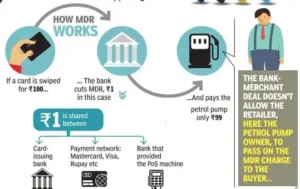
MDR is the fee paid by a merchant to banks or payment service providers for processing digital payments.
It helps cover expenses related to:
- Payment infrastructure and technology.
- Settlement and processing of transactions.
- Cybersecurity and fraud prevention.
- Maintenance of the digital payment network.
- Importantly, MDR is charged to merchants and not directly to customers.
Key Provisions of the Proposed Bill
- Permit the levy of MDR on UPI and RuPay debit card transactions.
- Apply the fee only to transactions above ₹2,000.
- Restrict the levy to large merchants crossing a specified turnover threshold.
- Continue free UPI services for small businesses and person-to-person (P2P) transactions.
- Thus, the proposal is not a tax on UPI users, but a fee on eligible merchants.
Why is MDR Being Considered Again?
- Since January 2020, the government has prohibited MDR on UPI transactions and compensated banks through subsidies.
- However UPI transactions have grown exponentially, increasing operational costs.
- Banks and payment providers incur expenses for servers, security, fraud detection, and settlement systems.
- Government reimbursement has not kept pace with the expanding digital payment ecosystem.
- The proposal aims to create a financially sustainable payment infrastructure.
Key Issues
- The US Trade Representative (USTR) has argued that India’s digital payment policies favour domestic platforms.
- It has expressed concerns regarding: Promotion of RuPay, The zero-MDR policy, Regulatory measures affecting foreign payment networks.
- Some believe that introducing MDR could partially address concerns regarding competitive neutrality.
Significance of the Proposal
- For the Digital Payment Ecosystem: Creates a sustainable revenue model for banks and payment providers. Supports continued investment in technology and cybersecurity.
- For Merchants: Large businesses may incur additional transaction costs. Small merchants continue to enjoy free digital payment acceptance.
- For India’s Economy: Reinforces confidence in the rapidly growing digital payment system. Balances financial sustainability with continued promotion of digital transactions.
Concerns
- Additional costs may discourage some large merchants from accepting digital payments.
- There is a need to ensure that the burden is not indirectly passed on to consumers.
- Policy decisions should protect India’s digital payment sovereignty while remaining consistent with global trade commitments.
Way Forward
- Adopt a balanced MDR structure that does not affect small businesses.
- Continue government support for promoting financial inclusion.
- Ensure transparent consultation with banks, payment companies, merchants, and consumer groups.
- Strengthen UPI infrastructure, cybersecurity, and fraud management to maintain public confidence.
- Align payment regulations with both domestic priorities and international trade obligations.
Conclusion
India’s proposal to introduce a limited Merchant Discount Rate reflects the need to make the digital payment ecosystem financially sustainable as transaction volumes continue to rise. A carefully designed framework can strengthen India’s digital economy while preserving the global success of UPI as a model of inclusive digital innovation.
RESEARCH, DEVELOPMENT AND INNOVATION (RDI) FUND
TOPIC: (GS3) ECONOMY: THE HINDU
A recent investigation revealed that 15 of the 22 companies selected in the first round of the ₹1 lakh crore RDI Fund have investment links with members of the selection committee, raising concerns about transparency and conflict of interest.
Introduction
- India aims to become a global leader in deep technology (Deep-Tech) by encouraging research-driven innovation.
- However, many technology start-ups and research-based companies face difficulty in accessing long-term finance due to the high risks involved.
- To address this gap, the Government launched the Research, Development and Innovation (RDI) Fund in 2025 with a corpus of ₹1 lakh crore.
- The initiative seeks to provide affordable finance for transforming innovative ideas into commercially viable products.
What is the RDI Fund?
The RDI Fund is a flagship initiative designed to support high-risk, high-impact technologies through long-term financial assistance.
Key Objectives
- Promote indigenous research and innovation.
- Encourage commercialisation of advanced technologies.
- Reduce dependence on imported critical technologies.
- Strengthen India’s deep-tech ecosystem.
- Increase private sector investment in research and development.
- Accelerate the journey from laboratory research to market-ready products.
- Priority Sectors: Artificial Intelligence (AI), Quantum Computing, Semiconductors, Space Technology, Defence Technology, Robotics.
Anusandhan National Research Foundation (ANRF)
- Acts as the nodal institution under the Ministry of Science and Technology.
- Oversees the implementation of the fund through a Special Purpose Fund (SPF).
- Second-Level Fund Managers (SLFMs: The ANRF channels funds through specialised agencies such as:
Technology Development Board (TDB)
Biotechnology Industry Research Assistance Council (BIRAC)
- Funding Mechanism: Unlike traditional grants, the RDI Fund provides soft loans to encourage responsible utilisation of public resources.
Key Features
- Loans up to 50% of the project cost
- Collateral-free financing.
- Low interest rate of about 2–4%.
- Repayment period of up to 15 years.
Current Progress
- 124 applications received in the first round, 51 proposals evaluated, 22 companies selected.
- Around ₹2,192 crore sanctioned.Remaining applications are under evaluation for the next phase.
Concerns over Transparency
- Several selected companies reportedly have investment links with members of the Investment Committee.
- Although no rule violation has been established, such associations may create a perception of conflict of interest.
- Public confidence in innovation funding depends on fair, transparent, and objective decision-making.
Wayforward
- Include independent scientists and academicians from institutions such as IITs and IISc in evaluation committees.
- Mandate conflict-of-interest disclosures by committee members.
- Introduce independent external assessment of project valuation and funding requirements.
- Publish clear evaluation criteria and selection outcomes to improve transparency.
Conclusion
The RDI Fund success will depend not only on financial assistance but also on transparent governance, accountability, and merit-based project selection. Strengthening these safeguards will enhance public trust and ensure that public funds create lasting technological and economic value.
RBI CLASSIFIES TATA SONS AS NBFC–UPPER LAYER
TOPIC: (GS3) ECONOMY: THE HINDU
The Reserve Bank of India (RBI) has classified Tata Sons Ltd. as an NBFC–Upper Layer (NBFC-UL) for 2026–27, while its application for de-registration as an NBFC is still under review.
Introduction
- The Non-Banking Financial Company (NBFC) sector plays a vital role in India’s financial system by providing credit to sectors that are often underserved by banks.
- As some NBFCs have grown significantly in size and interconnectedness, the RBI has introduced a risk-based regulatory framework to ensure financial stability.
- The classification of Tata Sons as an NBFC-Upper Layer reflects this approach and highlights the increasing importance of stronger regulation for systemically important financial institutions.
What is NBFC–Upper Layer (NBFC-UL)?
- The NBFC-Upper Layer (NBFC-UL) consists of large and systemically important NBFCs whose failure could affect the stability of the financial system.
- Eligibility: NBFCs with an asset size of ₹1 lakh crore or more qualify for this category.
- Once classified, an entity remains in the Upper Layer for at least five years, even if its asset size declines.
Regulatory Requirements
- Higher Capital Adequacy Ratio (CAR) and Common Equity Tier-1 (CET-1) requirements.
- Stronger corporate governance and board oversight.
- Enhanced risk management and provisioning standards.
- Greater financial disclosures and transparency.
- Mandatory listing on stock exchanges (for eligible private NBFCs) within the prescribed timeline.
RBI’s Decision on Tata Sons
- Tata Sons has been included among 17 NBFCs identified as NBFC-UL for 2026–27.
- The RBI clarified that this classification is subject to the outcome of Tata Sons’ pending de-registration application.
- If the application is approved, the company may avoid mandatory listing.
- If rejected, Tata Sons must comply with all NBFC-UL regulations, including listing its shares on stock exchanges.
Four Regulatory Layers of NBFC
- Base Layer (NBFC-BL): Small NBFCs with basic regulation.
- Middle Layer (NBFC-ML): Larger and deposit-taking NBFCs.
- Upper Layer (NBFC-UL): Systemically important NBFCs requiring bank-like supervision.
- Top Layer (NBFC-TL): NBFCs posing exceptional systemic risk.
The framework enables the RBI to apply proportionate regulation, ensuring that larger institutions face stronger oversight.
Why Does Tata Sons Qualify?
- It has assets exceeding ₹1 lakh crore.
- It is the holding company of the Tata Group, one of India’s largest business conglomerates.
- The RBI considers it an indirect recipient of public funds, as several listed Tata companies hold equity in Tata Sons.
Significance
- Strengthens financial stability by improving supervision of large NBFCs.
- Promotes better governance, accountability, and transparency.
- Supports the RBI’s shift towards risk-based regulation, aligning oversight with the growing role of NBFCs in India’s financial system.
NON-BANKING FINANCIAL COMPANIES (NBFCS)
Non-Banking Financial Companies (NBFCs) are financial institutions registered under the Companies Act, 2013, that provide financial services such as loans, invetments, leasing, hire purchase, and asset financing, but do not hold a banking licence.
- Regulation: NBFCs are regulated by the Reserve Bank of India (RBI) under the RBI Act, 1934, though they are subject to regulations different from commercial banks.
- Key Difference from Banks: Unlike banks, NBFCs cannot accept demand deposits (savings/current accounts) and cannot issue cheques drawn on themselves or be part of the payment and settlement system.
- Role in the Economy: NBFCs play a crucial role in financial inclusion by providing credit to MSMEs, rural households, infrastructure projects, vehicle financing, housing finance, and other underserved sectors where traditional banks have limited reach.
Conclusion
The classification of Tata Sons as an NBFC-Upper Layer reflects the RBI’s focus on safeguarding financial stability through stronger regulation of systemically important institutions. Going forward, balancing regulatory oversight, corporate governance, and business flexibility will be essential for sustaining confidence in India’s financial sector.
ASIATIC LION CONSERVATION
TOPIC: (GS3) ENVIRONMENT: THE HINDU
A recent analysis has noted that the Asiatic lion population has crossed 1,000, marking a major conservation milestone.
Introduction
- The Asiatic Lion (Panthera leo persica) is India’s only wild lion species and an important symbol of the country’s biodiversity.
- Once distributed across West Asia and northern India, it is now naturally found only in the Gir landscape of Gujarat.
- Although India has achieved remarkable success in increasing its population, ensuring the species’ future requires moving beyond population growth to habitat security, disease management, and long-term ecological planning.
About the Asiatic Lion
- Scientific Name: Panthera leo persica
- Natural Habitat: Gir landscape, Gujarat
- IUCN Red List: Vulnerable
- Wildlife (Protection) Act, 1972: Schedule I
- CITES: Appendix I
- It is slightly smaller than the African lion and is identified by a distinct fold of skin along its abdomen.
Conservation Achievements
- The population has increased from around 100–150 lions in the 1960s to over 1,000 today.
- Nearly half of the lions now live outside protected areas, indicating healthy natural dispersal.
- The species has expanded beyond Gir National Park into Girnar Hills, Mitiyala forests, Savarkundla-Liliya region, coastal areas, agricultural fields, grasslands, and riverbeds.
- Improved forest protection, prey availability, and community participation have played a major role in this recovery.
Factors Behind the Success
- Strong political commitment towards wildlife conservation.
- Efficient forest administration and regular monitoring.
- Continuous financial support for habitat management and protection.
- Cooperation of local communities, who have largely accepted the presence of lions and supported coexistence.
Challenges
- Concentration in a Single Region: The entire wild population is still confined to the Gir landscape. A single catastrophic event such as a disease outbreak, wildfire, or natural disaster could severely affect the entire species.
- Disease Threats: The 2018 Canine Distemper Virus (CDV) outbreak caused the death of more than 20 lions. It highlighted the need for continuous disease surveillance and veterinary care.
- Habitat Fragmentation: Expansion of roads, industries, railways, and urban settlements can break wildlife corridors. Fragmented habitats reduce lion movement and increase human-lion conflicts.
Way Forward
- Strengthen landscape-based conservation by protecting habitats beyond Gir.
- Preserve and restore wildlife corridors connecting lion habitats.
- Enhance disease monitoring, veterinary infrastructure, and scientific research.
- Promote community-based conservation through awareness and compensation mechanisms.
Conclusion
A balanced approach combining scientific management, habitat connectivity, and geographical diversification will ensure that the Asiatic lion continues to thrive for future generations.
KERALA FLOODS AND HUMAN-INDUCED FACTORS
TOPIC: (GS3) DISASTER MANAGEMENT: THE HINDU
Continuous heavy rainfall in early August 2026 triggered severe floods across Kerala, particularly affecting Kottayam, Pathanamthitta, and Alappuzha districts.
Introduction
- Kerala is one of India’s most flood-prone states due to its heavy monsoon rainfall, short rivers, and steep terrain.
- However, recent floods indicate that natural factors alone are not responsible.
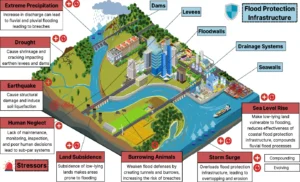
- Unplanned development, shrinking wetlands, sediment-filled rivers, and changing land use have significantly reduced the state’s ability to absorb and drain excess rainwater, making floods more frequent and destructive.
Major Reasons Behind the Severity of Kerala Floods
Reduced Carrying Capacity of Rivers
- Rivers have accumulated large amounts of silt and sand, reducing their water-carrying capacity.
- The 2018 floods deposited massive sediments in river channels, which were not adequately removed.
- Frequent landslides in hilly regions continue to add soil and debris into rivers.
- Formation of sandbars and small deltas slows the flow of floodwater, causing rivers to overflow quickly.
Sedimentation in Reservoirs and Dams
- Many reservoirs have lost a significant portion of their storage due to continuous silt deposition.
- Lower storage capacity forces dam authorities to release water earlier during heavy rainfall, increasing downstream flood risk.
- Lack of regular sediment studies and desilting has worsened the situation.
Loss of Wetlands and Paddy Fields
- Wetlands, marshes, and paddy fields naturally absorb excess rainwater and recharge groundwater.
- Rapid urbanisation and conversion of agricultural land have drastically reduced these natural flood buffers.
- As a result, rainwater flows directly into rivers instead of being temporarily stored in low-lying areas.
Changes in Natural Drainage
- Expansion of roads, buildings, parking areas, and concrete surfaces has increased impermeable land cover.
- Rainwater now runs off rapidly into rivers instead of percolating into the soil.
- This accelerates flooding, especially in urban and low-lying areas.
Climate Change
- Rising temperatures have increased the frequency of extreme rainfall events over short durations.
- Such intense rainfall overwhelms rivers and drainage systems, increasing the likelihood of flash floods.
Impacts of the Floods
- Loss of lives and large-scale displacement of people.
- Damage to houses, roads, bridges, and public infrastructure.
- Crop losses and disruption of local livelihoods.
- Increased risk of water-borne diseases after floodwaters recede.
- High expenditure on relief, rehabilitation, and reconstruction.
Government Measures
- Proposal to desilt rivers and reservoirs to improve water storage and flow.
- Preparation of an asset register for rivers, streams, and lakes.
- Land audits to prevent encroachment of water bodies.
- Better coordination in dam management and flood forecasting.
- Promotion of scientific river restoration and sustainable watershed management.
Way Forward
- Restore wetlands, floodplains, and paddy fields as natural water-storage systems.
- Undertake periodic desilting of rivers and reservoirs based on scientific assessment.
- Enforce strict land-use regulations to prevent encroachments in flood-prone areas.
- Strengthen urban drainage systems and adopt sponge city concepts.
- Integrate climate-resilient infrastructure, early warning systems, and community-based disaster preparedness.
Conclusion
Long-term flood management requires a combination of scientific planning, ecosystem restoration, and sustainable urban development. Building resilience today will reduce future disaster losses and support environmentally responsible growth.