

...
Daily Current affairs 07 September 2026

Daily Current Affairs 07 September 2026

Share this Post

INDIA–CHINA MILITARY TALKS IN ARUNACHAL PRADESH

TOPIC: (GS2) POLITY: THE HINDU

India and China held their first Corps Commanderlevel meeting in the Eastern Sector of the Line of Actual Control (LAC) at the Vacha–Damai Border Personnel Meeting Point in Arunachal Pradesh.

India–China Relations

  • Ancient cultural exchanges through Buddhism (monks like Xuanzang visited India). Trade via the Silk Route connected India with China for centuries.
  • Border Disputes: India and China share a 3,488 km long border across Ladakh, Himachal Pradesh, Uttarakhand, Sikkim, and Arunachal Pradesh.
  • Disputes exist in Aksai Chin (claimed by India, controlled by China) and Arunachal Pradesh (claimed by China as “South Tibet”).
  • The 1962 SinoIndian War was fought over border disputes.
  • Later agreements: 1993 (Maintenance of Peace & Tranquility), 1996 (Confidence Building Measures), 2005 (Political Parameters for Boundary Settlement).
  • China is one of India’s largest trading partners.
  • Both countries are members of BRICS, SCO, G20, and cooperate in multilateral forums.
  • Military tensions at the Line of Actual Control (LAC) (e.g., Galwan clashes 2020) coexist with dialogue mechanisms like WMCC and Special Representatives’ talks.

Key Developments

  • The Indian side was led by Lt. Gen. Girish Kalia, Commander of the 3 Corps (Spear Corps), headquartered at Rangapahar, Nagaland. The delegation included officers from the IndoTibetan Border Police (ITBP).
  • The 3 Corps and 4 Corps (Tezpur) are responsible for the frontier in Arunachal Pradesh.
  • The talks precede the BRICS Summit (Sept 11–13, New Delhi), where Chinese President Xi Jinping is expected to attend.
  • Backdrop: Reports of Chinese incursions and military activity in Taksing (Upper Subansiri district) prompted the meeting.
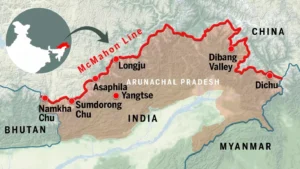
India-China Military Talks in Arunachal Pradesh

Significance

  • Traditionally, Corps Commanderlevel talks were held at Chushul–Moldo (Ladakh). Extending this mechanism to the Eastern Sector reflects India’s intent to institutionalize dialogue across all sensitive border areas.
  • The meeting follows the 36th WMCC (Aug 6, 2026) and the 25th Special Representatives’ talks (Aug 26, Beijing), where both sides signed an eightpoint outcome document.
  • Establishment of two new Border Personnel Meeting Points (Eastern & Central Sectors). Creation of new hotlines for better communication.
  • Army Chief Gen. Dhiraj Seth recently reviewed combat readiness at 3 Corps HQ, underlining India’s focus on strengthening infrastructure and surveillance in Arunachal Pradesh.

Conclusion

By extending highlevel military dialogue beyond Ladakh, India signals its determination to safeguard sovereignty while keeping communication channels open. The outcome reflects a pragmatic strategy: strengthening operational readiness, institutionalizing dialogue, and balancing security with diplomacy.

JUDICIAL INTEGRITY AND INSTITUTIONAL ACCOUNTABILITY IN INDIA

TOPIC: (GS2) POLITY: THE HINDU

Recent allegations against Justice Sanjeev Prakash Sharma, Acting Chief Justice of the Rajasthan High Court, have raised serious concerns about judicial integrity.

Background

  • Rajasthan High Court operated without a permanent Chief Justice for nearly 11 months, undermining institutional stability.
  • Complaints include victimisation of judges, favoritism towards select lawyers, and improper case transfers. Justice Sharma has denied these charges.
  • Lawyers staged protests, forcing Justice Sharma to step aside from hearings. Subsequently, the Collegium recommended Justice Sanjay Agrawal as the new Chief Justice.
  • India’s judicial appointment process, dominated by the Collegium and executive collaboration, remains opaque and vulnerable to arbitrariness.

Historical Precedents

  • In 1990, Justice V. Ramaswami faced inquiry,  CJIs Mukharji and Venkatachaliah ensured he was kept away from judicial work despite impeachment failure.
  • In 2025, Justice Yashwant Varma was swiftly transferred and denied judicial work after allegations of misconduct.
  • These examples show that prompt action by CJIs can preserve institutional credibility even without systemic reforms.

Structural Concerns

  • Appointments: No transparent criteria; India’s judicial selection remains closed system.
  • Judges (Inquiry) Act, 1968: Weak law, rarely used, ineffective against corruption.
  • K. Veeraswami Case (1991): FIR against judges needs CJI’s prior permission.
  • Judicial Standards Bill (2012): Lapsed; impeachment remains ineffective accountability option.
  • Inhouse Mechanism (1999): Internal system exists but failed to deliver credible outcomes.

Institutional Accountability in judiciary

  • Foundation of Rule of Law: Integrity ensures that justice is impartial, fair, and credible.
  • Public Trust: Accountability builds confidence in institutions, preventing erosion of democratic legitimacy.
  • Checks and Balances: Transparent systems prevent misuse of power and arbitrary decisionmaking.
  • Corruption Control: Strong accountability mechanisms reduce corruption and safeguard institutional reputation.
  • Meritocracy: Integrity in appointments ensures only competent and ethical individuals hold office.

CHIEF JUSTICE OF A HIGH COURT

  • Appointment Authority: The President of India appoints the Chief Justice of a High Court.
  • Process:
    • The Collegium System recommends names (Supreme Court CJI + senior judges).
    • The recommendation is sent to the Union Law Ministry, then to the Prime Minister, and finally to the President for approval.
  • Tenure: Holds office until the age of 62 years (Article 217).
  • Transfer: A High Court judge, including the Chief Justice, can be transferred to another High Court by the President, after consultation with the CJI (Article 222).
  • Qualifications (Article 217):
    • Must be a citizen of India.
    • Must have at least 10 years as an advocate in a High Court, or 10 years as a judicial officer in India.
  • Removal:
    • Same process as Supreme Court judges — by impeachment under Article 217(1)(b) read with Article 124(4).
    • Requires a motion passed by Parliament with special majority.
  • Oath: Administered by the Governor of the State (Article 219).

Conclusion

The Rajasthan High Court episode underscores the urgent need for judicial statesmanship and systemic reform. Judicial integrity is the cornerstone of democracy; without credible accountability, the legitimacy of the judiciary itself is at risk.

EOS05: INDIA’S FIRST GEOSYNCHRONOUS EARTHIMAGING SATELLITE

TOPIC: (GS3) SCIENCE AND TECHNOLOGY: THE HINDU

The Indian Space Research Organisation (ISRO) successfully launched EOS05, India’s first dedicated earthimaging satellite in geosynchronous orbit (~36,000 km), marking a strategic milestone in space technology.

What Are EarthImaging Satellites?

  • Artificial satellites equipped with sensors that collect images and information about Earth’s surface and atmosphere.
  • Use remote sensing instruments (active and passive) to measure electromagnetic radiation reflected or emitted by Earth.
  • Launches began with Sputnik 1 (1957) and later Explorer 6 (1959), which captured the first crude images of Earth.

EOS05 India’s First Geosynchronous Earthimaging Satellite

Key Features

  • Orbit: Geosynchronous, enabling continuous observation of the same region.
  • Payloads: Multispectral sensors to distinguish vegetation, water, land use.
  • Coverage: Rapid revisit capability with imaging Indian subcontinent every 30 minutes.
  • Applications: Agriculture monitoring, disaster management, environment studies, and strategic surveillance.
  • Comparison: Unlike lowearth orbit satellites (polar/sunsynchronous), EOS05 trades fine detail for realtime, frequent coverage.

Strategic Importance

  • Disaster Monitoring: Tracks floods, cyclones, forest fires, and glacier changes.
  • Agriculture: Assesses crop health, irrigation, and stubble burning patterns.
  • Security: Supports border surveillance and strategic monitoring.
  • Environment: Observes deforestation, pollution, and landform changes.

Institutional Significance

  • ISRO’s Resilience: EOS05 marks the first successful launch of 2026, restoring confidence after two PSLV failures (2025, 2026).
  • Cryogenic Stage: Success strengthens reliability of GSLV after earlier setbacks.
  • Strategic Label: ISRO describes EOS05 as “strategic,” reflecting its dual civilian and defence utility.

Broader Context

  • India earlier relied on INSAT3D series for weather imaging in geostationary orbit.
  • Dedicated earthobservation satellites were limited to lowearth orbits, offering high resolution but less frequent coverage.
  • EOS05 bridges this gap, combining widearea monitoring with rapid revisit cycles.

Conclusion

EOS05 represents a technological leap for India’s space programme, enhancing capabilities in realtime monitoring, disaster preparedness, agriculture, and national security. For India, the true measure of credibility lies not in one successful launch but in the consistent utility of payloads and sustained cadence of missions.


INDIA’S UNEMPLOYMENT DATA DILEMMA

TOPIC: (GS3) ECONOMY: THE HINDU

India has begun publishing monthly unemployment data through the Periodic Labour Force Survey (PLFS), but questions remain about its credibility and ability to capture the realities of India’s labour market.

Recent Trends

  • PLFS reported unemployment at 5.1% in July 2026, a fourmonth low.
  • Decline driven by seasonal demand in agriculture and construction during kharif season, not structural job creation.
  • Rural unemployment fell to 4.5%, but this reflects distressdriven entry into lowproductivity jobs, not sustainable employment.
  • Labour Force Participation Rate (LFPR) rose, but translating participation into stable, highproductivity jobs remains the challenge.

Advantages of Monthly Unemployment Data

  • Highfrequency indicator: Provides quicker insights into labour market trends compared to yearly surveys.
  • Policy responsiveness: Helps government take timely corrective measures for job creation and welfare schemes.
  • Seasonal employment capture: Reflects shortterm changes in agriculture, construction, and informal sectors.
  • Labour participation tracking: Monitors shifts in workforce entry, especially among youth and women.

Challenges in Measurement

  • Current Weekly Status (CWS) measures activity in the past seven days, but fails to capture job quality, wage regularity, and underemployment.
  • Nearly 90% of India’s workforce is informal, making headline unemployment rates inadequate.
  • Seasonal labour migration (30–35 million workers annually) is rarely reflected in official statistics.
  • EPFO, ESIC, GST records, corporate payrolls, gig economy data, and rural wage indicators remain disconnected and incomplete.

Global Comparison

  • Advanced economies (U.S., EU, Japan, U.K.) rely on Labour Force Surveys aligned with ILO definitions, supported by decades of household data.
  • These surveys capture job duration, wages, parttime vs fulltime work, labour mobility, and unemployment spells, offering a more comprehensive picture.

Conclusion

India’s move to monthly unemployment data is a step forward, but without addressing informal sector dominance, migration, and job quality, the statistics risk being misleading. A robust, transparent, and integrated labour database is vital to ensure that employment figures reflect real improvements in livelihoods, not just seasonal fluctuations.

A DECADE OF INFLATION TARGETING IN INDIA

TOPIC: (GS3) ECONOMY: THE HINDU

India has completed ten years of inflation targeting (IT) as a formal policy framework of the Reserve Bank of India (RBI). The RBI aims to maintain inflation at 4% ± 2%. However, recent studies suggest India’s Phillips curve is flat, raising doubts about IT’s effectiveness.

Inflation targeting in India

  • Adoption: Inflation targeting was formally institutionalised through an amendment to the RBI Act, 1934 in May 2016.
  • Mandate: RBI’s primary objective is to maintain price stability while keeping growth in mind.
  • Target: CPI inflation at 4% ± 2% (i.e., between 2% and 6%).
  • Review: The target is set by the Central Government in consultation with RBI once every five years (Section 45ZA).
  • Renewal: In March 2026, the government extended the framework till March 2031 with the same parameters.

Key Considerations of MPC in Inflation Targeting

  • Consumer Price Index (CPI): Primary measure of inflation, with focus on food and fuel components.
  • Core Inflation: Excludes volatile items like food and fuel to assess underlying price trends.
  • Supply Shocks: Impact of monsoon, agricultural output, global oil prices, and supply chain disruptions.
  • Growth Tradeoff: Balances inflation control with GDP growth and employment generation.
  • Inflation Expectations: Household and business expectations influence wage negotiations and pricing behaviour.

Comparative Perspective

  • Advanced Economies: IT works better due to strong wageprice linkages, mature labour markets, and reliable household survey data.
  • India’s Reality: Informal employment and weak wage bargaining dilute the assumptions behind IT, limiting its effectiveness.

Challenges of Inflation Targeting in India

  • Headline Inflation Focus: Overemphasis on headline CPI ignores supply shocks, food, and fuel volatility.
  • Growth Tradeoff: Monetary tightening disproportionately hurts output, investment, and employment generation.
  • Weak Labour Data: Lack of reliable data on job quality, wages, and productivity hampers policy design.
  • Fiscal Coordination Gap: Inflation targeting works in isolation without adequate fiscal support for infrastructure, agriculture, and welfare.
  • Expectation Mismatch: Household inflation expectations remain consistently higher than RBI projections, reducing credibility.

MONETARY POLICY COMMITTEE

The Monetary Policy Committee (MPC) is India’s statutory body within the Reserve Bank of India (RBI) that decides the country’s benchmark interest rate (repo rate) to manage inflation and support growth. It was formally established in 2016 under amendments to the RBI Act, 1934, as part of India’s inflationtargeting framework.

Composition of MPC

  • RBI Governor: Chairperson of the committee.
  • RBI Deputy Governor: In charge of monetary policy.
  • One RBI official: Nominated by the Central Board.
  • Three external members: Appointed by the Government of India.
  • Tenure: External members serve for 4 years, not eligible for immediate reappointment.
  • Decision Rule: Each member has one vote; in case of a tie, the RBI Governor has a casting vote.

Conclusion

Inflation targeting disciplines policy, but India’s flat Phillips curve and mismatched expectations demand a broader approach combining growth, employment, structural reforms, and sustainable stability.

BAR COUNCIL OF INDIA (BCI)

TOPIC: (GS2) POLITY: THE HINDU

The Supreme Court recently ruled that the Bar Council of India (BCI) and its chairperson lack jurisdiction to discipline or penalise law students, reaffirming its role as a regulator of advocates only.

About BCI

  • Statutory Body: Established under the Advocates Act, 1961 based on recommendations of the All India Bar Committee.
  • Objective: Safeguards the rights, interests, and privileges of advocates across India.
  • Representation: Serves as the apex body regulating the legal profession and education.

Functions of BCI

  • Regulatory Role: Prescribes standards of professional conduct and exercises disciplinary jurisdiction over advocates.
  • Legal Education: Sets standards for law colleges and grants recognition to universities whose law degrees qualify for enrolment.
  • Examinations: Conducts the All India Bar Examination (AIBE) to grant a Certificate of Practice.
  • Welfare Schemes: Provides support for economically weaker and physically handicapped advocates.
  • International Recognition: Recognizes foreign law qualifications on a reciprocal basis.

Composition

  • Members elected from each State Bar Council, plus the Attorney General of India and Solicitor General of India as exofficio members.
  • Members serve for five years; Chairman and ViceChairman are elected for two years.

Conclusion

The Bar Council of India plays a pivotal role in regulating the legal profession and education in India. While its jurisdiction is limited to advocates, its functions ensure professional standards, welfare, and credibility of the Indian bar.

Write a Review

Your email address will not be published. Required fields are marked *

Seraphinite AcceleratorOptimized by Seraphinite Accelerator
Turns on site high speed to be attractive for people and search engines.