Table of Contents
ToggleUnderstanding Union Territories in India is crucial for candidates preparing Union Territories Notes UPSC for the Indian Polity UPSC syllabus. Unlike full-fledged states, a Union Territory of India represents a unit directly administered by the Central Government, reflecting a distinct administrative structure under the Union Territories Indian Constitution framework.
What are Union Territories & Constitutional Provisions
A Union Territory of India is a federally governed administrative division. Governed under Part VIII of the Constitution (Articles 239 to 241), the primary constitutional provisions include:
- Article 239: Direct Administration of Union Territories by the President through an appointed Administrator of Union Territories or Lieutenant Governor of Union Territories.
- Article 239A: Creation of local legislatures or Council of Ministers for certain UTs (such as Puducherry and Jammu & Kashmir).
- Article 239AA & Article 239AB: Special Constitutional Position of Delhi (National Capital Territory of Delhi) establishing an elected Assembly alongside special administrative provisions.
- Article 240: Power of the President to make regulations for certain UTs (e.g., Andaman & Nicobar Islands, Lakshadweep).
- Article 241: Power of Parliament to establish High Courts for Union Territories of India.
State vs Union Territory & Administration
| States | Union Territories |
|---|---|
| Possess an independent constitutional structure with executive and legislative autonomy over State List subjects. | Feature centralized oversight where Parliament retains ultimate legislative authority over State and Concurrent subjects. |
List of Union Territories in India
| Category | Union Territories |
|---|---|
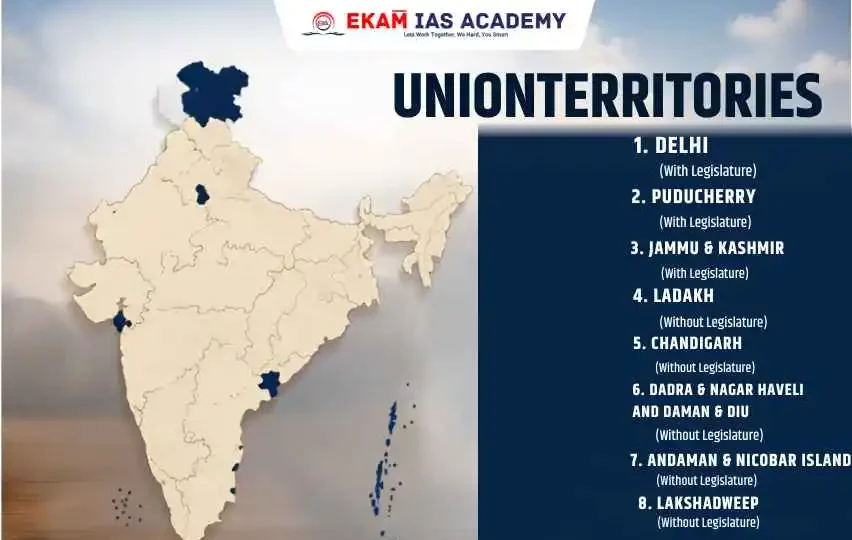
| Union Territories with Legislatures | Delhi, Puducherry, and Jammu & Kashmir |
| Union Territories Without Legislatures | Ladakh, Chandigarh, Dadra & Nagar Haveli and Daman & Diu, Andaman & Nicobar Islands, and Lakshadweep |
Strategic Importance, Challenges, & Federal Dynamics
The creation and maintenance of Union Territories in India UPSC units stem from distinct political, cultural, or strategic reasons (such as border security or island protection). However, governance challenges persist regarding jurisdictional friction between elected Chief Ministers and appointed Lieutenant Governors, particularly in Delhi and Puducherry. Balancing central administration with local democratic aspirations remains an evolving topic in Union Territories and States dynamics.
Conclusion
Mastering the constitutional articles and structural nuances of Union Territories in India is vital for securing high marks in Union Territories UPSC examinations. These territories demonstrate the adaptive flexibility of Indian federalism, ensuring national security alongside localized democratic governance.
UPSC Prelims: PYQs & Practice Questions
Previous Year Questions (Prelims)
Q: Which one of the following statements is correct regarding Union Territories in India?
(a) Every Union Territory is administered by the President acting through an Administrator appointed by him.
(b) The President can make regulations for the peace, progress and good government of all Union Territories under Article 240.
(c) Parliament cannot establish a High Court for a Union Territory or declare any court in such territory to be a High Court.
(d) An Administrator of a Union Territory is a constitutional head of state equivalent to a Governor.
Answer: (a)
Explanation:
Statement (a) is correct. Under
Article 239, every Union Territory is administered by the President, acting to such extent as he thinks fit through an
Administrator appointed by him.
Statement (b) is incorrect. Under
Article 240, the President can make regulations for the peace, progress and good government of
specified Union Territories, not all Union Territories.
Statement (c) is incorrect. Under
Article 241, Parliament may by law constitute a
High Court for a Union Territory or declare any court in such territory to be a High Court.
Statement (d) is incorrect. The Administrator of a Union Territory functions as an
agent of the President and does not enjoy the same constitutional position as the Governor of a State.
Q: Consider the following statements:
1. The Constitution of India provides for a legislature in every Union Territory.
2. The Administrator of a Union Territory can promulgate ordinances when the Legislative Assembly is dissolved or suspended.
Which of the statements given above is/are correct?
(a) 1 only
(b) 2 only
(c) Both 1 and 2
(d) Neither 1 nor 2
Answer: (d) Neither 1 nor 2
Explanation:
Statement 1 is incorrect. The Constitution does not provide a legislature for every Union Territory. Legislatures exist only in specified Union Territories, including
Puducherry, Delhi and Jammu & Kashmir.
Statement 2 is incorrect. Under
Article 239B, the Administrator may promulgate ordinances only when the Legislative Assembly is
not in session.
Such ordinance-making power cannot be exercised during a period when the Legislative Assembly is
dissolved or its functioning remains suspended.
Practice Questions
Q: With reference to the Special Constitutional Status of the National Capital Territory of Delhi under Article 239AA, consider the following statements:
1. The Legislative Assembly of Delhi can make laws on all subjects in the State List and Concurrent List except Public Order, Police and Land.
2. The Chief Minister of Delhi is appointed by the Lieutenant Governor of Delhi.
3. In case of a difference of opinion between the Lieutenant Governor and his Ministers, the Lieutenant Governor must refer the matter to the President for a decision.
Which of the statements given above are correct?
(a) 1 and 2 only
(b) 1 and 3 only
(c) 2 and 3 only
(d) 1, 2 and 3
Answer: (b) 1 and 3 only
Explanation:
Statement 1 is correct. Under
Article 239AA(3), the Delhi Legislative Assembly can make laws on subjects in the State List and Concurrent List, except
Entries 1, 2 and 18 of the State List, relating to
Public Order, Police and Land.
Statement 2 is incorrect. Under
Article 239AA(5), the Chief Minister of Delhi is appointed by the
President, not by the Lieutenant Governor.
Statement 3 is correct. Under
Article 239AA(4), where there is a difference of opinion between the Lieutenant Governor and the Council of Ministers, the Lieutenant Governor may refer the matter to the
President for a decision and act according to the President’s direction.
Q: Consider the following statements regarding the administration of Union Territories in India:
1. A Governor of an adjoining State can be appointed as the Administrator of a Union Territory.
2. When a Governor is appointed as the Administrator of an adjoining Union Territory, he exercises his functions as Administrator independently of his State Council of Ministers.
Which of the statements given above is/are correct?
(a) 1 only
(b) 2 only
(c) Both 1 and 2
(d) Neither 1 nor 2
Answer: (c) Both 1 and 2
Explanation:
Statement 1 is correct. Under
Article 239(2), the President may appoint the Governor of a State as the
Administrator of an adjoining Union Territory.
Statement 2 is correct. When functioning as the Administrator of a Union Territory, the Governor acts
independently of the Council of Ministers of his State.
UPSC Mains – Previous Year & Practice Questions
Mains Previous Year Questions
[15 Marks | 250 Words]
Question: “The office of the Lieutenant Governor in Union Territories with Legislative Assemblies has become a flashpoint in Centre-State political relations.” Discuss with reference to the National Capital Territory of Delhi.
[15 Marks | 250 Words]
Question: Whether the Supreme Court judgment of 2018 in the NCT of Delhi vs. Union of India case settled the long-standing jurisdictional dispute between the Chief Minister and the Lieutenant Governor? Critically analyse. (UPSC CSE Mains 2021, GS Paper II)
[15 Marks | 250 Words]
Question: The reorganisation of Jammu and Kashmir under the Jammu and Kashmir Reorganisation Act, 2019 altered the constitutional status of the region from a full State to two Union Territories. Examine the legal and administrative implications of this transition. (UPSC CSE Mains 2019, GS Paper II)
[10 Marks | 150 Words]
Question: Examine the special constitutional position enjoyed by the National Capital Territory of Delhi under Article 239AA. How does it differ from other Union Territories with local legislatures such as Puducherry? (UPSC CSE Mains 2016, GS Paper II)
[10 Marks | 150 Words]
Question: Discuss the constitutional grounds and rationale behind the creation of Union Territories in India. How far do they fit within the broader framework of Indian Federalism? (UPSC CSE Mains 2013, GS Paper II)
Mains Practice Questions
[15 Marks | 250 Words]
Question: “Union Territories in India reflect an exception to the general framework of cooperative federalism by establishing direct central oversight.” Evaluate the constitutional mechanisms that balance central administration with regional democratic aspirations.
[15 Marks | 250 Words]
Question: Compare and contrast the legislative and executive powers of the Legislative Assemblies of Puducherry, Delhi and Jammu & Kashmir. How does the scope of Central intervention vary across these Union Territories?
[10 Marks | 150 Words]
Question: “Ambiguity in statutory powers between elected Chief Ministers and appointed Administrators or Lieutenant Governors frequently leads to governance friction in Union Territories.” Suggest constitutional and procedural reforms to streamline Union Territory administration.



Union Territories-FAQs
What is a Union Territory in India?
A Union Territory is an administrative unit governed directly by the Union Government through an Administrator or Lieutenant Governor appointed by the President.
Which Articles deal with Union Territories?
Articles 239 to 241 under Part VIII of the Indian Constitution deal with the administration and legal framework of Union Territories.
How many Union Territories are there in India?
India currently has 8 Union Territories: Delhi, Puducherry, Jammu & Kashmir, Ladakh, Chandigarh, Dadra & Nagar Haveli and Daman & Diu, Andaman & Nicobar Islands, and Lakshadweep.
Which Union Territories have legislatures?
Delhi, Puducherry, and Jammu & Kashmir are Union Territories with legislatures.
Why are Union Territories important for UPSC?
Union Territories are important because they connect Indian federalism, Centre-State relations, constitutional administration, national security, and democratic governance.