
Table of Contents
ToggleThe framework of Special Provisions for States in the Indian Constitution reflects the unique adaptiveness of Asymmetric Federalism in India. Designed to cater to regional aspirations, protect tribal cultures, and address economic imbalances, mastering Special Provisions for States UPSC topics is essential for students preparing comprehensive Centre State Relations UPSC notes and navigating Indian Federalism UPSC questions in Special Provisions for States Indian Polity.
What are Special Provisions for States & Why Were They Introduced?
Special Constitutional Provisions are temporary, transition, or specific constitutional guarantees granted to certain states under Part XXI of the Constitution. Why Were Special Provisions Introduced? They were incorporated to:
- Protect traditional tribal land ownership and social customs.
- Mitigate socio-economic backwardness in remote, hilly, or border regions.
- Resolve law and order challenges stemming from ethnic insurgencies.
- Fulfill historical commitments made during political integrations.
Constitutional Articles: Special Provisions Under Article 371
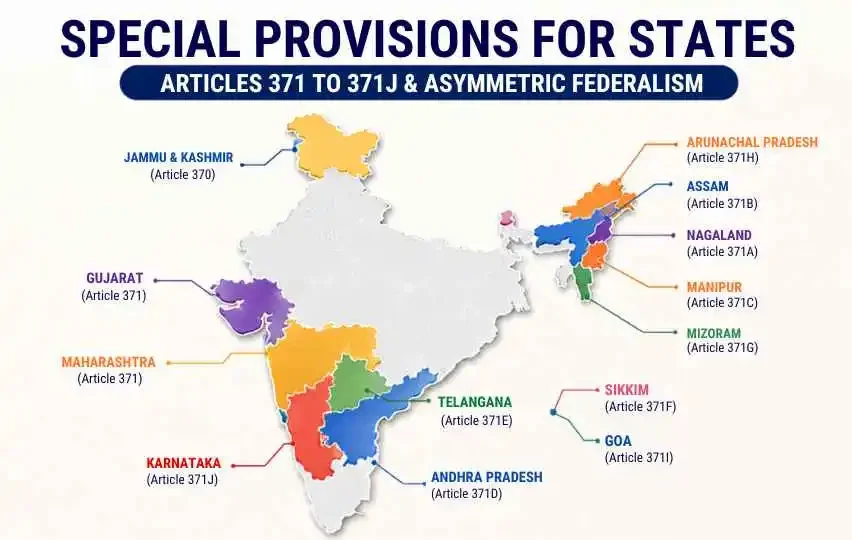
The primary Constitutional Articles Related to Special Provisions range across Articles 371 to 371J:
- Article 371: Special provisions for Maharashtra and Gujarat (development boards for Vidarbha, Marathwada, Saurashtra, and Kutch).
- Article 371A: Special Provisions for Nagaland protecting Naga customary law, ownership of land and resources, and civil/criminal justice practices.
- Article 371B: Special Provisions for Assam regarding the committee of the Legislative Assembly for tribal areas.
- Article 371C: Special Provisions for Manipur providing for a committee of assembly members elected from the Hill Areas.
- Article 371D & 371E: Special Provisions for Andhra Pradesh and Special Provisions for Telangana regarding equitable opportunities in public employment, education, and the establishment of a Central University.
- Article 371F: Special provisions for Sikkim following its integration.
- Article 371G: Special provisions for Mizoram regarding religious and social practices, land ownership, and customary law.
- Article 371H: Special provisions for Arunachal Pradesh granting special responsibility to the Governor regarding law and order.
- Article 371I: Special provisions for Goa regarding legislative assembly size.
- Article 371J: Special provisions for Karnataka establishing a development board for the Hyderabad-Karnataka (Kalyana-Karnataka) region.
Special Provisions vs Special Status & Asymmetric Federalism
A clear distinction exists between Special Provisions in Indian Constitution and Special Status of States in India:
- Special Status: Traditionally referred to financial assistance granted under the former Gadgil-Mukherjee formula by the Centre (90% grants, 10% loans).
- Special Provisions Under Article 371: Refer to specific constitutional safeguards protecting culture, identity, land rights, or regional administrative mechanisms.
These mechanisms underscore Asymmetric Federalism in India, ensuring equal integration of diverse regions without enforcing uniform assimilation.
Advantages, Challenges, and Important Amendments
- Advantages: Preserves local tribal heritages, maintains national integrity, and targets regional development.
- Challenges: Creates administrative complexity, triggers demands for similar privileges from other regions, and occasionally generates friction with central legislation.
- Important Amendments: Key constitutional amendments—such as the 13th Amendment (Article 371A), 27th Amendment (Article 371C), and 98th Amendment (Article 371J)—have continuously adapted the Article 371 Indian Constitution provisions to dynamic regional demands.
Conclusion
Understanding Special Provisions for States provides deep insights into how the Article 371 UPSC provisions maintain equilibrium between regional diversity and national unity. Studying these Special Constitutional Provisions helps civil services candidates grasp the constitutional genius of Asymmetric Federalism in India.
UPSC Prelims: PYQs & Practice Questions
Previous Year Questions (Prelims)
Q: Which one of the following Articles of the Constitution of India deals with special provisions regarding Nagaland?
(a) Article 370
(b) Article 371A
(c) Article 371B
(d) Fifth Schedule
Answer: (b) Article 371A
Explanation:
Article 371A provides special constitutional safeguards for the State of
Nagaland.
It was inserted through the
13th Constitutional Amendment Act, 1962.
Under Article 371A, Acts of Parliament relating to
Naga religious or social practices, Naga customary law and procedure, administration of civil and criminal justice according to Naga customary law, and ownership and transfer of land and its resources
do not automatically apply to Nagaland unless the
Nagaland Legislative Assembly passes a resolution to that effect.
Q: Consider the following statements regarding the special provisions under Article 371 of the Constitution of India: (UPSC CSE Prelims 2014)
1. Article 371 deals with special provisions for the States of Maharashtra and Gujarat.
2. Under Article 371, the Governor of Maharashtra has a special responsibility for the establishment of separate development boards for Vidarbha and Marathwada.
Which of the statements given above is/are correct?
(a) 1 only
(b) 2 only
(c) Both 1 and 2
(d) Neither 1 nor 2
Answer: (c) Both 1 and 2
Explanation:
Statement 1 is correct. Article 371 contains special provisions relating to
Maharashtra and Gujarat.
Statement 2 is correct. The President may confer special responsibility upon the Governor of Maharashtra for establishing separate
development boards for Vidarbha, Marathwada and the rest of Maharashtra.
Similar provisions exist for
Saurashtra, Kutch and the rest of Gujarat.
These provisions aim to ensure
equitable allocation of development funds, balanced regional development and adequate opportunities for technical and vocational education and employment.
Practice Questions
Q: With reference to Article 371J of the Constitution of India, consider the following statements:
1. It grants special provisions to the Hyderabad-Karnataka, now Kalyana-Karnataka, region.
2. It was added to the Constitution by the 98th Constitutional Amendment Act, 2012.
3. It provides for reservation in educational institutions and public employment for people belonging to the region.
How many of the above statements are correct?
(a) Only one
(b) Only two
(c) All three
(d) None
Answer: (c) All three
Explanation:
All three statements are correct.
Article 371J provides special constitutional provisions for the
Hyderabad-Karnataka region, now known as Kalyana-Karnataka.
It was inserted through the
98th Constitutional Amendment Act, 2012.
The provision enables the establishment of a
development board for the region, equitable allocation of developmental expenditure, and special opportunities for local residents in
education and public employment.
Q: Consider the following pairs of constitutional Articles and their corresponding States:
1. Article 371C — Manipur
2. Article 371F — Sikkim
3. Article 371G — Mizoram
4. Article 371H — Arunachal Pradesh
How many of the pairs given above are correctly matched?
(a) Only one pair
(b) Only two pairs
(c) Only three pairs
(d) All four pairs
Answer: (d) All four pairs
Explanation:
All four pairs are correctly matched.
Article 371C: Special provisions for
Manipur, including arrangements relating to the Hill Areas Committee.
Article 371F: Special constitutional provisions for
Sikkim.
Article 371G: Special provisions for
Mizoram, including safeguards relating to Mizo religious and social practices, customary law and land.
Article 371H: Special provisions for
Arunachal Pradesh, including the Governor’s special responsibility with respect to law and order.
UPSC Mains – Previous Year & Practice Questions
Mains Previous Year Questions
[15 Marks]
Question: “ Asymmetric Federalism is a structural feature of the Indian Constitution designed to accommodate diverse historical and regional realities.” Evaluate in the light of Articles 371 to 371J. (UPSC GS Paper II – 2021)
[10 Marks]
Question: “ Article 371A of the Indian Constitution reflects a unique compromise between national integration and tribal autonomy.” Discuss how customary rights are protected under this provision. (UPSC GS Paper II – 2019)
[15 Marks]
Question: Compare and contrast the scope of autonomy granted under the Sixth Schedule with that under Articles 371 to 371J for the North-Eastern States. (UPSC GS Paper II – 2018)
[10 Marks]
Question: How do special provisions under Article 371 contribute to reducing regional disparities within a State? Answer with special reference to Maharashtra and Karnataka. (UPSC GS Paper II – 2016)
[15 Marks]
Question: Discuss the constitutional mechanisms available under Indian Federalism to address sub-national regional aspirations without weakening the Union. (UPSC GS Paper II – 2014)
Mains Practice Questions
[15 Marks | 250 Words]
Question: How do Articles 371 to 371J institutionalize the principle of “holding together” federalism in India? Examine their role in mitigating internal security challenges in border States.
[10 Marks | 150 Words]
Question: “ Special status based on financial grants and special constitutional provisions under Article 371 serve distinct purposes.” Analyse the differences and discuss the growing demands by States for special constitutional status.
[15 Marks | 250 Words]
Question: Critically evaluate the special and discretionary responsibilities assigned to Governors under various provisions of Articles 371 to 371J. Do such powers undermine the authority of the elected State executive?
Special Provisions for States-FAQs
What are Special Provisions for States?
Special Provisions for States are constitutional safeguards under Part XXI that address regional, cultural, tribal, administrative and developmental needs of certain states.
Which Articles deal with Special Provisions for States?
Articles 371 to 371J deal with special provisions for states such as Maharashtra, Gujarat, Nagaland, Assam, Manipur, Andhra Pradesh, Telangana, Sikkim, Mizoram, Arunachal Pradesh, Goa and Karnataka.
What is Article 371A?
Article 371A provides special safeguards for Nagaland, including protection of Naga customary law, social practices, land ownership and resource rights.
What is Article 371J?
Article 371J provides special provisions for Karnataka’s Hyderabad-Karnataka, now Kalyana-Karnataka, region through a development board and reservation benefits.
Why are Special Provisions important for UPSC?
They are important because they connect Indian federalism, asymmetric federalism, Centre-State relations, tribal rights, regional development and national integration.