Table of Contents
ToggleLabour Rights in India: Supreme Court, BWSSB and the Meaning of Industry
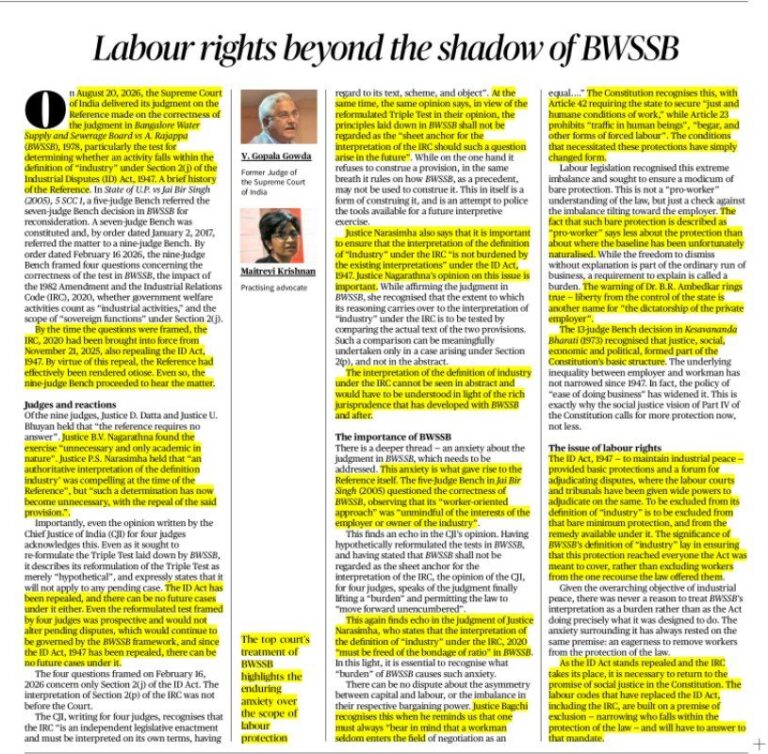
The Supreme Court’s 2026 consideration of the Bangalore Water Supply and Sewerage Board (BWSSB) case has revived an important debate on the scope of labour rights in India. At the centre of the issue is the meaning of “industry” under labour law and whether workers should continue receiving the broad protections developed through decades of judicial interpretation.
What Is the BWSSB Case?
In Bangalore Water Supply and Sewerage Board v. A. Rajappa (1978), a seven-judge Bench of the Supreme Court gave a broad interpretation to the term “industry” under Section 2(j) of the Industrial Disputes Act, 1947.
The judgment expanded labour-law protection to a wide range of establishments and workers. Its interpretation later came under reconsideration, including through State of U.P. v. Jai Bir Singh (2005) and a Presidential Reference under Article 143 of the Constitution.
Why Does the Definition of “Industry” Matter?
The definition determines which workers can access important labour protections, including remedies against arbitrary dismissal and mechanisms for resolving industrial disputes.
The article argues that narrowing the definition may exclude large categories of workers from legal protection. Therefore, interpretation cannot be separated from the broader history and purpose of Indian labour jurisprudence.
Constitutional Basis of Labour Protection
The article highlights the constitutional foundations of labour welfare. Article 42 directs the State to secure just and humane conditions of work, while Article 23 prohibits forced labour, including begar and similar forms of exploitation.
Labour legislation is based on the recognition that employers and workers often possess unequal bargaining power. Protective laws therefore seek to create greater fairness rather than provide an unjustified advantage to workers.
Labour Rights and Social Justice
The article also connects labour protection with the constitutional commitment to social, economic and political justice. It refers to Kesavananda Bharati (1973) to underline the importance of social justice within India’s constitutional framework.
Industrial Relations Code and the Future of Labour Rights
With the Industrial Relations Code (IRC) replacing the Industrial Disputes Act framework, similar questions about exclusions and the meaning of “industry” continue to arise.
The article argues that future interpretations should not ignore the jurisprudence developed under BWSSB simply because a new legislative framework has emerged.
Conclusion
The BWSSB debate goes beyond a technical definition. It concerns the extent to which Indian labour law protects workers facing unequal bargaining power.
As labour laws evolve under the Industrial Relations Code, courts must ensure that statutory interpretation remains consistent with constitutional values of dignity, fairness and social justice, while preserving meaningful protection against arbitrary employment practices.
Vocabulary
1. Industry – Statutory category governing labour relations
2. Industrial Dispute – Employment-related conflict
3. Bargaining Power – Ability to negotiate employment terms
4. Social Justice – Fair protection of socio-economic rights
5. Industrial Relations Code – Framework regulating industrial relations
Frequently Asked Questions (FAQs)
What is the BWSSB judgment?
The BWSSB v. A. Rajappa (1978) judgment broadly interpreted “industry” under Section 2(j) of the Industrial Disputes Act. It brought a wide range of establishments and workers within labour-law protection.
Why is the definition of “industry” important?
The definition determines which workers and establishments are covered by industrial dispute laws. A narrower definition could leave some workers without important legal protections and remedies.
Which constitutional provisions protect labour rights?
Article 42 promotes just and humane working conditions, while Article 23 prohibits forced labour. These provisions support India’s wider constitutional commitment to worker dignity and social justice.
What is the connection between BWSSB and the Industrial Relations Code?
Although the Industrial Relations Code replaces the earlier Industrial Disputes Act framework, similar questions about the meaning and scope of “industry” remain relevant. The article argues that BWSSB jurisprudence should continue to inform interpretation.
Why does labour law provide special protection to workers?
Labour law recognises the unequal bargaining power between employers and workers. Its purpose is to provide minimum safeguards, dispute-resolution mechanisms and protection against arbitrary employment practices.
Source From : The Hindu
Caste Census and OBC Data: Can Incentives Inflate Population Numbers?
The debate around Caste Census in India has raised questions about whether individuals might falsely identify themselves as belonging to the Other Backward Classes (OBCs) to gain access to reservations and welfare benefits. The article argues that fears of artificially inflated OBC numbers are not supported by available evidence.
Why Are Concerns Being Raised About OBC Numbers?
One argument against caste enumeration is that reservation benefits in education and employment could create incentives for individuals to falsely report themselves as OBC.
However, the article challenges this assumption, pointing out that human behaviour does not automatically change simply because a theoretical incentive exists. Such claims must be tested against actual population data.
What Does the Data Show About the OBC Population?
According to the article, National Sample Survey (NSS) data show remarkable stability in the estimated share of OBCs.
Data from 1999-2000, 2004-05, 2009-10, 2014 and 2017-18 indicate that the OBC share remained broadly between 42% and 43%. If people were systematically misreporting their caste to obtain benefits, a significant upward trend would be expected.
The absence of such a trend weakens the argument that incentives automatically lead to inflated OBC numbers.
Does the Census Provide Individual Benefits?
Another important safeguard comes from Section 15 of the Census Act, 1948. Individual Census responses are confidential and cannot ordinarily be used as evidence in civil or criminal proceedings.
Therefore, declaring oneself as OBC during the Census does not automatically provide access to reservations, certificates or other government benefits. This significantly reduces the incentive for individual misreporting.
How Should Caste Data Be Collected?
The article cautions against an unrestricted, open-ended caste question, which could produce millions of different spellings and caste descriptions.
Instead, it suggests a structured approach for identifying OBC, SC, ST and General categories, supported by sociologists and anthropologists. Existing State caste lists and earlier ethnographic exercises can assist in standardising classifications.
Conclusion
The concern that a Caste Census will automatically inflate OBC population figures lacks strong empirical support. Historical survey data show a relatively stable OBC share, while Census confidentiality limits the possibility of direct individual gain.
The real challenge is therefore not whether caste data should be collected, but how it should be scientifically classified, standardised and accurately recorded.
Vocabulary
1. Perverse Incentive – Incentive producing unintended behaviour
2. Caste Enumeration – Counting population by caste
3. Self-Declaration – Information reported by respondents themselves
4. Confidentiality – Protection of Census information
5. Sub-Caste – Subdivision within a broader caste group
Frequently Asked Questions (FAQs)
Can people falsely identify as OBC during the Census to get reservation benefits?
The article argues that this incentive is weak because Census responses do not directly determine reservation eligibility. Section 15 of the Census Act also protects the confidentiality of individual responses.
Has the OBC population share increased sharply in surveys?
No. The article notes that NSS-based estimates from different years have kept the OBC population broadly around 42–43%, suggesting considerable stability over time.
Why is caste enumeration considered difficult?
India has thousands of castes and sub-castes with different spellings and regional names. An open-ended question could therefore create serious problems in classification and data standardisation.
How can caste data be collected more accurately?
A structured questionnaire combined with State caste lists and expert classification by sociologists and anthropologists can improve consistency and reduce errors.
Why is caste census data important?
Reliable caste data can provide a clearer picture of India’s social composition and support evidence-based policy debates. Its usefulness, however, depends on accurate enumeration and scientific classification.