

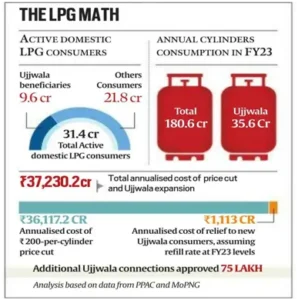
On September 1, 2026, oilmarketing companies (OMCs) raised the price of the commercial LPG cylinder due to underrecoveries in the domestic segment.
What Prompted the Hike?
- UnderRecoveries: OMCs incur losses when selling LPG below cost. In June 2026, underrecoveries were over ₹700 per cylinder, falling to ₹188 in August but still significant.
- CrossSubsidisation: Commercial LPG hikes help offset losses in the domestic segment, which accounts for 90.4% of consumption.
- Ujjwala Subsidy: About 10.6 crore beneficiaries receive ₹300 subsidy per cylinder, further increasing fiscal pressure.
Supply Situation
- Imports Decline: POL imports fell by 45.1% between April–July 2026 due to reduced LPG inflows.
- Domestic Production: OMCs ramped up daily bottled LPG output from 34,000 MT to 55,000 MT.
- Target Setting: Government directive fixed a daily production target of 63,810 MT to meet demand.
Wider Impact
- Commercial Sector: Restaurants and hospitality see marginal cost increases, though concerns persist about future hikes.
- Industrial Use: Industries like glassmaking rely on bottled LPG but are transitioning to piped natural gas (PNG) for stability.
- Festive Season Demand: Elevated demand during festivals could amplify price pressures.
- Inflationary Concerns: Though limited in immediate effect, repeated hikes risk contributing to inputcost inflation.
Way forward
- Balancing Subsidies: Government must manage fiscal burden of Ujjwala subsidies while ensuring affordability.
- Diversification: Expanding PNG networks and promoting electric cooking can reduce LPG dependence.
- Strategic Reserves: Enhancing cavern storage to cushion against import volatility.
- Transparent Pricing: Linking LPG prices to global benchmarks with clear subsidy mechanisms.
Conclusion
While commercial hikes offset domestic losses, sustainable solutions lie in diversifying energy sources, strengthening reserves, and balancing subsidies with fiscal prudence. Without longterm reforms, India risks recurring cycles of price volatility and consumer distress.
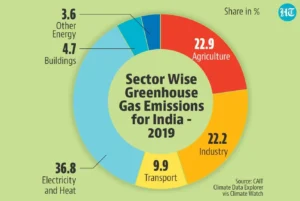
India’s steel industry, the world’s second largest, contributes 12% of national greenhouse gas emissions, raising climate concerns.
Emission intensity of steel industry
- High Emission Intensity: Current steelmaking emits 2.55–2.65 tCO₂e per tonne, above global average of 1.85.
- National Mission on Green Steel: Government targets reducing intensity to 2.2 tCO₂e by 202930 through certification and innovation.
- Policy Choice Ahead: India must redirect investments from coalbased BFBOF to cleaner DRIEAF and hydrogen pathways.
Emission Intensity of Steel Industry
Current Status
- India’s average emission intensity (202324): 2.54 tCO₂ per tonne of crude steel.
- Global average: 1.85 tCO₂ per tonne, highlighting India’s higher carbon footprint.
- Range in Indian integrated plants: 2.3–3.2 tCO₂ per tonne, depending on fuel mix, ore quality, and plant age.
Production Routes and Their Emission Profiles
Production Route | Process | Emission Intensity (tCO₂e/tcs) | Notes |
BFBOF | Blast Furnace + Basic Oxygen Furnace | 2.0–2.8 | Coalintensive, ~70% of India’s steel output |
EAF | Electric Arc Furnace (scrap/DRI + electricity) | 0.4–1.2 | 3–5x lower emissions; cleaner if powered by renewables |
Induction Furnace | Electromagnetic processing of scrap/DRI | ~1.2–1.6 | Energyefficient, but limited scale |
Challenges
- BFBOF Dominance: 43% of steel via blast furnacebasic oxygen furnace; projected to rise to 56% by 2030. Relining furnaces locks in coalbased emissions for 15–20 years.
- Scrap Shortage: Limited scrap availability restricts expansion of electric arc furnaces (EAFs).
- Green Hydrogen Costs: Currently expensive; natural gasbased DRIEAF seen as interim pathway until hydrogen becomes competitive post2040.
- Market Demand: Certification exists, but demand for green steel remains weak.
Way Forward
- Investment Redirection: Avoid new BFBOFs; channel funds into DRIEAF and hydrogenready infrastructure.
- Technology Adoption: Scale up EAFs and induction furnaces; integrate renewable power.
- Policy Push: Create demand through government procurement, green steel standards, and fiscal incentives.
- International Cooperation: Collaborate on hydrogen technology and carbon capture innovations.
Current Policy Initiatives
- National Mission on Green Steel: Targets reducing emissions intensity to 2.2 tCO₂e by 202930.
- Certification Scheme: Steel below 2.2 tCO₂e labelled “green”; 89 units certified by March 2026.
- Financial Support: ₹5,000crore scheme announced to accelerate decarbonisation.
- Hydrogen Pilots: MNRE funded three pilot projects worth ₹400 crore; JSW Energy commissioned India’s largest green hydrogen plant in Karnataka.
Conclusion
Early investment in green pathways offers a highleverage climate opportunity, and market creation, India can transform steel from a “hardtoabate” industry into a futureproof pillar of sustainable growth.
Recently the Indian Space Research Organisation (ISRO) employee associations demanding clarity on ISRO’s longterm vision, highlighting tensions between exploration ambitions and developmental priorities.
India’s Space Policy
- Indian Space Policy 2023: Announced a gradual shift in ISRO’s role — moving away from routine commercial satellite manufacturing and launch services, with greater focus on advanced exploratory missions.
- Private Sector Participation: Creation of INSPACe as a singlewindow regulator to facilitate private involvement, mirroring NASA’s transition from manufacturing to missionoriented research.
- Employee Concerns: Nine ISRO employee associations expressed apprehensions regarding staff strength, recruitment, and outsourcing of core functions, fearing job losses despite official assurances that ISRO would “not be diminished.”
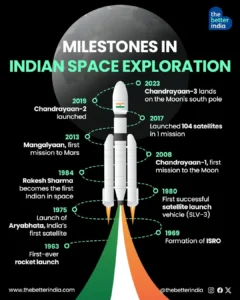
ISRO’s Model:
- Budget reduced from 0.7% of US GDP in 1966 to 0.1% today;
- workforce shrank from 36,000 to 14,000.
- NASA shifted from manufacturing to partnerships with private firms.
- Unlike NASA, ISRO has historically collaborated with Indian industry (e.g., L&T, Walchandnagar).
- The current transition, however, emphasizes startups rather than established players.
Challenges
- Development vs Exploration: ISRO’s founding principle was to use space technology for social development — agriculture, communication, disaster management. A shift towards “moonshots” risks sidelining this mission.
- Privatisation Concerns: Outsourcing core functions may affect job security and institutional expertise.
- Global Competition: China’s expanding space programme poses strategic challenges, requiring India to balance ambition with capacity.
- Startup Ecosystem: New entrants, often backed by foreign capital, focus on satellite data services rather than indigenous manufacturing depth.
Way Forward
- Transparent Policy: ISRO must clearly articulate its roadmap, balancing exploration with developmental applications.
- Inclusive Growth: Ensure private participation does not undermine employee welfare or institutional expertise.
- Strategic Focus: Prioritize sectors that generate jobs, skilled labour absorption, and export earnings by 2035.
- Avoid Bandwagoning: India should resist aligning with space races driven by billionaire fantasies or colonial notions of conquest.
The collapse of a fivestorey building in Satya Niketan, Delhi (September 2026) killing six people has once again highlighted India’s recurring problem of unsafe urban structures.
Background
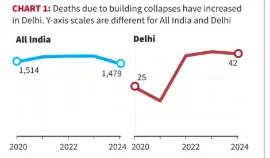
- Data from the Accidental Deaths and Suicides in India (ADSI) reports shows nearly 7,874 deaths due to building collapses between 20202024, making it a persistent urban safety challenge.
- Recurring Incidents: Hundreds of collapses occur annually, often unnoticed unless death tolls are high.
- ADSI Data: Uttar Pradesh (223 deaths in 2024) and Maharashtra (220 deaths) recorded the highest fatalities. Delhi, despite its smaller size, consistently ranks among the top 15 states.
- Population Risk: Delhi recorded the 2nd or 3rd highest deaths per million population in 20222024, reflecting severe vulnerability in dense urban areas.
Causes of Building Collapses
- Illegal Constructions: Unauthorized multistorey buildings without safety clearances.
- Poor Enforcement: Municipal laxity in monitoring structural safety and adherence to codes.
- Use of Substandard Materials: Cheap, noncompliant materials increase vulnerability.
- Overcrowding: High population density strains infrastructure and accelerates wearandtear.
- Neglected Maintenance: Old structures often lack periodic safety audits.
Policy and Institutional Response
- Municipal Crackdowns: Postincident sealing of illegal structures, though reactive rather than preventive.
- Building Codes: The National Building Code prescribes safety standards, but enforcement remains weak.
- Affordable Housing: Rising demand for lowcost housing fuels unsafe constructions.
- Disaster Management Framework: NDMA guidelines exist but lack integration with municipal planning.
Way Forward
- Strengthen Enforcement: Mandatory periodic structural audits and strict penalties for violations.
- Urban Planning: Integrate safety norms into affordable housing schemes.
- Capacity Building: Train municipal engineers and inspectors in modern safety practices.
- Community Awareness: Educate residents on risks of illegal PGs and unsafe rentals.
- Technology Use: GIS mapping and AIbased monitoring of highrisk structures.
Conclusion
Building collapses in India represent a silent urban disaster, Sustainable urban safety requires proactive regulation, affordable housing solutions, and integration of technology with governance. Only then can India prevent avoidable tragedies like Satya Niketan and ensure resilient cities.
Reports from America’s Poison Centers indicate that cases of Vitamin B6 poisoning, though rare, have increased by nearly 40% in the last decade.
About Vitamin B6
- Nature: Also called pyridoxine, it is a watersoluble vitamin, meaning the body cannot store it.
- Functions:
- Supports brain development and nervous system health.
- Helps make antibodies to fight infections.
- Maintains nerve function.
- Produces hemoglobin; deficiency can cause anemia.
- Breaks down proteins; higher protein intake increases B6 requirement.
- Regulates blood sugar levels.

Sources
- Food Sources: Poultry, fish, potatoes, chickpeas, bananas, fortified cereals.
- Supplements: Available as capsules, tablets, or liquids.
Deficiency Risks
- Seen in kidney disease, malabsorption syndromes, autoimmune disorders, alcohol dependence, and with certain epilepsy drugs.
- Symptoms: confusion, depression, irritability, glossitis (mouth/tongue sores), peripheral neuropathy.
Toxicity
- Large doses may cause difficulty in coordination, numbness, and sensory changes.
- Poisoning remains rare but rising, highlighting the need for regulated supplement use.
Conclusion
Vitamin B6 is vital for immune, nervous, and metabolic health, but both deficiency and excess pose risks. Balanced dietary intake remains the safest way to maintain optimal levels.
The Eastern Economic Forum (EEF), established in 2015 by Russian President Vladimir Putin, has emerged as a key international platform for economic cooperation in the AsiaPacific region. Held annually in Vladivostok, it focuses on boosting the economic development of Russia’s Far East while strengthening global investment ties.
Objectives
- Economic Development: Promote growth in Russia’s Far East, a resourcerich but sparsely populated region.
- International Cooperation: Expand partnerships with AsiaPacific nations, including India, China, Malaysia, Mongolia, and Myanmar.
- Investment Platform: Provide a forum for governments, businesses, and investors to discuss opportunities and challenges.

Significance of Russian Far East
- Geography: Borders the Pacific and Arctic Oceans, and five countries — China, Japan, Mongolia, U.S., DPRK.
- Resources: Rich in gold, diamonds, oil, natural gas, coal, and hydroengineering potential.
- Strategic Importance: Spans four time zones, diverse climates, and serves as Russia’s gateway to Asia.
Conclusion
The EEF has evolved into a solid platform for regional and global cooperation, linking Russia’s Far East with AsiaPacific economies. For India, participation offers opportunities in energy, infrastructure, and strategic connectivity, aligning with its broader IndoPacific engagement.