Table of Contents
ToggleComposition of Lok Sabha UPSC
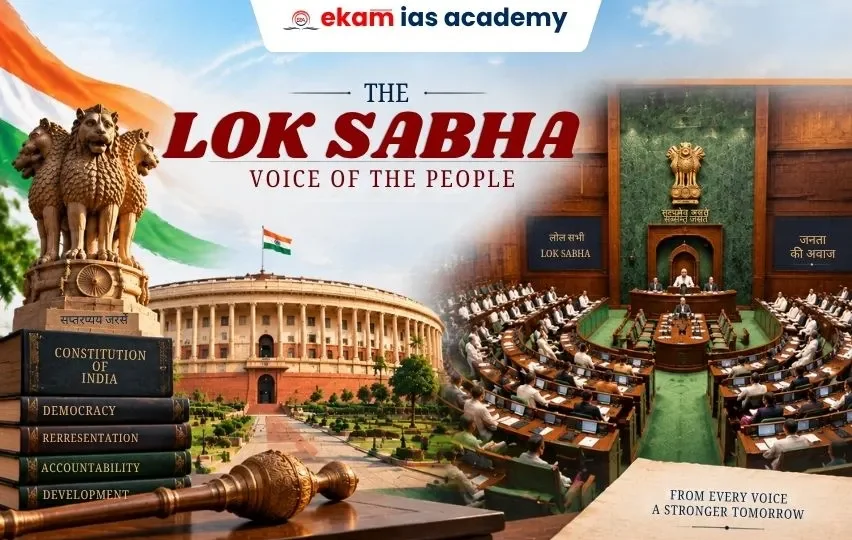
The Composition of Lok Sabha forms the backbone of democratic representation within the Parliament of India UPSC framework. As the House of the People, the Lok Sabha directly reflects popular sovereignty, enabling citizens to participate in national governance through universal adult suffrage. Mastering the Lok Sabha Structure, election mechanics, and seat allocation dynamics is essential for mastering Lok Sabha Indian Constitution concepts in civil services examination preparation.
What is the Lok Sabha?
- Lower House: Operates as the directly elected lower house of India’s bicameral federal legislature.
- Popular Chamber: Represents the collective political voice of the nation’s total population across state boundaries.
- Legislative Core: Holds primary authority over financial bills, national budgeting, and executive accountability.
- Five-Year Mandate: Functions on a five-year term, subject to prior dissolution by the President under constitutional provisions.
Constitutional Provisions Related to Lok Sabha
- Article 81: Outlines the core framework governing the Composition of Lok Sabha and direct election mechanisms.
- Article 82: Mandates the readjustment of territorial constituencies after every decennial national census.
- Article 330: Guarantees the reservation of seats for Scheduled Castes and Scheduled Tribes based on population ratios.
- Article 83: Defines the standard duration, tenure, and extension conditions during a proclaimed National Emergency.
Present Composition and Strength of Lok Sabha
- Maximum Sanctioned Limit: The constitutional ceiling for Lok Sabha Total Seats stands at 550 members (post-104th Amendment).
- State Allocation: Up to 530 members directly represent electors across various Indian states.
- Union Territory Allocation: Up to 20 members represent electors residing in Union Territories.
- Actual Working Strength: The current operational Lok Sabha Strength consists of 543 elected Lok Sabha Members.
Election of Lok Sabha Members
- Direct Suffrage: Elected directly by citizens aged 18 and above through universal adult franchise under Article 326.
- FPTP System: Utilizes the First-Past-The-Post voting system within single-member electoral divisions.
- Secret Ballot: Conducted independently by the Election Commission of India to ensure free, fair, and democratic polling.
- Electoral Plurality: Candidates securing the highest number of valid votes in a constituency are declared elected.
Territorial Constituencies and Delimitation
- Proportionality Principle: States are divided into Lok Sabha Constituencies to ensure uniform population-to-seat ratios across states.
- Delimitation Commission: An independent statutory body tasked with redrawing constituency boundaries to prevent electoral imbalances.
- Constitutional Freeze: The allocation of seats remains frozen based on the 1971 Census figures until the post-2026 census data is published.
- 84th Amendment Act: Extended the seat freeze to maintain demographic balance among states adopting family planning measures.
Reservation of Seats in Lok Sabha
- Affirmative Action: Provisions under Article 330 ensure proportionate political representation for marginalized communities.
- Current Reserved Count: Out of 543 elected seats, 84 are reserved for Scheduled Castes and 47 for Scheduled Tribes.
- Joint Electorate: Reserved seats are contested exclusively by SC/ST candidates, but voted on by all registered electors in that constituency.
- Periodic Extension: Extended up to 2030 via the 104th Constitutional Amendment Act, 2019.
Anglo-Indian Representation in Lok Sabha
- Article 331 Provisions: Previously allowed the President to nominate up to two Anglo-Indian community members if underrepresented.
- 104th Amendment Act, 2019: Ceased the nomination mechanism for Anglo-Indians in January 2020.
- Shift to Pure Democracy: Transitioned the Lok Sabha into a 100% directly elected legislative body.
- Historical Context: Originally introduced as a temporary constitutional protection for a tiny diaspora community post-independence.
Qualification and Disqualification of Lok Sabha Members
- Basic Qualifications: Must be an Indian citizen, at least 25 years old, and registered as an elector.
- Disqualification Grounds: Governed by Article 102 and the Representation of the People Act, 1951 (e.g., holding an office of profit or unsound mind).
- Anti-Defection Law: Disqualification under the Tenth Schedule is adjudicated by the Speaker of the Lok Sabha.
- RPA Disqualification: Mandates disqualification upon conviction for criminal offenses resulting in two or more years of imprisonment.
Lok Sabha vs Rajya Sabha
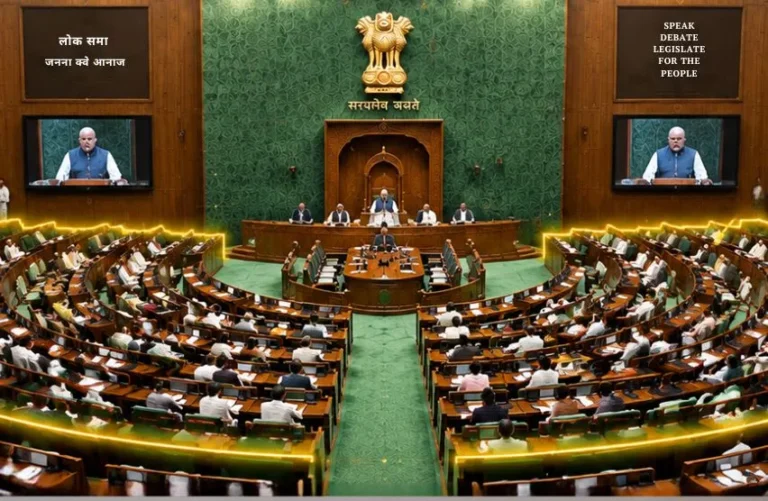
- Representation Focus: The Lok Sabha represents the people directly, whereas the Rajya Sabha represents federating states and Union Territories.
- Financial Supremacy: Money Bills can only be introduced in the Lok Sabha, leaving the Rajya Sabha with limited 14-day delay powers.
- Executive Accountability: The Council of Ministers is collectively responsible solely to the Lok Sabha under Article 75(3).
- Joint Sitting Advantage: Numerical superiority gives the Lok Sabha a decisive edge during joint parliamentary sittings under Article 108.
Importance of Lok Sabha in Indian Democracy
- Democratic Accountability: Serves as the primary national forum for questioning executive policies and administrative decisions.
- Financial Control: Exercises exclusive authority over taxation, public expenditure, and the Consolidated Fund of India.
- Policy Formulation: Enacts key legislative statutes shaping national socio-economic and security frameworks.
- Grievance Redressal: Connects local grassroots issues directly with central executive governance.
Important Constitutional Amendments Related to Lok Sabha
- 42nd Amendment Act, 1976: Extended Lok Sabha tenure to 6 years temporarily and froze delimitation seat counts.
- 44th Amendment Act, 1978: Restored the original 5-year duration of the Lok Sabha.
- 61st Amendment Act, 1988: Lowered the voting age from 21 to 18 years, expanding Lok Sabha Representation.
- 106th Amendment Act, 2023: Introduced a 33% seat reservation for women in the Lok Sabha, pending future delimitation.
Current Issues Related to Lok Sabha Composition
- Post-2026 Delimitation Risk: Potential political friction between high-population northern states and southern states that successfully controlled population growth.
- Women’s Representation: Low historical percentage of female parliamentarians, triggering the Nari Shakti Vandan Adhiniyam.
- Electoral Malapportionment: Discrepancies in voter population sizes across different constituencies due to the long-standing seat freeze.
- Criminalization of Politics: Rising numbers of elected members facing serious criminal charges, prompting electoral reform demands.
Conclusion
- Democratic Foundation: Understanding the Composition of Lok Sabha highlights its vital role in upholding parliamentary democracy.
- Evolving Structure: Adapts continuously through key legislative amendments to foster inclusive representation.
- Vital Exam Prep: Mastering these constitutional provisions provides a strong foundation for answering Lok Sabha UPSC questions.
UPSC Prelims: PYQs & Practice Questions
Previous Year Questions (Prelims)
Q: Regarding the office of the Speaker of Lok Sabha, consider the following statements:
1. The Speaker holds office during the pleasure of the President.
2. The Speaker need not be a member of the House at the time of his/her election
but has to become a member of the House within six months from the date of election.
3. If the Speaker intends to resign, his/her letter of resignation has to be addressed
to the Deputy Speaker.
Which of the statements given above is/are correct?
(a) 1 and 2 only
(b) 3 only
(c) 1, 2 and 3
(d) None
Answer: (b) 3 only
Explanation:
Statement 1 is incorrect: The Speaker does not hold office during
the pleasure of the President. The Speaker continues in office from the date of
election until the first meeting of the next Lok Sabha, unless removed through a
resolution passed by the Lok Sabha.
Statement 2 is incorrect: Unlike a Minister, who can continue for six months without being a Member of Parliament, the Speaker must be a member of the Lok Sabha at the time of election.
Statement 3 is correct: According to Article 94(b), the Speaker may resign by writing under his/her hand addressed to the Deputy Speaker.
Q: With reference to the Parliament of India, consider the following statements:
1. A private member's bill is a bill presented by a Member of Parliament who is not
elected but only nominated by the President of India.
2. Recently, a private member's bill has been passed in the Parliament of India
for the first time in its history.
Which of the statements given above is/are correct?
(a) 1 only
(b) 2 only
(c) Both 1 and 2
(d) Neither 1 nor 2
Answer: (d) Neither 1 nor 2
Explanation:
Statement 1 is incorrect: A
Private Member is any Member of Parliament who is not a Minister.
It includes both elected and nominated MPs.
Statement 2 is incorrect: Private Member Bills have been passed by Parliament earlier. Around 14 Private Member Bills have been passed in Indian parliamentary history, with the last one passed in 1970.
Practice Questions
Q: With reference to the composition and constitutional provisions of the Lok Sabha, consider the following statements:
1. The maximum strength of the Lok Sabha fixed by the Constitution is currently
552 members.
2. The 104th Constitutional Amendment Act, 2019 discontinued the
constitutional provision for nominating two members of the Anglo-Indian community
to the Lok Sabha.
3. The allocation of seats in the Lok Sabha to the states is currently frozen based
on the population figures of the 2001 Census.
Which of the statements given above is/are correct?
(a) 1 and 2 only
(b) 2 only
(c) 2 and 3 only
(d) 1, 2 and 3
Answer: (b) 2 only
Explanation:
Statement 1 is incorrect: After the abolition of the two nominated
Anglo-Indian seats by the 104th Constitutional Amendment Act, 2019,
the maximum sanctioned strength of the Lok Sabha stands reduced to
550 members (530 from States + 20 from Union Territories).
Statement 2 is correct: The 104th Constitutional Amendment Act, 2019 ended the provision for nominating members of the Anglo-Indian community to the Lok Sabha and State Legislative Assemblies.
Statement 3 is incorrect: The allocation of seats among states remains frozen based on the 1971 Census figures. The freeze was extended until the first census after 2026 by the 84th Constitutional Amendment Act, 2001.
Q: Consider the following statements regarding the qualification and disqualification of members of the Lok Sabha:
1. The minimum age required to contest elections for the Lok Sabha is 25 years.
2. If any question arises as to whether a member of the Lok Sabha has become subject
to any disqualifications under Article 102(1), the decision of the Speaker is final.
3. Under the Tenth Schedule, the question of disqualification on the ground of
defection is decided by the President of India on the advice of the Election Commission.
Which of the statements given above is/are correct?
(a) 1 only
(b) 1 and 2 only
(c) 2 and 3 only
(d) 1, 2 and 3
Answer: (a) 1 only
Explanation:
Statement 1 is correct: According to
Article 84, the minimum age to contest Lok Sabha elections is
25 years, while it is 30 years for the Rajya Sabha.
Statement 2 is incorrect: For disqualifications under Article 102(1), the decision is made by the President of India, who acts according to the opinion of the Election Commission under Article 103.
Statement 3 is incorrect: Disqualification under the Tenth Schedule (Anti-Defection Law) is decided by the Speaker of the Lok Sabha, not the President.
UPSC Mains – Previous Year & Practice Questions
Mains Previous Year Questions
Question: "The role of the Speaker is paramount in preserving the dignity and efficiency of the House of the People." Critically analyze the structural challenges facing the office of the Lok Sabha Speaker. (UPSC GS Paper II – 2023, 15 Marks)
Question: "While the Lok Sabha represents the national popular will, the Rajya Sabha reflects the federal character of the Indian polity." Compare the constitutional status and powers of the two Houses of Parliament. (UPSC GS Paper II – 2020, 15 Marks)
Question: Examine the significance of the 106th Constitutional Amendment Act (Nari Shakti Vandan Adhiniyam) on the future composition and gender representation of the Lok Sabha. (UPSC GS Paper II – 2023, 10 Marks)
Question: Discuss the impact of the constitutional freeze on the delimitation of Lok Sabha constituencies based on the 1971 Census. What challenges are expected after 2026? (UPSC GS Paper II – 2019, 15 Marks)
Question: How does the parliamentary committee system enhance the legislative oversight of the Lok Sabha over the executive? Explain with examples. (UPSC GS Paper II – 2021, 12.5/15 Marks)
Mains Practice Questions
[15 Marks | 250 Words]
Question: The post-2026 delimitation exercise threatens to create a sharp demographic divide between India’s northern and southern states in terms of Lok Sabha representation. Discuss the constitutional and political remedies to address this regional imbalance.
[10 Marks | 150 Words]
Question: Critically evaluate the implications of discontinuing Anglo-Indian nominations under the 104th Constitutional Amendment Act on minority representation in the Indian Parliament.
[15 Marks | 250 Words]
Question: "The First-Past-The-Post (FPTP) electoral system used for Lok Sabha elections often leads to a distortion between vote share and seat share." Examine this statement and discuss whether India should transition toward a proportional representation model.
Composition of Lok Sabha -FAQs
What is the Composition of Lok Sabha?
The Lok Sabha consists of directly elected representatives from States and Union Territories, forming the popular chamber of Parliament.
What is the current strength of Lok Sabha?
The current elected strength of Lok Sabha is 543 members.
Which Article deals with Composition of Lok Sabha?
Article 81 deals with the composition of the House of the People and allocation of seats.
How many Lok Sabha seats are reserved for SCs and STs?
At present, 84 seats are reserved for Scheduled Castes and 47 seats are reserved for Scheduled Tribes.
Why is Composition of Lok Sabha important for UPSC?
It is important because it connects parliamentary democracy, Article 81, delimitation, universal adult franchise, SC/ST reservation, women reservation and federal representation.