Table of Contents
ToggleArticle 18 of the Indian Constitution UPSC
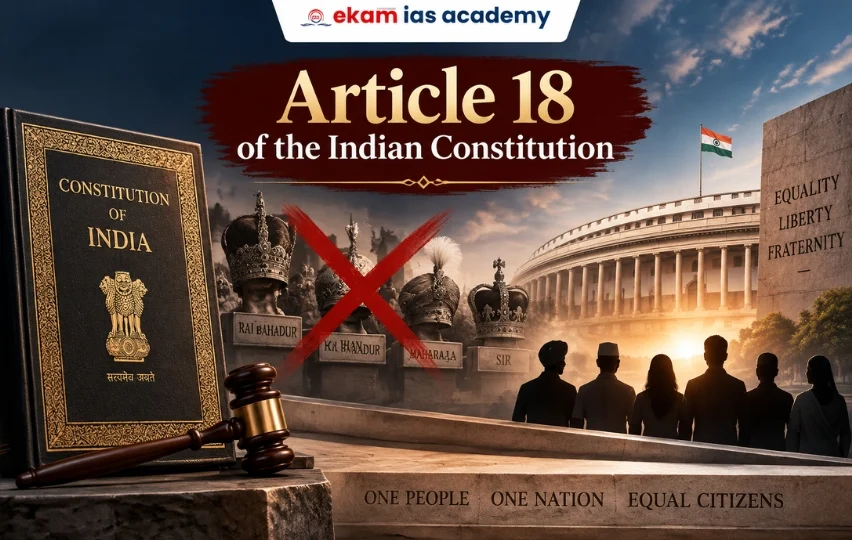
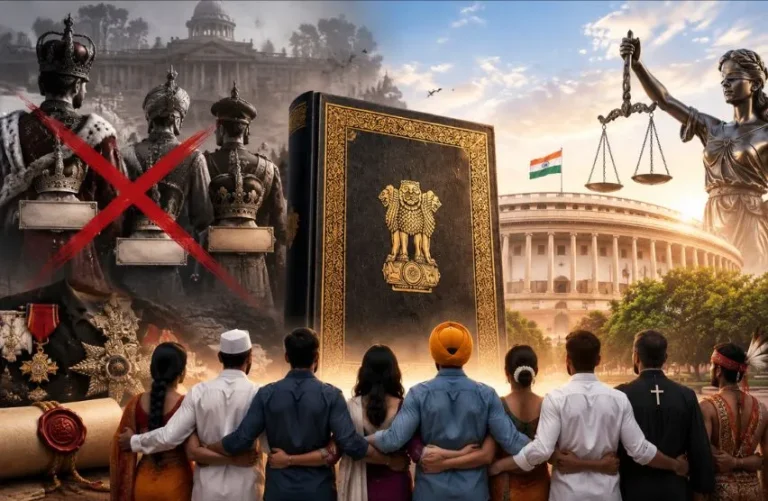
The framework of Article 18 of the Indian Constitution completes the code of social equality established under Part III (Fundamental Rights UPSC). By eliminating hereditary nobility titles, colonial honorifics, and feudal distinctions, Article 18 ensures that the republic maintains an egalitarian political order. Mastering Article 18 UPSC provisions, judicial benchmarks, and exceptions is vital for civil services examination preparation under Right to Equality UPSC topics.
What is Article 18?
- Egalitarian Mandate: Dismantles artificial social hierarchies created by hereditary or state-conferred titles.
- Prohibitory Nature: Functions primarily as a constitutional prohibition on the State and individual citizens rather than a positive enforceable right.
- Civic Equality: Ensures no individual holds a constitutional status superior to fellow citizens based on state-granted honorifics.
- Anti-Feudal Instrument: Eliminates colonial-era titles like Rai Bahadur, Khan Bahadur, Maharaja, and Knight Commander.
Constitutional Text of Article 18
- Article 18(1): Prohibits the State from conferring any title, excepting military or academic distinctions, on anyone (citizen or non-citizen).
- Article 18(2): Explicitly bars any citizen of India from accepting any title from any foreign State.
- Article 18(3): Prevents non-citizens holding an office of profit/trust under the State from accepting foreign titles without presidential consent.
- Article 18(4): Restricts any person holding an office of profit/trust under the State from accepting present, emolument, or office from any foreign State without presidential consent.
Core Provisions and Exceptions
- Academic Exceptions: Allows the State to award academic degrees and titles (e.g., Doctor, Professor, Doctorate).
- Military Exceptions: Permits military decorations and ranks (e.g., Major, General, Param Vir Chakra, Field Marshal).
- Foreign Acceptance Guard: Prevents foreign powers from exerting political influence on Indian public officials via honorifics.
- Non-Self-Executing Clause: Like Article 17, Article 18 does not contain express penal sanctions unless Parliament enacts supporting statutory laws.
National Awards vs. Titles (Balaji Raghavan Case)
- Milestone Precedent: Balaji Raghavan v. Union of India (1996) addressed the validity of National Awards (Bharat Ratna, Padma Vibhushan, Padma Bhushan, Padma Shri).
- Constitutional Validity: The Supreme Court held that National Awards do not violate Article 18 as they do not constitute “titles.”
- Merit-Based Recognition: Rules that decoratory awards honor exceptional service and do not create an aristocracy of birth or status.
- Restriction on Usage: Expressly ruled that national honors cannot be used as prefixes or suffixes to the awardee’s name (violators forfeit the award).
Article 18 and Fundamental Rights Synergy
- Article 14 Alignment: Complements equality before the law by preventing state-sponsored creation of privileged classes.
- Article 15 Synergy: Reinforces non-discrimination provisions by eliminating hereditary elite status.
- Democracy & Fraternity: Fosters a sense of common brotherhood and civic fraternity necessary for functional democratic governance.
- Part III Integration: Works alongside Articles 14, 15, 16, and 17 to complete the constitutional framework for Abolition of Titles.
Important Supreme Court Judgments
- Balaji Raghavan v. Union of India (1996): Validated National Awards while prohibiting their usage as title prefixes/suffixes.
- State of Uttar Pradesh v. Raj Narain (1975): Reaffirmed democratic equality and the prohibition against feudal state patronage.
- Indira Sawhney v. Union of India (1992): Emphasized that social democracy requires eradicating artificial caste and feudal privileges.
- Raghunathrao Ganpatrao v. Union of India (1994): Upheld the abolition of Privy Purses and royal titles under the 26th Constitutional Amendment.
Issues and Challenges Related to Article 18
- Informal Usage: Continued commercial and media usage of royal prefixes (Maharaja, Nawab) despite constitutional abolition.
- Lack of Direct Penalties: Absence of explicit statutory criminal penalties for citizens who accept unauthorized foreign titles.
- Public Misuse of Awards: Occasional prefixing of Padma awards on letterheads, business cards, and public advertisements.
- Ambiguity on Foreign Honors: Operational delays in screening private citizens receiving non-governmental international awards.
Way Forward
- Enforce Award Guidelines: Strictly monitor and penalize the public prefixing/suffixing of National Awards on commercial media.
- Statutory Enforcement: Consider enacting parliamentary legislation under Article 35 to penalize unauthorized acceptance of foreign titles.
- Public Awareness: Educate public figures and media houses regarding the constitutional boundary between merit recognition and forbidden titles.
- Uphold Civic Equality: Preserve the spirit of republicanism by rejecting feudal status symbols in civic life.
Conclusion
- Democratic Equality: Upholding Article 18 Short Notes principles guarantees that India remains a republic built on egalitarian values.
- Balanced Recognition: Distinguishes between forbidden hereditary titles and valid state honors bestowed for meritorious service.
- Exam Relevance: Mastering these provisions provides a thorough foundation for tackling civil services examination questions on Indian Polity.
UPSC Prelims: PYQs & Practice Questions
Previous Year Questions (Prelims)
Q: Consider the following statements in respect of Bharat Ratna and Padma Awards:
1. Bharat Ratna and Padma Awards are titles under
Article 18(1) of the Constitution of India.
2. Padma Awards, which were instituted in the year 1954, were suspended only once.
3. The number of Bharat Ratna Awards is restricted to a maximum of five in a
particular year.
Which of the above statements are NOT correct?
(a) 1 and 2 only
(b) 2 and 3 only
(c) 1 and 3 only
(d) 1, 2 and 3
Answer: (d) 1, 2 and 3
Explanation:
Statement 1 is incorrect: In
Balaji Raghavan v. Union of India (1996), the Supreme Court held that
Bharat Ratna and Padma Awards are civilian decorations recognising merit and service,
not prohibited titles under Article 18(1). However, they cannot be used
as prefixes or suffixes with names.
Statement 2 is incorrect: Padma Awards were suspended twice — first from 1977 to 1980 and again from 1992 to 1995.
Statement 3 is incorrect: The number of Bharat Ratna Awards is restricted to a maximum of three in a particular calendar year, not five.
Q: Which one of the following statements is correct regarding the nature of Fundamental Rights under Part III of the Indian Constitution?
(a) All Fundamental Rights are available exclusively to citizens of India.
(b) Fundamental Rights operate as absolute claims without any exceptions or restrictions.
(c) Fundamental Rights are binding only on the State and cannot be enforced against
private individuals under any circumstance.
(d) Certain Fundamental Rights, such as Article 17 and Article 18, enforce egalitarian
principles and restrict individual and State actions.
Answer: (d) Certain Fundamental Rights, such as Article 17 and Article 18, enforce egalitarian principles and restrict individual and State actions.
Explanation:
Fundamental Rights under Part III operate through both
vertical application (against the State) and
horizontal application (against private individuals in specific cases).
Article 18 promotes democratic equality by prohibiting the State from conferring titles and preventing citizens from accepting titles from foreign States under Article 18(2).
Practice Questions
Q: With reference to Article 18 of the Indian Constitution, consider the following statements:
1. Article 18 prohibits the State from conferring any title on a citizen, but permits
conferring titles on foreigners serving the Indian State.
2. An Indian citizen holding an office of profit under the State can accept a foreign
title if granted approval by Parliament.
3. The designation of 'Senior Advocate' conferred by the Supreme Court
or High Courts is considered a prohibited title under Article 18.
Which of the statements given above is/are correct?
(a) 1 and 2 only
(b) 2 and 3 only
(c) 1, 2 and 3
(d) None
Answer: (d) None
Explanation:
Statement 1 is incorrect:
Article 18(1) prohibits the State from conferring titles on
any person, whether citizen or foreigner, except military and
academic distinctions.
Statement 2 is incorrect: Under Article 18(2), an Indian citizen is completely prohibited from accepting any title from a foreign State. The provisions of approval under Articles 18(3) and 18(4) apply to non-citizens holding offices of profit or trust.
Statement 3 is incorrect: In Indira Jaising v. Supreme Court of India (2017), the Supreme Court held that the designation of Senior Advocate is a professional classification based on legal competence and is not a prohibited title under Article 18.
Q: Consider the following pairs regarding Constitutional Articles and their underlying principles under the Right to Equality:
Article — Primary Objective
1. Article 14 — Absence of arbitrary state privileges and equality before law
2. Article 17 — Social emancipation and abolition of caste disabilities
3. Article 18 — Republican egalitarianism and abolition of feudal honorifics
How many of the pairs given above are correctly matched?
(a) Only one pair
(b) Only two pairs
(c) All three pairs
(d) None of the pairs
Answer: (c) All three pairs
Explanation:
Pair 1 is correctly matched:
Article 14 provides equality before law and equal protection of laws.
Pair 2 is correctly matched: Article 17 abolishes untouchability and removes caste-based social disabilities.
Pair 3 is correctly matched: Article 18 abolishes titles to eliminate feudal hierarchies and promote republican equality.
UPSC Mains – Previous Year & Practice Questions
Mains Previous Year Questions
Question: "The constitutional guarantee of equality under Articles 14 to 18 aims to establish a social order free from feudal privileges and arbitrary classifications." Critically analyze the scope of Article 18 in preserving republican democratic values. (UPSC GS Paper II – 2021, 15 Marks)
Question: Examine the constitutional validity of National Civilian Awards in India in light of Article 18. What safeguards were laid down by the Supreme Court in the Balaji Raghavan case to prevent their misuse? (UPSC GS Paper II – 2018, 10 Marks)
Question: "While the Constitution abolishes titles, social and informal honorifics continue to dominate political and public discourse in India." Discuss the implementation challenges of Article 18. (UPSC GS Paper II – 2016, 12.5 Marks)
Question: How do Articles 17 and 18 collectively reinforce the concept of civic fraternity and social democracy as conceptualized by Dr. B.R. Ambedkar? (UPSC GS Paper II – 2019, 15 Marks)
Question: Analyze the restrictions imposed on Indian citizens and public officials regarding the acceptance of foreign titles, presents, and honorifics under Article 18. (UPSC GS Paper II – 2017, 10 Marks)
Mains Practice Questions
[10 Marks | 150 Words]
Question: "Article 18 acts as a shield against foreign influence and divided loyalty among public officials holding offices of trust under the State." Examine this statement with reference to Clauses (3) and (4) of Article 18.
[15 Marks | 250 Words]
Question: Critically evaluate whether the lack of explicit statutory penal provisions under Article 18 weakens its constitutional mandate against the public misuse of civilian honors.
[15 Marks | 250 Words]
Question: "Democracy requires the recognition of individual merit without creating a distinct class of citizens." Discuss how the Indian judiciary has harmonized meritocratic recognition with egalitarian rights under Article 18.
Article 18 of the Indian Constitution-FAQs
What is Article 18 of the Indian Constitution?
Article 18 abolishes titles and prevents the creation of artificial social distinctions in a democratic republic. It prohibits the State from granting titles except military and academic distinctions.
Which Fundamental Right includes Article 18?
Article 18 is part of the Right to Equality under Part III of the Indian Constitution.
Does Article 18 prohibit Bharat Ratna and Padma Awards?
No. In Balaji Raghavan v. Union of India (1996), the Supreme Court held that National Awards are not titles under Article 18, provided they are not used as prefixes or suffixes.
What are the exceptions under Article 18?
Article 18 allows:
- Academic distinctions like degrees and doctorates.
- Military distinctions and honours such as ranks and gallantry awards.
Why is Article 18 important for UPSC?
Article 18 is important because it explains constitutional equality, republican values, abolition of colonial privileges, and the balance between merit recognition and social equality.