Table of Contents
ToggleEstablishment of North Indian Empire UPSC
The Establishment of the North Indian Empire during the 16th century marked a profound geopolitical transformation in the subcontinent. Transitioning from fragmented regional sultanates to a centralized state, the Rise of North Indian Empire altered administrative, military, and economic structures across South Asia. This core topic within Medieval History UPSC covers the dramatic struggle that firmly placed the Indo-Gangetic plains under imperial Mughal rule.
POLITICAL BACKGROUND
- Medieval Indian Empires preceding the 16th century were severely weakened by regional decentralization and noble rebellions.
- The Delhi Sultanate under Ibrahim Lodi faced widespread disaffection from Afghan governors across Punjab and Bihar.
- Independent North Indian Kingdoms, particularly the Rajput confederacy under Rana Sanga, actively expanded their territorial ambitions.
BABUR AND THE FOUNDATION OF MUGHAL RULE
- Zahir-ud-din Muhammad Babur crossed the Hindu Kush from Kabul to lay the foundation for a new North Indian Empire.
- Brought advanced Central Asian warfare, field artillery, and matchlock technology to the subcontinent.
- Exploited local political divisions to launch systematic military campaigns into northern India.
FIRST BATTLE OF PANIPAT
- Fought in April 1526, this landmark encounter smashed the military authority of the Lodi dynasty.
- Combined the Tulughma flanking maneuver with the Araba gun-cart defensive system to defeat a numerically superior force.
- Ended centuries of Sultanate rule and initiated the Establishment of Empire in North India under Mughal leadership.
CONSOLIDATION OF BABUR’S POWER
- Secured key imperial administrative centers at Delhi and Agra immediately following his victory at Panipat.
- Distributed captured treasuries among his military commanders to preserve troop loyalty and supply lines.
- Neutralized immediate regional threats to create a stable operational base in the Gangetic core
BATTLE OF KHANWA
- Fought in 1527 against the formidable Rajput coalition commanded by Maharana Sanga of Mewar.
- Babur rallied his troops by declaring the conflict a Jihad and waiving commercial taxes for Muslim merchants.
- Decisively crushed Rajput resistance, solidifying the long-term presence of the North Indian Empire History.
BATTLE OF CHANDERI
- Fought in 1528 against Medini Rai, a key Rajput chieftain and close associate of Rana Sanga.
- Secured the strategic fortress of Chanderi, effectively neutralizing opposition in Malwa.
- Strengthened the southern defenses of the nascent imperial core around Agra.
BATTLE OF GHAGHRA
- Fought in 1529 against the combined eastern Afghan forces under Mahmud Lodi and Nusrat Shah of Bengal.
- Marked Babur’s first major amphibious battle, coordinated across the Ghaghra River.
- Suppressed Afghan resistance across Bihar, securing eastern frontiers for the Mughal state.
HUMAYUN AND THE MUGHAL CRISIS
- Inherited an uncoordinated administration, empty treasuries, and hostile brothers upon Babur’s death.
- Faced intense opposition from Bahadur Shah of Gujarat and the rising Afghan leader Sher Shah Suri.
- Suffered disastrous defeats at Chausa (1539) and Kannauj (1540), forcing him into a 15-year exile
SHER SHAH SURI
- Revived Afghan supremacy and halted Mughal Empire Building in North India under the Sur Empire.
- Introduced revolutionary administrative reforms, including standard coinage (Rupiya) and land revenue assessments.
- Built extensive infrastructure like the Grand Trunk Road (Sadak-i-Azam) to improve trade and troop movement.
RESTORATION OF MUGHAL RULE
- Humayun capitalized on the rapid decline and internal succession feuds of the Sur Empire after Sher Shah’s death.
- Secured Persian military backing from Shah Tahmasp of the Safavid Empire.
- Recaptured Lahore, Delhi, and Agra in 1555, restoring the Mughal lineage.
AKBAR AND FINAL CONSOLIDATION
- Defeated Hemu at the Second Battle of Panipat (1556), ending the Hindu-Afghan bid for Delhi.
- Integrated regional elites by building strategic alliances with Rajput ruling houses through diplomacy and rank.
- Formulated the Mansabdari system and Zabt revenue framework, executing the ultimate Expansion of North Indian Empires.
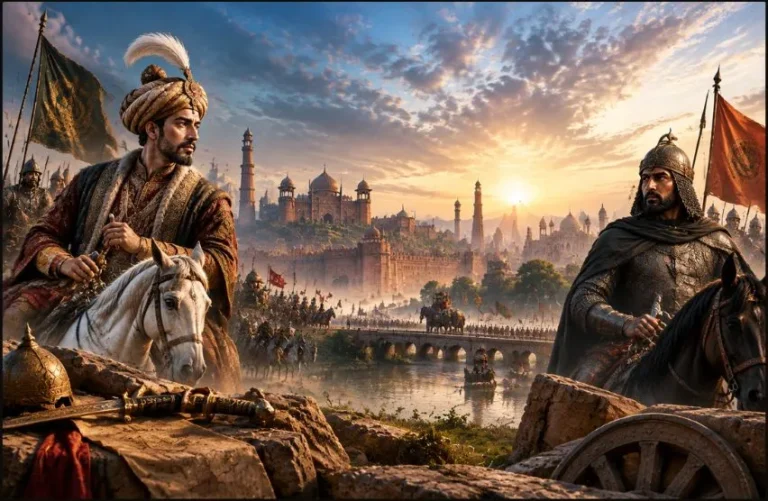
IMPORTANT BATTLES
| Year | Battle | Main Opponents | Result | Significance |
|---|---|---|---|---|
| 1526 | First Battle of Panipat | Babur vs Ibrahim Lodi | Babur won | End of Lodi rule |
| 1527 | Khanwa | Babur vs Rana Sanga | Babur won | Defeat of Rajput confederacy |
| 1528 | Chanderi | Babur vs Medini Rai | Babur won | Rajput resistance weakened |
| 1529 | Ghaghra | Babur vs Afghan forces | Babur won | Eastern consolidation |
| 1539 | Chausa | Sher Shah vs Humayun | Sher Shah won | Afghan revival |
| 1540 | Kannauj | Sher Shah vs Humayun | Sher Shah won | Sur Empire established |
| 1556 | Second Battle of Panipat | Akbar vs Hemu | Akbar won | Mughal restoration |
REASONS FOR MUGHAL SUCCESS
- Tactical military innovations, including the combined use of field artillery and mobile cavalry.
- Transitioned from personal tribal loyalties to a centralized, meritocratic bureaucratic state.
- Adopted inclusive socio-political policies that integrated diverse local elites into imperial governance.
HISTORICAL SIGNIFICANCE
- Unified fragmented regional territories into a cohesive political structure spanning North India.
- Unlocked vibrant economic networks linking Central Asia, Iran, and the Indian Ocean trade routes.
- Laid the foundations of Indo-Islamic art, language, and architectural design studied in Indian History Empire UPSC.
Conclusion
The Establishment of the North Indian Empire was a turning point that linked medieval political structures with early modern statecraft. From Babur’s initial tactical breakthroughs to Akbar’s administrative consolidation, this period redefined power dynamics across North India History UPSC modules, leaving an indelible imprint on the socio-political evolution of the Indian subcontinent.
UPSC Prelims: PYQs & Practice Questions
Previous Year Questions (Prelims)
Q: Who among the following was the first medieval ruler to introduce
field artillery and gunpowder technology on a large scale in
Northern India?
(a) Alauddin Khilji
(b) Sher Shah Suri
(c) Babur
(d) Akbar
Answer: (c) Babur
Explanation:
Babur introduced field artillery (Topkhana) and
matchlocks on a large scale during his campaigns in Northern India.
His effective combination of artillery (Araba) and cavalry flanking tactics (Tulughma) at the First Battle of Panipat (1526) enabled him to defeat the numerically superior army of Ibrahim Lodi and establish Mughal dominance in India.
Q: Consider the following battles fought during the establishment of
the Mughal Empire in North India:
1. Battle of Chanderi
2. First Battle of Panipat
3. Battle of Khanwa
4. Battle of Ghaghra
Which of the following represents the correct chronological order of the battles listed above?
(a) 2 - 3 - 1 - 4
(b) 2 - 1 - 3 - 4
(c) 3 - 2 - 4 - 1
(d) 1 - 2 - 3 - 4
Answer: (a) 2 - 3 - 1 - 4
Explanation:
First Battle of Panipat: April 1526
(Babur vs Ibrahim Lodi)
Battle of Khanwa: March 1527
(Babur vs Rana Sanga)
Battle of Chanderi: January 1528
(Babur vs Medini Rai)
Battle of Ghaghra: May 1529
(Babur vs eastern Afghan chiefs)
Practice Questions
Q: With reference to the administrative and financial reforms introduced by Sher Shah Suri, consider the following statements:
1. He introduced the silver coin called the Rupiya, which
served as a standard currency for centuries.
2. He established the Zabt land measurement system, which
completely abolished all local revenue intermediaries.
Which of the statements given above is/are correct?
(a) 1 only
(b) 2 only
(c) Both 1 and 2
(d) Neither 1 nor 2
Answer: (a) 1 only
Explanation:
Statement 1 is correct:
Sher Shah Suri reformed the coinage system and introduced a standardized silver coin
called the Rupiya, weighing about 178 grains. It became the
foundation of the modern rupee system and remained influential even during the British period.
Statement 2 is incorrect: Sher Shah improved revenue administration through land surveys, measurement systems, Patta and Qabuliyat. However, he did not completely abolish local intermediaries such as zamindars and village officials, who continued to play important roles in revenue collection.
Q: Which of the following military strategies was utilized by Babur to defeat the eastern Afghan coalition at the Battle of Ghaghra (1529)?
(a) Naval blockades across the Arabian Sea
(b) Combined amphibious river-crossing operations and land artillery deployment
(c) Pure reliance on elephant charges backed by archers
(d) Guerrilla mountain warfare tactics
Answer: (b) Combined amphibious river-crossing operations and land artillery deployment
Explanation:
The Battle of Ghaghra (1529) was one of Babur's major military
operations in India where he effectively combined
river-crossing strategies with
field artillery deployment.
Babur coordinated boat movements across the Ghaghra River along with land-based artillery attacks to defeat the combined Afghan forces of Bihar and Bengal, strengthening Mughal control in eastern India.
UPSC Mains – Previous Year & Practice Questions
Mains Previous Year Questions
Question: "Babur’s victories at Panipat and Khanwa laid the military foundations, but it was Akbar’s administrative consolidation that truly established the North Indian Empire." Critically analyze. (UPSC CSE Mains 2018)
Question: Evaluate the contribution of Sher Shah Suri in laying the administrative and infrastructural groundwork for the Mughal Empire under Akbar. (UPSC CSE Mains 2013)
Question: Discuss the geopolitical difficulties faced by Humayun upon his accession. How far were his own errors responsible for the temporary collapse of Mughal rule? (UPSC CSE Mains 2005)
Question: Examine the political significance of the Battle of Khanwa (1527) in securing the imperial foothold of the early Mughals in Northern India. (UPSC CSE Mains 1999)
Question: Analyze the military innovations that enabled Babur to establish a new imperial lineage in North India despite his numerical inferiority. (UPSC CSE Mains 1991)
Mains Practice Questions
[15 Marks | 250 Words]
Question: To what extent was the collapse of the Sur Empire after Sher Shah's death a consequence of structural administrative weaknesses rather than leadership failures?
[15 Marks | 250 Words]
Question: Analyze how the shift from regional Sultanate rule to a consolidated North Indian Empire under the early Mughals impacted trade networks and urban economic centers.
[15 Marks | 250 Words]
Question: "The Second Battle of Panipat (1556) was not merely a military victory for Akbar, but the final elimination of the Afghan-Hindu challenge to Mughal sovereignty." Elucidate.
Establishment of North Indian Empire-FAQs
Who established the North Indian Empire?
Babur established the foundation of the Mughal Empire in North India after defeating Ibrahim Lodi in the First Battle of Panipat in 1526.
How did Babur establish Mughal rule in India?
Babur established Mughal rule through military victories at Panipat (1526), Khanwa (1527), Chanderi (1528), and Ghaghra (1529), defeating Afghan and Rajput opponents.
Why was the First Battle of Panipat important?
The First Battle of Panipat ended the Lodi dynasty, introduced effective gunpowder warfare in Indian battles, and marked the beginning of Mughal rule.
What role did Sher Shah Suri play in North Indian history?
Sher Shah Suri temporarily displaced the Mughals but introduced important reforms in revenue administration, currency, roads, and governance that later influenced Mughal administration.
How did Akbar consolidate the North Indian Empire?
Akbar expanded Mughal territory through military campaigns, Rajput alliances, the Mansabdari system, and efficient revenue administration like the Zabt system.