Table of Contents
ToggleAfghans, Rajputs and Mughals
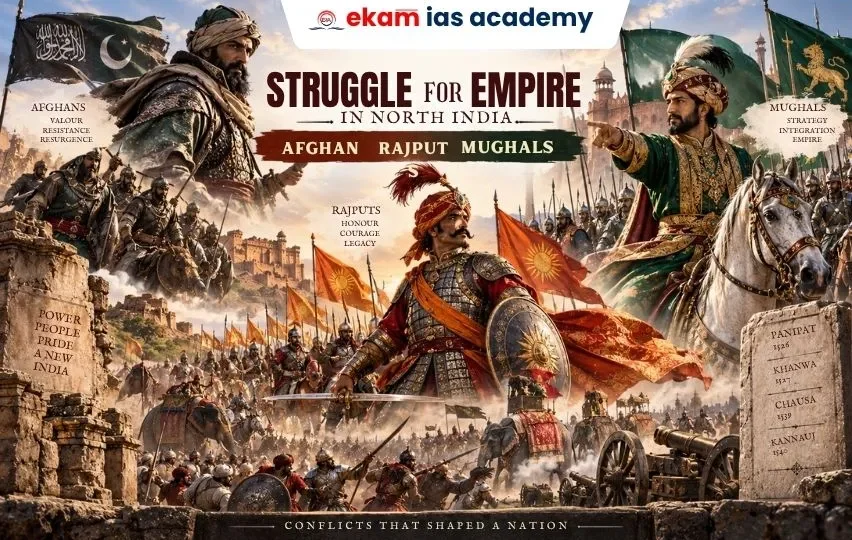
The 16th-century Struggle for Empire in North India represents a tri-cornered contest among Afghans, Rajputs and Mughals. As the Delhi Sultanate fractured, these three distinct political forces vied to establish supreme hegemony over the Indo-Gangetic plains. This period of intense conflict permanently transformed the trajectory of the Mughal Empire UPSC core syllabus.
Political Condition of North India Before Babur
- North India was politically fragmented into autonomous kingdoms following the decline of the Tughlaq dynasty.
- Sultan Ibrahim Lodi faced severe resistance from disgruntled Afghan chieftains in Punjab and Bihar.
- A formidable confederacy under Rana Sanga was consolidating regional power in Central India and Rajasthan.
The Afghan Power in North India
- Afghan Rule in India rested on a clan-based confederation with decentralized military leadership under the Lodi dynasty.
- Internal factionalism among Afghan nobles weakened central governance in Delhi and Agra.
- Prominent Afghan governors actively sought foreign alliances to overthrow Sultan Ibrahim Lodi’s autocratic rule.
Rise of Rajput Power
- Mewar emerged as the nucleus of military resistance, uniting various clans into a cohesive coalition.
- Maharana Sanga expanded Rajput influence across Malwa, Gujarat, and eastern Rajasthan.
- The growth of Rajput military power directly threatened the territorial integrity of the fragile Delhi Sultanate.
Rise of Babur and the Mughal Challenge
- Zahir-ud-din Muhammad Babur crossed the Hindu Kush seeking a sustainable imperial base after losing Fergana.
- Introduced advanced field artillery, firearms, and innovative Central Asian cavalry tactics to the subcontinent.
- Posed a dual challenge to both established Afghan rulers and expanding Rajput confederacies.
Babur's Early Expeditions into India
- Led multiple preliminary incursions between 1519 and 1524 to test border defenses in Punjab.
- Captured strategic frontier outposts including Bhira, Sialkot, and Lahore to secure supply lines.
- Exploited local disaffection to turn the Afghan Mughal Conflict to his strategic advantage.
First Battle of Panipat, 1526
- Pitted Babur’s disciplined army directly against Sultan Ibrahim Lodi and Babur on April 21, 1526.
- Deployed the Tulughma flanking strategy combined with the defensive Araba gun-cart line.
- Ended Lodi rule, smashed Afghan dominance in Delhi, and established the Mughal Empire in North India.
Babur and the Rajput Challenge
- Babur and Rajputs clashed at the decisive Battle of Khanwa 1527 against Rana Sanga’s united forces.
- Used modern artillery and religious rhetoric (Jihad) to unite his hesitant troops before battle.
- Defeated the Rajput coalition, effectively ending the chance of a Hindu imperial restoration in North India.
Babur and the Afghan Challenge
- Surviving Afghan chieftains reorganized in eastern India under Mahmud Lodi and Nusrat Shah of Bengal.
- Babur confronted and defeated the eastern Afghan coalition at the Battle of Ghagra in 1529.
- Preserved imperial lines, though Afghan pockets of resistance survived across Bihar and Bengal.
Sher Shah Suri and the Afghan Revival
- Sher Shah Suri and Mughals re-engaged in an intense power struggle during the reign of Humayun.
- Sher Shah reorganized Afghan power, defeating Humayun at Chausa (1539) and Kannauj (1540).
- Temporarily ousted the Mughals, establishing the short-lived but administratively brilliant Sur Empire.
Afghans, Rajputs and Mughals – Comparative Analysis
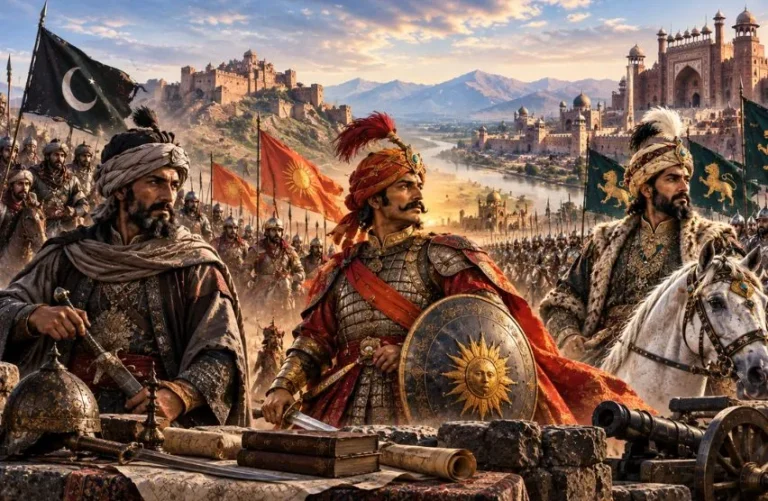
- Mughals: Centralized command, superior gunpowder tactics, disciplined mobile cavalry, and flexible diplomacy.
- Afghans: Tribal allegiance, fierce battlefield valor, decentralized military structures, and internal factionalism.
- Rajputs: Chivalric tradition, high personal courage, clan loyalties, and lack of unified imperial strategy.
Major Battles in the Struggle for North India
- First Battle of Panipat 1526: Smashed Lodi power and opened the gates of Delhi to Babur.
- Battle of Khanwa 1527: Neutralized the powerful Rajput confederacy under Maharana Sanga.
- Battle of Chausa 1539: Marked the dramatic resurgence of Afghan power under Sher Shah Suri.
Important Personalities
- Babur: Founder of the Mughal Dynasty, master strategist, and pioneer of field artillery in India.
- Rana Sanga: Legendary ruler of Mewar who rallied the Rajputs against foreign invaders.
- Sher Shah Suri: Afghan military genius who built an administrative system later inherited by Akbar.
Timeline of the Struggle for Empire in North India
- 1526: First Battle of Panipat 1526 ends Lodi dynasty rule.
- 1527: Battle of Khanwa 1527 breaks the Rajput confederacy.
- 1540: Sher Shah Suri defeats Humayun, reviving Afghan rule until 1555.
Why Did the Mughals Succeedx
- Tactical superiority in fire-power, field fortifications, and swift cavalry maneuvers.
- Shift from tribal appanage governance to centralized imperial administration under Akbar.
- Pragmatic policy of integrating former enemies—including Rajputs and local Afghans—into the state structure.
Historical Significance
- Replaced fragmented regional rule with a unified, centralized imperial framework across North India.
- Created a lasting political synthesis through the eventual integration of Mughals Afghans and Rajputs.
- Established administrative innovations in land revenue and military rank that lasted for centuries.
Important Facts for UPSC Prelims
- Rajput Mughal Conflict dynamics changed under Akbar, who shifted from open warfare to matrimonial and administrative alliances.
- Humayun and Sher Shah fought two decisive battles: the Battle of Chausa (1539) and the Battle of Bilgram/Kannauj (1540).
- Rajputs and Mughals formed the backbone of the imperial mansabdari system under mid-Mughal governance.
Conclusion
The triangular struggle among Afghans, Rajputs and Mughals ultimately shaped the political destiny of medieval India. While Afghan revolts and Rajput resistance repeatedly challenged Mughal expansion, superior tactics and inclusive administrative policies ensured the long-term triumph of the Mughal state.
UPSC Prelims: PYQs & Practice Questions
Previous Year Questions (Prelims)
Q: Consider the following statements regarding the Battle of Khanwa (1527):
1. It was fought between Babur and Rana Sanga of Mewar.
2. Babur declared the war as Jihad (holy war) to motivate his troops.
3. The battle resulted in the complete annexation of Mewar into the Mughal Empire.
Which of the statements given above is/are correct? (UPSC CSE Prelims 2010)
(a) 1 and 2 only
(b) 2 and 3 only
(c) 1 and 3 only
(d) 1, 2 and 3
Answer: (a) 1 and 2 only
Explanation:
Statement 1 is correct: The Battle of Khanwa (1527)
was fought between Babur and Rana Sanga of Mewar,
who led a broad coalition of Rajput rulers and Afghan supporters.
Statement 2 is correct: To boost the morale of his hesitant soldiers facing the formidable Rajput army, Babur declared the war a Jihad, gave up drinking wine, and swore not to touch it again.
Statement 3 is incorrect: Although Babur won a decisive victory at Khanwa, Mewar was not annexed into the Mughal Empire. Its power was significantly weakened, but its independence survived.
Q: Who among the following Afghan rulers defeated Humayun at the Battle of Chausa (1539) and Battle of Kannauj (1540), forcing him to flee to Iran?
(a) Bahlul Lodi
(b) Sikandar Lodi
(c) Sher Shah Suri
(d) Islam Shah Suri
Answer: (c) Sher Shah Suri
Explanation:
Sher Shah Suri (Sher Khan) dealt two crushing defeats to
Humayun—first at Chausa in 1539 and then at
Kannauj (Bilgram) in 1540.
These victories enabled Sher Shah to capture Delhi and Agra, forcing Humayun into exile in Persia for about 15 years and temporarily restoring Afghan rule in North India under the Sur Dynasty.
Practice Questions
Q: With reference to the triangular struggle among Afghans, Rajputs, and Mughals in 16th-century North India, consider the following statements:
1. The Rajput confederacy at Khanwa included Afghan leaders like
Mahmud Lodi who opposed Babur.
2. The Battle of Ghagra (1529) was fought between Babur and the united forces
of the Rajputs and the Suri Empire.
Which of the statements given above is/are correct?
(a) 1 only
(b) 2 only
(c) Both 1 and 2
(d) Neither 1 nor 2
Answer: (a) 1 only
Explanation:
Statement 1 is correct: Discontented Afghan leaders, including
Mahmud Lodi (brother of Ibrahim Lodi) and
Hasan Khan Mewati, joined Rana Sanga’s coalition at Khanwa
to defeat Babur.
Statement 2 is incorrect: The Battle of Ghagra (1529) was fought between Babur and the allied Afghan chiefs of Bihar and Bengal, supported by Nusrat Shah of Bengal. It was not fought against the Rajputs or the Suri Empire, which had not yet fully emerged under Sher Shah.
Q: Consider the following pairs of battles and their historical outcomes:
1. First Battle of Panipat (1526) – Ended the political dominance of the Delhi Sultanate.
2. Battle of Chausa (1539) – Re-established Afghan supremacy under the Sur Dynasty.
3. Battle of Ghagra (1529) – Ended Rajput political resistance in Central India.
Which of the pairs given above is/are correctly matched?
(a) 1 and 2 only
(b) 2 and 3 only
(c) 1 and 3 only
(d) 1, 2 and 3
Answer: (a) 1 and 2 only
Explanation:
Pair 1 is correctly matched: The
First Battle of Panipat (1526) broke the Lodi dynasty and brought an end
to the Delhi Sultanate.
Pair 2 is correctly matched: The Battle of Chausa (1539) marked the resurgence of Afghan power under Sher Shah Suri and set the stage for Humayun’s expulsion from North India.
Pair 3 is incorrectly matched: The Battle of Ghagra (1529) was fought against the eastern Afghan chiefs, not against Rajput rulers.
UPSC Mains – Previous Year & Practice Questions
Mains Previous Year Questions
Question: "The sixteenth century in North India was characterized by a multi-cornered struggle for imperial supremacy among the Afghans, Rajputs, and Mughals." Examine the structural factors that led to the eventual victory of the Mughals. (UPSC CSE Mains 2017)
Question: Evaluate the political ambition and military organization of Rana Sanga. Why did his confederacy fail against Babur at Khanwa? (UPSC CSE Mains 2008)
Question: Analyze the nature of Afghan resistance to Mughal expansion during the reign of Babur and Humayun. (UPSC CSE Mains 2001)
Question: Discuss the administrative and military genius of Sher Shah Suri in reviving Afghan rule in North India. (UPSC CSE Mains 1995)
Question: How far is it correct to state that the Battle of Khanwa was more decisive in establishing Mughal power in India than the First Battle of Panipat? (UPSC CSE Mains 1988)
Mains Practice Questions
[15 Marks | 250 Words]
Question: The inability of the Afghan nobility to move beyond tribal alliances and build a centralized state structure was the primary cause of their ultimate failure against the Mughals. Critically analyze.
[15 Marks | 250 Words]
Question: Compare the military tactics, leadership styles, and geopolitical strategies of Rana Sanga and Sher Shah Suri in their respective challenges to Mughal expansion.
[15 Marks | 250 Words]
Question: To what extent did Akbar’s policy toward the Rajputs and local Afghan chiefs reflect a realization of the mistakes made by early Mughal rulers in North India?
Afghans, Rajputs and Mughals-FAQs
What was the Struggle for Empire in North India?
It was a triangular contest among Afghans, Rajputs and Mughals for political supremacy over North India during the 16th century.
Who fought the First Battle of Panipat in 1526?
The First Battle of Panipat was fought between Babur and Ibrahim Lodi, resulting in the defeat of the Lodi dynasty.
Why was the Battle of Khanwa important?
The Battle of Khanwa in 1527 defeated Rana Sanga’s Rajput confederacy and strengthened Babur’s position in North India.
How did Sher Shah Suri revive Afghan power?
Sher Shah Suri defeated Humayun at Chausa in 1539 and Kannauj in 1540, temporarily removing Mughal rule and establishing the Sur Empire.
Why did the Mughals succeed in North India?
The Mughals succeeded due to superior artillery, mobile cavalry, tactical innovation, centralized leadership and later administrative integration of Rajputs and Afghans.