Table of Contents
ToggleArticle 19 of the Indian Constitution
Understanding Article 18 and Article 19 forms the core of mastering Part III under Fundamental Rights UPSC preparation. While Article 18 eliminates feudal nobility, Article 19 serves as the vital pillar of civil liberties within the Article 19 Right to Freedom framework. For civil services aspirants, grasping the constitutional scope, judicial evolution, and Reasonable Restrictions Article 19 criteria is vital for scoring high in Indian Polity.
What is Article 19 of the Indian Constitution?
- Democratic Guarantee: Guarantees fundamental civil liberties to Indian citizens to ensure individual autonomy and democratic participation.
- Citizen-Specific Right: Available strictly to Indian citizens, excluding foreign nationals and legal corporations.
- Qualified Protection: Provides protected liberties that are not absolute, granting the State regulatory authority.
- Part III Core: Functions as a cornerstone within the Article 19 Fundamental Rights umbrella.
Six Fundamental Freedoms Under Article 19
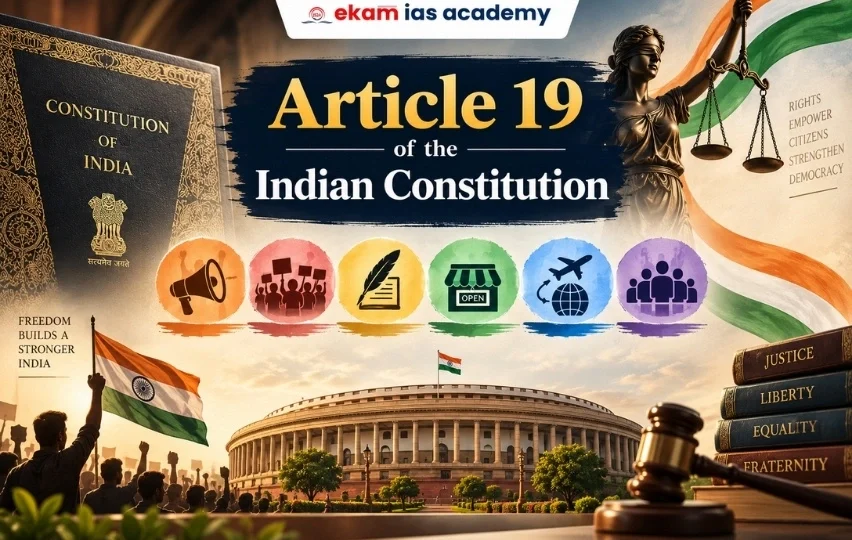
- Article 19(1)(a) Freedom of Speech: Protects expression of thoughts via speech, writing, printing, or digital media.
- Article 19(1)(b) Right to Assemble: Guarantees peaceful public gathering without arms.
- Article 19(1)(c) Right to Association: Permits forming unions, political groups, or cooperative societies.
- Article 19(1)(d), (e), (g): Protects Freedom of Movement, Right to Residence, and Right to Profession across India.
What Happened to the Seventh Freedom?
- Original Provision: Formerly contained seven freedoms, including Article 19(1)(f) protecting the right to acquire, hold, and dispose of property.
- 44th Amendment Act, 1978: Omitted Article 19(1)(f) from Part III to eliminate property ownership as a fundamental right.
- Article 300A Transition: Reclassified property ownership as a legal/constitutional right under Part XII.
- Egalitarian Intent: Removed structural hurdles toward implementing land reforms and socialist economic policies.
Reasonable Restrictions Under Article 19
- Sub-Clauses (2) to (6): Empowers the legislature to impose regulatory limits on each fundamental freedom.
- Specific Grounds: Allows restrictions based on sovereignty, security, public order, decency, or morality.
- Judicial Review: Subject to judicial checks to prevent arbitrary executive or legislative overreach.
- Proportionality Test: Requires state restrictions to be narrowly tailored toward achieving a legitimate state objective.
Article 19(1)(a) and Freedom of Speech
- Expression Scope: Encompasses Freedom of Speech and Expression India, including silence and broadcasting rights.
- Democratic Tool: Enables citizens to criticize state policy and hold the executive accountable.
- Article 19(2) Grounds: Restricted by defamation, contempt of court, incitement to offense, or public disorder.
- Commercial Speech: Protects commercial advertisements under free speech guarantees (Tata Press Case).
Article 19 and Freedom of Press
- Implicit Protection: Freedom of the press is implied within Article 19(1)(a) Freedom of Speech.
- No Special Status: Grants media institutions the same speech rights as individual citizens (Sakal Papers Case).
- Pre-Censorship Limits: Prohibits arbitrary state pre-censorship unless justified under Article 19(2) grounds.
- Editorial Freedom: Protects circulation volume, layout choices, and editorial independence from state coercion.
Article 19 and Internet Freedom
- Anuradha Bhasin Case (2020): Rules that online speech and trade enjoy protection under Article 19(1)(a) and 19(1)(g).
- Indefinite Suspensions Invalid: Declares indefinite internet shutdowns unconstitutional and subject to judicial review.
- Proportionality Requirement: Mandates that web suspensions comply with strict necessity and temporary duration tests.
- Modern Expansion: Adapts Article 19 Indian Constitution principles to safeguard digital communications.
Important Supreme Court Judgments on Article 19
- Romesh Thappar (1950): Affirmed that free speech includes the right to circulate ideas without arbitrary state suppression.
- Maneka Gandhi (1978): Broadened personal liberty by establishing interlinkages between Articles 14, 19, and 21.
- Bijoe Emmanuel (1986): Upheld the right to remain silent as a form of expression under Article 19(1)(a).
- Shreya Singhal (2015): Struck down Section 66A of the IT Act for violating free expression standards.
Article 19 and the Doctrine of Reasonable Restrictions
- Non-Arbitrary Test: Demands that restrictions imposed by the State must not be excessive or arbitrary.
- Substantive & Procedural: Evaluates both the legislative objective and the procedural implementation of restrictions.
- Balance of Interest: Balances individual liberty against collective national interest and public order.
- Standard of Reasonableness: Uses objective judicial standards rather than subjective executive satisfaction.
Article 19 and Article 21
- Golden Triangle: Combines with Article 14 and Article 21 to form the core of constitutional liberty.
- Interconnected Scope: Ensures that state action restricting liberty must pass tests across all three articles simultaneously.
- Due Process Synergy: Enforces fair, just, and reasonable procedural standards against arbitrary state action.
- Human Dignity: Extends individual freedoms beyond physical movement into holistic personal development.
Article 19 and Article 14
- Anti-Arbitrariness: Prevents state action that restricts civil liberties under Article 19 from being discriminatory under Article 14.
- Equal Freedom: Guarantees that restrictions applied to Article 19 freedoms affect all citizens without arbitrary bias.
- Egalitarian Balance: Works together with Article 18 to remove feudal privileges and uphold democratic equality.
- Judicial Scrutiny: Empowers courts to strike down laws that fail reasonable classification or non-arbitrariness tests.
Article 19 During Emergency
- Article 358 Automatic Suspension: Automatically suspends Article 19 rights when a National Emergency is declared under war or external aggression.
- Internal Emergency Exemption: The 44th Amendment Act prevents the suspension of Article 19 during armed rebellion.
- Executive Immunity: Precludes legal challenges to laws or executive acts passed during emergency periods under Article 19.
- Automatic Restoration: Restores Article 19 guarantees immediately upon the revocation of a National Emergency proclamation.
Article 19 and Foreigners
- Citizen Exclusive: Guarantees Six Freedoms under Article 19 solely to Indian citizens.
- Foreigner Exclusions: Prevents non-citizens from claiming fundamental freedoms under Article 19 before courts.
- Article 21 Contrast: Article 21 guarantees life and personal liberty to all persons (citizens and foreigners alike).
- Deportation Authority: Allows the State to restrict movement or deport non-citizens without infringing Article 19 rights.
Article 19 and Reasonable Restrictions
| Freedom Clause | Constitutional Right | Article Sub-Clause for Restrictions | Key Permissible Grounds |
| Article 19(1)(a) | Speech & Expression | Article 19(2) | Sovereignty, public order, defamation, contempt of court |
| Article 19(1)(b) | Peaceful Assembly | Article 19(3) | Sovereignty, integrity of India, public order |
| Article 19(1)(c) | Associations & Unions | Article 19(4) | Public order, morality, sovereignty, integrity |
| Article 19(1)(d) & (e) | Movement & Residence | Article 19(5) | Protection of general public & scheduled tribes interests |
| Article 19(1)(g) | Trade & Profession | Article 19(6) | Professional qualifications & state monopolies |
Article 19 and Constitutional Amendments
- 1st Amendment Act, 1951: Added “public order,” “friendly relations with foreign states,” and “incitement to an offense” to Article 19(2).
- 16th Amendment Act, 1963: Included “sovereignty and integrity of India” as grounds for restriction across clauses.
- 44th Amendment Act, 1978: Removed the right to property and limited emergency suspensions.
- 97th Amendment Act, 2011: Added “co-operative societies” to Article 19(1)(c).
Contemporary Issues Related to Article 19
- Seditions (Section 124A IPC/BNS): Debates over whether colonial-era sedition statutes undermine free speech.
- Hate Speech vs Free Speech: Balancing Article 19(1)(a) Freedom of Speech against preventing communal polarization.
- Digital Surveillance: Evaluating state monitoring of online activity against free expression standards.
- SLAPP Lawsuits: Strategic litigation designed to intimidate journalists and suppress free press coverage.
Conclusion
- Democratic Backbone: Understanding Six Freedoms under Article 19 highlights its role in protecting individual liberties.
- Dynamic Balance: Balances civil freedoms with Reasonable Restrictions Article 19 safeguards to preserve public order.
- UPSC Core Topic: Mastering these provisions provides a thorough foundation for tackling Article 19 UPSC exam questions.
UPSC Prelims: PYQs & Practice Questions
Previous Year Questions (Prelims)
Q: Which Article of the Constitution of India safeguards one’s right to marry the person of one’s choice?
A) Article 19
B) Article 21
C) Article 25
D) Article 29
Answer: B) Article 21
Explanation:
The Supreme Court held that the right to marry a person of one’s choice is an integral part of the
Right to Life and Personal Liberty under Article 21 in
Shafin Jahan v. Asokan K.M. (2018). The right reflects personal autonomy and individual choice.
Q: With reference to the Indian judiciary, consider the following statements:
1. Right to access the internet is a fundamental right under Article 19(1)(a) of the Constitution of India.
2. The right to travel abroad is guaranteed under Article 19(1)(d) of the Constitution of India.
Which of the statements given above is/are correct?
A) 1 only
B) 2 only
C) Both 1 and 2
D) Neither 1 nor 2
Answer: A) 1 only
Explanation:
In Anuradha Bhasin v. Union of India (2020), the Supreme Court recognized that freedom of speech and expression and the freedom to practice any trade or profession through the internet are constitutionally protected under
Article 19(1)(a) and Article 19(1)(g). The right to travel abroad, however, falls under
Article 21, not Article 19(1)(d), as clarified in Maneka Gandhi v. Union of India (1978).
Practice Questions
Q: With reference to "Reasonable Restrictions" under Article 19 of the Indian Constitution, consider the following statements:
1. The grounds for imposing reasonable restrictions on the freedom of speech and expression under
Article 19(2) are exhaustive and listed in the Constitution itself.
2. "Public Order" and "Sovereignty and Integrity of India" were part of the original Constitution adopted in 1950 under Article 19(2).
3. The standard of reasonableness of a restriction is determined by executive discretion and is immune from judicial review.
Which of the statements given above is/are correct?
A) 1 only
B) 1 and 2 only
C) 2 and 3 only
D) 1, 2, and 3
Answer: A) 1 only
Explanation:
Statement 1 is correct: The grounds for restricting Article 19 rights are specifically enumerated in clauses (2) to (6), including the grounds listed under Article 19(2). The State cannot restrict free speech on a ground not explicitly mentioned in the constitutional text.
Statement 2 is incorrect: "Public Order" was added to Article 19(2) by the 1st Constitutional Amendment Act, 1951, while "Sovereignty and Integrity of India" was added by the 16th Constitutional Amendment Act, 1963.
Statement 3 is incorrect: Whether a restriction imposed by law is "reasonable" is an objective test open to judicial review by the High Courts and Supreme Court.
Q2: Consider the following pairs regarding Fundamental Rights under Article 19 and their corresponding restriction clauses:
1. Article 19(1)(a) – Freedom of Speech: Defamation and Contempt of Court
2. Article 19(1)(b) – Assembly: Protection of the interests of Scheduled Tribes
3. Article 19(1)(c) – Association: Sovereignty and Integrity of India
4. Article 19(1)(g) – Trade/Profession: State Monopoly and Professional Qualifications
How many of the above pairs are correctly matched?
A) Only one pair
B) Only two pairs
C) Only three pairs
D) All four pairs
Answer: C) Only three pairs
Explanation:
Pair 1 is correctly matched: Article 19(2) explicitly permits restrictions on speech on grounds of
defamation and contempt of court.
Pair 2 is incorrectly matched: Restrictions on assembly under Article 19(3) can be imposed only on grounds of "Sovereignty and Integrity of India" and "Public Order". The protection of the interests of any Scheduled Tribe is a restriction ground applicable to Freedom of Movement [Article 19(1)(d)] and Residence [Article 19(1)(e)] under Article 19(5).
Pair 3 is correctly matched: Under Article 19(4), association rights can be restricted on grounds of public order, morality, or sovereignty and integrity.
Pair 4 is correctly matched: Article 19(6) permits restrictions on trade or profession in the interest of the general public, including prescribing technical qualifications or creating State monopolies.
UPSC Mains – Previous Year & Practice Questions
Mains Practice Questions
[15 Marks | 250 Words]
Question: “Freedom of speech and expression is the mother of all liberties, yet it cannot be absolute in a constitutional democracy.” Discuss the constitutional grounds and judicial tests applied to determine ‘reasonable restrictions’ under Article 19(2).
[15 Marks | 250 Words]
Question: Examine the scope of Freedom of Speech and Expression under Article 19(1)(a) in the digital age. How has the Supreme Court balanced internet freedom with national security in the Anuradha Bhasin judgment?
[10 Marks | 150 Words]
Question: Analyze the impact of striking down Section 66A of the Information Technology Act in Shreya Singhal v. Union of India on free speech and online expression in India.
[15 Marks | 250 Words]
Question: “The Golden Triangle of Articles 14, 19, and 21 forms the bedrock of personal liberty in India.” Explain how the judicial interpretation in the Maneka Gandhi case transformed Indian constitutional law.
[15 Marks | 250 Words]
Question: Critically evaluate the constitutionality of colonial-era laws like Sedition (Section 124A IPC) in light of the fundamental freedom guaranteed under Article 19(1)(a).
Mains Practice Questions
[15 Marks | 250 Words]
Question: "The Doctrine of Proportionality has become the central touchstone for testing executive restrictions on fundamental freedoms under Article 19." Discuss with reference to recent judicial decisions on internet shutdowns and preventive orders.
[15 Marks | 250 Words]
Question: Examine the constitutional relationship between Article 19(1)(a) Freedom of Press and the right to privacy under Article 21. How should courts balance investigative journalism against individual reputational rights?
[10 Marks | 150 Words]
Question: "Commercial speech and the right to remain silent are intrinsic components of Article 19(1)(a)." Explain the judicial evolution of these implied rights under the Indian Constitution.



Article 19 of the Indian Constitution-FAQs
What freedoms are guaranteed under Article 19?
Article 19 guarantees six freedoms to Indian citizens: speech and expression, peaceful assembly, association, movement, residence, and profession, trade or business.
Are the freedoms under Article 19 absolute?
No. The freedoms are subject to reasonable restrictions under Articles 19(2) to 19(6), based on grounds such as public order, security, morality, and sovereignty and integrity of India.
What happened to the Right to Property under Article 19?
The 44th Constitutional Amendment Act, 1978 removed Article 19(1)(f). The Right to Property is now protected as a constitutional right under Article 300A.
Does Article 19 protect freedom of speech on the internet?
Yes. The Supreme Court in Anuradha Bhasin v. Union of India (2020) recognised that freedom of speech and expression through the internet is protected under Article 19(1)(a), subject to constitutional restrictions.
Which important Supreme Court cases are associated with Article 19?
Important cases include Romesh Thappar (1950), Maneka Gandhi (1978), Bijoe Emmanuel (1986), and Shreya Singhal (2015), which shaped the interpretation of freedom of speech and other liberties under Article 19.