Table of Contents
ToggleMedieval Indian Culture UPSC
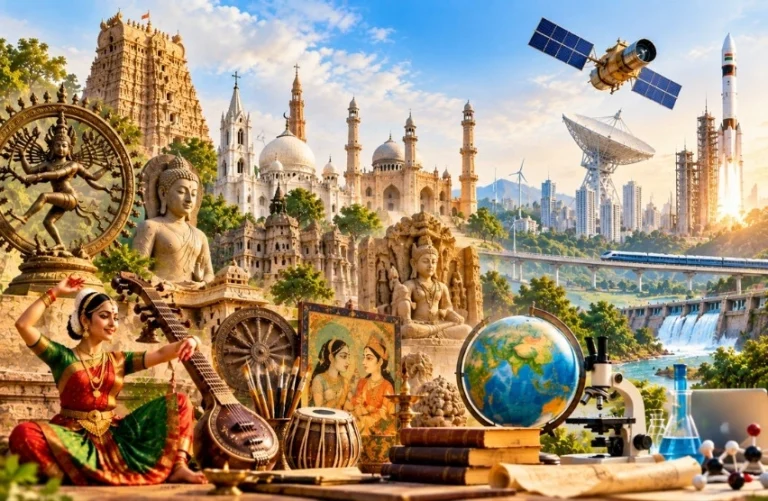
The synthesis of Religion Fine Arts Science and Technology during the medieval era redefined the cultural landscape of the Indian subcontinent. Characterized by vibrant devotional movements, monumental Indo-Islamic architecture, and substantial scientific continuity, this period harmonized spiritual depth with material innovation. For civil services aspirants studying Indian Culture UPSC and Art and Culture UPSC, evaluating the interplay between Religion and Culture in India provides essential analytical insights into the artistic and scientific heritage of the medieval state.
Religious Developments in Medieval India
- Witnessed the rapid evolution of egalitarian spiritual traditions that challenged rigid orthodoxy.
- Integrated diverse philosophical schools into daily life, reshaping Religion and Society in India.
- Fostered peaceful co-existence among traditional Indic systems, Islamic theology, and indigenous sects.
Bhakti Movement
- Divided into Saguna (form-based) and Nirguna (formless) traditions, led by saints like Kabir, Mirabai, and Chaitanya Mahaprabhu.
- Promoted regional vernacular languages over Sanskrit, democratizing spiritual literature under Indian Religious Traditions.
- Rejected caste hierarchies and elaborate rituals, emphasizing personal devotion (Bhakti) to the divine.
Sufi Traditions
- Organized into major orders (Silsilas) such as Chishti, Suhrawardi, and Naqshbandi across urban and rural centers.
- Utilized hospices (Khanqahs) to provide social welfare, spiritual guidance, and communal dining (Langar).
- Popularized mystical music (Qawwali) to convey divine love, deepening popular spiritual syncretism.
Religious Synthesis and Cultural Interaction
- Inspired composite cultural philosophies, epitomized by Emperor Akbar’s Din-i-Ilahi and Sulh-i-Kul.
- Led to the translation of classical Sanskrit texts into Persian, including Dara Shikoh’s Sirr-i-Akbar (translation of the Upanishads).
- Fostered a shared cultural identity known as Ganga-Jamuni Tehzeeb across North India.
Sikhism and the Religious Landscape
- Founded by Guru Nanak Dev Ji, advocating strict monotheism, social equality, and rejection of idol worship.
- Institutionalized egalitarian practices through Langar (community kitchen) and Pangat (sitting as equals).
- Codified sacred scriptures into the Guru Granth Sahib and established the Khalsa brotherhood under Guru Gobind Singh Ji.
Indo-Islamic Architecture
- Combined Islamic arches, domes, and minarets with traditional Indian Temple Architecture motifs like brackets, beams, and lotus designs.
- Introduced advanced engineering techniques, including the Pietra Dura stone inlay work and double-dome structures.
- Produced iconic UNESCO world heritage monuments such as the Qutub Minar, Taj Mahal, and Fatehpur Sikri.
Mughal Painting, Sculpture and Decorative Arts
- Developed a distinctive imperial style blending Persian, Indian, and European artistic elements under Akbar and Jahangir.
- Focused on detailed court miniatures, portraiture, wildlife, and naturalistic flora and fauna.
- Advanced decorative crafts, including delicate Jali (trellis) lattice work, Bidriware metalwork, and royal carpet weaving.
Music and Performing Arts
- Flourished through courtly patronage, giving rise to Hindustani classical music styles such as Dhrupad and Khayal.
- Celebrated legendary musicians like Mian Tansen, who standardized musical compositions (Ragas).
- Developed innovative musical instruments, including the Sitar and Tabla, attributed to Amir Khusrau.
Literature and Language
- Witnessed the rapid growth of regional vernacular languages, including Marathi, Bengali, Tamil, and Hindi.
- Developed Urdu (Zaban-e-Urdu-e-Mu’alla) as a vibrant linguistic synthesis of Persian, Arabic, and local dialects.
- Produced timeless literary epics, such as Tulsidas’s Ramcharitmanas and Malik Muhammad Jayasi’s Padmavat.
Science in Medieval India
- Preserved and expanded upon the empirical foundations of Science and Technology in Ancient India.
- Facilitated intellectual exchange with the Arab, Persian, and European scientific worlds.
- Applied scientific knowledge to statecraft, irrigation systems, architecture, and manufacturing.
Mathematics
- Advanced computational methods through the Kerala School of Astronomy and Mathematics, led by figures like Madhava of Sangamagrama.
- Developed early foundations of calculus, infinite series, and trigonometric approximations.
- Translated core mathematical texts, such as Bhaskara II’s Lilavati, into Persian under imperial patronage.
Astronomy
- Saw the construction of sophisticated masonry observatories (Jantar Mantar) by Sawai Jai Singh II across North India.
- Compiled updated, highly accurate planetary tables (Zij-i Muhammad Shahi) to standardize calendars.
- Continued the theoretical tradition of astronomical calculations following the works of Aryabhata and Brahmagupta.
Medicine
- Integrated traditional Ayurveda with the Unani-Tibb system of medicine brought from Central Asia.
- Produced comprehensive medical encyclopedias, such as the Tibb-e-Sikandari, compiling treatments for diverse ailments.
- Established public hospitals (Dar-ul-Shifa) in major imperial cities to provide free medical care.
Military Technology
- Introduced gunpowder artillery, matchlocks, and field cannons to the subcontinent under Babur.
- Constructed massive, artillery-resistant forts featuring sophisticated battlements, moats, and granaries.
- Improved warship designs and riverine fleets (Ghurabs) to protect coastal and inland river routes.
Timeline
- 1206–1526 CE: Emergence of the Delhi Sultanate; development of Indo-Islamic arcuate architecture.
- 14th–15th Century: Peak of the Bhakti and Sufi movements; founding of Sikhism by Guru Nanak Dev Ji.
- 1526–1707 CE: Mughal golden age; zenith of Mughal painting, court music, and imperial architecture.
- 18th Century: Construction of Jai Singh’s astronomical observatories (Jantar Mantar).
Conclusion
The historical evolution of Religion Fine Arts Science and Technology highlights a dynamic, syncretic epoch in Indian history. By synthesizing indigenous traditions with new artistic and scientific influences, medieval India enriched its Indian Fine Arts and Culture while making lasting contributions to Science and Technology UPSC modules. Understanding these multi-faceted achievements is essential for mastering Indian Heritage and Culture UPSC topics.
UPSC Prelims: PYQs & Practice Questions
Previous Year Questions (Prelims)
Q: Consider the following statements regarding the developments in
science and astronomy in medieval India:
1. Zij-i Muhammad Shahi was a set of astronomical tables compiled to enable people
to make precise calculations of the time of planetary movements.
2. It was prepared under the patronage and supervision of
Sawai Jai Singh II of Amber.
Select the correct answer:
(a) 1 only
(b) 2 only
(c) Both 1 and 2
(d) Neither 1 nor 2
Answer: (c) Both 1 and 2
Explanation:
Zij-i Muhammad Shahi was a major set of astronomical tables compiled to reform
calendar calculations, predict eclipses, and determine exact planetary locations.
Raja Sawai Jai Singh II of Amber patronized and directed the project,
which was named after Mughal Emperor Muhammad Shah. He also established five masonry
observatories known as Jantar Mantar at Jaipur, Delhi, Ujjain, Varanasi,
and Mathura.
Q: With reference to the cultural history of medieval India, consider the following statements regarding the Bhakti and Sufi traditions:
1. Siddhas (Sittars) of the Tamil region were monotheistic and vehemently condemned
idolatry.
2. The Chishtis rejected state patronage and courtly ties, maintaining distance from
political rulers during the Delhi Sultanate.
Select the correct answer:
(a) 1 only
(b) 2 only
(c) Both 1 and 2
(d) Neither 1 nor 2
Answer: (c) Both 1 and 2
Explanation:
The Tamil Siddhas were radical, non-orthodox mystics who emphasized
single-minded monotheistic devotion and criticized ritualism, caste inequality, and
idol worship. Early Chishti Sufi masters such as Nizamuddin Auliya and
Baba Farid followed Faqr (poverty) and generally maintained distance from
imperial court patronage, unlike the Suhrawardi order, which accepted
government positions.
Practice Questions
Q: With reference to the scientific and metallurgical advancements in medieval India, consider the following statements:
1. Wootz Steel produced in southern and central India possessed a high carbon content and unique
microstructures, making it highly prized for forging swords across Western Asia and Europe.
2. The manufacture of seamless hollow bronze and brass cannons using the lost-wax
(Cire Perdue) casting method reached its technological zenith during the Mughal period under
Emperor Akbar.
Which of the statements given above is/are correct?
(a) 1 only
(b) 2 only
(c) Both 1 and 2
(d) Neither 1 nor 2
Answer: (c) Both 1 and 2
Explanation:
Statement 1 is correct: Indian Wootz Steel, known globally as Damascus steel,
was renowned for its high carbon composition, exceptional toughness, and razor-sharp edge retentiveness.
Statement 2 is correct: Akbar's royal workshops (Karkhanas) made significant
metallurgical advances under master founders, perfecting the casting of hollow, seamless brass and
bronze cannons in single molds.
Q: In the context of medieval Indian literature and science, who among the following translated Bhaskaracharya’s major mathematical work Lilavati into Persian under royal imperial patronage?
(a) Amir Khusrau
(b) Faizi
(c) Dara Shikoh
(d) Abul Fazl
Answer: (b) Faizi
Explanation:
As part of Emperor Akbar’s efforts to encourage cross-cultural scientific exchange, the court poet
laureate Faizi translated Bhaskara II's mathematical work Lilavati into Persian
in 1587 CE. Later, Abul Fazl's brother and Dara Shikoh translated other Sanskrit works, including the
Upanishads (Sirr-i-Akbar).
UPSC Mains – Previous Year & Practice Questions
Mains Previous Year Questions
[15 Marks | 250 Words]
Question: "Indo-Islamic architecture represents a harmonious fusion of traditional Indian structural motifs with Islamic arcuate techniques." Discuss with reference to monumental structures built during the Delhi Sultanate and Mughal periods. (UPSC CSE Mains 2021)
[15 Marks | 250 Words]
Question: Evaluate the contribution of the Bhakti movement toward the growth and development of regional vernacular languages and literature across different parts of India. (UPSC CSE Mains 2019)
[15 Marks | 250 Words]
Question: Compare and contrast the distinctive thematic elements and stylistic developments of the Mughal school of miniature painting with the contemporary Rajasthani and Pahari schools. (UPSC CSE Mains 2015)
[15 Marks | 250 Words]
Question: Examine the major advancements made in the fields of astronomy, medicine, and metallurgy during the medieval period in India. (UPSC CSE Mains 2012)
[15 Marks | 250 Words]
Question: "The development of Hindustani classical music during the medieval era reflected deep socio-cultural synthesis and patronage by imperial courts." Elucidate. (UPSC CSE Mains 2007)
Mains Practice Questions
[15 Marks | 250 Words]
Question: How far did the integration of Unani-Tibb and Ayurvedic systems in medieval India reflect an environment of empirical exchange and scientific pluralism?
[15 Marks | 250 Words]
Question: "The architectural innovations of double domes, Pietra Dura inlay, and Jali work were not merely ornamental, but represented advanced structural engineering." Critically analyze with reference to Mughal imperial architecture.
[15 Marks | 250 Words]
Question: "To what extent did the establishment of the Khalsa brotherhood by Guru Gobind Singh Ji synthesize spiritual egalitarianism with military technology and organization?"
Medieval Indian Culture UPSC-FAQs
What were the major religious developments in medieval India?
The major religious developments included the Bhakti and Sufi movements, the growth of Sikhism, and increasing interaction between Hindu, Islamic, and regional spiritual traditions.
What is the contribution of medieval India to fine arts and architecture?
Medieval India witnessed major developments in Indo-Islamic architecture, Mughal miniature painting, decorative arts, music, and literature, producing landmarks such as the Taj Mahal, Qutb Minar, and Fatehpur Sikri.
What scientific developments took place in medieval India?
Medieval India contributed to mathematics, astronomy, medicine, metallurgy, and military technology. The Kerala School advanced mathematical and astronomical calculations, while observatories such as Jantar Mantar reflected developments in astronomy.
How did the Bhakti and Sufi movements influence medieval Indian society?
Both movements emphasized personal devotion, spiritual equality, and social inclusiveness. They contributed to the growth of vernacular languages, literature, music, and cultural interaction across communities.
Why is medieval Indian art, science and technology important for UPSC?
It is important for UPSC Prelims and Mains because it covers Indian heritage and culture, religious movements, architecture, literature, painting, music, scientific developments, and the cultural synthesis of medieval India.