
Table of Contents
ToggleAurangzeb’s Second Phase UPSC
The Temples, Jizyah, and the Second Phase (1679-1707) of Emperor Aurangzeb’s reign mark a decisive turning point in the socio-political trajectory of the Mughal state. Driven by intensifying regional conflicts, military overextension, and fiscal pressures, this era witnessed a significant departure from earlier administrative norms. For civil services aspirants studying Medieval History UPSC, evaluating the complex interplay between Temples, Jizyah, Second Phase (1679-1707) policies provides key insights into imperial statecraft and governance.
Background: From the First Phase to the Second Phase
- The transition from the first phase (1658–1678) to the second phase (1679–1707) was marked by escalating military turmoil across the Deccan, Rajputana, and the North-West frontier.
- Mounting fiscal strains from long military campaigns compelled the imperial treasury to seek reliable revenue sources and ideologically unify the ruling elite.
- The death of key allies like Maharaja Jaswant Singh of Marwar in 1678 disrupted traditional Rajput-Mughal diplomatic alliances, accelerating imperial centralization.
Reimposition of Jizya in 1679
- Re-introduced the poll tax (Jizyah) on non-Muslim subjects in 1679 after a gap of more than a century since its abolition by Akbar.
- Implemented the tax to assert formal Islamic state identity, satisfy the orthodox Ulama, and supplement dwindling military reserves.
- Structured tax rates based on income classes, explicitly exempting women, children, the impoverished, monks, and government officials.
Public Reaction to Jizya
- Triggered widespread peaceful protests and demonstrations by urban traders, artisans, and common citizens near the Delhi court and imperial mosques.
- Led to localized resistance and non-compliance across various provinces, straining local tax collection networks.
- Alienated agrarian and mercantile communities, raising administrative overhead costs associated with tax enforcement.
Temple Policy Under Aurangzeb, 1679–1707
- Shifted toward stricter destruction of major Temples in regions experiencing active political rebellions or defiance of imperial decrees.
- Targeted prominent religious sites in Marwar, Mewar, and parts of the Deccan as direct retaliatory measures against rebel chieftains.
- Issued specific imperial grants (patta) to select loyal monastic institutions, demonstrating that political obedience often influenced local temple policies.
Religious Policy and Political Rebellions
- Intertwined religious decrees with anti-insurgency operations against Maratha forces, Jat agrarian rebels, and Sikh movements.
- Used destruction of prominent local Temples to undermine the political authority and prestige of rebellious regional leaders.
- Fueled prolonged regional resistance, transforming local political conflicts into ideological and identity-driven struggles.
Role of the Ulama and Islamic Law
- Elevated the political status of the Sunni orthodox Ulama, granting them administrative influence over tax assessment and judicial functions.
- Utilized legal digests like the Fatawa-i-Alamgiri to standardize imperial law and replace informal regional customs.
- Relied heavily on religious legitimacy to sustain troops’ morale during prolonged, exhausting campaigns across the Deccan plateau.
Treatment of Non-Muslims During the Second Phase
- Retained a high proportion of Hindu noblemen—particularly Maratha and Rajput chieftains—within the upper tiers of the imperial Mansabdari system.
- Imposed differential trade taxes, subjecting non-Muslim merchants to higher customs tariffs than their Muslim counterparts.
- Restricted non-Muslims from key financial administrative roles in certain central departments, though local revenue posts remained unchanged.
Second Phase Compared with First Phase
- First Phase (1658–1678): Focused primarily on personal austerity, public moral regulation (Muhtasibs), and selective administrative reforms.
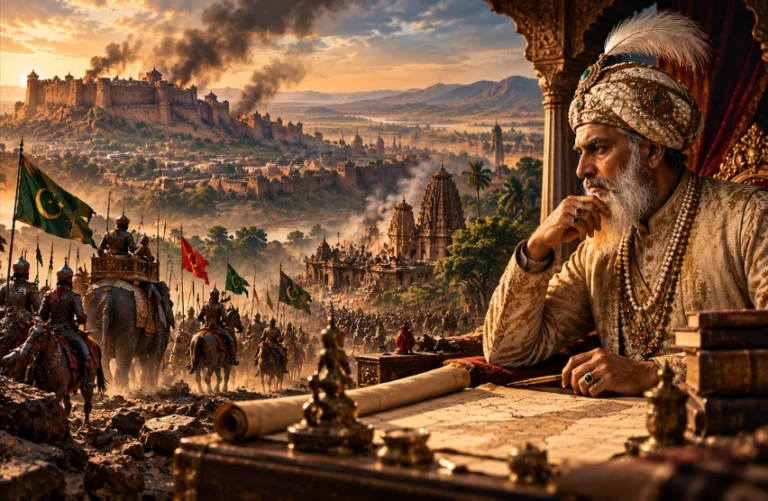
- Second Phase (1679–1707): Characterized by formal ideological measures, widespread imposition of Jizyah, and large-scale destruction of major Temples in conflict zones.
- Administrative Focus: Shifted from northern imperial consolidation to relentless military campaigning and political containment across the Deccan.
Impact of Religious Policy on the Mughal Empire
- Deepened political polarization between the central Mughal state and traditional regional ruling elites.
- Severely strained the imperial treasury through heightened administrative resistance and the immense cost of endless warfare.
- Weakened the broad social consensus and multi-religious political coalition built during the 16th century.
Was Religious Policy the Main Cause of Mughal Decline
- Historians debate whether ideological shifts or structural issues—such as the Jagirdari crisis and agrarian distress—were the primary drivers of decline.
- Revisionist scholars argue that administrative overextension and the “Deccan Ulcer” contributed more directly to institutional collapse than religious policy alone.
- Modern consensus views the policy shift as a contributing factor that exacerbated existing economic, administrative, and regional fractures.
Conclusion
The historical examination of Temples, Jizyah, and the Second Phase (1679-1707) highlights a critical epoch in medieval Indian statecraft. While these measures aimed to consolidate central power and bolster imperial finances during intense warfare, they ultimately altered the internal equilibrium of the state. A comprehensive grasp of Temples, Jizyah, Second Phase (1679-1707) dynamics remains indispensable for mastering medieval history topics in civil service examinations.
UPSC Prelims: PYQs & Practice Questions
Previous Year Questions (Prelims)
Q: With reference to the reimposition of Jizya during the reign of Aurangzeb, consider the following statements:
1. Jizya was reimposed in 1679, over a century after its abolition by Akbar.
2. Women, children, the indigent, and government servants were explicitly exempted from paying Jizya under Islamic legal norms followed by the state.
Which of the statements given above is/are correct?
(a) 1 only
(b) 2 only
(c) Both 1 and 2
(d) Neither 1 nor 2
Answer: (c) Both 1 and 2
Explanation:
Statement 1 is correct: Akbar abolished Jizya in 1564. Aurangzeb reimposed it in 1679—115 years later—as part of a shift toward formal orthodoxy and state revenue generation during the Second Phase (1679–1707).
Statement 2 is correct: Under Hanafi jurisprudence codified in the Fatawa-i-Alamgiri, Jizya was levied only on adult, sane, able-bodied non-Muslim males. Women, children, the elderly, religious ascetics/monks, the destitute, and those serving in the imperial military/bureaucracy were officially exempted.
Q2: During the second phase of Aurangzeb's reign (1679–1707), why did the Mughal state target specific temple structures in Marwar, Mewar, and the Deccan?
(a) To force non-Muslim populations into urban migration.
(b) As retaliatory political and military measures against local ruling houses engaged in armed rebellion.
(c) To convert religious institutions into imperial revenue collecting offices.
(d) To implement a systematic land confiscation law across all imperial provinces.
Answer: (b) As retaliatory political and military measures against local ruling houses engaged in armed rebellion
Explanation:
Historical analysis shows that during the Second Phase (1679–1707), major temple demolitions coincided with active political rebellions, such as the Rathore rebellion in Marwar, conflict with Mewar, and military clashes with the Marathas.
Imperial statecraft used temple destruction to break the political prestige and legitimacy of rebel chieftains who used those sites as centers of authority or funding.
Practice Questions
Q: Regarding the economic and political dynamics of the Second Phase (1679–1707) under Aurangzeb, consider the following statements:
1. The reimposition of Jizya in 1679 led to immediate, passive public protests and demonstrations by urban merchants and artisans in Delhi.
2. The percentage of Hindu Mansabdars in Mughal state service decreased sharply after 1679 due to widespread purges.
Which of the statements given above is/are correct?
(a) 1 only
(b) 2 only
(c) Both 1 and 2
(d) Neither 1 nor 2
Answer: (a) 1 only
Explanation:
Statement 1 is correct: Historical accounts, including Khafi Khan's chronicle, record that large crowds of urban traders, artisans, and common citizens gathered near the Red Fort and Jama Masjid in Delhi to protest the burden of Jizya in 1679.
Statement 2 is incorrect: The proportion of Hindu Mansabdars actually rose to its highest historic level, approximately 31.6% to 33%, during Aurangzeb's second phase, driven by the induction of Maratha and Deccani nobles into imperial service.
Q2: With reference to the administrative collection of Jizya in the Second Phase (1679–1707), who among the following were entrusted with the primary task of tax assessment and collection?
(a) Local village Muqaddams and Patwaris
(b) Specialized collectors called Amin-i-Jizya overseen by the Qazis and Ulama
(c) European trading company agents operating along coastal ports
(d) Mansabdars as part of their regular Jagir assignments
Answer: (b) Specialized collectors called Amin-i-Jizya overseen by the Qazis and Ulama
Explanation:
To ensure strict adherence to religious law and separate Jizya from general agrarian revenues, Aurangzeb appointed dedicated officers called Amin-i-Jizya. These collectors operated under the supervision of local Qazis and the orthodox religious establishment, or Ulama.
UPSC Mains – Previous Year & Practice Questions
Mains Previous Year Questions
Question: "The reimposition of Jizya in 1679 was not merely an act of religious zeal, but a calculated political and economic response to the growing crises of the empire." Discuss. (UPSC CSE Mains 2020)
Question: Analyze the shift in Aurangzeb's policy toward Temples and regional ruling elites during the Second Phase (1679–1707) of his reign. (UPSC CSE Mains 2015)
Question: Critical evaluation: Was the "Deccan Ulcer" accompanied by ideological shifts responsible for the eventual weakening of the Mughal Empire? (UPSC CSE Mains 2010)
Question: Examine the role played by the Ulama and Islamic legal institutions in influencing administrative decisions during the second half of Aurangzeb’s rule. (UPSC CSE Mains 2005)
Question: Contrast the religious and administrative policies of the first phase (1658–1678) with the second phase (1679–1707) under Emperor Aurangzeb. (UPSC CSE Mains 1999)
Mains Practice Questions
[15 Marks | 250 Words]
Question: The temple policies of Aurangzeb between 1679 and 1707 were deeply tied to counter-insurgency operations rather than uniform iconoclasm. Critically analyze.
[15 Marks | 250 Words]
Question: To what extent did the financial collection of Jizyah alienate the urban mercantile classes and exacerbate the administrative Jagirdari crisis during the late 17th century?
[15 Marks | 250 Words]
Question: "The paradox of Aurangzeb's second phase lies in the simultaneous rise of orthodox religious policies and the highest historic representation of non-Muslims in the imperial nobility." Elucidate.
Aurangzeb’s Second Phase-FAQs
Why was Jizya reintroduced by Aurangzeb in 1679?
Jizya was reintroduced as part of Aurangzeb’s changing religious and administrative policy. The measure was also associated with the financial pressures and political circumstances of the later Mughal period.
How did Aurangzeb’s temple policy change during the second phase?
The second phase witnessed stricter action against some prominent temples, particularly in areas associated with political rebellion. However, the policy also varied according to local political circumstances and imperial relationships.
What was the significance of the second phase of Aurangzeb’s religious policy?
The period from 1679 to 1707 saw greater emphasis on formal religious measures alongside intensified military campaigns. Jizya, temple-related policies and the growing role of the Ulama became important features of this phase.
Did Aurangzeb exclude Hindus from the Mughal administration?
No. Hindu nobles, including Rajputs and Marathas, continued to serve in the Mughal Mansabdari system. This demonstrates that religious policy and administrative pragmatism operated simultaneously.
Was Aurangzeb’s religious policy the main cause of Mughal decline?
Historians differ on this question. Religious policies are considered one contributing factor, while fiscal stress, the Jagirdari crisis, agrarian problems and prolonged Deccan warfare also played significant roles.