Table of Contents
ToggleNepal’s Climate Litigation Against Major Carbon Emitters
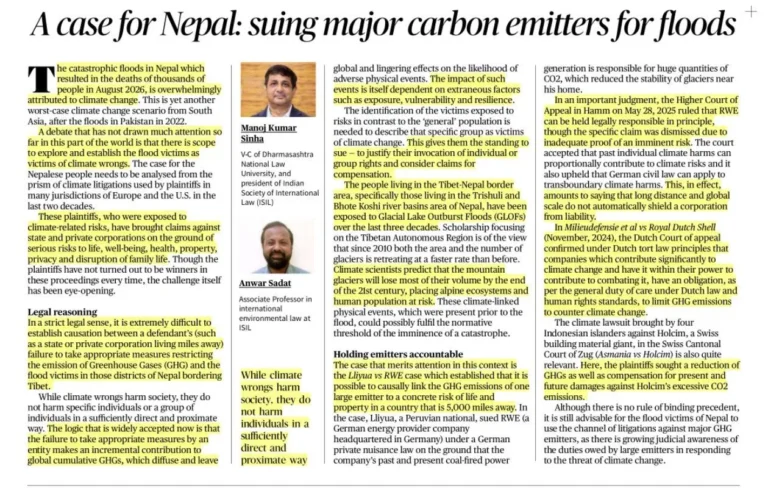
Catastrophic floods in Nepal in August 2026, which caused thousands of deaths, have renewed debate over whether countries and corporations responsible for significant greenhouse gas emissions can be held legally accountable for climate-related disasters.
Climate Change and Nepal’s Vulnerability
Nepal is highly vulnerable to climate change despite its relatively small contribution to global greenhouse gas emissions.
- Rising temperatures are accelerating Himalayan glacier retreat.
- Glacial Lake Outburst Floods (GLOFs) pose growing risks to downstream communities.
- The Trishuli and Bhote Koshi river basins have witnessed increasing climate-related risks.
- Changes in glaciers, permafrost and extreme rainfall can increase the probability of floods, landslides and other disasters.
This raises the issue of climate justice: whether countries and corporations responsible for substantial historical emissions should bear greater responsibility for climate-related harm.
Can Major Emitters Be Held Liable?
A major legal challenge is establishing a direct causal connection between a particular emitter’s greenhouse gas emissions and a specific disaster occurring thousands of kilometres away.
However, emerging climate litigation is expanding the scope of legal responsibility.
- Lliuya v. RWE: A Peruvian farmer sought legal accountability from German energy company RWE for its contribution to climate risks affecting his region.
- High Court of Hamm: The court held that a major emitter could, in principle, be legally responsible for climate-related harm, although the specific claim was dismissed for insufficient evidence of imminent risk.
- Milieudefensie v. Royal Dutch Shell: Dutch courts examined corporate responsibilities concerning greenhouse-gas emissions.
- Litigation involving Holcim and other major emitters also reflects the growing use of human rights and environmental law to address climate change.
Significance for India and the Global South
Climate litigation can provide vulnerable developing countries with an additional avenue to seek:
- Compensation for climate-related losses.
- Stronger emission-reduction commitments.
- Corporate accountability.
- Recognition of transboundary environmental harm.
- Greater adherence to the principle of Common but Differentiated Responsibilities and Respective Capabilities (CBDR-RC).
Challenges
- Difficulty in proving direct causation.
- Complex attribution of emissions among multiple actors.
- Jurisdictional barriers in transboundary cases.
- Absence of universally binding rules on corporate climate liability.
- Difficulty in quantifying climate-related damages.
Conclusion
Nepal’s experience highlights the widening gap between climate vulnerability and responsibility for emissions. Climate litigation cannot replace international climate negotiations, but it can strengthen accountability and provide vulnerable communities with legal avenues for seeking justice.
Vocabulary
1. Climate Litigation – Legal action concerning climate-related harm.
2. GLOF – Sudden release of water from a glacial lake.
3. Climate Liability – Legal responsibility for climate-related damage.
Prelims MCQs
MCQ 1
Consider the following statements:
1. GLOFs can result from the sudden failure of glacial lake barriers.
2. Climate litigation may seek compensation from major greenhouse gas emitters.
3. The Paris Agreement automatically makes corporations liable for all climate-related disasters.
Which are correct?
A) 1 and 2 only
B) 2 and 3 only
C) 1 and 3 only
D) 1, 2 and 3
Answer: A
UPSC Mains Question
“Climate litigation is emerging as a tool for corporate accountability.” Examine its potential and challenges.
(10 Marks)
Frequently Asked Questions (FAQs)
What is climate litigation?
Legal action seeking accountability for climate-related harm, inadequate emission controls or failure to protect climate rights.
Why is Nepal vulnerable to climate change?
Its Himalayan geography exposes it to glacier retreat, GLOFs, landslides, floods and changing precipitation patterns.
What is climate justice?
The principle that the unequal contribution to climate change and unequal vulnerability should be reflected in responsibility, finance and adaptation support.
What is the relevance of Lliuya v. RWE?
It illustrates emerging attempts to establish legal links between major emitters and specific climate-related risks.
Source From : The Hindu
ECI’s SIR U-Turn and the Issue of Electoral Exclusion
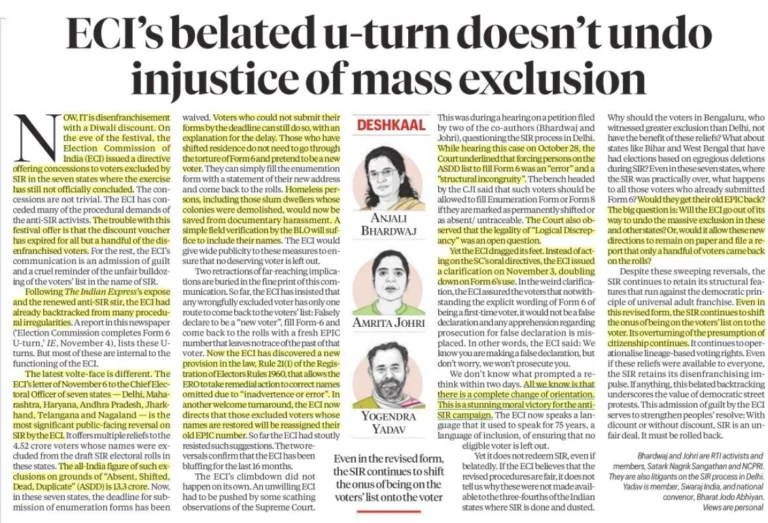
The Election Commission of India (ECI) has offered concessions to voters excluded during the Special Intensive Revision (SIR) of electoral rolls in seven States where the exercise has not yet officially concluded. The move follows criticism over procedural difficulties and concerns about the exclusion of genuine voters.
What is the Latest ECI Decision?
The ECI’s November 5 communication to the Chief Electoral Officers of Delhi, Maharashtra, Haryana, Andhra Pradesh, Jharkhand, Telangana and Nagaland provides relief to several categories of excluded voters.
Key measures include:
- Voters who could not submit enumeration forms within the deadline may now submit them with an explanation.
- Those who have shifted residence can provide a new address and re-enter the electoral rolls.
- Homeless persons and residents whose settlements were demolished can submit their names for inclusion.
- Simple field verification by Booth Level Officers can facilitate inclusion.
- The ECI has invoked Rule 21(1) of the Registration of Electors Rules, 1960, under which an Electoral Registration Officer can correct names omitted due to inadvertence or error.
- Voters whose names were excluded can be restored and reassigned their EPIC number.
Supreme Court Intervention
The editorial highlights that the ECI’s revised position followed observations by the Supreme Court during hearings concerning the SIR process.
The Court questioned the treatment of persons listed in the ASDD category — Absent, Shifted, Dead and Duplicate. The ECI acknowledged that asking such persons to submit Form 6 instead of Form 8 was a “structural error” in the process.
The Court also observed that the legality of the concept of “logical discrepancy” remained an open question.
Concerns with SIR
The editorial highlights the scale of exclusion. Across the seven States, around 4.52 crore voters were excluded from the draft SIR electoral rolls, while the ASDD category reportedly covered around 13.3 crore entries.
The central concern is that procedural requirements should not become barriers to exercising the democratic right to vote.
A delayed correction may provide relief, but it does not completely address the consequences faced by voters who were temporarily excluded from the electoral process.
Way Forward
- Ensure transparent and accessible voter verification.
- Provide adequate time and assistance for documentation.
- Strengthen grievance-redress mechanisms.
- Ensure that electoral-roll revision does not disproportionately affect vulnerable groups.
- Maintain a balance between preventing electoral fraud and protecting genuine voters.
Conclusion
Electoral-roll revision is essential for maintaining the integrity of elections, but accuracy and inclusiveness must go together. The ECI’s concessions are a corrective step, but the larger lesson is that procedural safeguards must be designed so that genuine voters are not disenfranchised.
Vocabulary
1. Disenfranchisement – Deprivation of voting rights.
2. Electoral Roll – Official list of eligible voters.
3. Universal Adult Franchise – Voting rights for all eligible adults.
Prelims MCQs
MCQ 1
Consider the following statements:
1. Article 324 vests electoral supervision in the ECI.
2. Article 326 provides for adult suffrage.
3. The ECI has constitutional authority to determine Indian citizenship.
Which are correct?
A) 1 and 2 only
B) 2 and 3 only
C) 1 and 3 only
D) 1, 2 and 3
Answer: A
UPSC Mains Question
“Electoral roll revisions must balance accuracy with voter inclusion.” Examine. (10 Marks)
Frequently Asked Questions (FAQs)
What is Special Intensive Revision (SIR)?
SIR is an exercise for intensive verification and revision of electoral rolls.
What does ASDD stand for?
Absent, Shifted, Dead and Duplicate.
What is the significance of Rule 21(1) of the Registration of Electors Rules, 1960?
It allows an Electoral Registration Officer to take remedial action where names have been omitted due to inadvertence or error.
What was the ECI’s “structural error”?
The ECI acknowledged that directing certain voters in the ASDD category to use Form 6 instead of Form 8 was a structural error.
Why is the issue important for UPSC?
It links electoral reforms, democratic participation, Election Commission, electoral rolls, judicial oversight and constitutional governance.