
Daily Current Affairs 09-October-2025

Share this Post

THE DANGER OF AN UNCHECKED PRE-CRIME FRAMEWORK

TOPIC: (GS2) INDIAN POLITY: THE HINDU

The Supreme Court in Dhanya M. vs State of Kerala (2025) struck down a preventive detention order, warning that such powers must be used sparingly and in strict accordance with constitutional safeguards.

Preventive Detention

  • Preventive detention means detaining a person to prevent them from committing a possible offence in the future, not for something they have already done.
  • It is a precautionary measure used by the State when it suspects that a person may act in a manner that threatens public order, national security, or the maintenance of essential supplies.
  • Articles 22(3) of the Constitution allow preventive detention, making India one of the few democracies to do so even in normal times.
  • The concept dates back to British colonial rule, such as the Bengal Regulation of 1818, used to suppress dissent.

Judicial Developments and Concerns

    • A.K. Gopalan vs State of Madras (1950) upheld preventive detention laws, isolating Article 22 from other fundamental rights.
    • A.K. Roy vs Union of India (1982) continued this trend, refusing to apply Articles 14, 19, and 21 protections to detention laws.

Conflict with “Golden Triangle”

    • The Golden Triangle of Articles 14 (equality), 19 (freedoms) and 21 (life and liberty) ensures due process.
    • Preventive detention forms a “Bermuda Triangle”, where these rights often disappear due to executive overreach.

Colonial Legacy and Continuing Misuse

  • Post-Independence, governments retained colonial-style detention powers, using them to maintain public order, handle protests, and suppress dissent.
  • Broad definitions like “goonda” and “rowdy” under KAAPA allow misuse against petty offenders or political opponents.
  • Scholars such as Gautam Bhatia and Granville Austin note that preventive detention has become a routine administrative tool rather than a rare emergency measure.

Way Forward

  • Re-examine outdated precedents such as A.K. Gopalan and A.K. Roy.
  • Restrict use only to grave threats like terrorism and organized crime.
  • Strengthen safeguards—periodic review, transparency, and stricter judicial oversight.
  • Reinforce constitutional balance between security and liberty to prevent misuse of “pre-crime” powers.

CONSTITUTIONAL PROVISIONS

Article 22 (Clauses 3 to 7) – Part III (Fundamental Rights)

  • Article 22 provides rights to persons who are arrested or detained, including those under preventive detention.
  • It permits preventive detention but lays down safeguards to prevent misuse.

Key Points under Article 22:

  • Article 22(3)(b): The protection of personal liberty (right to be informed of reasons for arrest and right to lawyer) does not apply to a person detained under a preventive detention law.
  • Article 22(4): No law can authorise preventive detention for more than 3 months unless approved by an Advisory Board.
  • Article 22(5): The person detained must be informed of the reasons for detention as soon as possible.
  • Article 22(6): The government may withhold facts that it considers to be against the public interest from disclosure to the detainee.
  • Article 22(7): Parliament may by law:
      • Authorise detention for more than 3 months without Advisory Board approval.
      • Prescribe maximum detention periods under preventive detention laws.

Maximum Period of Preventive Detention

  • The Constitution does not fix a uniform period; it authorises Parliament to set limits.
  • National Security Act (NSA), 1980 → Maximum detention up to 12 months.
  • COFEPOSA Act (1974) → Preventive detention for up to 1 year (can extend in special cases).

Major Preventive Detention Laws in India

  • National Security Act (NSA), 1980: Used to detain individuals who threaten national security or public order.
  • COFEPOSA Act, 1974: Deals with smuggling and foreign exchange violations.
  • Unlawful Activities (Prevention) Act (UAPA), 1967: Used against individuals involved in terrorist activities.

Conclusion:

Unchecked preventive detention erodes constitutional freedoms and mirrors a “pre-crime” system where suspicion replaces proof. India must urgently reform this framework to uphold the spirit of justice, liberty, and due process.

This article has been updated and published in detail on our new platform. Please visit the link below for the latest version:

👉 Read the full article on ekamiasacademy.in

AN ANCHOR FOR INDIA–U.K. TIES, ECONOMIC PARTNERSHIP

TOPIC: (GS3) ECONOMY: THE HINDU

The recent visit of U.K. Prime Minister Keir Starmer to India, along with the signing of the Comprehensive Economic and Trade Agreement (CETA) in July 2025, has given new momentum to India–U.K. relations.

Background

  • India and the U.K. have long-standing ties in trade, education, and technology.
  • In recent years, both countries have aimed to build a modern, strategic, and economic partnership focused on investment, innovation, and defence.
  • The CETA now serves as a foundation for a next-generation partnership between the two economies.

Highlights of the Comprehensive Economic and Trade Agreement (CETA)

  • Expanding Trade: CETA is expected to double bilateral trade by 2030. Lower tariffs on exports like textiles, agricultural goods, and pharmaceuticals.
  • Ease of Mobility: Exempts Indian professionals working in the U.K. from dual social security contributions for up to three years.
  • Investment Growth: The U.K. is India’s 6th largest investor, contributing nearly 5% of total FDI. A proposed Bilateral Investment Treaty (BIT) aims to enhance U.K. investments in Indian manufacturing, services, and technology sectors.
  • Encourages British firms to use India as a global manufacturing and export hub while Indian companies gain technological and market access in Europe.

Beyond Trade: Strategic Cooperation

  • Vision 2035 Roadmap: Aims for deeper cooperation in defence, climate change, education, mobility, and technology.
  • Technology Security Initiative (TSI) – 2024: Encourages collaboration in critical technologies such as AI, quantum computing, semiconductors, and critical minerals.

Global and Strategic Context

  • The visit comes amid a fragmented global economy and the rise of regional trading blocs.
  • CETA enables both countries to enhance supply chain resilience and adapt to global realignments.
  • For Britain, India offers a growing market, digital innovation, and green finance opportunities.
  • For India, the U.K. brings advanced technology, investment, and defence cooperation.

The Way Forward

  • Build a next-generation partnership based on:
    • Trade liberalisation with sustainability goals.
    • Tariff reductions with skilled mobility frameworks.
    • Defence cooperation with innovation in critical technology.
  • Policymakers should ensure effective implementation of CETA through reduced trade barriers, harmonised regulations, and wider industry participation.
  • Priority sectors: Renewable energy, electric mobility, digital finance, aerospace, and higher education.

Conclusion

The India–U.K. partnership is evolving into a strategic and technology-driven alliance. By reinforcing CETA and Vision 2035, both nations can shape a resilient, inclusive, and innovation-led global economic order, positioning themselves as key partners in growth and global stability.

This article has been updated and published in detail on our new platform. Please visit the link below for the latest version:

👉 Read the full article on ekamiasacademy.in

MANIPUR DATA MASKS SCALE OF CRIMES AGAINST WOMEN IN 2023

TOPIC: (GS2) GOVERNANCE: THE HINDU

The NCRB (National Crime Records Bureau) data for 2023 revealed a sharp rise in most crimes in Manipur during the ethnic conflict, but surprisingly showed a decline in reported crimes against women.

The Manipur Conflict (2023)

  • Ethnic clashes between the Meitei community (Imphal Valley) and Kuki-Zo tribes (hill districts) began in May 2023.
  • The violence led to hundreds of deaths and the displacement of nearly 70,000 people.
  • Reports of sexual violence, torture, and murder of women emerged during the conflict.
  • The Supreme Court, in July 2023, described the sexual violence as being of a “systemic and unprecedented magnitude.”

NCRB (National Crime Records Bureau) data for 2023                                 

Key Crime Data Trends in Manipur (NCRB 2023)

Sharp Rise in Overall Crimes

    • Rioting: from 84 → 5,421 cases
    • Murders: from 47 → 151 cases
    • Attempt to murder: from 153 → 818
    • Robbery and burglary: from 46 → 513 combined
    • Dacoity: from 1 → 1,213 cases
    • Theft: from 1,286 → 2,394
    • Promoting enmity between groups: from 15 → 473

Reported Drop in Crimes Against Women

    • Rape cases: from 42 (2022) → 27 (2023)
    • Assault with intent to outrage modesty: from 67 → 66
    • Sexual harassment: from 5 → 1
    • Rape of minors (POCSO): from 44 → 43
    • Despite visible violence and media reports, official data show a 30% fall in crimes against women.

Evidence of Underreporting

  • Multiple reports and testimonies highlighted widespread sexual assaults and harassment during the peak of violence.
  • Ten Kuki-Zo legislators in July 2023 cited several rape and murder incidents involving women from their community.
  • Civil society groups and the National Commission for Women (NCW) also received complaints of assault, harassment, and killings of women in Imphal and other districts.
  • Instances included violence at Manipur University, Nightingale Nursing Institute, and local workplaces.

Why the Discrepancy

  • Breakdown of policing and administration during conflict limited crime registration.
  • Social stigma and fear of retribution discouraged women from filing complaints.
  • Many survivors were displaced, cutting them off from police and legal systems.
  • Reflects a larger trend of underreporting of crimes against women in India, intensified in conflict zones.

Conclusion

The decline in NCRB-recorded crimes against women in Manipur contradicts ground reports, indicating severe underreporting and institutional collapse during the 2023 conflict.

This article has been updated and published in detail on our new platform. Please visit the link below for the latest version:

👉 Read the full article on ekamiasacademy.in

ARE WORKERS’ RIGHTS BEING ERODED IN INDIA?

TOPIC: (GS1) SOCIAL ISSUES: THE HINDU

A series of industrial accidents in 2023, including the Sigachi Industries chemical blast in Telangana, has raised serious questions about worker safety and weakening labour protections in India.

Recent Industrial Accidents

Sigachi Industries Explosion (Telangana, June 30, 2023)

    • A chemical reactor burst, killing around 40 workers and injuring many others.
    • The reactor was functioning at double the allowed temperature, with no alarms or safety officers present.
    • The machinery was outdated, maintenance ignored, and unregistered contract workers had no records.
    • No on-site ambulance was available; injured workers were shifted in a damaged company bus.

Other Incidents

    • Gokulesh Fireworks Blast (Tamil Nadu, July 1, 2023): 8 workers died.
    • Ennore Thermal Power Station Collapse (Chennai, September 30, 2023): 9 workers killed due to a faulty coal-handling structure.

These repeated tragedies point to a systemic failure in enforcing workplace safety across industries.

ILO’s Stand on Industrial Accidents

  • The International Labour Organization (ILO) notes that industrial disasters are not random; they result from poor management practices and cost-cutting on safety.
  • Even when labelled as “human error,” the deeper causes lie in: Long working hours and inadequate rest. Lack of safety training and equipment.

Legal Framework for Workers’ Safety in India

  • Factories Act, 1948: Governs factory registration, working conditions, and machinery maintenance. Based on the principle that safe workplaces ensure productivity and dignity.
  • Compensation Laws: Workmen’s Compensation Act, 1923 and Employees’ State Insurance Act, 1948 provide for compensation in cases of injury or death. In practice, compensation is minimal and delays are common.

Current Scenario and Erosion of Rights

  • Since the 1990s, India has seen a gradual dilution of labour protections.
  • “Ease of Doing Business” reforms and State-level self-certification have weakened inspection systems.
  • The Occupational Safety, Health and Working Conditions (OSHWC) Code, 2020, though yet to be implemented, reduces safety from a statutory right to executive discretion.
  • States like Karnataka have even extended working hours, worsening safety risks.

Why Worker Safety is Declining

  • Profit-first mindset: Employers prioritise cost-cutting over safety investments.
  • Weak enforcement: Reduced inspections and staff shortages in labour departments.
  • Informal labour: A large unregistered workforce remains outside legal protection.
  • Government leniency: Safety laws treated as “barriers to business.”

Conclusion

India records nearly one in four fatal workplace accidents worldwide, showing the deep neglect of worker safety. Unless the State restores inspection systems, enforces accountability, and treats safety as a legal right, the cycle of industrial deaths will continue.

This article has been updated and published in detail on our new platform. Please visit the link below for the latest version:

👉 Read the full article on ekamiasacademy.in

DIGITAL TRANSFORMATION OF GOVERNANCE IN INDIA

TOPIC: (GS3) SCIENCE AND TECHNOLOGY: INDIAN EXPRESS

The government’s ongoing efforts to expand Digital India initiatives and strengthen citizen-centric online services highlight India’s rapid shift toward digital and transparent governance.

E-Governance

  • e-Governance refers to the application of Information and Communication Technology (ICT) in public administration to make governance more transparent, efficient, participatory, and accountable.

Objectives of e-Governance

  • Transparency: Digital records and audit trails curb corruption.
  • Efficiency: Automation reduces delays and improves service delivery.
  • Inclusivity: Ensures access for rural and marginalized groups.
  • Accountability: Real-time monitoring enhances responsibility.
  • Affordability: Cuts administrative costs for both government and citizens.

Evolution of e-Governance in India

Phase I – Foundation Stage (Before 2000)

  • NIC (1976): Introduced computerization in government departments.
  • NICNET (1987): India’s first satellite-based government network.
  • Early systems like computerized railway booking and Income Tax data boosted administrative efficiency.
  • e-Seva (1999, Andhra Pradesh): One-stop digital service delivery for citizens.

Phase II – Expansion Stage (2000–2014)

  • Landmark projects: Gyandoot (MP) for rural communication, Bhoomi (Karnataka) for land records, FRIENDS (Kerala) and Lokvani (UP) for citizen services.
  • National e-Governance Plan (NeGP, 2006): Built the national digital infrastructure via
  • Aadhaar (2010): Introduced digital identity for welfare delivery. Faced issues like poor internet access and limited scalability.

Phase III – Integration and Ecosystem Building (2015–2019)

  • Digital India (2015): Shifted focus from service delivery to digital empowerment.
  • JAM Trinity (Jan Dhan, Aadhaar, Mobile): Enabled direct benefit transfers.
  • India Stack & UPI: Revolutionized digital finance and authentication.
  • UMANG, DigiLocker, e-Kranti, and DigiYatra: Integrated service platforms connecting citizens to government digitally.

Challenges and Concerns

  • Digital Divide: Rural areas still face connectivity and literacy gaps.
  • Cybersecurity Risks: Data breaches and online frauds threaten trust.
  • Language Barriers: Most platforms favor English over regional languages.
  • Resistance to Change: Lack of digital skills among officials hampers adoption.
  • Inter-departmental Gaps: Limited data sharing reduces efficiency.

Policy Support

The Ministry of Electronics and IT (MeitY) promotes policies like:

  • Open Source adoption,
  • Cloud-based applications,
  • Open APIs for seamless integration,
  • Data and email security frameworks.

Conclusion

e-Governance has redefined the relationship between state and citizen, making governance more accessible, transparent, and participatory.

This article has been updated and published in detail on our new platform. Please visit the link below for the latest version:

👉 Read the full article on ekamiasacademy.in

WHEAT CULTIVATION IN INDIA

TOPIC: (GS3) ECONOMY: THE HINDU

India has reaffirmed its position as the second-largest wheat producer in the world, with new efforts to improve productivity through climate-smart agriculture, modern irrigation, and resilient seed varieties. The crop remains vital for national food security and farmer income, especially in northern India.

Introduction

  • Wheat is India’s second most important food grain after rice. It plays a central role in ensuring food security, providing livelihoods to millions, and contributing significantly to the agricultural economy.
  • The crop’s adaptability and nutritional value make it a cornerstone of India’s agricultural system, particularly in the Indo-Gangetic plains.
WHEAT CULTIVATION IN INDIA

Production and Distribution

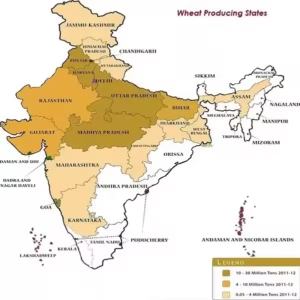
  • India contributes significantly to global wheat supply, next only to China. The major producing regions are Punjab, Haryana, Uttar Pradesh, Madhya Pradesh, and Rajasthan.
  • These areas benefit from fertile plains, canal irrigation, and high-yielding seed varieties developed during the Green Revolution.
  • States like Bihar, Gujarat, and Maharashtra also grow wheat under irrigated conditions.

Importance of Wheat

  • Food Security: Core part of the Public Distribution System (PDS) ensuring stable food supply.
  • Nutrition: Provides essential nutrients vital for health and energy.
  • Economic Value: Key contributor to farm income and national agricultural GDP.
  • Employment: Engages millions of small and medium farmers across rural India.
  • Export Potential: Surplus production opens opportunities for international trade.

Challenges

  • Falling water tables due to excessive irrigation in north India.
  • Soil degradation from continuous monocropping.
  • Climate change leading to heat stress during grain filling.
  • Small landholdings restricting mechanisation and efficiency.
  • Need for diversification and resource-efficient technologies.

WHEAT

Wheat is one of the oldest cultivated grains and a major source of carbohydrates, proteins, iron, and B vitamins.

It is widely consumed in northern, western, and central India, especially in Punjab, Haryana, Uttar Pradesh, Madhya Pradesh, and Rajasthan. It forms the base of everyday foods like chapati, bread, and pasta, making it essential to India’s diet.

Climatic Requirements

  • Wheat thrives in cool, dry weather and is primarily a Rabi crop, sown in winter and harvested in spring.
  • Temperature: Around 10–15°C during sowing and 21–26°C at ripening.
  • Rainfall: Needs 50–75 cm of evenly spread rainfall; excess moisture harms yield.
  • Sunlight: Bright sunshine during ripening improves grain quality.
  • Frost & hailstorms can severely damage crops during flowering.

Soil Conditions

  • Best grown in well-drained loamy or clay-loam soils with good moisture retention.
  • The Indo-Gangetic alluvial soils are most productive due to their fertility and irrigation support.
  • Wheat tolerates neutral to slightly alkaline soils (pH 6.5–7.5) and requires less water than rice, making it suitable for semi-arid zones.

Conclusion

Wheat remains the backbone of India’s food economy. To sustain growth, India must adopt climate-resilient farming, precision irrigation, and sustainable soil practices. Strengthening research, infrastructure, and export capacity will secure the future of wheat cultivation in India.

This article has been updated and published in detail on our new platform. Please visit the link below for the latest version:

👉 Read the full article on ekamiasacademy.in

INDIAN RADIO SOFTWARE ARCHITECTURE (IRSA)

TOPIC: (GS3) SCIENCE AND TECHNOLOGY: THE HINDU

Recently, the Defence Research and Development Organisation (DRDO), in collaboration with the Integrated Defence Staff and the Tri-Services, launched Indian Radio Software Architecture (IRSA) Standard 1.0, marking a major step in defence communication technology.

About IRSA

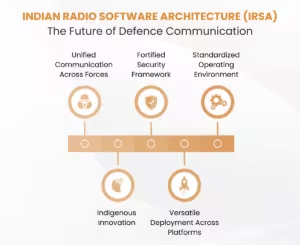
  • IRSA provides a standardized software architecture that enables secure and efficient communication between different radio systems used by the armed forces.
  • It is India’s first national specification defining a unified structure for Software Defined Radios (SDRs).
  • Vision: To make IRSA a global standard, allowing India to export IRSA-compliant SDR technologies to friendly nations.
INDIAN RADIO SOFTWARE ARCHITECTURE (IRSA)

Key Features

  • Defines interfaces, APIs, and execution environments for SDR systems.
  • Ensures waveform portability, interoperability, and certification standards.
  • Enables secure communication across multiple platforms within the Indian military network.

Global Context

  • IRSA places India among an elite group with the US (SCA framework), Europe (ESSOR), and NATO (STANAG) SDR standards.
  • Developed under the Directorate of Standardisation (DoS), Ministry of Defence.

About Software Defined Radios (SDR)

  • SDRs use software-based systems instead of traditional hardware components to manage communication.
  • They are flexible, upgradeable, and suitable for modern, multi-band operations in a rapidly evolving digital environment.

Significance

  • Enhances interoperability and cybersecurity among India’s defence networks.
  • Reduces dependence on foreign communication systems.
  • Strengthens India’s position as a global leader in secure radio technology.

This article has been updated and published in detail on our new platform. Please visit the link below for the latest version:

👉 Read the full article on ekamiasacademy.in

UNICORN COMPANY

TOPIC: (GS3) ECONOMY: THE HINDU

The Defence Minister recently highlighted the growing role of startups in India’s defence innovation ecosystem and urged entrepreneurs to set new benchmarks, including the creation of India’s first defence unicorn.

Meaning of Unicorn Company

  • A unicorn is a privately held startup valued at over $1 billion.
  • The term was first popularized in 2013 by venture capitalist Aileen Lee, referring to rare high-value startups.
  • Unicorns are not publicly traded on stock exchanges.

Key Characteristics

  • High Valuation: $1 billion or more, often based on future growth potential rather than current profits.
  • Private Ownership: Maintains independence from public market pressures.
  • Rapid Growth: Demonstrates strong innovation and expansion in a short time.
  • Disruptive Technology: Often introduces products or services that change existing markets.
  • Investment Attraction: Secures substantial funding from venture capitalists and private investors.

Growth Pathways

  • Some unicorns go public through IPOs.
  • Others remain private, using successive funding rounds to expand.
  • Many get acquired by larger companies, integrating into bigger ecosystems.

Global & Indian Context

  • As of July 2025, there are over 1,200 unicorns globally.
  • Unicorns play a key role in innovation, employment generation, and economic growth.
  • India aims to create unicorns in strategic sectors, including defence technology.

Other Startup Classifications

  • Gazelle Startups: Founded after 2000; have potential to become unicorns within 2 years; valued at $500 million to $1 billion.
  • Cheetah Startups: High-growth potential; may become unicorns within 4 years; valued at $200 million to $500 million.

Significance

  • Unicorns encourage technology-driven innovation.
  • They attract foreign investment and strengthen India’s startup ecosystem.
  • Creation of defence unicorns aligns with Atmanirbhar Bharat and modernisation of India’s strategic industries.

This article has been updated and published in detail on our new platform. Please visit the link below for the latest version:

👉 Read the full article on ekamiasacademy.in

Write a Review

Your email address will not be published. Required fields are marked *