
MODERNISATION OF FINANCIAL ARCHITECTURE
TOPIC: (GS3) ECONOMY: THE HINDU
India’s Finance Minister recently stated that the country must be ready to engage with crypto assets, especially stablecoins.
What are Stablecoins?
- Definition: Stablecoins are blockchain-based digital tokens designed to maintain a stable value by being linked to specific assets such as fiat currency, commodities, or crypto reserves.
- Purpose: They combine the efficiency of cryptocurrencies with the stability of traditional money, making them suitable for payments and remittances.
- Types:
- Fiat-backed – backed by reserves like USD (e.g., USDT, USDC)
- Crypto-backed – collateralised by other crypto assets (e.g., DAI)
- Algorithmic – stability maintained via supply-demand algorithms (e.g., TerraUSD, riskier)
Global Financial Shift
- Efficiency Gains: Stablecoins reduce transaction costs (as low as $0.01) and enable real-time cross-border transfers compared to traditional methods like SWIFT.
- Institutional Adoption: Major financial firms (e.g., BlackRock, Fidelity) and payment networks (Visa, Mastercard) are integrating stablecoins for settlements.
- Regulatory Clarity: The EU’s MiCA and U.S. GENIUS Act are setting standards for reserves, audits, and consumer protection.
India’s Changing Approach
- India earlier took a cautious stance, concerned about risks of volatility and money laundering.
- The government now recognises the potential of stablecoins for modernising finance, enhancing cross-border remittances, and complementing UPI and digital public infrastructure.
- A clear regulatory framework could allow safe experimentation while ensuring financial stability.
Significance for India
- Financial Modernisation: Can make payments faster, cheaper, and transparent.
- Global Competitiveness: Aligns India with global financial innovations.
- Integration with AI & Automation: Enables machine-speed transactions in future digital economies.
Way Forward
- Frame comprehensive regulations ensuring transparency, reserves, and consumer protection.
- Build interoperability between UPI, blockchains, and currencies.
- Encourage pilot projects with institutional participation under RBI oversight.
BLOCKCHAIN:
A blockchain is a digital record-keeping system that stores data in “blocks” linked together in a chain. Each block contains transaction data and is secured using cryptography, making it tamper-proof.
- Decentralized: Instead of a central authority, copies of the blockchain are stored across multiple computers (nodes), making it transparent and resistant to fraud.
Uses of Blockchain:
- Cryptocurrency: Bitcoin, Ethereum, and other digital currencies rely on blockchain to securely record transactions.
- Supply Chain Management: Tracks the movement of goods, ensuring transparency and reducing fraud.
- Banking & Finance: Enables secure cross-border payments and faster settlements.
- Healthcare: Stores patient records securely and allows sharing between authorized institutions.
- Voting Systems: Can enable tamper-proof digital voting, reducing electoral fraud.
Conclusion
Stablecoins represent a new layer of financial infrastructure. With proper regulation and integration, India can harness them to strengthen its digital economy, boost cross-border trade, and lead in the future of programmable finance.
WHY INDIAN CAPITAL NEEDS TO INVEST DOMESTICALLY
TOPIC: (GS3) ECONOMY: THE HINDU
The global economy is facing rising trade barriers, tariffs, and slowdown in external demand, prompting a need for Indian businesses to invest more within the country to sustain growth and reduce dependence on foreign markets.
Context
- Global trade is witnessing disruptions due to tariff wars and geopolitical tensions.
- India’s growth momentum depends on domestic investment and demand creation as external markets weaken.
- Despite record corporate profits, private investment in India has been stagnant, creating a gap that public spending alone cannot fill.
Need for Domestic Investment
Global Uncertainty and Risks
- Rising tariffs and trade distortions are creating negative shocks to external demand.
- To safeguard the economy, Indian capital must focus on domestic opportunities and align with public interest.
Low Private Investment Despite High Profits
- Corporate profits are at 15-year highs, yet private investment has remained flat.
- Between FY20 and FY25, public capex tripled (₹3.4 lakh crore → ₹10.2 lakh crore), while private capex lagged.
- Meanwhile, outward FDI by Indian firms grew at 12.6% CAGR, showing greater interest in foreign markets than the domestic economy.
Weak Wage Growth Dampens Demand
- Corporate profits have surged but real wages remain stagnant, reducing purchasing power.
- Economic Survey 2024-25 flagged a distribution imbalance — profits rising faster than wages.
- Low wage growth weakens domestic consumption, a key driver of sustainable demand.
Insufficient R&D Investment
- India spends only 0.64% of GDP on R&D, much lower than advanced economies.
- Private sector contribution is just 36%, compared to over 70% in countries like the U.S. and China.
- Investment is also narrowly focused in select industries (pharma, IT, defence), neglecting diversified innovation.
Way Forward
- Reinvest domestically: Use high profits to fund infrastructure, manufacturing, and innovation.
- Boost wages: Ensure fair wage growth to expand domestic demand.
- Expand R&D: Focus on long-term productivity and technological self-reliance.
- Public-private coordination: Businesses should align with national development goals, not just profit motives.
CAPITAL INVESTMENT
Capital investment refers to the allocation of financial resources to acquire, upgrade, or maintain physical assets such as machinery, buildings, or infrastructure. These investments are essential for enhancing productive capacity and fostering economic growth.
Recent Trends in India:
- Government Capital Expenditure (CAPEX): The Indian government has shown a consistent increase in capital expenditure over recent years. For instance, from July to November 2024, CAPEX grew by 8.2% year-on-year, reflecting the government’s commitment to infrastructure development and economic resilience.
- Private Sector Investment: In FY24, private sector capital formation continued to expand, albeit at a slower rate compared to previous years. This indicates a sustained interest in long-term investments, despite global economic challenges.
Conclusion
In an era of global volatility, self-reliance through domestic investment is key. Indian capital must partner with the government to drive growth, innovation, and inclusive development, ensuring economic resilience and sustained progress.
U.S. VISA POLICIES AND THE RISK OF LOSING GLOBAL STEM TALENT
TOPIC: (GS2) INTERNATIONAL RELATIONS: THE HINDU
The U.S. recently introduced a $1,00,000 visa fee for new H-1B visa workers, a move seen as discouraging for foreign STEM talent, especially Indians. Experts warn this may harm America’s own innovation and job growth.
Background
- The H-1B visa allows skilled foreign workers, mainly from India, to work in U.S. STEM sectors.
- Sectors like Information Technology, Healthcare, and Scientific Research heavily depend on foreign professionals.
- The new visa policy could reduce foreign participation in these high-growth areas.
Dependence on Foreign STEM Talent
- High Growth Sectors: Between 2016–2024, IT jobs grew 40%, making it one of the fastest-expanding fields. Healthcare and life sciences also recorded significant growth.
- Foreign Worker Share: About 25% of the workforce in IT and healthcare support roles are foreign-born. This share has remained stagnant since 2016, despite rising job demand.
STEM Education Trends
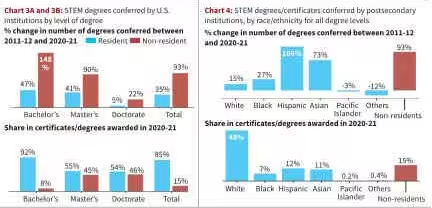
- Slower Growth in U.S. Students: U.S. residents pursuing STEM degrees increased by 47% (2011–21). Non-residents grew by 148%, showing greater dependence on foreign students.
- Master’s Level Gap: 45% of STEM Master’s graduates are non-residents, indicating a heavy reliance on foreign talent for future STEM workforce.
Policy Impact
- H-1B visa fee makes hiring foreign talent costly, reducing access to skilled professionals.
- Could discourage foreign students from staying and contributing to the U.S. economy.
- May slow innovation and job growth in high-demand STEM sectors.
Global Reaction
- China: Promoting K visa as an H-1B alternative.
- U.K. & Germany: Exploring visa fee cuts and open invitations to Indian STEM workers.
- Japan & South Korea: Planning similar talent-attracting initiatives.
Concerns for U.S.
- Risk of talent flight to other countries.
- Domestic talent supply insufficient to meet projected 8% growth in STEM jobs (vs. 2.7% in non-STEM).
- Potential decline in competitiveness and innovation capacity.
Conclusion
The U.S. policy may undermine its own economy by restricting access to global STEM talent. Encouraging openness and balanced visa reforms could sustain growth and innovation leadership.
A PATH TO PROGRESS THAT IS PAVED WITH GOLD
TOPIC: (GS3) ECONOMY: THE HINDU
India is exploring ways to achieve financial self-reliance by mobilising domestic gold reserves to finance growth and reduce dependency on volatile foreign capital, as global investment flows decline.
Context
- Atmanirbhar Bharat (Self-Reliant India) is not only an economic policy but also a civilisational philosophy.
- India’s history shows that self-reliance in crises — like the Green Revolution, IT revolution, and COVID-19 vaccine development — has led to long-term national strength.
- Today, the next frontier is financial Atmanirbharta, where India funds its own growth by unlocking domestic wealth.
The Case for Financial Self-Reliance
- India has received over $1 trillion FDI since 2000, but global capital flows are now shrinking:
- 11% fall in global investment (2024)
- 27% drop in international project finance
- Foreign portfolio flows are volatile and unreliable.
- Hence, India must depend on internal capital, especially household-held gold.
India’s Gold Wealth
- Indian households hold nearly 25,000 tonnes of gold (~$2.4 trillion value), equal to 55% of India’s GDP (FY26).
- Despite this, India imports ~87% of its gold, creating a trade deficit burden.
- The challenge is to transform idle gold into a productive asset.
Reimagining Gold Monetisation
- To succeed, a trust-based, modern scheme is essential with three key pillars:
- Infrastructure Development: Expand hallmarking and purity testing centres nationwide. Only a fraction of gold today is standardised or branded.
- Efficient Logistics: Banks to manage deposits and interest. Collection centres to ensure secure movement of gold.
- Digital Integration: Metal accounts to track deposits like bank balances. Simplified rules — no GST/custom scrutiny, “no questions asked” deposits.
Economic Benefits
- Cost of gold-based funds: 4.5–6.5%, cheaper than external borrowing.
- Mobilising even a small fraction can:
- Reduce imports
- Strengthen current account balance
- Create domestic capital for infrastructure and innovation
Way Forward: Financial Atmanirbharta
- India must convert cultural trust in gold into economic strength.
- Mobilising domestic wealth is a civilisational mission, not just economic reform.
- With trust, transparency, and technology, “Bharat can fund Bharat”, achieving self-reliant, sustainable growth.
Conclusion:
India’s gold reserves represent untapped potential. By building a credible, citizen-friendly gold monetisation framework, the nation can finance its aspirations from within, ensuring long-term stability and true Atmanirbharta.
WHO GLOBAL REPORT ON TRENDS IN PREVALENCE OF TOBACCO USE
TOPIC: (GS2) HEALTH: INDIAN EXPRESS
The World Health Organization (WHO) released its latest Global Report (2000–2024) on tobacco use, along with projections till 2030, highlighting global and national trends in tobacco consumption and the progress made in reduction efforts.
Global Usage
- Declining Usage: The share of adults using tobacco globally has fallen from 26.2% in 2010 to 19.5% in 2024.
- Persistent Concern: Despite progress, 1 in 5 adults still consume tobacco worldwide.
- Emerging Challenge: The rise of e-cigarettes — with over 100 million users globally — is creating new health and regulatory issues.
India’s Status and Achievements
- Tobacco Users: Around 243.48 million Indians aged 15 years and above still use tobacco (2024).
- Global Rank: India is the 2nd largest producer after China and 2nd largest exporter after Brazil.
- Reduction Target: India is on track to achieve a 43% decline in tobacco use between 2010–2025, surpassing the WHO NCD target of 30%.
India’s Key Measures to Curb Tobacco Use
Legislative Framework
- COTPA, 2003: Bans smoking in public places, prohibits advertisements, restricts sales to minors, and mandates health warnings on packaging.
- Prohibition of Electronic Cigarettes Act, 2019: Completely bans production, import, sale, and advertising of e-cigarettes.
Policy and Programmes
- National Tobacco Control Programme (2007-08): Focuses on awareness, capacity building, and enforcement aligned with WHO-FCTC commitments.
- Tobacco-Free Film Rules (2024): Tightened regulations on portrayal of tobacco in films and TV.
- Yellow Line Campaign: Marks a 100-yard zone around schools, restricting tobacco sales near educational institutions.
Fiscal Measures
- Regular increases in excise and GST duties, though experts suggest further hikes for greater deterrence.
About Tobacco Plant
- Scientific Name: Nicotiana tabacum.
- Origin: Native to South America, now widely cultivated globally.
- Climate Needs: Grows best in 20–30°C, 90–120 frost-free days, and 500 mm rainfall.
- Nicotine Content: Found in all plant parts (except seeds); leaves hold 64% of total nicotine (2–8% concentration).
Conclusion
Despite significant progress, tobacco use remains a major public health issue. Strengthened taxation, strict regulation of emerging products like e-cigarettes, and sustained awareness campaigns are crucial to meet 2030 reduction goals.
FISHERIES SECTOR TO GET SUSTAINABILITY LABEL
TOPIC: (GS3) ENVIRONMENT: THE HINDU
Around 10 Indian fish and shrimp varieties are in the process of receiving the Marine Stewardship Council (MSC) certification by 2026, marking a major step toward sustainable fishing practices and enhanced global market access.
MSC Certification
- The Marine Stewardship Council (MSC) is a global non-profit organisation that provides certification based on scientific and sustainable fishing standards.
- The MSC eco-label is a voluntary, market-driven certification that ensures fish and seafood are caught sustainably and are traceable throughout the supply chain.
- Currently, 20% of the world’s fisheries are certified under the MSC programme.
- India’s Ashtamudi clam fishery was the first to receive MSC certification and is now being re-certified.
Significance of MSC Certification
- Revenue Growth: Expected to boost the fisheries sector’s income by 30%.
- Market Diversification: Opens new global markets beyond the U.S., reducing dependency amid potential trade barriers.
- Sustainability Boost: Encourages eco-friendly fishing, maintaining marine biodiversity.
- Livelihood Security: Promotes stable incomes through responsible fishing and improved product value.
INDIA’S FISHERIES SECTOR
- Global Position: India is the 2nd largest fish producer, contributing 8% to global fish output.
- Major Fish-Producing States: Andhra Pradesh, Gujarat, Kerala, Odisha, Tamil Nadu, Karnataka, Maharashtra, West Bengal.
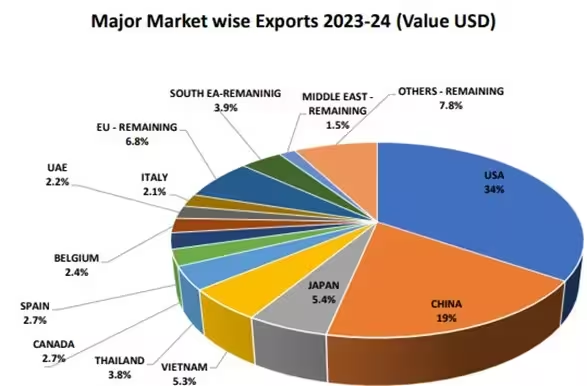
- Export Performance (2024–25):
- Total seafood exports: $7.38 billion (1.78 million metric tonnes).
- Frozen shrimp contributed 66% of total export earnings ($4.88 billion).
- Export destinations: USA, China, Japan, Vietnam, Thailand.
Challenges
- Revenue Risk: Dependence on the U.S. market (34.5%); higher tariffs could reduce competitiveness.
- Overfishing: Unsustainable catch levels threatening marine ecosystems.
- Climate Change & Pollution: Affecting breeding and reducing catch.
- Infrastructure Gaps: Weak cold-chain systems and quality issues affect exports.
Government Efforts
- Aquaculture Development: Introduction of advanced technologies and better farming practices.
- Duty Relief (Budget 2024–25): Zero duty on fish lipid oil, algal prime, crude fish oil; Reduced import duties on feed ingredients.
- Export Incentives: RoDTEP refund raised from 2.5% to 3.1%.
- Pradhan Mantri Matsya Sampada Yojana (PMMSY): Focuses on modernization, cold-chain, loss reduction, and productivity enhancement.
Conclusion
The move towards MSC certification is a transformative step that will help Indian fisheries adopt sustainable practices, improve export competitiveness, and ensure long-term ecological and economic stability.
NOBEL PRIZE IN PHYSICS 2025
TOPIC: (GS3) SCIENCE AND TECHNOLOGY: THE HINDU
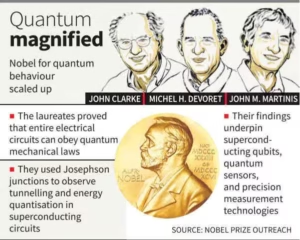
The 2025 Nobel Prize in Physics has been awarded to John Clarke, Michel Devoret, and John Martinis for their groundbreaking work in developing a device that demonstrates quantum tunnelling, a key phenomenon in quantum mechanics.
About the Discovery
- The trio designed experiments that revealed how particles in the quantum world behave in unexpected ways.
- Their research focused on “quantum tunnelling” — a phenomenon where particles can pass through barriers that would normally block them.
- This behaviour defies classical physics and can only be explained through quantum mechanics.
Understanding Quantum Tunnelling
- In simple terms, tunnelling is when a particle crosses an energy barrier it shouldn’t be able to, according to conventional physics.
- Example: It’s like a cricket ball occasionally passing through the ground instead of bouncing back — an impossible event at the macroscopic level but possible in the subatomic realm.
- The scientists showed how collections of particles could be made to act together and exhibit tunnelling in controlled lab conditions.
The Experimental Breakthrough
- The team built an electrical circuit using two superconductors separated by a thin insulating layer, known as a Josephson Junction.
- Superconductors conduct electricity with zero resistance, while the insulating layer normally blocks current.
- In their setup, they showed that charged particles in the superconductor could behave as a single unified entity, capable of tunnelling through the insulating layer.
- They further demonstrated current flow without voltage, a purely quantum mechanical effect.
About the Laureates
- John Clarke – Professor at UC Berkeley (USA), expert in superconductors and quantum circuits.
- Michel Devoret – Joined Clarke’s group in the 1980s; currently a leading figure in quantum electronics.
- John Martinis – Doctoral student in Clarke’s group; known for work in quantum computing and macroscopic quantum effects.
Significance of the Work
- The research provides deeper understanding of quantum mechanics and its real-world applications.
- Quantum tunnelling is a cornerstone for emerging technologies like:
- Quantum computers
- Superconducting circuits
- Ultra-sensitive sensors
- Their work mirrors how early quantum discoveries led to inventions like transistors and microchips.
QUANTUM MECHANICS:
Quantum mechanics is the branch of physics that explains how very small particles like electrons, photons, and atoms behave.
- Unpredictable Behaviour: At this microscopic level, particles don’t follow the usual rules; they can act like waves and particles, and their exact position or speed cannot be known exactly (uncertainty principle).

- Foundation of Modern Technology: It forms the basis of technologies like semiconductors, lasers, quantum computers, and MRI machines.
Conclusion
The trio’s pioneering work not only validates quantum tunnelling at a macroscopic level but also lays the foundation for next-generation quantum technologies, reinforcing how fundamental physics fuels modern innovation.
MUD VOLCANO
TOPIC: (GS1) GEOGRAPHY: INDIAN EXPRESS
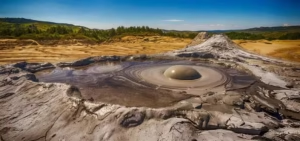
The Geological Survey of India (GSI) is sending a team to Baratang Island in the Andaman Islands to study the recent eruption of India’s only active mud volcano.
Mud volcanoes
- Mud volcanoes are geological structures that emit mud, water, and gases from beneath the Earth’s surface.
- Unlike conventional volcanoes, they do not erupt molten lava and are generally less hazardous.
Formation:
- Often located in areas with subsurface hydrocarbon deposits.
- Tectonic movements or compression cause gas pressure to build beneath the surface.
- Increased pressure forces mud and fluids upward through fractures or faults.
- Repeated eruptions create a cone-shaped mound, called a “mud volcano.”
Characteristics:
- Eruptions are usually non-explosive and localized.
- Can release warm mud and gases over small areas.
- Though less dangerous than lava volcanoes, sudden eruptions or gas emissions may cause localized damage.
Significance:
- Indicator of subsurface hydrocarbon presence.
- Provides insight into tectonic activity in subduction zones.
- Helps researchers understand geophysical and geological processes in seismic regions.
India Context:
- Baratang Island hosts the country’s only active mud volcano.
- Located in the Andaman and Nicobar Islands, part of the seismically active Indo-Myanmar subduction zone.
- Monitoring is essential to study hazards, inform local communities, and conduct scientific research.
Conclusion:
Mud volcanoes, while less destructive than lava volcanoes, are important geological features that indicate tectonic and hydrocarbon activity. The GSI’s investigation will enhance understanding of such formations and their implications in India’s seismically active zones.