

India is considering a review of its 2003 nuclear doctrine amid evolving China–Pakistan threats and rapid advances in emerging military technologies.
India’s Nuclear Doctrine
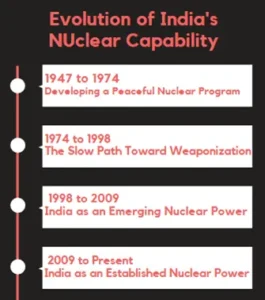
- India conducted the Pokhran-II nuclear tests in 1998, after which the 1999 Draft Nuclear Doctrine outlined the broad framework of nuclear deterrence.
- The Cabinet Committee on Security (CCS) operationalised the doctrine on 4 January 2003.
- Its major principles include:
- Credible Minimum Deterrence: maintaining sufficient nuclear capability to deter nuclear threats.
- No First Use (NFU): nuclear weapons would be used in retaliation to a nuclear attack on India or Indian forces.
- Massive retaliation: nuclear retaliation would be intended to cause unacceptable damage.
- Civilian control: nuclear retaliation can be authorised only by the civilian political leadership through the Nuclear Command Authority (NCA).
- Non-use against non-nuclear weapon states.
Special Provision in the Doctrine
- India has retained the option of nuclear retaliation after a major biological or chemical weapons attack on India or Indian forces.
- Therefore, India’s NFU posture contains a specific qualification rather than being an unconditional commitment.
Why a Review is Being Discussed
- China’s expanding nuclear arsenal and border infrastructure are altering India’s strategic security environment significantly.
- Pakistan’s full-spectrum deterrence and tactical nuclear weapons seek to offset India’s conventional military superiority.
- AI, cyber warfare, hypersonic weapons and missile defence are transforming nuclear decision-making and strategic stability.
- Cyber and space attacks could disrupt nuclear communication, command, control, surveillance and early-warning systems.
- India’s nuclear triad and submarine capabilities strengthen survivability and ensure credible second-strike capability during crises.
Strategic Significance
- Security: Maintains credible deterrence against nuclear threats.
- Stability: Clear declaratory policies can reduce uncertainty during crises.
- Diplomacy: India’s emphasis on restraint and nuclear disarmament supports its image as a responsible nuclear-weapon state.
- Strategic autonomy: India can strengthen capabilities while retaining independent decision-making on national security.
Way Forward
- Periodically review doctrine and threat perceptions without automatically changing declared principles.
- Strengthen nuclear C4I2SR, cyber security, early warning and secure communication networks.
- Maintain a survivable nuclear triad and credible second-strike capability.
- Continue diplomatic efforts for universal, non-discriminatory and verifiable nuclear disarmament.
Conclusion:
India’s challenge is to keep its nuclear deterrence credible in a technologically changing environment while preserving restraint, civilian control and strategic autonomy.
Karnataka’s resistance to the proposed Western Ghats ESA framework has renewed debate over conservation, livelihoods, development and Centre-State coordination.
Western Ghats and ESA
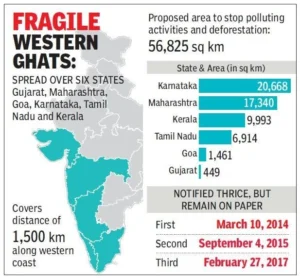
- The Western Ghats extend for about 1,500 km across Gujarat, Maharashtra, Goa, Karnataka, Kerala and Tamil Nadu.
- It is a global biodiversity hotspot, containing endemic species and important ecosystems such as shola forests and Myristica swamps.
- The region is also a major water source, giving rise to rivers including the Godavari, Krishna and Cauvery.
- ESA designation aims to regulate environmentally damaging activities while permitting sustainable and livelihood-compatible development.
Gadgil and Kasturirangan committee recommendations
- Gadgil Committee (WGEEP, 2011): Recommended declaring the entire Western Ghats as an Ecologically Sensitive Area, with three ecological zones having different levels of regulation.
- Kasturirangan Committee (2013): Covered a larger Western Ghats region of 1.64 lakh sq km, but proposed ESA status for only about 60,000 sq km (37%).
- Natural vs Cultural Landscape: Kasturirangan identified around 41% as natural landscape, while nearly 59% was already human-dominated through settlements, agriculture and plantations.
- Scientific Mapping: The Kasturirangan Group used 24-metre satellite-data resolution, compared with the 9-km resolution used by the Gadgil approach.
- Development Approach: Instead of restricting all development, Kasturirangan proposed regulating mainly high-impact activities such as mining, quarrying and highly polluting industries within ESAs.
Why Karnataka Opposes the Framework
- Karnataka has questioned the reliability of remote-sensing and satellite data used for identifying natural and human-dominated landscapes.
- Applying ESA boundaries at the revenue-village level can potentially bring farms and settlements under ecological regulations.
- Farmers and local communities fear restrictions could affect agriculture, construction, employment and infrastructure development.
- Stakeholders associated with activities facing environmental restrictions may also contribute to local opposition.
Challenges
- Unregulated mining, quarrying, large infrastructure and intensive construction can increase land degradation, habitat fragmentation and disaster vulnerability.
- Karnataka’s Western Ghats also face risks from intense rainfall, floods and landslides, according to the State’s climate assessment.
- At the same time, poorly designed restrictions can affect farmers, forest-dependent communities and local economic opportunities.
- Therefore, ESA policy must distinguish between ecologically damaging activities and sustainable livelihood activities rather than treating all human activity alike.
Way Forward
- Conduct updated ground-truthing and high-resolution ecological mapping instead of depending mainly on older datasets.
- Prepare village-level micro-plans identifying forests, farms, settlements, water sources and critical habitats separately.
- Establish scientific carrying-capacity assessments for infrastructure, tourism, mining and other high-impact activities.
- Strengthen Gram Sabha and local-community participation in boundary identification and livelihood safeguards.
Conclusion
Western Ghats conservation requires a cooperative federal approach that protects ecological systems while making development locally sustainable and socially acceptable.
The government plans to promote domestically designed chips for smart meters by 2028, strengthening cybersecurity and reducing dependence on imported components.
What are Smart Meters?
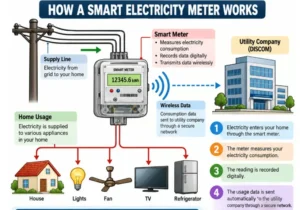
- A smart meter digitally measures electricity consumption and enables two-way communication between consumers and DISCOMs.
- Unlike conventional meters, they can provide near real-time consumption information, support remote meter reading and enable prepaid electricity services.
- Major components include:
- Measurement unit – records voltage, current and electricity consumption.
- Microcontroller/chip – processes and stores metering data.
- Communication module – enables communication with DISCOMs.
- Security system – uses authentication and encryption to protect data.
Why are Smart Meters Important?
- Reduce power losses: Help DISCOMs identify theft, tampering and abnormal consumption.
- Improve revenue collection: Prepaid metering reduces delayed payments and improves cash flow.
- Consumer empowerment: Consumers can monitor consumption and manage electricity expenditure.
- Better grid management: Feeder and transformer-level data helps identify technical losses and equipment problems.
- Renewable-energy integration: Digital metering can support distributed solar, time-of-day tariffs and future smart-grid systems.
Government Initiatives
- The Revamped Distribution Sector Scheme (RDSS) was launched in July 2021 to improve distribution efficiency and financial sustainability.
- RDSS targets 12–15% pan-India AT&C losses and aims to eliminate the ACS-ARR gap.
- As of December 2025, 20.33 crore smart meters had been sanctioned under RDSS, with 3.58 crore installed under the scheme.
- Smart metering covers consumers, Distribution Transformers and feeders, creating an integrated electricity-monitoring system.
Need for Indigenous Chips
- Smart meters are connected digital devices and therefore require protection against cyberattacks, data theft and remote tampering.
- Domestic chip design can strengthen supply-chain security and technological self-reliance.
- India has already developed indigenous smart-energy-meter chip capabilities; the Semicon 2.0 programme also identifies smart meters among its application areas.
Way Forward
- Ensure interoperable and secure metering standards.
- Strengthen encryption, authentication and regular cybersecurity audits.
- Provide transparent grievance-redress mechanisms for consumers.
- Promote indigenous chips while maintaining cost, reliability and quality standards.
Conclusion
Smart meters can transform India’s power distribution by combining consumer empowerment, lower losses, stronger DISCOM finances and a smarter electricity grid.
A motion seeking the removal of the Chief Election Commissioner (CEC) has been initiated in Parliament, bringing constitutional safeguards for the Election Commission into focus.
Constitutional Basis
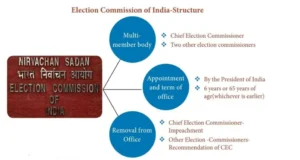
- Article 324 establishes the Election Commission of India (ECI) and provides constitutional protection to the CEC.
- Under Article 324(5), the CEC can be removed only through the same procedure and grounds applicable to a Supreme Court judge.
- This high threshold is intended to protect the ECI from arbitrary removal and preserve its institutional independence.
Procedure for Removal
- The process is governed by the constitutional provisions relating to removal of Supreme Court judges and the applicable parliamentary inquiry framework.
- A removal motion requires signatures of at least 100 Lok Sabha members or 50 Rajya Sabha members.
- After admission, an inquiry committee examines the allegations. It includes a Supreme Court judge, a High Court Chief Justice and a distinguished jurist.
- If the charges are established, Parliament considers the removal motion.
- The process ultimately requires approval by the prescribed special majority in Parliament, followed by the President’s order.
CEC vs Other Election Commissioners
- The CEC enjoys stronger removal protection than other Election Commissioners.
- Other Election Commissioners and Regional Commissioners can be removed by the President only on the recommendation of the CEC under Article 324(5).
- The distinction is designed to provide institutional protection while retaining constitutional accountability.
Significance
- Electoral independence: Prevents removal based merely on political disagreement.
- Accountability: A defined parliamentary process allows serious allegations to be examined.
- Constitutional balance: Combines independence of the ECI with legislative scrutiny.
- Public confidence: Transparent procedures are important for maintaining trust in the electoral process.
Conclusion
A high constitutional threshold for removing the CEC seeks to balance electoral accountability with the independence essential for credible democratic elections.
Google is preparing an orbital test of AI processors on satellites, exploring whether space can support large-scale, solar-powered AI computing infrastructure.
What is Project Suncatcher?
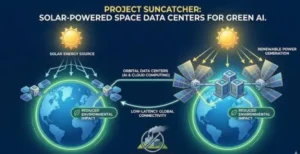
- Project Suncatcher is Google’s research initiative to explore AI computing infrastructure in space.
- It envisages satellites equipped with Tensor Processing Units (TPUs) operating in Low Earth Orbit (LEO).
- The initial mission, developed with Planet, will test TPU performance under radiation, vibration and thermal conditions in space.
- Google eventually proposes interconnected satellite clusters capable of handling large AI workloads.
What is a TPU?
- Tensor Processing Unit (TPU) is a specialised processor developed by Google specifically for machine-learning and AI workloads.
- Unlike general-purpose CPUs, TPUs are designed to perform the mathematical operations required by AI models efficiently.
How Could Space-Based AI Work?
- Solar energy: Satellites can access abundant sunlight, potentially providing greater solar-energy availability than terrestrial systems.
- Optical communication: Future satellites could use laser-based links for high-bandwidth communication between orbiting processors.
- Distributed computing: Multiple satellites could function as a connected computing network rather than isolated platforms.
Key Challenges
- Radiation: Cosmic rays and solar radiation can cause electronic errors.
- Thermal management: Space has no atmospheric airflow, requiring specialised heat pipes and radiators.
- Launch stresses: Hardware must withstand intense vibration and acceleration during launch.
- Communication: Precise laser links between rapidly moving satellites are technically demanding.
Significance for India
- Could influence future space-based computing, satellite communication and AI infrastructure.
- Creates opportunities for ISRO, semiconductor industries and private space companies.
- However, issues of space debris, cybersecurity, spectrum coordination and orbital sustainability require careful regulation.
Conclusion
Project Suncatcher represents an emerging convergence of space technology, semiconductor innovation, renewable energy and artificial intelligence.