

...
Daily Current affairs 28 July 2026

Daily Current Affairs 28-July-2026

Share this Post

SUICIDES AMONG INDIANS IN GULF

TOPIC: (GS1) SOCIAL ISSUES: THE HINDU

The Ministry of External Affairs (MEA) reported that 70% of suicides among Indians abroad in the last three years occurred in Gulf countries. This highlights the mental health and socio-economic challenges faced by migrant workers in West Asia.

Background

  • Gulf nations host nearly 8.5 million Indian workers, mostly in construction, domestic work, and low-wage sectors.
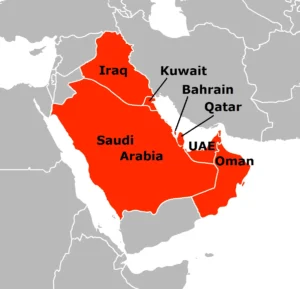
  • MEA data (2022–23) shows 1,340 suicides among Indians in Gulf countries, with the highest numbers in Saudi Arabia (354) and UAE (251).
  • Causes of death abroad include natural reasons, workplace accidents, crime, and suicides, reflecting vulnerabilities of migrant life.
Suicides Among Indians in Gulf

Key Statistics

  • Saudi Arabia: 6,376 natural deaths; 354 suicides.
  • UAE: 5,702 natural deaths; 251 suicides.
  • Kuwait: 162 suicides.
  • Oman, Qatar, Bahrain: ~270 suicides combined.
  • Workplace accidents also remain significant, with 182 deaths in Saudi Arabia and 128 in UAE.

Broader Implications

  • Mental Health Crisis: Long working hours, poor living conditions, and isolation contribute to stress.
  • Economic Pressure: Many migrants take loans to migrate, leading to debt traps.
  • Governance Accountability: Highlights need for stronger bilateral labour agreements and welfare monitoring.
  • Global Image: India must ensure migrant safety to uphold its reputation as a protector of diaspora rights.
  • Example: Similar concerns were raised during the COVID-19 pandemic, when thousands of Indian workers in Gulf countries faced job losses and repatriation challenges.

Government Response

  • Pravasi Bharatiya Bima Yojana (PBBY)
    • Provides insurance coverage to Indian workers abroad, including accidental death and medical expenses.
    • Data Point: Over 3.2 million workers have been covered under PBBY since its inception (MEA report).
  • MADAD Portal
    • Online grievance redressal system for Indians overseas.
    • Helps track complaints related to employment disputes, deaths, and repatriation.
  • Embassy Helplines
    • Indian missions in Gulf countries provide 24×7 helplines for counselling and emergency support.
    • Example: During COVID19 lockdowns (2020), helplines assisted thousands of stranded workers.
  • Skill Development & Orientation
    • Predeparture orientation programmes prepare workers for legal rights, cultural adaptation, and workplace safety.
    • Implemented under the Pravasi Kaushal Vikas Yojana (PKVY).

Way Forward

  • Mental Health Support: Establish counselling centres in Gulf countries with trained professionals. WHO estimates 15% of migrant workers globally suffer from depression or anxiety disorders.
  • Workplace Safety Norms: Enforce strict safety standards through bilateral labour agreements. Regular inspections to reduce workplace accidents (over 400 deaths annually among Indians abroad due to accidents – MEA).
  • Insurance & Social Security: Expand coverage beyond PBBY to include healthcare, pension, and disability benefits. Collaborate with host countries for portable social security schemes.
  • National Migration Policy Integration: Align diaspora welfare with India’s National Migration Policy. Ensure coordination between MEA, Ministry of Labour, and state governments for holistic support.

Conclusion:

The MEA data underscores that protecting the lives and dignity of Indian workers abroad is as vital as securing their economic opportunities.

RIGHT TO PEACEFUL PROTEST AND SUPREME COURT’S STAND ON POLICE ACCOUNTABILITY

TOPIC: (GS2) GOVERNANCE: THE HINDU

The Supreme Court of India recently reaffirmed that peaceful protest is a constitutional right under Article 19. The Court also stated that police excesses during protests can be examined, ensuring equal concern for injuries to both protesters and police personnel.

Background of the Case

  • The case originated from alleged police firing during protests in Bihar, raising concerns about excessive use of force.
  • Protesters claimed violation of their constitutional rights, while police cited lawandorder duties.
  • Supreme Court’s Emphasissed the need for selfdiscipline in democratic protests. It stressed that protests must remain peaceful and authorities must act with restraint.
  • Balanced policing was highlighted as essential to maintain trust between citizens and the state.

Ramlila Maidan Case (2012)

  • In this landmark ruling, the Supreme Court held that excessive police action against peaceful protestors was unconstitutional.
    • The judgment established that minimum force should be used and citizens’ rights under Article 19 must be protected.
    • It serves as a guiding precedent for current and future protestrelated cases.

Key Observations of SC

  • Right to Protest: Citizens can assemble peacefully without arms.
  • Police Accountability: Any excesses or violence by police must be subject to judicial scrutiny.
  • Equal Concern: Injuries to protesters and police are both matters of constitutional importance.
  • Preventive Measures: Authorities must evolve guidelines to avoid escalation.

Governance Dimensions

  • Legal Framework: CrPC Sections 129–131 empower police to disperse unlawful assemblies but must be used proportionately.
  • Checks & Balances: Judicial review ensures accountability of state actions.
  • Human Rights: National Human Rights Commission (NHRC) monitors violations during protests.
  • Example: RTI Act and Anna Hazare’s movement showed how peaceful protests can lead to major policy changes.

Broader Implications

  • Strengthening Democratic Accountability: The SC reiterated that peaceful protest is constitutionally guaranteed under Article 19.
    • This ensures that state power is not misused and that police actions remain subject to judicial review.
    • Data Point: India witnessed over 6,000 protest events in 2025 (Ministry of Home Affairs data), highlighting the importance of clear protocols.
  • Encouraging Citizen Participation: Citizens can express dissent without fear of repression, reinforcing trust in governance.
    • Example: The RTI movement (2005) emerged from grassroots protests, leading to landmark legislation.
  • Reinforcing India’s Global Image: Upholds India’s reputation as a constitutional democracy committed to rights.
    • Aligns with UN Human Rights Council standards on freedom of assembly.
  • Guidance for Police Reforms: The SC emphasized that injuries to both protesters and police personnel are of equal concern.
    • Data Point: In 2024, over 1,200 police personnel were injured during protests nationwide (MHA report).

Way Forward

  • Standard Operating Procedures (SOPs): Develop uniform SOPs for protest policing across states. SC has directed consideration of a panIndia protocol for handling demonstrations.
  • Dialogue Mechanisms: Institutionalize state–citizen dialogue platforms to reduce confrontation. Example: Kerala’s Jan Sunwai (public hearings) model can be adapted for protest mediation.
  • Legal Safeguards: Ensure Article 19 protections are upheld, with proportional use of CrPC Section 144. Independent inquiries into allegations of police excesses must be mandatory.
  • Technology with Privacy: Over 300 CCTV cameras were deployed in Delhi during 2025 protests, but concerns about misuse remain.

Conclusion:

The Supreme Court’s ruling underscores that peaceful protest is the heartbeat of democracy, and accountability ensures it remains protected.

YOUTH ACTIVISM AND DEMOCRATIC REFORM

TOPIC: (GS2) POLITY: THE HINDU

Recent youth-led agitations in India have highlight how public dissent and activism can strengthen democratic accountability.

Understanding Dissent in Democracy

  • Dissent means disagreement or opposition to prevailing ideas, policies, or actions of authority.
  • It is expressed through words, writings, protests, or other peaceful means.
  • In a democracy, dissent is not disloyalty—it is a legitimate right under Article 19(1)(a) of the Indian Constitution.

Background

  • An agitation continued for weeks, compelling the government to engage in dialogue and eventually produce structural reforms.
  • Indian democracy demonstrated that dissent can lead to negotiation and policy change.

Forms of Dissent

  • Peaceful Protests – Citizens gather to express opposition (e.g., farmers’ protests, anti-corruption movements).
  • Public Debate – Intellectuals, media, and civil society critique government policies.
  • Judicial Challenges – Filing PILs or petitions against unconstitutional laws.
  • Art & Literature – Writers, artists, and filmmakers highlight social or political issues.
  • Digital Platforms – Social media campaigns amplify voices of dissent.

Importance of Dissent

  • Democratic Accountability: Keeps government answerable to citizens.
  • Policy Correction: Helps identify flaws in governance and push reforms.
  • Citizen Empowerment: Encourages participation in decision-making.
  • Global Standards: Aligns with UN principles on freedom of expression.
  • Example: The RTI Act (2005) was born out of grassroots dissent demanding transparency.

Limits of Dissent

  • Must remain peaceful and non-violent.
  • Cannot incite hatred, rebellion, or public disorder.
  • Restrictions allowed under Article 19(2) for sovereignty, security, and public order.
  • Example: In Kedar Nath Singh case (1962), SC held that criticism is allowed unless it incites violence.

Challenges in Democratic Processes

  • Trust Deficit: Citizens often doubt the fairness of institutions due to corruption or inefficiency.
  • Delayed Responses: Governments sometimes respond late, leading to prolonged unrest.
  • Youth Frustration: Rising unemployment and exam irregularities fuel discontent.
  • Political Accountability: Responsibility is often blurred between agencies and political leadership.

Role of Youth Movements

  • Catalysts for Reform: Youth activism forces governments to rethink policies and adopt reforms.
  • Dialogue Creation: Sustained protests bring authorities to the negotiating table.
  • Structural Change: Movements often lead to new laws or institutional reforms.
  • Example: The Right to Information Act (2005) emerged from grassroots activism demanding transparency.

Way Forward

  • Institutional Dialogue: Create structured platforms for youth-government interaction.
  • Legal Safeguards: Strengthen protections for peaceful assembly under Article 19.
  • Technology Integration: Use digital grievance portals like MADAD or CPGRAMS for faster redressal.
  • Capacity Building: Train police and administrators in rights-based protest management.
  • Inclusive Policy Making: Involve youth representatives in policy consultations.

Conclusion:

Youth activism proves that dissent, when peaceful and sustained, can transform into dialogue and reform, strengthening the foundations of Indian democracy.

INDIA BANGLADESH GANGA WATER TREATY

TOPIC: (GS2) POLITY: THE HINDU

The 1996 Ganga Water Treaty between India and Bangladesh has completed 30 years, prompting a review of its ecological, political, and diplomatic impact. Both nations are discussing future cooperation on water-sharing and sustainability.

Ganga Water Treaty

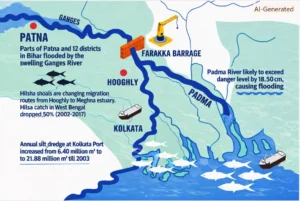
  • Signing and Duration: The Ganga Water Treaty was signed in December 1996 between India and Bangladesh for a 30year period, for sharing river water at the Farakka Barrage during lean seasons.
  • Landmark in Bilateral Relations: It marked a historic milestone in India–Bangladesh cooperation, ensuring equitable distribution of Ganga water management in South Asia.
  • Objective and Vision: The treaty sought to minimize disputes, build mutual trust, and promote joint monitoring mechanisms for sustainable river governance.
  • Strategic Importance: The agreement strengthened India’s regional diplomacy and demonstrated how shared water resources can be managed through dialogue rather than confrontation.
    • Example: The treaty’s success inspired discussions on similar frameworks for rivers like Teesta and Brahmaputra.
India Bangladesh Ganga Water Treaty

Key Provisions

  • Allocation of Ganga waters between India and Bangladesh during lean season (January–May).
  • Joint monitoring through a Joint Committee for data sharing and dispute resolution.
  • Emphasis on mutual cooperation and avoidance of unilateral actions.

Challenges in Current Context

  • Seasonal Variability: Climate change has altered river flows, reducing predictability.
  • Ecological Concerns: Declining water quality and biodiversity in the Ganga basin.
  • Population Pressure: Rising demand for irrigation, drinking water, and industry.
  • Trust Deficit: Occasional disagreements over water release at Farakka.
  • Example: Bangladesh has raised concerns about dry-season shortages affecting agriculture.

Broader Implications

  • Regional Diplomacy: Strengthens India–Bangladesh ties and sets precedent for other river treaties.
  • Environmental Governance: Highlights need for sustainable river basin management.
  • Economic Impact: Water availability directly affects agriculture and livelihoods in both nations.
  • Global Dimension: Connects with UN principles on equitable sharing of transboundary rivers.

Way Forward

  • Renewal of Treaty: Extend or renegotiate terms beyond 2026 with updated ecological data.
  • Integrated River Basin Management: Adopt holistic approaches including pollution control and biodiversity protection.
  • Technology Use: Satellite monitoring and AI-based hydrological models for accurate flow prediction.
  • Regional Cooperation: Expand dialogue to include Nepal and Bhutan for upstream water management.
  • Community Participation: Involve local stakeholders in conservation and water-use planning.

Conclusion:

The Ganga Water Treaty remains a symbol of cooperation and shared responsibility, but its renewal must integrate climate realities and ecological sustainability to secure the future of both nations.

STATEHOOD OF JAMMU & KASHMIR

TOPIC: (GS2) POLITY: THE HINDU

The debate over restoring statehood to Jammu & Kashmir (J&K) has intensified after the abrogation of Article 370 in August 2019.

Meaning of Statehood

  • Statehood means a region has its own elected legislature and government, functioning under the Constitution of India.
  • It ensures autonomy in administration, law-making powers, and direct accountability to citizens.
  • In contrast, a Union Territory (UT) is governed more directly by the Central Government through an Administrator or Lieutenant Governor.
Statehood of Jammu & Kashmir

Background

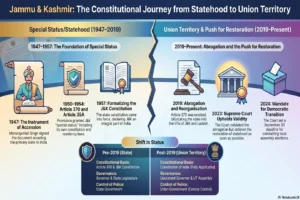
  • Before 2019, J&K enjoyed special status under Article 370 and had its own Constitution and flag.
  • On 5 August 2019, the Government of India abrogated Article 370 and reorganized J&K into two Union Territories ,Jammu & Kashmir and Ladakh under the J&K Reorganisation Act, 2019.
  • The Centre assured that statehood would be restored “at an appropriate time.”
  • In December 2023, the Supreme Court upheld the abrogation but directed the Centre to restore statehood at the earliest.

Democratic Concerns

  • Absence of Elected Government: J&K has been under central rule since 2018, the longest period without an assembly since independence.
  • Accountability Gap: Bureaucratic governance lacks direct public accountability.
  • Political Representation: Local parties like National Conference (NC) and People’s Democratic Party (PDP) demand immediate elections and restoration of statehood.
  • Federal Balance: Prolonged UT status challenges India’s federal spirit and democratic decentralization.

Government’s Position

  • The Centre maintains that statehood will be restored after peace and normalcy are ensured.
  • Development initiatives like PM Development Package, Digital Governance Mission, and infrastructure projects are being prioritized.
  • Security and delimitation exercises are cited as prerequisites for elections.

Broader Implications

  • Democratic Deficit: Weakens the link between responsibility and accountability.
  • Public Trust: Delay may erode confidence in democratic institutions.
  • Regional Stability: Political empowerment is essential for long-term peace.
  • Constitutional Balance: Tests India’s commitment to federalism and participatory governance.

Way Forward

  • Conduct free and fair assembly elections to restore democratic representation.
  • Strengthen grassroots institutions like Panchayats and Urban Local Bodies.
  • Ensure transparent communication on timelines for statehood restoration.
  • Promote inclusive dialogue among stakeholders for lasting peace.

Conclusion:

Restoring J&K’s statehood is vital to revive democratic accountability and reaffirm India’s federal ethos, ensuring governance truly reflects the will of its people.

AI DATA CENTRES AND INDIA’S POWER DEMAND

TOPIC: (GS3) ECONOMY: THE HINDU

The Ministry of Power informed Parliament that AI data centres in India are projected to require an additional 26.3 gigawatts (GW) of electricity by 2031–32. This surge reflects India’s rapid digital transformation and AI adoption, raising questions about energy sustainability and infrastructure readiness.

Background

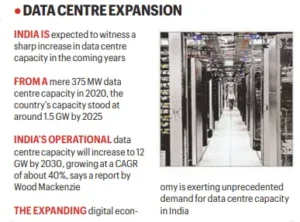
  • India’s data centre capacity has grown from 375 MW in 2020 to an expected 5 GW by 2025, driven by cloud computing, egovernance, and AI applications.
  • Reports by Tech Mahindra and Ministry of Electronics & IT project a compound annual growth rate (CAGR) of 40%, reaching 102 GW by 2030.
  • The digital economy is expected to touch $1 trillion by 2030, contributing nearly 12% of India’s GDP.

Key Drivers of Growth

  • AI and Cloud Computing: Hyperscale providers like AWS, Google, and Microsoft expanding operations in India.
  • Digital India Mission: Push for data localization and secure cloud infrastructure.
  • Urbanisation and Ecommerce: Rising demand for realtime data processing and storage.
  • Government Initiatives: Policies under National Data Centre Policy (draft) and Digital Personal Data Protection Act, 2023 encourage domestic data hosting.
AI Data Centres and Indias Power Demand

Energy Implications

  • Power Demand Surge: AI data centres could add 26.3 GW to India’s electricity load by 2031–32 — equivalent to the total power consumption of several midsized states.
  • Renewable Integration: The Ministry of Power plans to meet this demand through solar and wind capacity expansion under the National Electricity Plan (2023–32).
  • Carbon Footprint Challenge: Data centres consume large amounts of energy for cooling and computation, necessitating green data centre standards.
  • Example: The AdaniConneX project in Chennai integrates renewable power for sustainable operations.

Broader Implications

  • Economic Growth: Boosts employment and investment in digital infrastructure.
  • Energy Transition: Accelerates India’s shift toward clean energy ecosystems.
  • Policy Coordination: Requires synergy between Ministry of Power, MeitY, and NITI Aayog for sustainable planning.
  • Global Competitiveness: Positions India as a hub for AIdriven cloud services in Asia.

Way Forward

  • Promote energyefficient cooling technologies and AIbased power optimization.
  • Encourage green building certifications for data centres.
  • Expand renewableenergy corridors near major data clusters (Mumbai, Hyderabad, Chennai).
  • Strengthen cybersecurity and data protection frameworks to complement infrastructure growth.

Conclusion:

India’s AIdriven data revolution must be powered by clean, efficient, and resilient energy systems, ensuring that technological progress aligns with sustainable development goals.


REFORMING INDIA’S PUBLIC EXAMINATION SYSTEM

TOPIC: (GS2) GOVERNANCE: THE HINDU

The Prime Minister has appointed a high-powered task force to reform India’s public examination system, with Nandan Nilekani identified as a key figure to lead it.

Background

  • India conducts large-scale exams like UPSC, SSC, NEET, JEE, and state recruitment tests, involving millions of candidates.
  • Recent controversies over paper leaks and irregularities have eroded public trust.
  • The government aims to restore integrity, transparency, and efficiency in examinations.
  • Past experiences, such as protests at Jantar Mantar, reflect youth frustration with systemic flaws.

Challenges in Current System

  • Paper Leaks: Frequent breaches undermine credibility of recruitment and academic exams; lakhs of aspirants are affected when papers are cancelled.
  • Technology Gaps: Limited use of secure digital platforms makes exams vulnerable to malpractice.
  • Institutional Trust Deficit: Candidates increasingly doubt fairness and transparency in recruitment processes.
  • Political Responsibility: Accountability is often blurred between agencies and governments, leading to governance gaps.
  • Example: In 2024, multiple statelevel recruitment exams were cancelled due to leaks, impacting lakhs of aspirants and eroding public trust.

Role of Technology

  • Digital Platforms: Secure online exam systems can reduce leak risks and ensure realtime monitoring.
  • AI & Analytics: Artificial Intelligence can detect irregularities, malpractice patterns, and suspicious behaviour during exams.
  • Blockchain Solutions: Blockchain ensures tamperproof question paper distribution and transparent evaluation records.
  • Example: The CBSE’s digital evaluation system improved transparency in board exams, showing how technology can strengthen credibility.

Integrity and Institutional Trust

  • Technology alone cannot solve systemic issues; institutional integrity is crucial.
  • Need for independent oversight bodies to monitor exam conduct.
  • Transparency in recruitment builds youth confidence in governance.
  • Example: UPSC’s reputation for fairness is often cited as a benchmark.

Way Forward

  • National Examination Authority: Create a centralized body to set uniform standards for recruitment and academic exams, ensuring consistency and reducing duplication across states.
  • Secure Digital Infrastructure: Implement biometric verification, encrypted paper transmission, and blockchain systems to prevent leaks and malpractice.
  • Legal Frameworks: Strengthen laws under the Public Examinations (Prevention of Unfair Means) Act, 2024, with fasttrack courts for quick disposal of fraud cases.
  • Dialogue with Students: Institutionalize grievance redressal and regular consultations with aspirants to restore trust and reduce unrest.
  • Integration with National Missions: Align reforms with Skill India for competencybased testing and Digital India for secure platforms, ensuring exams meet future workforce needs.

Conclusion:

Reforming India’s examination system requires a blend of technology, integrity, and accountability, ensuring that merit and fairness remain the foundation of public recruitment.

Write a Review

Your email address will not be published. Required fields are marked *

Seraphinite AcceleratorOptimized by Seraphinite Accelerator
Turns on site high speed to be attractive for people and search engines.