

Table of Contents
ToggleFiscal Federalism in India: Efficiency Versus Equity Concerns
Fiscal federalism refers to the financial relationship between the Union government and the States, including the distribution of taxation powers, revenue sharing, and grants. In India, the Finance Commission plays a crucial role in maintaining fiscal balance by recommending the distribution of resources between the Centre and States.
The debate today revolves around balancing efficiency, fiscal discipline, and equity among states with different levels of development.
Role of the Finance Commission
Constitutional Mandate
The Finance Commission is a constitutional body under Article 280 of the Indian Constitution.
Its major functions include:
- Recommending the distribution of tax revenues between the Centre and States.
- Suggesting principles for grants-in-aid.
- Addressing fiscal imbalances among states.
It acts as an important institution for strengthening cooperative federalism.
Evolution of Fiscal Transfers
Changing Approach of Finance Commissions
Earlier Finance Commissions focused significantly on:
- Correcting vertical imbalance between Centre and States.
- Providing grants to address state-specific needs.
Recent Finance Commissions have increasingly focused on:
- Fiscal efficiency
- Performance-based incentives
- Maintaining fiscal discipline
The 16th Finance Commission has continued this approach by emphasising grants linked with outcomes and responsible fiscal management.
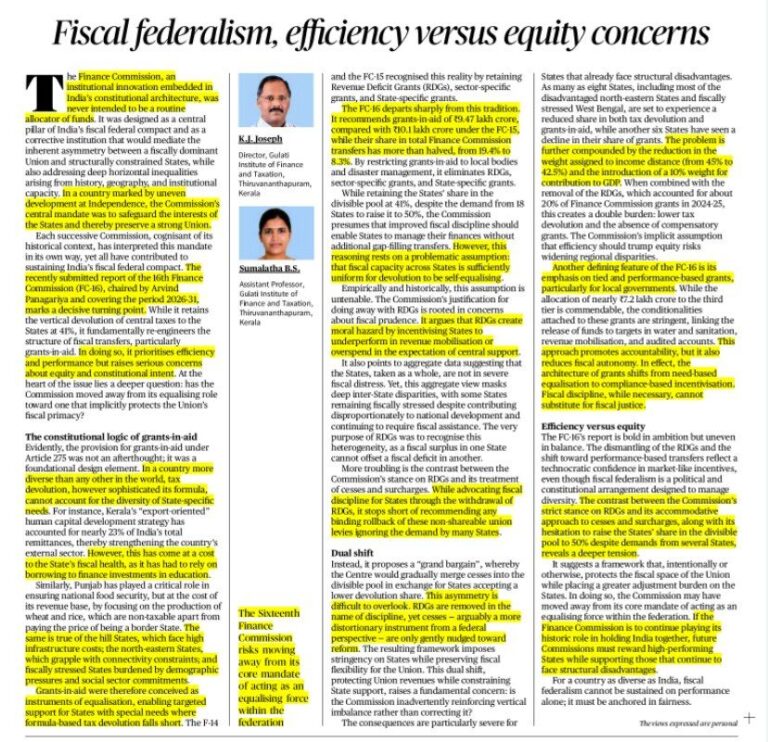
Equity Concerns Among States
Unequal Development Levels
Indian states differ significantly in:
- Revenue generation capacity
- Infrastructure development
- Human development indicators
Less developed states often require greater fiscal support to ensure balanced regional development.
However, excessive emphasis on performance-based grants may disadvantage states that already face structural challenges.
Efficiency Versus Equity Debate
Need for Balanced Fiscal Transfers
Efficiency-based transfers encourage:
- Better governance
- Responsible expenditure
- Improved revenue mobilisation
However, equity requires:
- Supporting weaker states
- Reducing regional disparities
- Ensuring equal access to public services
Fiscal federalism must balance both objectives.
Challenges in Indian Fiscal Federalism
Major concerns include:
- Dependence of states on central transfers
- Limited revenue autonomy
- Regional inequalities
- Tension between fiscal discipline and welfare commitments
A fair transfer system must recognise historical, geographical, and institutional differences among states.
Way Forward
India needs a fiscal framework that promotes:
- Greater state autonomy
- Transparent transfer mechanisms
- Incentives for efficiency
- Adequate support for disadvantaged regions
- Cooperative decision-making between Centre and States
Conclusion
Fiscal federalism is not only about sharing financial resources but also about maintaining the balance between economic efficiency and social equity. A successful system should encourage responsible governance while ensuring that weaker states receive adequate support for inclusive development.
Vocabulary
1. Fiscal Federalism – Financial relations between Centre and States
2. Tax Devolution – Sharing of central taxes with States
3. Grants-in-Aid – Financial assistance under Article 275
4. Revenue Deficit Grant (RDG) – Grant to bridge revenue gaps
5. Equity – Fair distribution of resources
Frequently Asked Questions (FAQs)
What is fiscal federalism in India?
Fiscal federalism refers to the financial relationship between the Union and States, including taxation powers, revenue sharing, grants and fiscal responsibilities.
What is the role of the Finance Commission in India?
The Finance Commission (Article 280) recommends the distribution of tax revenues between the Union and States and suggests principles for grants-in-aid to address fiscal imbalances.
Why is there a debate between efficiency and equity in fiscal transfers?
Efficiency-based transfers encourage better governance and fiscal discipline, while equity-based transfers ensure support for less developed states. A balance between both is necessary for inclusive growth.
What are the major challenges in India’s fiscal federalism?
Key challenges include regional disparities, dependence of states on central transfers, limited revenue autonomy, and balancing welfare spending with fiscal responsibility.
How can fiscal federalism be strengthened in India?
Fiscal federalism can be improved through greater state autonomy, transparent resource-sharing mechanisms, performance incentives, and adequate support for economically weaker states.
Source From : The Hindu
Gen Z Protests in India: Youth Aspirations, Political Accountability and Crisis of Trust
The rise of Gen Z protests in India reflects growing concerns among young citizens regarding education, employment, fairness, and institutional accountability. These protests are not merely reactions against a particular government or policy but represent deeper dissatisfaction with systems that many young people feel are unable to meet their aspirations.
Why Are Gen Z Protests Increasing?
Crisis of Opportunities
A major reason behind youth dissatisfaction is the growing uncertainty around career and economic security.
Key concerns include:
- Limited employment opportunities
- Increasing competition in examinations
- Concerns over fairness and transparency
- Pressure to achieve professional stability
For many young Indians, education and hard work no longer guarantee the same social mobility that earlier generations experienced.
Changing Nature of Youth Politics
Digital and Decentralised Movements
Gen Z participates in politics differently from previous generations. Their movements are often driven by:
- Social media platforms
- Online campaigns
- Independent civic participation
- Decentralised leadership
This reflects a shift from traditional political mobilisation towards issue-based movements focused on accountability and reform.

Institutional Trust and Politics of Accommodation
Need for Democratic Reforms
The article highlights concerns over a culture where institutions and individuals often adjust to existing systems rather than addressing structural problems.
Young citizens increasingly demand:
- Transparent governance
- Equal access to opportunities
- Fair institutional processes
- Greater accountability from authorities
A strong democracy requires not only elections but also institutions that respond effectively to citizens’ concerns.
Responsibility of Previous Generations
Addressing the Intergenerational Gap
The debate also raises questions about whether systems created by previous generations are suitable for today’s challenges.
Issues such as:
- Changing job markets
- Educational pressures
- Economic uncertainty
require collective solutions rather than placing blame on a single generation.
Way Forward
Addressing youth concerns requires:
- Employment-focused economic growth
- Education reforms
- Transparent recruitment systems
- Stronger democratic institutions
- Greater youth participation in policymaking
Conclusion
The rise of Gen Z protests in India represents a larger conversation about democracy, opportunities, and institutional trust. Young citizens are demanding a system that is more inclusive, accountable, and responsive to their aspirations. Strengthening institutions and creating meaningful opportunities for youth participation will be essential for India’s future development.
Vocabulary
1. Institutional Decay – Weakening of public institutions
2. Accountability – Responsibility for actions and decisions
3. Accommodation Politics – Compromise without structural reform
4. Disillusionment – Loss of trust or confidence
5. Democratic Renewal – Revitalising democratic institutions
Frequently Asked Questions (FAQs)
Why are Gen Z protests increasing in India?
Gen Z protests are driven by concerns over employment opportunities, education systems, fairness, and institutional accountability. Young citizens are questioning whether existing structures can meet their aspirations.
How is Gen Z’s political participation different from earlier generations?
Gen Z uses digital platforms, social media campaigns, and decentralised movements to express concerns. Their activism is often issue-based rather than led only by traditional political organisations.
What are the major challenges faced by Indian youth today?
Major challenges include unemployment, intense competition, uncertainty in career growth, and concerns over transparency in education and recruitment processes.
Why is institutional trust important for addressing youth concerns?
Strong institutions ensure fairness, accountability, and equal opportunities. Declining trust can increase dissatisfaction among citizens and weaken democratic participation.
How can India address the concerns raised by Gen Z?
India needs employment-focused growth, education reforms, transparent systems, and greater youth participation in policymaking to build a more inclusive and responsive democracy.