Table of Contents
ToggleThe Deccan and Mughals UPSC
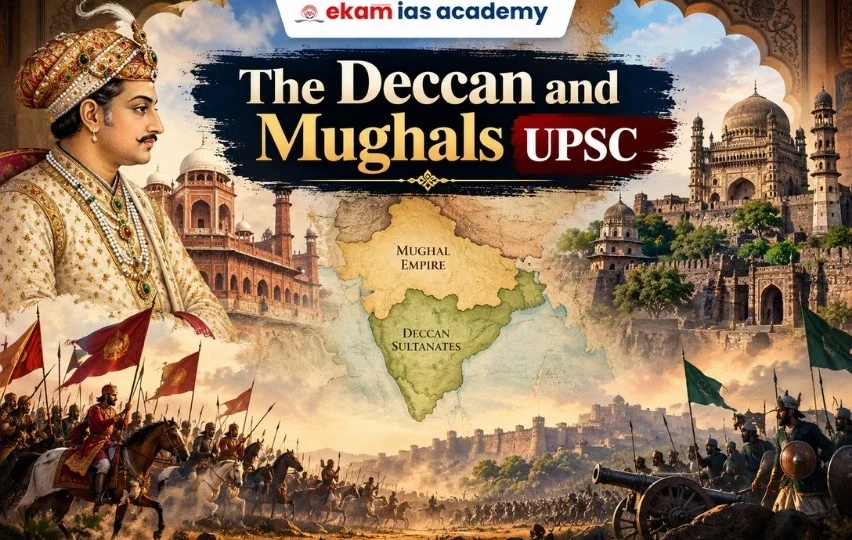
The strategic relationship between The Deccan and Mughals shaped the geopolitical and administrative trajectory of medieval India. Expanding southward beyond the Vindhyas, the Deccan and Mughal Empire dynamic involved continuous military campaigns, diplomatic maneuvers, and territorial acquisitions. Studying Mughals in Deccan UPSC modules reveals how southern conquests impacted imperial stability up to 1657 within Medieval History UPSC.
Political Background of the Deccan
- The political landscape of the Deccan was dominated by five successor states of the Bahmani Empire: Ahmadnagar, Bijapur, Golconda, Berar, and Bidar.
- Mutual rivalries among these Deccan Sultanates created chronic instability across the southern plateau.
- Deccan Sultanates and Mughals relations were further strained by internal succession disputes and growing Portuguese maritime dominance along the western coast.
Akbar’s Deccan Policy
- Mughal Deccan Policy originated under Akbar, who sought to establish imperial suzerainty over southern rulers through diplomacy.
- Initiated military campaigns following the rejection of his diplomatic envoys, leading to the siege of Ahmadnagar defended by Chand Bibi.
- Annexed Berar, Khandesh, and parts of Ahmadnagar by 1601, establishing a firm base for Mughal Expansion in Deccan.
Jahangir and the Deccan
- Jahangir continued campaigns against the kingdom of Ahmadnagar and Mughals encountered fierce guerrilla resistance.
- Faced brilliant military opposition from Malik Ambar, the Abyssinian military commander who effectively deployed Bargi-giri (guerrilla tactics).
- Dispatched Prince Khurram (later Shah Jahan) to secure temporary diplomatic truces and regain lost border territories.
Shah Jahan’s Deccan Policy
- Shah Jahan Deccan Policy adopted a decisive and aggressive forward strategy to permanently neutralize southern threats.
- Extinguished the Nizam Shahi dynasty of Ahmadnagar completely in 1636, dividing its territory.
- Forced Bijapur and Mughals along with Golconda and Mughals into signing the Treaties of 1636, securing annual tribute and imperial oversight.
The Deccan Under Aurangzeb as Prince (Up to 1657)
- Aurangzeb Deccan Policy took shape during his two terms as Viceroy of the Deccan (1536–1544 and 1653–1657).
- Reorganized regional revenue administration with the assistance of Murshid Quli Khan using the Zabt framework.
- Launched aggressive sieges against Golconda (1656) and Bijapur (1557), which were halted prematurely due to Shah Jahan’s intervention and illness.
Major Battles, Campaigns, and Treaties
- Siege of Ahmadnagar (1595–1600): Marked the first major military breakthrough for Mughals in the Deccan.
- Treaties of 1636: Forced Bijapur and Golconda to read the Khutba in Shah Jahan’s name and pay regular tribute.
- Siege of Bidar and Kalyan (1657): Demonstrated Prince Aurangzeb’s aggressive military strategy before the War of Succession.
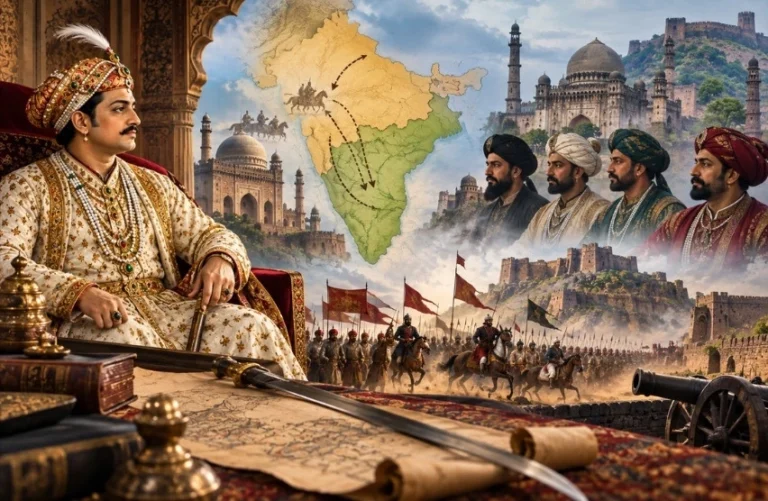
Comparison of Mughal Deccan Policies
- Akbar: Focused on securing Northern entry points and establishing nominal suzerainty through diplomacy.
- Jahangir: Maintained defensive forward posts while struggling against Malik Ambar’s guerrilla tactics.
- Shah Jahan: Achieved total annexation of Ahmadnagar and complete vassalage of Bijapur and Golconda
Military and Administrative Features
- Introduced the Mansabdari and Jagirdari administrative systems into southern provinces.
- Deployed heavy siege artillery and fortified frontier outposts (Thanahs) to maintain regional control.
- Absorbed local Deccani and Maratha military leaders into the imperial service to stabilize administration.
Why Was the Deccan Difficult for the Mughals to Control
- Challenging geography featuring the Sahyadri mountains and rugged terrain suited guerrilla warfare over open battle.
- Protracted Mughal Deccan Conflict strained imperial treasuries and overextended supply lines from Delhi and Agra.
- Rising influence of Maratha chieftain forces who exploited the power vacuum left by declining Sultanates.
Historical Significance
- Shifted the imperial center of gravity southward, consuming vast military resources.
- Facilitated deep cultural, linguistic, and artistic synthesis between Indo-Persian and Deccani traditions.
- Set the stage for the protracted wars under Aurangzeb’s later reign, covered extensively in Deccan History UPSC modules.
Conclusion
The historical relationship between The Deccan and Mughals up to 1657 reflects a steady transition from diplomatic suzerainty to direct annexation. While Shah Jahan and Prince Aurangzeb secured significant territorial and financial gains, the region remained a complex frontier. Understanding this era provides critical insights into the broader dynamics of Mughal Empire UPSC studies.
UPSC Prelims: PYQs & Practice Questions
Previous Year Questions (Prelims)
Q: Who among the following brought about a detailed survey of land and introduced the Zabt system of land revenue in the Deccan during his viceroyalty under Shah Jahan?
(a) Malik Ambar
(b) Murshid Quli Khan
(c) Prince Dara Shikoh
(d) Prince Aurangzeb
Answer: (b) Murshid Quli Khan
Explanation:
During Prince Aurangzeb's second viceroyalty of the Deccan (1653–1657),
Murshid Quli Khan was appointed as the Diwan of the Deccan.
He extended Akbar’s Zabt land revenue system to the southern provinces,
classifying land according to fertility, measuring fields, and reforming tax collection to stabilize the regional economy.
Q2: Consider the following statements regarding Malik Ambar’s resistance against the Mughals:
1. He served as the Prime Minister and military commander of the Nizam Shahi kingdom of Ahmadnagar.
2. He pioneered the widespread use of guerrilla warfare (Bargi-giri) in the Deccan plateau.
3. He introduced revenue reforms in Ahmadnagar modeled on Todar Mal’s Zabt system.
Which of the statements given above are correct?
(a) 1 and 2 only
(b) 2 and 3 only
(c) 1 and 3 only
(d) 1, 2, and 3
Answer: (d) 1, 2, and 3
Explanation:
Statement 1 is correct: Malik Ambar was an Abyssinian military leader who became the chief minister
(Peshwa) and ruler-in-fact of Ahmadnagar.
Statement 2 is correct: He effectively organized light Maratha cavalry forces using Bargi-giri (guerrilla tactics) to harass Mughal supply lines and prevent their southward expansion.
Statement 3 is correct: He reformed the land revenue administration of Ahmadnagar by measuring agricultural land and fixing revenue demands based on actual crop production, similar to Todar Mal's reforms.
Practice Questions (Prelims)
Q: With reference to the Treaties of 1636 signed during the reign of Shah Jahan, consider the following statements:
1. The Nizam Shahi kingdom of Ahmadnagar was completely annexed and partitioned between the Mughals and Bijapur.
2. Both Bijapur and Golconda agreed to include Shah Jahan’s name in the Khutba and pay regular annual tribute.
Which of the statements given above is/are correct?
(a) 1 only
(b) 2 only
(c) Both 1 and 2
(d) Neither 1 nor 2
Answer: (c) Both 1 and 2
Explanation:
Statement 1 is correct: In 1636, Shah Jahan formally ended the Nizam Shahi dynasty of
Ahmadnagar, annexing its core territories while ceding some southern parts to Bijapur as part of a peace settlement.
Statement 2 is correct: Under the 1636 treaties, the rulers of Bijapur and Golconda accepted Mughal suzerainty, agreed to read the Khutba and strike coins in Shah Jahan's name, and paid annual tributes.
Q2: Which of the following best describes the main geopolitical reason for Akbar’s initial intervention in the Deccan towards the end of the 16th century?
(a) The desire to control the maritime trade networks of the Malabar coast.
(b) Securing the imperial southern border against potential expansion by the Portuguese and asserting Mughal suzerainty over the Deccani Sultanates.
(c) Total destruction of the Maratha military confederacy in the Western Ghats.
(d) Establishing direct control over the diamond mines of Golconda.
Answer: (b) Securing the imperial southern border against potential expansion by the Portuguese and asserting Mughal suzerainty over the Deccani Sultanates.
Explanation:
Akbar's forward movement into the Deccan was prompted by his vision of uniting the Indian
subcontinent under imperial rule, neutralizing regional instability along his southern border, and curbing
the rising influence of Portuguese naval power along the western coast.
UPSC Mains – Previous Year & Practice Questions
Mains Previous Year Questions
Question: The Deccan policy of the Mughals up to 1657 evolved from a search for nominal suzerainty to direct territorial annexation. Discuss with special reference to Shah Jahan’s campaigns. (Mains 2016)
Question: Evaluate the role of Malik Ambar in delaying Mughal expansion into the Deccan during the reigns of Akbar and Jahangir. (Mains 2011)
Question: Critically examine the diplomatic and military strategies adopted by Shah Jahan to establish peace in the Deccan through the Treaties of 1636. (Mains 2004)
Question: How far was the growth of Maratha power linked to the protracted military conflicts between the Mughals and the Deccan Sultanates? (Mains 1998)
Question: Analyze the administrative reforms introduced by Murshid Quli Khan in the Deccan during Prince Aurangzeb's viceroyalty. (Mains 1992)
Mains Practice Questions
[15 Marks | 250 Words]
Question: "Geographical terrain, guerrilla tactics, and overextended supply lines made the Deccan a persistent graveyard for imperial ambitions." Analyze this statement in the context of Mughal military campaigns up to 1657.
[15 Marks | 250 Words]
Question: Compare Akbar’s diplomatic approach to the Deccan Sultanates with Shah Jahan’s forward policy of active annexation.
[10 Marks | 150 Words]
Question: To what extent did Prince Aurangzeb's military campaigns against Golconda and Bijapur in the 1650s set the stage for the administrative and financial exhaustion of the Mughal Empire in the late 17th century?



The Deccan and Mughals-FAQs
What were the major Deccan Sultanates during Mughal expansion?
The major Deccan Sultanates included Ahmadnagar, Bijapur, Golconda, Berar and Bidar. Their political rivalries and resistance shaped Mughal strategy in the Deccan.
What was Akbar’s Deccan policy?
Akbar initiated Mughal expansion into the Deccan and secured territories including Berar, Khandesh and parts of Ahmadnagar. His campaigns established an important Mughal base in southern India.
Who was Malik Ambar and why was he important?
Malik Ambar was a prominent military leader of Ahmadnagar who effectively resisted Mughal expansion during Jahangir’s reign. He is particularly associated with the use of guerrilla warfare.
What was the significance of the Treaty of 1636?
The Treaties of 1636 under Shah Jahan significantly strengthened Mughal control in the Deccan. Ahmadnagar was effectively eliminated as an independent power, while Bijapur and Golconda accepted Mughal suzerainty.
Why was the Deccan difficult for the Mughals to control?
Rugged terrain, prolonged warfare, strong regional powers, guerrilla tactics and extended supply lines made the Deccan a challenging frontier. These factors increased the military and financial costs of Mughal expansion.