Table of Contents
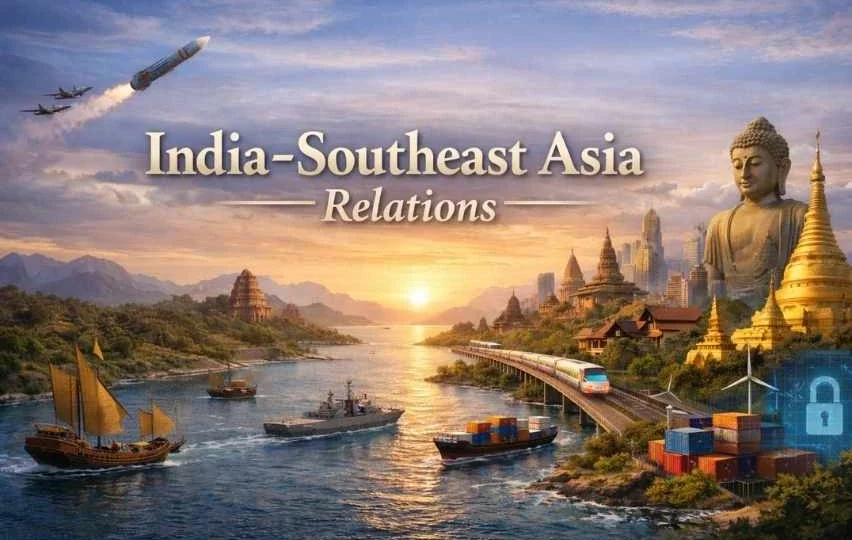
ToggleIndia-Southeast Asia relations UPSC are defined by centuries of shared civilization, maritime trade, and religious ties. In the contemporary era, this region has become the centerpiece of India’s global strategy. Strengthening ties with the ASEAN (Association of Southeast Asian Nations) bloc is not just an economic necessity but a strategic imperative to ensure a balanced and multi-polar Indo-Pacific.
Historical Background
The relationship is rooted in “Greater India” influence, where Indian culture, Hinduism, and Buddhism spread to the Shrivijaya and Majapahit empires. The Silk Road of the Sea facilitated the exchange of spices, textiles, and philosophy. Post-independence, India was a proponent of the Bandung Conference (1955), though Cold War dynamics temporarily distanced India from the pro-Western Southeast Asian states until the 1990s.
Definition and Scope
The scope of this relationship primarily involves India’s engagement with the 10 member states of ASEAN (Brunei, Cambodia, Indonesia, Laos, Malaysia, Myanmar, Philippines, Singapore, Thailand, and Vietnam) and Timor-Leste. It covers the 4Cs: Culture, Commerce, Connectivity, and Capacity Building.
Evolution of Relations
- Look East Policy (1991): Launched by P.V. Narasimha Rao to reconnect with the booming “Asian Tigers” after the Cold War.
- Strategic Partnership (2012): Ties were elevated during the commemorative summit in New Delhi.
- Act East Policy (2014): Prime Minister Modi transformed the policy to be more action-oriented, security-focused, and inclusive of the wider Indo-Pacific region.
India’s Initiatives
- Plan of Action (2021-2025): A roadmap to implement the ASEAN-India Strategic Partnership.
- Mekong-Ganga Cooperation (MGC): An initiative involving India and five ASEAN nations for tourism, culture, and education.
- AIGTF: The ASEAN-India Green Fund to support climate-change-related projects.
- Delhi Dialogue: The premier annual track 1.5 event to discuss India-ASEAN relations.
Strategic Significance
- Maritime Security: Southeast Asia sits on vital choke points like the Strait of Malacca.
- Economic Integration: ASEAN is India’s 4th largest trading partner.
- Counter-Hegemony: Cooperation with ASEAN is vital to counter China’s aggressive “Nine-Dash Line” claims in the South China Sea.
Key Areas of Cooperation
- Connectivity: The India-Myanmar-Thailand Trilateral Highway and the Kaladan Multi-modal Transit Transport Project.
- Defense: Joint naval exercises like SIMBEX (Singapore) and CORPAT (Indonesia/Thailand), and the export of the BrahMos missile to the Philippines.
- Digital Economy: Promoting FinTech (UPI-PayNow linkage) and cybersecurity cooperation.
Recent Developments
- Comprehensive Strategic Partnership: The elevation of ties to the highest level of diplomatic engagement.
- ASEAN-India Maritime Exercise (AIME): The institutionalization of joint naval drills in the South China Sea.
- Supply Chain Resilience: Moving manufacturing hubs from China to India and Southeast Asia (China+1 strategy).
Importance for India’s Foreign Policy
- ASEAN Centrality: India maintains that ASEAN must remain at the heart of the Indo-Pacific security architecture.
- North-East Development: The “Act East” policy treats India’s North-Eastern states as the gateway to Southeast Asia.
- Strategic Autonomy: Engaging with ASEAN allows India to bypass the constraints of SAARC and build a “Rules-Based Order.”
Challenges
- Trade Deficit: India faces a significant trade imbalance with ASEAN nations.
- RCEP Withdrawal: India’s exit from the Regional Comprehensive Economic Partnership has created an economic gap.
- Connectivity Gaps: Long-standing delays in completing physical infrastructure projects in Myanmar.
Way Forward
- AITIGA Review: Expediting the review of the ASEAN-India Trade in Goods Agreement to make trade more balanced.
- Blue Economy: Increasing cooperation in sustainable ocean mining and disaster management.
- Tourism: Leveraging the “Buddhist Circuit” to increase people-to-people ties.
Conclusion
For IR UPSC notes southeast asia, it is clear that India’s destiny is inextricably linked to this region. By focusing on the Indo-Pacific Oceans Initiative (IPOI) and ensuring ASEAN Centrality, India can foster a region characterized by “Security and Growth for All” (SAGAR).
UPSC Prelims: PYQs & Practice Questions
Previous Year Questions (Prelims)
Q1. [UPSC Prelims 2015]
Q: India is a member of which among the following?
1. Asia-Pacific Economic Cooperation (APEC)
2. Association of South-East Asian Nations (ASEAN)
3. East Asia Summit (EAS)
Select the correct answer:
(a) 1 and 2 only
(b) 3 only
(c) 1, 2 and 3
(d) India is a member of none of them
Answer: (b) 3 only
Explanation:
India is a member of the East Asia Summit (EAS), but it is not a member of ASEAN, which consists of 10 Southeast Asian countries, and it is also not a member of APEC. Therefore, only Statement 3 is correct.
Q2. [UPSC Prelims 2018]
Q: Consider the following countries:
1. Australia
2. Canada
3. China
4. India
5. Japan
6. USA
Which of the above are among the ‘free-trade partners’ of ASEAN?
(a) 1, 2, 4 and 5
(b) 3, 4, 5 and 6
(c) 1, 3, 4 and 5
(d) 2, 3, 4 and 6
Answer: (c) 1, 3, 4 and 5
Explanation:
ASEAN has Free Trade Agreements with Australia, China, India, Japan, South Korea, and New Zealand. Canada and the United States do not have a formal FTA with ASEAN as a bloc. Hence, the correct combination is 1, 3, 4 and 5.
Practice Questions
Q: With reference to the ‘BrahMos’ missile deal, which Southeast Asian country became the first to receive this system in 2024? (Practice-based)
(a) Vietnam
(b) Indonesia
(c) Philippines
(d) Thailand
Answer: (c) Philippines
Explanation:
In April 2024, India delivered the first batch of BrahMos supersonic cruise missiles to the Philippines under a $375 million deal. This marked a major milestone in India’s defence exports and strengthened India’s strategic presence in Southeast Asia and the Indo-Pacific region.
UPSC Mains – Previous Year & Practice Questions
Mains Previous Year Questions
Q1. [UPSC CSE Mains 2016]
Question: Evaluate the economic and strategic dimensions of India’s Look East Policy in the context of the post-Cold War international scenario.
Q2. [UPSC CSE Mains 2023]
Question: Discuss the strategic importance of the Indo-Pacific region for India, particularly in the context of maritime security and the 'Act East' Policy.
Q3. [UPSC CSE Mains 2021]
Question: The newly tri-nation partnership AUKUS is aimed at countering China’s ambitions in the Indo-Pacific region. Is it going to supersede the existing partnerships in the region? Discuss.
Question: Analyze the impact of India's withdrawal from the Regional Comprehensive Economic Partnership (RCEP) on its 'Act East' Policy.
Question: India’s engagement with Southeast Asia has moved from 'passive observation' to 'active participation'. Critically examine.
Mains Practice Questions
Q1. [15 Marks | 250 Words]
Question: "The '4Cs'—Culture, Connectivity, Commerce, and Capacity Building—form the pillars of India’s Act East Policy. Evaluate the progress made in each pillar."
Q2. [10 Marks | 150 Words]
Question: Examine the challenges posed by the civil war in Myanmar to India's connectivity projects like the Kaladan Multi-modal Transit Transport Project.
Q3. [15 Marks | 250 Words]
Question: As India and ASEAN elevate their ties to a Comprehensive Strategic Partnership (CSP), discuss the potential for 'Digital Diplomacy' and 'Green Energy' cooperation.
India and Southeast Asia -fAQs
What is the difference between "Look East" and "Act East"?
Look East (1991) focused primarily on economic integration with ASEAN. Act East (2014) is more proactive, adding a heavy security and strategic dimension, and expanding the geographical scope to include East Asia (Japan, South Korea) and the Pacific (Australia, PICs).
What are the 'Delhi Dialogue' and 'ADMM-Plus'?
The Delhi Dialogue is an annual premier track 1.5 event to discuss India-ASEAN relations. ADMM-Plus (ASEAN Defence Ministers’ Meeting Plus) is a platform for ASEAN and its eight dialogue partners (including India) to strengthen security and defense cooperation.
Why is the India-Myanmar-Thailand (IMT) Trilateral Highway important?
It is a 1,360 km long highway that will connect Moreh (India) with Mae Sot (Thailand) via Myanmar. It is the “land bridge” intended to link India’s Northeast with the markets of Southeast Asia.
What is the 'AITIGA' review?
The ASEAN-India Trade in Goods Agreement (AITIGA) is currently being reviewed (slated for completion by 2025) to address the widening trade deficit and to modernize rules of origin and non-tariff barriers that have historically disadvantaged Indian exporters.
How does India cooperate with Vietnam in the defense sector?
Vietnam is a key strategic partner. Cooperation includes the gifting of the active warship INS Kirpan (2023), training of Vietnamese pilots for Su-30 aircraft, and collaboration on maritime domain awareness to counter assertiveness in the South China Sea.