
Table of Contents
ToggleINDIA’S FOREX MANAGEMENT DILEMMA
TOPIC: (GS3) ECONOMY: THE HINDU
Recently Indian govt is taking measures such as cutting withholding tax on government bonds to attract foreign inflows to offset stress on rupee.
Forex Reserves
- Forex reserves are the stock of foreign currencies and assets held by the Reserve Bank of India (RBI).
- They act as a buffer to protect the economy against external shocks like capital flight, currency depreciation, or global crises.
Forms in Which They Are Preserved
- Foreign Currency Asset: Held in major currencies like US Dollar, Euro, Pound, Yen. Largest component of India’s forex reserves.
- Gold Reserves: RBI holds physical gold as part of reserves. Provides stability and acts as a hedge against currency volatility.
- Special Drawing Rights (SDRs): International reserve asset created by the IMF. Can be exchanged for freely usable currencies.
INDIA’S FOREX RESERVES COMPOSITION (MAY 2026):
- Foreign Currency Assets – Largest share (~79%), held in USD, Euro, Pound, Yen.
- Gold Reserves – About 17%, acts as a hedge against currency volatility.
- Special Drawing Rights (SDRs) – Around 3%, IMFcreated reserve assets.
- Reserve Position in IMF – Less than 1%, India’s contribution that can be drawn in emergencies.
Present rupee scenario:
- India’s external sector is under stress due to geopolitical tensions, rising crude oil prices, weakening rupee, and foreign capital outflows.
- Declining forex reserves: Nearly $38 billion depletion in two months (2026).
- Persistent FPI outflows: $22.5 billion withdrawn in 2026 so far.
- Rupee depreciation: Fell 11% in one year, touching ₹95.96 per USD (May 2026).
- High crude oil prices: West Asia conflict escalates import bill.
- Global interest rates: US yields remain elevated, reducing EM attractiveness.
- Objective: Conserve reserves, stabilise rupee, attract foreign capital.
Cutting Withholding Tax
- Definition: Tax deducted at source on interest earned by foreign investors in Indian government bonds.
- Current rate: 20% (among highest globally). Earlier concessional 5% till 2023.
- Global comparison: China (10%), Vietnam (5%), Malaysia (exempt).
- Complexities in India: DTAA(Double Taxation Avoidance Agreement) reduces burden for some investors. Nonresidents face higher rates without tax residency certificate.
- Objective: Improve posttax returns, attract FPIs, strengthen rupee, ease forex pressure.
Forex Conservation Measures
- Gold import duty hike: Raised to curb nonessential imports and reduce the Current Account Deficit (CAD).
- Austerity appeal by PM: Citizens urged to limit gold purchases, foreign travel, and fuel consumption to conserve forex.
- Fuel price adjustments: Suppressed prices strain fiscal credibility; controlled hikes inevitable to maintain macroeconomic discipline.
RBI’s Intervention Strategy
- Massive forex sales: $213 bn (202223), $399 bn (202425 record), $166 bn (202526 till March) to stabilise rupee.(leads to sell dollars and increase rupees in economy).
- Forward position: Net short $104 bn (Feb 2026), reflecting aggressive intervention.
- Objective: Prevent disorderly depreciation and maintain investor confidence in the rupee.
Positive Developments
- 2013 Taper Tantrum lesson: FCNR(B) swap window raised $26 bn in 3 months; current policymakers reject similar schemes due to risks.
- FDI inflows rising: $6.27 bn in 202526 vs $959 mn in 202425; February 2026 saw $4.6 bn inflows, highest in 4 years.
- Implication: Despite volatility, longterm investor confidence in India’s growth story remains intact.
DOUBLE TAXATION AVOIDANCE AGREEMENT.
- When a foreign investor earns income in India (like interest, dividends, royalties), they may be taxed both in India and their home country.
- DTAA ensures that such income is taxed only once either in India or in the investor’s home country, or taxed at a reduced rate.
- This makes crossborder investment more attractive and reduces tax burden.
Key Features
- Reduced tax rates: For example, withholding tax on interest may drop from 20% to 10% or even 5% under DTAA.
- Tax credit mechanism: Investors can claim credit in their home country for taxes paid in India.
- Scope: Covers income types like dividends, interest, royalties, capital gains, and fees for technical services.
- Residency certificate requirement: Investors must provide a Tax Residency Certificate (TRC) from their home country to avail DTAA benefits.
Conclusion
India’s forex dilemma reflects the tension between shortterm stability and longterm growth. Cutting withholding tax may ease barriers but cannot alone overcome global risk aversion.
CAPITAL FLIGHT AND RUPEE PRESSURE
TOPIC: (GS3) ECONOMY: THE HINDU
The rupee has depreciated sharply, raising concerns about forex reserve sustainability, inflationary pressures, and investor confidence.
Currency Depreciation:
- Currency depreciation means the fall in value of a country’s currency compared to foreign currencies.
- Example: If ₹1 = $0.012 today but falls to $0.011 tomorrow, the rupee has depreciated against the US dollar.
- Causes: It usually happens due to capital outflows, rising imports, inflation, or global uncertainty.
What is Capital Flight and Currency Depreciation
- Capital Flight: Refers to the largescale movement of money or investments out of a country. Happens when investors feel the economy is unstable, risky, or less profitable.
- Example: If foreign investors sell Indian shares and bonds and move their money to the US, that is capital flight.
- Currency Depreciation: Means the fall in value of a country’s currency compared to others.
- When investors withdraw money, they exchange rupees for dollars → demand for dollars rises → rupee value falls.
- A weaker rupee makes imports like oil and electronics more expensive, increasing costs for the economy.
India’s Current Situation
- Rupee weakened against USD due to: Foreign Portfolio Investors (FPIs) pulling money out.
- Rising imports, especially crude oil, increasing demand for dollars. Global uncertainty pushing investors toward safer markets.
- Forex reserves under pressure: RBI uses reserves to defend the rupee, but reserves are limited.
- Widening Current Account Deficit (CAD): Higher import bills (oil, gold, electronics) mean India spends more foreign currency than it earns.
Impact on Emerging Economies
- Attraction of Capital: Emerging economies like India often offer higher returns compared to developed countries. This makes them attractive destinations for foreign investors seeking better profits.
- Risks Involved: These economies also carry risks such as currency volatility, inflation, and policy uncertainty. If inflation rises or the local currency weakens, the net return for foreign investors falls, reducing their interest in investing.
- Interest Rate Differential: The decision of investors depends largely on the gap between interest rates in India and developed economies (especially the US)
- If US interest rates rise: investors prefer safer US assets, shifting money out of India. This leads to capital outflows, rupee depreciation, and forces the RBI to intervene.
- Overall Effect: Capital flight reduces foreign exchange reserves, weakens the rupee, and increases import costs.
Lessons from 2013 Taper Tantrum
- US Fed’s QE Taper Announcement: The announcement of tapering (changing intrest rates) quantitative easing triggered massive capital outflows from India and other emerging markets.
- Rupee Depreciation & RBI Response: The rupee depreciated sharply, creating external sector stress. RBI introduced the FCNR(B) swap window, mobilising $26 billion in just three months, which helped rebuild forex reserves and stabilise the currency.
- Key Lesson for India: Expectations alone can drive capital flight even before actual policy changes. Emerging economies remain highly vulnerable to global sentiment shifts, requiring strong reserves, diversified inflows.
Impact on Indian Economy
- Widening Current Account Deficit (CAD): Rising crude oil import bills have significantly expanded India’s CAD, straining external balances.
- Rupee Depreciation: The rupee has experienced a sharp fall against the US dollar, intensifying pressure on forex reserves and investor confidence.
- Inflationary Pressures: Higher fuel and LPG prices are burdening households, raising living costs, and even triggering reverse migration of workers back to villages.
- Monetary Policy Dilemma
- Raise interest rates → Defend rupee and curb outflows, but risk slowing growth.
- Maintain current rates → Support investment and growth, but risk inflation and further depreciation.
- Impose capital controls
Government and RBI Response
- RBI Intervention: Tightened rules on forex derivative contracts and conducted direct market sales to curb speculative pressure on the rupee.
- Gold Import Duty Hike: Raised duties to discourage nonessential imports and reduce the Current Account Deficit (CAD).
- PM’s Austerity Appeal: Citizens urged to cut down on gold/fuel consumption, prefer public transport, adopt electric vehicles, and support locally manufactured goods.
Challenges
- High Import Dependence: Heavy reliance on crude oil, gold, and electronics imports strains external balances.
- Weak Export Competitiveness: India lags behind peers like Vietnam and Bangladesh in manufacturing exports.
- Exposure to Global Monetary Policy: Sensitive to US Federal Reserve decisions and interest rate shifts.
- Geopolitical Risks: Strategic chokepoints like the Strait of Hormuz heighten vulnerability.
- Volatile Capital Flows: Foreign portfolio investments react quickly to global shocks, destabilising markets.
Way Forward
- ShortTerm Measures:
- Strengthen forex reserves through targeted interventions.
- Diversify crude oil sources to reduce West Asia dependence.
- Promote gold monetisation to utilise idle household gold.
- Encourage domestic tourism to conserve foreign exchange outflows.
- LongTerm Reforms:
- Boost exports via PLI scheme and Make in India.
- Accelerate renewable energy adoption to cut oil dependence.
- Deepen financial markets to attract stable, longterm capital.
- Build strategic petroleum reserves for supply security.
- Implement structural reforms in labour, land, and capital markets to enhance competitiveness.
Conclusion
India’s current challenge reflects the fragility of external sector stability amid global shocks. By combining forex conservation, energy diversification, export competitiveness, and resilient financial markets, India can safeguard its economy against future turbulence.
INDIA’S SUGAR EXPORT BAN
TOPIC: (GS3) ECONOMY: THE HINDU
The Government of India has banned sugar exports until September 30, 2026. The move is driven by concerns over El Niño risks to agriculture and West Asia geopolitical uncertainty affecting fertiliser supplies.
Sugar Industry in India
- Secondlargest producer globally (after Brazil) and largest consumer.
- Employs millions of farmers and workers which is a socially significant agroindustry.
- Factors for location:
- Raw material proximity (sugarcane is bulky, perishable).
- Tropical/subtropical climate with irrigation and rainfall.
- Labourintensive farming and processing.
- Transport networks crucial for timely cane delivery.
- Heavy water and power use in mills.
- Government policy (FRP for cane, market regulation).
Geographical Distribution
- North India belt: Uttar Pradesh dominant; shorter crushing season, lower yield.
- South India belt: Maharashtra, Karnataka, Tamil Nadu, Andhra Pradesh; longer season, higher sucrose content, modern cooperative mills.
India’s Sugar Supply Position
- Production (202526): 279 lakh tonnes.
- Opening stocks: 50 lakh tonnes → total availability 329 lakh tonnes.
- Exports allowed: 20 lakh tonnes quota; actual exports ~6.5 lakh tonnes.
- Domestic consumption: 280 lakh tonnes.
- Closing stocks: 42.5 lakh tonnes (lowest since 201617, but covers ~1.8 months demand).
Reasons for Export Ban
- El Niño risk: Weak monsoon may affect next planting cycle (202728).
- Fertiliser supply risk: West Asia crisis may disrupt imports, lowering yields.
- Stock uncertainty: Possible mismatch between declared and actual mill stocks.
- Inflation management: Prevent sugar price spikes amid food/fuel volatility.
- Export economics weak: Domestic sales more profitable than exports.
Impact on Global Trade
- India’s Position: India is the secondlargest sugar exporter after Brazil.
- Export Trends: Shipments peaked at ₹45,132 crore in 2022, but steadily declined to ₹30,688 crore (2023), ₹18,906 crore (2024), and ₹18,586 crore (2025).
- Major Buyers Affected: Countries like Somalia, Sudan, Djibouti, Yemen, UAE, Bangladesh, Kenya, Sri Lanka, and Iran will face supply disruptions.
- Regional Impact: Since 90% of exports go outside EU/US, the ban will hit African and Asian importers hardest, creating trade imbalances and food security concerns in those regions.
Way Forward
- Diversify Agricultural Base: Promote crop diversification schemes (e.g., National Food Security Mission, PMKSY for irrigation efficiency) to reduce dependence on sugarcane and ensure resilience against climate shocks.
- Strengthen Domestic Value Addition: Expand Ethanol Blending Programme (EBP) to absorb surplus sugar domestically, reduce oil imports, and stabilise farmer incomes.
- Boost Export Competitiveness: Use Production Linked Incentive (PLI) schemes for food processing to modernise mills and improve efficiency.
- Negotiate bilateral trade agreements to secure preferential access for Indian sugar once global conditions stabilise.
Conclusion
While shortterm trade partners face disruption, India can mitigate risks by diversifying crops, expanding ethanol use, and modernising industry. A balanced policy mix will protect domestic stability while preserving India’s role as a reliable global supplier in the long run.
INDIA’S LABOUR MARKET GAINS
TOPIC: (GS3) ECONOMY: THE HINDU
The PLFS 2025 report highlights positive labour market momentum but also points to persistent structural gaps that must be addressed to harness the demographic dividend.
Positive Developments
- Strong Employment Indicators: Labour force participation at 59%, workforce participation at 57%, unemployment at 3%.
- Youth & Women’s Participation: Youth unemployment declining; rural women’s participation steadily improving.
- Shift to Quality Jobs: Rise in regular salaried employment, decline in selfemployment → more stable income and social protection.
- Women’s Earnings Rising Faster: Wages growing faster than men’s, though gender pay gap persists.
- Structural Transformation: Agriculture’s share falling; manufacturing and services expanding.
- Social Inclusion: Lower caste/gender segregation among younger workers due to better education and mobility.
Key Challenges
- EducationEmployment Gap: Between 2004–23, ~5 million graduates entered annually, but only 2.8 million found jobs.
- Limited Skill Training: Only 4% of workingage population received formal vocational/technical training.
- Barriers for Women: Childcare and household responsibilities restrict consistent participation.
- Gender Workload Inequality: Women work fewer paid hours due to unpaid domestic labour (urban men work ~17.5 hrs more weekly).
- Large NEET Population: Many youth Not in Education, Employment, or Training, excluded from unemployment statistics, worsening disengagement.
Way Forward
- ShortTerm Priorities:
- Expand industrylinked skill training.
- Promote apprenticeship programmes for NEET youth.
- Support women’s participation via childcare, flexible work, and safety measures.
- Create stable jobs with stronger social protection.
- LongTerm Reforms:
- Boost manufacturing and exports through PLI & Make in India.
- Encourage employment in green industries.
- Deepen financial markets to absorb savings and channel investment.
- Structural reforms in labour, land, and capital markets to enhance productivity.
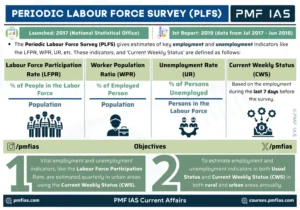
PLFS SURVEY
- Launched in 2017 by NSO
- Introduced to provide timely and comprehensive labour market data at quarterly (urban) and annual (rural + urban) levels.
- Replaced earlier quinquennial employment surveys for more frequent updates.
- Objectives
- Estimate Labour Force Participation Rate (LFPR), Worker Population Ratio (WPR), and Unemployment Rate (UR).
- Track employment trends in both usual status (long-term) and current weekly status (short-term).
- Coverage & Methodology
- Surveys households across India, covering individuals aged 15 years and above.
- Provides insights into sectoral employment shifts, gender participation, wages, and skill levels.
- Uses large sample sizes (e.g., 3.7 lakh persons surveyed in April 2026 monthly bulletin).
- Recent Findings (2025–26)
- Unemployment rate: Around 5.2% in April 2026, highest in six months.
- LFPR: 55% (April 2026), showing slight moderation.
- Women’s participation: Rural female LFPR improving, but urban female LFPR remains lower.
Conclusion
India’s labour market shows positive momentum with rising participation and better job quality. A comprehensive strategy combining skill expansion, women’s empowerment, and structural reforms is essential to fully harness India’s demographic dividend.
PROJECT GARUD
TOPIC: (GS3) SCIENCE AND TECHNOLOGY: THE HINDU
Hyderabad based startup Dhruva Space has secured ₹105 crore under the Research, Development & Innovation Fund (RDIF) for Project Guard.
About Project Garud
- Satellite Platform Programme: Developed by Dhruva Space, focusing on a flatpack 500 kgclass satellite platform.
- Objective: Bridge the gap between small experimental satellites and large traditional systems.
- Standardised Design: Productionoriented spacecraft capable of supporting multiple mission configurations.
- Applications: Telecommunications, national security, earth observation, and emerging datadriven sectors.
Key Features
- FlatPack Architecture: Enables efficient launch stacking, faster integration, and quicker deployment timelines.
- Scalable Manufacturing: Designed for highvolume production, supporting up to two satellites per day.
- Industrial Infrastructure: Dhruva Space will establish tooling, processes, and facilities for mass satellite manufacturing.
- Annual Capacity: Nearly 500–600 satellites per year, positioning India as a global hub for satellite production.
Significance
- Boost to Private Sector: Strengthens India’s emerging private space ecosystem alongside ISRO.
- Strategic Utility: Supports national security and communication needs.
- Economic Potential: Expands India’s role in the global satellite market.
- Innovation in Design: Flatpack model reduces costs and enhances efficiency in satellite launches.
MAJOR PRIVATE SPACE COMPANIES IN INDIA
- Skyroot Aerospace
- Founded in 2018 by exISRO scientists.
- Achieved India’s first private rocket launch (VikramS) in November 2022.
- Developing Vikram1, India’s first privately built orbital launch vehicle.
- Agnikul Cosmos
- IIT Madrasincubated startup founded in 2017.
- Successfully tested semicryogenic engines and launched AgnibaanSOrTeD suborbital rocket in May 2024.
- Focused on customisable small satellite launch vehicles.
- Pixxel
- Bengalurubased Earthobservation startup.
- Launched Hyperspectral imaging satellites providing highresolution environmental and agricultural data.
- Partnered with global agencies for climate monitoring and precision farming.
Conclusion
Project Garud marks a milestone in India’s journey toward privatesector space leadership. By combining innovation, scalability, and strategic utility, it enhances India’s competitiveness in global satellite manufacturing.
EUPHRATES RIVER
TOPIC: (GS1) WORLD GEOGRAPHY: THE HINDU
The Euphrates River, one of the oldest rivers in human history, is rapidly disappearing due to climate change, overextraction, and regional conflicts.
About Euphrates River
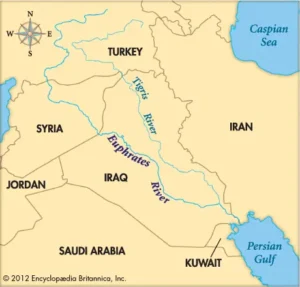
- Longest River in Western Asia: Length of about 2,800 km.
- Origin: Rises in the Armenian Highlands of southeastern Turkey.
- Course: Flows through Syria and Iraq, meets the Tigris River, and drains into the Persian Gulf.
- River System: Along with the Tigris and tributaries, forms the TigrisEuphrates River System.
Historical Significance
- Mesopotamia: Ancient civilizations flourished between the Tigris and Euphrates, known as the Fertile Crescent.
- Babylon: One of the world’s most important ancient cities was built along the Euphrates.
- Boundary Role: Often served as a frontier between kingdoms and witnessed historic battles.
- Cultural Legacy: Symbol of prosperity, agriculture, and early urbanization.
Hydrology
- Receives most water from winter rains and mountain snowmelt.
- Flows through largely arid and semiarid regions, making it vital for irrigation and survival.
- Increasing stress due to dams, diversion projects, and reduced rainfall.
Contemporary Challenges
- Climate Change: Reduced rainfall and rising temperatures.
- Overextraction: Heavy irrigation and damming in Turkey and Syria.
- Geopolitical Conflicts: Water disputes among riparian states.
- Agricultural Decline: Falling river levels threaten food security in Iraq and Syria.
Conclusion
The Euphrates is not just a river but a cradle of civilization, now facing existential threats. Its decline highlights the urgent need for regional cooperation, sustainable water management, and climate adapt ation.
SATELLITETAGGED GANGES SOFTSHELL TURTLE
TOPIC: (GS3) ENVIRONMENT: THE HINDU
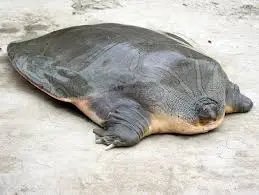
Recently, India released its first satellitetagged Ganges softshell turtle (Nilssonia gangetica) in Kaziranga National Park, Assam.
Ganges softshell turtle
- Belongs to family Trionychidae.
- Found in Ganga–Brahmaputra river systems.
- Listed under Schedule I of Wildlife Protection Act, 1972 (highest protection).
- Classified as Endangered in the IUCN Red List.
Threats:
- Habitat destruction, sand mining, pollution, overexploitation for meat and trade.
- Declining nesting sites due to riverbank erosion.
Satellite Tagging Significance
- Purpose: Track seasonal movement patterns and to Study home range, nesting, and breeding habits.
- Technology: Lightweight satellite transmitter fitted on turtle’s shell. Provides realtime location data via satellite signals.
- Collaborating agencies: Ministry of Environment, Forest and Climate Change. Assam Forest Department. National Geographic Society.
Conservation Importance
- Scientific research: Helps in designing speciesspecific conservation plans.
- Policy support: Data aids in river basin management and habitat restoration.
- Community awareness: Symbolic release on Endangered Species Day highlights conservation needs.
- Global relevance: India joins countries using advanced telemetry for reptile conservation.
Conclusion
The release of India’s first satellitetagged Ganges softshell turtle is a landmark in conservation science. It strengthens India’s commitment to protecting endangered species and riverine biodiversity.

NATIONAL PANCHAYAT AWARDS
TOPIC: (GS2) GOVERNANCE: THE HINDU
The National Panchayat Awards (NPA) were recently announced, highlighting the role of Panchayati Raj Institutions (PRIs) in advancing local governance and Sustainable Development Goals (SDGs).
Background
- Instituted under the Incentivization of Panchayats (IoP) scheme, a key component of the Rashtriya Gram Swaraj Abhiyan (RGSA).
- Revamped in 2022 to align with 9 themes of Localization of SDGs (LSDGs), covering all 17 SDGs.
- Objective: To assess Panchayat performance, encourage competitive spirit, and catalyze the process of achieving LSDGs by 2030.
Themes for Evaluation
Panchayats are ranked based on performance under nine LSDG themes:
- Poverty-free Panchayat and enhanced livelihoods.
- Healthy Panchayat.
- Child-friendly Panchayat.
- Water-sufficient Panchayat.
- Clean and Green Panchayat.
- Self-sufficient infrastructure in Panchayat.
- Socially just and secured Panchayat.
- Good governance Panchayat.
- Women-friendly Panchayat.
Award Categories
- Deen Dayal Upadhyay Panchayat Satat Vikas Puraskar (DDUPSVP): Recognises outstanding Gram Panchayats across the nine LSDG themes.
- Nanaji Deshmukh Sarvottam Panchayat Satat Vikas Puraskar (NDSPSVP): Awarded to the best-performing Panchayats at District, Block, and Gram Panchayat levels on an overall basis.
Significance
- Promotes grassroots democracy and strengthens local governance.
- Encourages Panchayats to act as agents of SDG localization.
- Enhances accountability and transparency in developmental outcomes.
- Builds momentum for inclusive and sustainable rural development.
Conclusion
By rewarding innovation and efficiency, these awards reinforce the role of PRIs as the foundation of India’s democratic and developmental framework.
INDIA ROAD ACCIDENT FATALITIES
TOPIC: (GS2) GOVERNANCE: THE HINDU
Recently, India’s road accident fatalities came into news as official figures for 2024 showed discrepancies between reports released by the Ministry of Road Transport and Highways (MoRTH) and the National Crime Records Bureau (NCRB), raising concerns over data consistency and reliability for policy planning.
Sources of Road Accident Data
- Police records: Primary source, as police are first responders.
- MoRTH data collection: Through its Transport Research Wing (TRW), using formats under the UNESCAP Asia-Pacific project.
- Information gathered: Accident identification, road conditions, vehicles, driver details.
- Shift to eDAR/iRAD: Designed for real-time reporting, but state-level delays persist.
- NCRB data: Compiled via State Crime Record Bureaus (SCRBs), District Crime Record Bureaus (DCRBs), and local police stations.
Legal Basis of Road Accident Data Recording
- Section 106 of Bharatiya Nyaya Sanhita: Fatal road accidents caused by negligence are registered under this section (earlier covered under IPC Section 304-A).
- WHO Global Practice: Nearly half of the countries worldwide rely primarily on police data for accident reporting.
Reasons for Discrepancies
- Different reporting channels: NCRB (Home Ministry) vs MoRTH (coordination with States).
- Mandatory reporting bias: Police must report to NCRB, but MoRTH depends on state cooperation.
- Data limitations: TRW formats restrict details, leading to gaps.
- Under-reporting risks: Victims dying after 30 days often not updated.
- Subjective bias: Police judgments may affect accuracy.
- Persistent challenges: Despite eDAR/iRAD, states report inconsistently.
India’s Global Position
- India has the highest total fatalities worldwide, followed by China and the USA.
- Countries like Iran report higher per capita death rates.
- Several developing nations (Pakistan, Nigeria, Ethiopia, China) show lower per capita fatality rates compared to India.
Measures to Improve Data Accuracy
- Unified Reporting System: Establish a single national platform integrating police, transport, and health departments to ensure consistency.
- Real-time Digital Tools: Strengthen use of e-DAR/iRAD systems with mandatory updates from all states to reduce delays and mismatches.
- Standardized Formats: Adopt uniform templates across ministries and states for accident reporting to avoid variation in categories and definitions.
- Health Department Integration: Include hospital and emergency care data to capture fatalities occurring after the accident, reducing under-reporting.
Conclusion
Reliable statistics are essential for effective policy design, infrastructure planning, and enforcement strategies. Strengthening real-time reporting systems, harmonising data channels, and reducing under-reporting are critical to addressing India’s road safety crisis.