

...
Daily Current affairs 18 May 2026

Daily Current Affairs 18-May-2026

Share this Post

CURRENCY DEPRECIATION AMID WEST ASIA CRISIS

TOPIC: (GS3) ECONOMY: THE HINDU

The Indian rupee has slipped to a record low of ₹96 per US dollar in May 2026 due to the ongoing West Asia conflict and heavy capital outflows, raising concerns of it crossing the psychological barrier of 100.

Understanding Currency Depreciation

  • Definition: Currency depreciation refers to the fall in the value of a currency against another, usually the US dollar.
  • Causes: Demand-supply imbalance of forex, capital outflows, trade deficits, interest rate differentials.
  • Effects:
  • Imports become costlier → fuels inflation.
  • Exports become cheaper → may boost competitiveness.
  • External debt servicing cost rises.

What is Balance of Payments?

  • Definition: BoP is the summary of inflows and outflows of foreign exchange.
  • It includes trade in goods and services, investment flows, remittances, and loans.
  • A surplus strengthens the currency, while a deficit weakens it.

Rupee Movement Timeline

  • Sep 2022: Breached 81/$
  • 2023–24: Artificial stability at 81–83/$ due to RBI intervention.
  • Oct 2024: Crossed 84/$
  • Dec 2024: Crossed 85/$
  • Jan–May 2026: Fell 11%, now at 96/$.

Current Crisis Factors

  • Crude Oil Prices: India imports nearly 85% of its crude oil needs. Rising global oil prices increase the import bill, widening the Current Account Deficit (CAD).
  • FII Outflows: Foreign Institutional Investors (FIIs) have withdrawn around ₹1.97 lakh crore between January–May 2026. This puts downward pressure on the rupee and hurts stock market sentiment.
  • Geopolitical Uncertainty: The ongoing West Asia war has created global instability. Uncertainty impacts trade routes, energy security, and overall investor confidence.
  • Pent-up Depreciation: Between 2023–24, the rupee was artificially stabilised at ₹82–83 per dollar through heavy RBI intervention. Markets are now adjusting for the delayed depreciation that should have occurred earlier.

Economic Implications of Fuel Price Surge

  • Inflation: Rising fuel costs push consumer prices higher. Every $10 increase in crude oil adds about 3% to CPI inflation. If crude hits $150/bbl, inflation could rise by 1.2 percentage points.
  • Current Account Deficit: Costly oil imports widen India’s trade gap. CAD may expand to 5–2% of GDP in FY27 (vs. 0.7% in FY24).
  • Rupee & Investor Confidence: The rupee has weakened to around ₹96 per USD. Depreciation fuels capital flight and reduces investor confidence.
  • External Debt: Dollar debt becomes costlier as rupee falls. India’s reserves (~$728B) provide a buffer, but repayment costs in rupee terms are rising.

Policy Responses

  • RBI: Dollar sales, forward market interventions, restrictions on speculative contracts.
  • Government:
  • Higher gold import duties.
  • Tax cuts to attract foreign investors.
  • Fuel price hikes.
  • PM’s austerity appeal to reduce gold & petrol use.
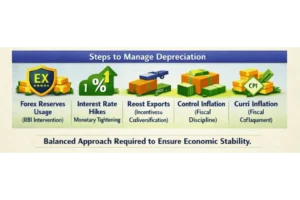
Currency Depreciation

Way Forward

  • Stabilize in the Short Term: RBI interventions, attracting NRI deposits, diversifying crude sources, and promoting gold monetisation to ease immediate pressure.
  • Strengthen Economic Foundations: Boost exports through PLI & Make in India, deepen financial markets, and build stronger forex reserves.
  • Drive Structural & Energy Reforms: Accelerate renewable energy transition and implement reforms in labour, land, and capital markets for sustainable growth.

Conclusion

The rupee’s sharp fall highlights India’s structural vulnerabilities and the limits of intervention. Strengthening domestic resilience and reducing import dependence are the only sustainable solutions.

GREAT NICOBAR PROJECT AND FOREST RIGHTS CHALLENGE

TOPIC: (GS3) ENVIRONMENT: THE HINDU

The Calcutta High Court’s Port Blair bench has admitted a PIL questioning the legality of tribal consent under the Forest Rights Act (FRA), 2006 for the ₹81,000 crore Great Nicobar infrastructure project.

Great Nicobar Project:

  • Mega Infrastructure Plan: ₹81,000 crore project including a transshipment port, integrated township, dual‑use airport, and solar + gas‑based power plants.
  • Forest Rights & Tribal Consent Issues: PIL challenges compliance with the Forest Rights Act, 2006.
  • Ecological & Indigenous Concerns: Diversion of 166 sq km of forest land threatens biodiversity and tribal habitats. Shompen tribe’s rights to food, water, shelter, and cultural survival are at risk, raising ethical and legal questions.

Key Issues Raised

Forest Rights Act Compliance

  • FRA mandates settlement of forest rights before diversion of land.
  • Petition alleges no claims were settled on Great Nicobar Island.
  • The Recognition of Forest Rights (RoFR) certificate issued in August 2022 is contested as unlawful.

Sub-Divisional Level Committee (SDLC)

  • FRA rules require at least two Scheduled Tribe members, including one woman.
  • The SDLC reportedly had only one Nicobarese member, violating norms.

Gram Sabha Consent

  • Gram Sabhas held in Campbell Bay, Laxmi Nagar, and Govind Nagar were allegedly settler panchayats, not tribal assemblies.
  • These bodies approved diversion of 166.10 sq km of forest land, including protected areas, without legitimate authority.

Tribal Consent Dispute

  • Nicobarese Council initially consented but withdrew support in November 2022.
  • Shompen Tribe, a semi-nomadic group, reportedly did not provide direct consent.
  • Consent was allegedly routed through the AAJVS (Andaman Adim Janjati Vikas Samiti), raising ethical and legal concerns.

Impact on Shompen Tribe

  • Project threatens forests used for foraging, hunting, horticulture, worship, and water access.
  • Risks include loss of food security, cultural survival, and displacement.
  • Past settlement of ex-servicemen in 1972 already pushed Shompens deeper into interiors, showing a pattern of marginalisation.

FOREST RIGHTS ACT, 2006

Objectives

  • Passed in December 2006, effective from 31 December 2007.
  • Seeks to correct historical injustices faced by Scheduled Tribes (STs) and Other Traditional Forest Dwellers (OTFDs).
  • Ensures livelihood security, social justice, and sustainable forest management.

Types of Rights Recognized

  • Individual Rights: Ownership of forest land for cultivation and habitation (up to 4 hectares).
  • Community Rights: Grazing, fishing, collection of minor forest produce (like bamboo, honey, medicinal plants).
  • Habitat Rights: Special protection for Particularly Vulnerable Tribal Groups (PVTGs).
  • Management Rights: Gram Sabhas empowered to conserve, protect, and manage community forest resources.

Institutional Mechanism

  • Gram Sabha: Primary authority to initiate claims and approve forest rights.
  • Forest Rights Committee (FRC): Formed at village level to process claims.
  • Sub-Divisional Level Committee (SDLC) and District Level Committee (DLC): Verify and approve claims.

State Level Monitoring Committee: Oversees implementation.

Conclusion

The case underscores the tension between development and indigenous rights. Ensuring genuine tribal consent and adherence to FRA norms is vital for balancing strategic projects with constitutional safeguards.

INDIA’S RENEWABLE PUSH AND ENERGY STORAGE NEEDS

TOPIC: (GS3) ENVIRONMENT: THE HINDU

India’s renewable energy share has crossed 53% of total installed capacity (283 GW out of 532 GW), but inadequate energy storage is creating grid stability concerns.

What is Energy Storage

  • Energy storage refers to technologies that store surplus electricity during high generation and release it when demand rises.
  • It helps in grid balancing, peak load management, and renewable integration.

Major Types of Energy Storage Systems

  • Pumped Hydro Storage (PHS): Uses excess electricity to pump water uphill; later released to generate power.
  • Battery Energy Storage Systems (BESS): Lithium‑ion (especially LFP) batteries dominate; account for 90% of global additions in 2025.
  • Concentrated Solar Thermal Storage: Stores heat in molten salt for later electricity generation.
  • Compressed-Air Storage: Stores compressed air underground, released to drive turbines.

India’s Current Status

  • Battery Storage (BESS): ~0.27 GW
  • Pumped Hydro Storage (PHS): ~7.2 GW
  • CEA Projection (2035‑36): 174 GW / 888 GWh
    • 80 GW BESS (short‑duration)
    • 94 GW PHS (long‑duration)
  • Storage systems of 4–6 hours duration will be critical post‑2030.

Challenges in Energy Storage

  • Import Dependence India relies on 75–80% imported lithium‑ion cells, making the sector vulnerable to external supply shocks.
  • High Cost Burden Lithium‑ion cells contribute nearly 80% of the total cost of battery storage systems, raising affordability concerns.
  • Geopolitical & Trade Risks Heavy concentration of global battery manufacturing in one Asian country exposes India to price volatility, trade disruptions, and geopolitical tensions.
  • Need for Domestic Manufacturing Urgent requirement to develop indigenous production capacity and diversify technologies (beyond lithium‑ion) to ensure long‑term energy security.

Conclusion

India’s renewable energy future depends on robust energy storage infrastructure. Scaling up domestic manufacturing and diversifying technologies will be vital to ensure grid stability and energy security.

SUPREME COURT STRENGTH EXPANDED

TOPIC: (GS2) POLITY: THE HINDU

The President of India has promulgated the Supreme Court (Number of Judges) Amendment Ordinance, 2026, raising the sanctioned strength of judges from 33 to 37 (excluding CJI). With the Chief Justice, the total strength rises from 34 to 38 judges.

Strength of the Supreme Court

  • Article 124 Establishes the Supreme Court of India and provides for the appointment of judges, including the Chief Justice of India.
  • Original Strength At its inception in 1950, the SC had 1 Chief Justice + 7 judges.
  • Supreme Court (Number of Judges) Act, 1956 Parliament determines the sanctioned strength of judges through this Act.
  • Amended multiple times to meet rising case pendency.
  • Latest amendment (Ordinance 2026) increased strength from 34 to 38 judges (including CJI).
  • Article 130 Provides that the SC shall sit in Delhi, though the President may appoint other places.
  • Article 145 Empowers the SC to frame rules for regulating its practice and procedure, including benches.

Ordinance-Making Power of the President

  • Constitutional Basis: Article 123 empowers the President to issue ordinances when Parliament is not in session.
  • Features: Ordinances carry the same force as laws but are temporary.
  • Duration: Must be approved within six weeks of Parliament reassembling.
  • Judicial Review: SC has upheld reviewability in cases like R.C. Cooper (1970), A.K. Roy (1982), and Krishna Kumar Singh (2017).
  • Checks: Criticism of repeated re‑promulgation in D.C. Wadhwa (1987).

Need for Increasing SC Strength

  • Rising Pendency: Over 93,000 cases pending; surge in e‑filing post‑COVID.
  • Complex Litigation: Constitutional matters, PILs, commercial disputes, service cases, and technology‑related litigation.
  • Access to Justice: More judges enable faster disposal, reduce delays, and strengthen citizens’ trust.
  • Specialised Benches: Expansion allows dedicated Constitution Benches and subject‑specific benches.

Other Judicial Reforms Needed

  • Strengthen Lower Judiciary: Vacancies in High Courts and subordinate courts must be filled promptly.
  • All India Judicial Service (AIJS): Under Article 312, to improve recruitment quality.
  • Limit Routine Appeals: SC should focus on constitutional/national importance cases.
  • Alternative Dispute Resolution (ADR): Mediation, arbitration, Lok Adalats to reduce burden.
  • Infrastructure & Technology: More courtrooms, digital systems, AI‑assisted case management, and e‑courts.
  • Permanent Constitution Benches: For quicker resolution of major constitutional issues.

Conclusion

The ordinance expanding SC strength is a short‑term relief to address pendency. In essence: Lasting judicial efficiency requires systemic reforms across all levels, not just adding judges at the apex.

COMMITTEE ON EMPOWERMENT OF WOMEN

TOPIC: (GS2) POLITY: THE HINDU

The Lok Sabha Speaker has recently re‑constituted the Committee on Empowerment of Women, highlighting its role in reviewing policies and programmes for women’s welfare.

Parliamentary Committees

  • Definition Small groups of Members of Parliament (MPs) formed to handle specific functions of legislative business more efficiently. They supplement the work of Parliament by detailed examination of issues.
  • Constitutional Basis
  • Mentioned under Articles 105 & 118 of the Constitution (powers and rules of Parliament).
  • Detailed provisions are framed under the Rules of Procedure and Conduct of Business in Lok Sabha and Rajya Sabha.
  • Types of Committees
    • Standing Committees – Permanent, reconstituted annually (e.g., Public Accounts Committee, Estimates Committee).
    • Ad‑hoc Committees – Temporary, set up for a specific purpose (e.g., Joint Committee on a Bill).

Composition & Tenure

  • Membership: 30 members in total. 20 nominated by the Lok Sabha Speaker. 10 nominated by the Rajya Sabha Chairman.
  • Tenure: One year; re‑constituted annually. Members work across party lines to advance women’s empowerment.

Functions

  • Review NCW Reports: Examines reports of the National Commission for Women and suggests measures to improve women’s status.
  • Equality & Representation: Scrutinises government initiatives for securing women’s dignity, education, and representation in legislatures, services, and other fields.
  • Welfare Programmes: Reviews implementation of schemes for women’s welfare and reports on their effectiveness.
  • Government Action Taken Reports: Monitors follow‑up by Union Government and UT administrations on committee recommendations.
  • Other Matters: Can examine issues referred by the Speaker or Chairman, Rajya Sabha.

Significance

  • Strengthens parliamentary oversight on gender issues.
  • Ensures policy accountability in women’s welfare programmes.
  • Promotes inclusive governance by focusing on equality and representation.
  • Acts as a bridge between legislature and executive on women’s concerns.

COMMITTEE ON EMPOWERMENT OF WOMEN

  • Formation
  • First set up on 29 April 1997 during the 11th Lok Sabha.
  • Re‑constituted every year.
  • Composition
  • 30 Members in total.
  • 20 nominated by the Lok Sabha Speaker.
  • 10 nominated by the Rajya Sabha Chairman.
  • Term: 1 year.
  • Functions
  • Reviews reports of the National Commission for Women.
  • Examines government measures for equality, dignity, and representation of women.
  • Studies welfare programmes and their effectiveness.
  • Reports on action taken by Union Government and UT administrations.

Can take up matters referred by the Speaker or Chairman, Rajya Sabha.

Conclusion

The Committee on Empowerment of Women is a key parliamentary mechanism to ensure gender justice and policy accountability. In short: Its effective functioning is crucial for advancing women’s rights and strengthening democratic oversight.

UNITED NATIONS FORUM ON FORESTS (UNFF)

TOPIC: (GS3) ENVIRONMENT: THE HINDU

The Global Forest Goals Report 2026 was released during the 21st session of the UNFF, highlighting global progress and challenges in sustainable forest management.

About UNFF

  • Establishment: Formed in 2000 by ECOSOC.
  • Objective: Promote sustainable forest management and conservation worldwide.
  • Mandate:
  • Build long‑term political commitment to forests.
  • Facilitate policy dialogue among countries and stakeholders.
  • Promote international cooperation, including financial and technical support.
  • Explore future options for global forest policy, including legal frameworks.
  • Membership: Open to all UN Member States and specialised agencies.
  • Sessions: Annual meetings at UN Headquarters, New York.
  • Odd years: Technical discussions.
  • Even years: Policy‑level dialogues.
  • India’s Role: Founding member, actively shaping global forest policy.
  • Financing Mechanism: Established the Global Forest Financing Facilitation Network (GFFFN) to help countries access funding and share best practices.


    Global Forest facts for UPSC

Significance

  • Provides a global platform for forest governance.
  • Strengthens international cooperation on conservation.
  • Supports climate change mitigation and biodiversity protection.
  • Encourages financial and technical assistance for developing countries.

Conclusion

The UNFF plays a crucial role in advancing sustainable forest management and ensuring global cooperation. It is a key forum for balancing ecological protection with developmental needs worldwide.

LATVIA

TOPIC: (GS1) GEOGRAPHY: THE HINDU

The Prime Minister of Latvia recently resigned following a controversy linked to stray Ukrainian drones, drawing global attention to the Baltic nation’s political developments.

Geographical Features

  • Location: Northeastern Europe, part of the Baltic region.
  • Borders: Estonia (north), Lithuania (south), Belarus (southeast), Russia (east).
  • Maritime Boundary: Along the Baltic Sea and Gulf of Riga.
  • Capital: Riga – largest city and cultural hub.
  • Climate: Temperate continental, with cold winters and mild summers.
  • Highest Point: Gaizinkalns – 311.6 m.
  • Rivers: Gauja (longest), Daugava, Lielupe, Venta, Salaca.
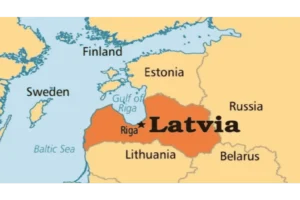

    Latvia

Political & Economic Context

  • Membership: Member of the European Union (EU) and NATO, enhancing its geopolitical importance.
  • Economy: Diversified economy with strengths in IT, manufacturing, and forestry.
  • Natural Resources: Limestone, gypsum, dolomite, peat, and construction materials.

Significance

  • Acts as a strategic buffer state between Western Europe and Russia.
  • Plays a role in regional security through NATO.
  • Rich natural resources and forests contribute to its economy.
  • Cultural heritage and Riga’s historic architecture make it a tourism hub.

Conclusion

Latvia’s importance lies in its strategic location and EU/NATO membership, making it central to European security and politics. Despite being a small nation, Latvia holds outsized geopolitical relevance in the Baltic region.

WESTERN HOOLOCK GIBBON

TOPIC: (GS3) ENVIRONMENT: THE HINDU

For the first time, a male Western Hoolock Gibbon in Assam’s Hollongapar Gibbon Sanctuary (Jorhat) successfully crossed canopy bridges installed over a railway line, marking a milestone in wildlife conservation.

Habitat & Distribution

  • Habitat: Occupies moist deciduous, evergreen, and subtropical forests.
  • Distribution:
  • In India: All northeastern states, mainly between south of Brahmaputra and east of Dibang river.
  • Outside India: Bangladesh and Myanmar.
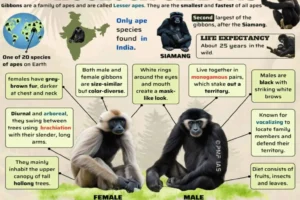
    Hoolock Gibbon

Characteristics

  • Physical Traits: Smallest and fastest ape, adapted for tree‑dwelling life.
  • Behavior:
    • Arboreal and diurnal, moving by brachiation (swinging with long arms).
    • Monogamous, living in small family groups.
    • Communicate through loud vocalisations.
  • Life Span: Around 25 years.

Threats

  • Habitat Destruction: Illegal logging and deforestation are the biggest dangers.
  • Fragmentation: Railway lines, roads, and settlements cut through forests, isolating populations.
  • Human Encroachment: Expansion of agriculture and urbanisation reduces canopy cover.

Conservation Status

  • IUCN Red List: Endangered.
  • Wildlife (Protection) Act, 1972: Listed under Schedule I, offering highest protection.
  • Sanctuaries: Hollongapar Gibbon Sanctuary in Assam is dedicated to their conservation.

Conclusion

The Western Hoolock Gibbon is a flagship species for forest conservation in northeast India. In short: Protecting its habitat ensures both biodiversity preservation and ecological balance.


Write a Review

Your email address will not be published. Required fields are marked *

Seraphinite AcceleratorOptimized by Seraphinite Accelerator
Turns on site high speed to be attractive for people and search engines.