Table of Contents
ToggleEcosystems are constantly subjected to natural and anthropogenic stresses, from global warming to chemical pollution. Measuring these changes using mechanical sensors can be expensive and localized. Instead, ecologists look at specialized organisms whose physiological sensitivities make them live parameters of environmental quality.
Definition of Indicator Species
An indicator species is any biological species or community whose presence, absence, or abundance reflects a specific environmental condition, habitat quality, or the degree of ecosystem degradation. They are proxies for diagnostic analysis of a broader geographic area.
Characteristics of Indicator Species
An ideal environment indicator UPSC study focuses on organisms that possess the following distinct traits:
- High Sensitivity: They react sharply to minor fluctuations in specific environmental variables (like pH, temperature, or toxicity).
- Narrow Tolerance Range: They are stenotopic organisms, meaning they can only survive within a very limited range of environmental parameters.
- Widespread Distribution: They must be common enough in their native biome to be easily sampled and monitored.
- Immediate Response: Their population or physiological baseline shifts quickly in response to ecological stress.
Ecological Role and Types of Indicator Species
Indicator species act as ecological barometers. They are broadly categorized based on what they measure:
Pollution Indicators
Organisms that signal the presence of chemical, heavy metal, or organic pollutants in the air, water, or soil.
Climate Change Indicators
Species whose migratory paths, breeding patterns, or geographic ranges shift predictably as global temperatures rise.
Habitat Fragmentation Indicators
Species whose decline points directly to the loss of large, contiguous, undisturbed forest canopies or corridors.
Major Indicator Species Examples
Understanding indicator species examples both globally and within India is critical for answer writing:
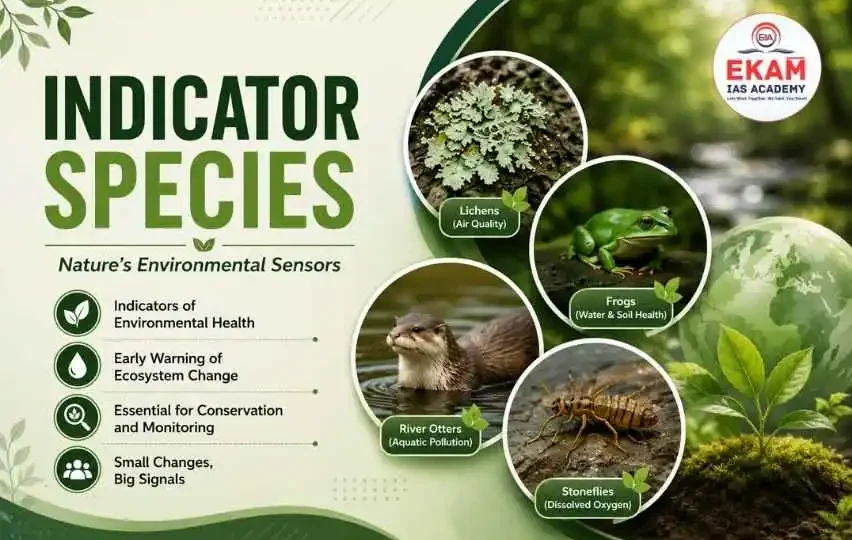
- Lichens (Air Quality): Lichens are a symbiotic association between algae and fungi. They have no cuticle and absorb nutrients directly from the air. They are highly sensitive to Sulfur Dioxide (SO2). A complete absence of lichens in an urban area signals severe air pollution.
- Amphibians/Frogs (Water and Soil): With highly permeable skin, frogs absorb toxic chemicals effortlessly. Deformities or declining populations in frogs signal heavy pesticide or chemical pollution in local wetlands.
- River Otters (Aquatic Pollution): As top predators in freshwater systems, their presence indicates clean water and a healthy, toxin-free fish population.
- Stoneflies (Dissolved Oxygen): Stonefly nymphs live under rocks in streams. They require very high levels of Dissolved Oxygen (DO); their disappearance indicates organic pollution and low DO levels.
Keystone Species vs. Indicator Species
| Parameters | Keystone Species | Indicator Species |
| Primary Definition | Defines and holds an entire ecosystem structure together. | Reflects or signals the health condition of an ecosystem. |
| Functional Role | Controls food webs (predators) or shapes landscapes (engineers). | Acts as a diagnostic proxy for environmental variables. |
| Impact of Removal | Triggers a catastrophic, cascading ecosystem collapse. | Does not collapse the ecosystem, but removes our ability to monitor it. |
| Core Focus | Abundance/Biomass is low, but impact is disproportionately massive. | Sensitivity is high; presence/absence tells an environmental story. |
Threats to Indicator Species
Because indicator species are defined by their extreme sensitivity, they are the very first casualties of ecological degradation:
- Chemical Runoff: Agricultural pesticides and industrial heavy metals decimate vulnerable aquatic macroinvertebrates.
- Micro-climatic Shifts: Small temperature increases dry out the moist micro-habitats required by amphibians and bryophytes.
- Acid Rain: Lowers the pH of lakes and soils, wiping out sensitive indicator fish like trout and certain forest lichens.
Indicator Species in India
India utilizes several key species to track regional ecological health:
- Gangetic River Dolphin: Acts as an indicator for the deep-water health of the Ganga-Brahmaputra river system. Its presence indicates low chemical toxicity and adequate water volume.
- Gharial: Highly sensitive to river siltation and sand mining; its population health reflects the ecological purity of clean flowing rivers like the Chambal.
- House Sparrow: Its rapid decline in urban India signals rising electromagnetic radiation, lack of nesting spaces due to modern architecture, and loss of insect food due to excessive chemical gardening.
Conservation and Monitoring Measures
- Biomonitoring Frameworks: Integrating macroinvertebrate sampling (like mayflies and dragonflies) into formal water quality assessments alongside chemical testing.
- Habitat Buffer Zones: Protecting the micro-climates of forests and wetlands where critical indicator species breed.
- Citizen Science: Leveraging public observation apps (like eBird or iNaturalist) to map changes in the distribution of common indicator animals like sparrows and butterflies.
Conclusion
For a robust score in the indicator species UPSC segment, these organisms must be treated as indispensable environmental sensors. Investing in the conservation of indicator species means investing in an early warning radar for our biosphere. By listening to the physiological signals of these sensitive organisms, policymakers can intervene before ecological degradation reaches an irreversible tipping point.
UPSC Prelims: PYQs & Practice Questions
Previous Year Questions (Prelims)
Q: Lichens, which are capable of initiating ecological succession even on a bare rock, are actually a symbiotic association of: (UPSC CSE Prelims 2014)
(a) Algae and bacteria
(b) Algae and fungi
(c) Fungi and mosses
(d) Fungi and bacteria
Answer: (b) Algae and fungi
Explanation:
Lichens represent a mutualistic symbiotic relationship between a
photosynthetic partner (algae/cyanobacteria) and a
fungal partner. They are pioneer organisms in
ecological succession and also function as important
indicator species for air pollution. Since lichens absorb moisture directly from the atmosphere and lack a protective cuticle, they are highly sensitive to
Sulfur Dioxide (SO₂). Their disappearance from an area often signals deteriorating air quality.
Q: Which of the following are the reasons for the occurrence of multi-drug resistance in microbial pathogens in India? (UPSC CSE Prelims 2020)
1. Genetic predisposition of some people
2. Taking incorrect doses of antibiotics to cure diseases
3. Using antibiotics in livestock farming
4. Multiple chronic diseases in some people
Select the correct answer using the code given below:
(a) 1 and 2
(b) 2 and 3
(c) 1, 3 and 4
(d) 2, 3 and 4
Answer: (b) 2 and 3
Explanation:
The rise of multi-drug resistance (MDR) is strongly linked to the
incorrect use of antibiotics and their extensive application in
livestock farming. This issue is also connected to
environmental microbiology, where antibiotic-resistant bacteria in rivers and lakes act as
indicator species of severe contamination from untreated sewage and pharmaceutical waste discharge.
Practice Questions
Q: In biomonitoring, macroinvertebrates such as Mayfly and Stonefly nymphs are extensively used to evaluate freshwater streams. If a river section shows a sudden and total disappearance of these nymphs, it directly indicates which of the following?
(a) A drastic rise in the water's salt concentrations (salinity).
(b) A severe depletion of Dissolved Oxygen (DO) levels, often caused by organic pollution.
(c) The introduction of an invasive macro-algae species.
(d) The natural transition of a lotic ecosystem into a lentic ecosystem.
Answer: (b) A severe depletion of Dissolved Oxygen (DO)
Explanation:
Mayfly, Stonefly, and
Caddisfly nymphs are highly sensitive to
organic pollution and require clean, oxygen-rich flowing water.
When sewage or agricultural runoff enters rivers, microbial decomposition increases the
Biochemical Oxygen Demand (BOD), which drastically reduces
Dissolved Oxygen (DO). These sensitive aquatic indicator organisms are therefore among the first to disappear.
Q: Consider the following statements regarding organisms with a "Narrow Tolerance Range" (Stenotopic organisms):
1. They usually make excellent indicator species because minor changes in habitat trigger noticeable shifts in their population or health.
2. The House Sparrow in urban India serves as an indicator species, signaling micro-climatic and electromagnetic alterations.
Select the correct answer using the code given below:
(a) 1 only
(b) 2 only
(c) Both 1 and 2
(d) Neither 1 nor 2
Answer: (c) Both 1 and 2
Explanation:
Stenotopic organisms possess a very narrow tolerance range and react sharply to environmental changes, making them highly reliable
indicator species. The decline of the
House Sparrow (Passer domesticus) in urban India reflects ecological stress factors such as loss of nesting spaces, reduction in insect populations due to pesticides, and possible impacts of electromagnetic radiation from communication towers.
UPSC Mains – Previous Year & Practice Questions
Mains Previous Year Questions
Question:
Identify the main causes of the loss of biodiversity in India.
(Mains 2023)
(Excellent opportunity to discuss how the decline of indicator species like amphibians signals wider habitat degradation before ecosystem collapse occurs)
Question:
Enumerate the indirect services provided by an ecosystem.
(Mains 2014)
(Biomonitoring and environmental stabilization provided by sensitive indicator organisms are critical indirect ecosystem services)
Question:
What is a wetland? Explain the Ramsar concept of
'wise use' in the context of wetland conservation in India.
(Mains 2018)
(Can incorporate how monitoring indicator species like the Gangetic Dolphin or migratory waterbirds helps assess wetland health)
Question:
Explain the causes and effects of coastal erosion in India.
(Mains 2021)
(Coral reefs act as important indicator ecosystems for coastal health and erosion vulnerability)
Question:
How does the draft Environment Impact Assessment (EIA) Notification, 2020 differ from the existing
EIA Notification, 2006?
(Mains 2020)
(Baseline ecological surveys in EIAs rely heavily on mapping regional indicator species and ecosystem sensitivity)
Mains Practice Questions
[10 Marks | 150 Words]
Question: Explain how biomonitoring using indicator species offers a more holistic evaluation of ecosystem health compared to purely chemical or mechanical environmental sensors.
[15 Marks | 250 Words]
Question: The health of the Gharial population in the Chambal River is directly reflective of the riverine ecosystem's purity. In light of this statement, analyze the anthropogenic threats facing riverine indicator species in India.
[15 Marks | 250 Words]
Question: Discuss how the integration of indicator species mapping can strengthen the execution of urban master plans and help mitigate the crisis of urban heat islands and water pollution in India.



indicator Species-FAQs
Why are amphibians considered the best indicator species for terrestrial and aquatic transition zones?
Amphibians have moist, permeable skin and live both in water and on land. Hence, pollution, chemicals, UV changes, or habitat degradation affect them quickly, making their population decline an early warning sign.
Difference between Indicator Species and Umbrella Species?
Indicator species show environmental change through their sensitivity, like lichens indicating air pollution. Umbrella species are protected to conserve a large habitat and many other species, like tigers.
How do corals act as indicator species for climate change?
Corals are highly sensitive to temperature rise. Even a small increase in sea temperature causes coral bleaching, making them key indicators of marine warming and ocean stress.
Can a single species indicate multiple environmental problems?
Yes, some species reflect overall ecosystem health. For example, a decline in Gangetic River Dolphins may indicate pollution, reduced water flow, and overfishing.
What is Biotic Index in indicator species?
Biotic Index measures water quality based on organisms present in water. Clean-water species like mayflies indicate good quality, while pollution-tolerant species like sludge worms indicate poor quality.