
Table of Contents
ToggleEarth’s biological wealth is not distributed uniformly. Tropical and sub-tropical regions present a disproportionately high density of flora and fauna compared to temperate zones. To optimize international funding, scientific research, and policy interventions, conservationists categorize countries holding exceptional biological parameters under a unified framework.
Defining Megadiverse Countries
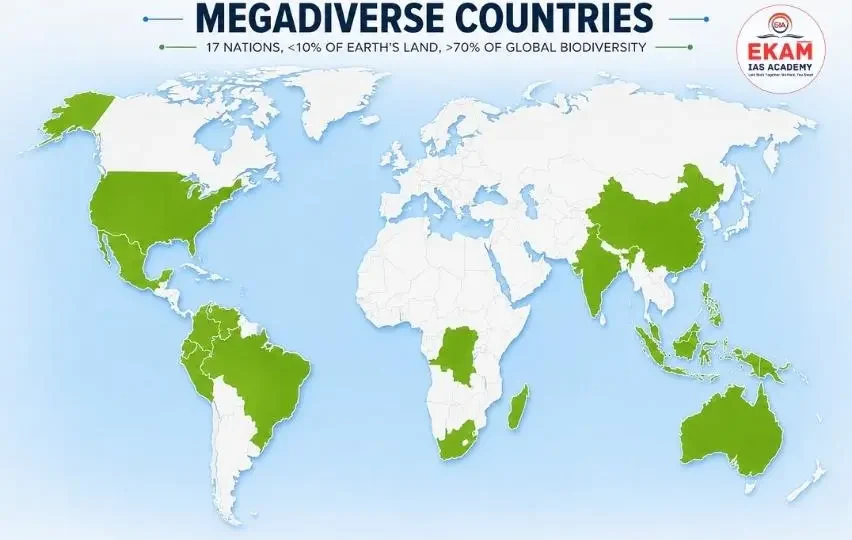
A megadiverse country is a nation that harbors a total percentage of species diversity and high levels of endemism (species found nowhere else on Earth). Together, these countries represent less than 10% of the Earth’s surface but support over 70% of the planet’s overall biodiversity.
Origin of the Concept
- The Pioneer: The term was first proposed by American primatologist and conservationist Russell Mittermeier in 1988.
- Institutional Adoption: The concept was formally popularized by Conservation International (CI) in the 1990s.
- The Cancun Declaration (2002): Driven by the need for geopolitical leveraging, a group of these nations met in Mexico to form the Like-Minded Megadiverse Countries (LMMC) mechanism to act as a joint voting bloc under international environmental treaties.
Characteristics of Megadiverse Countries
To qualify for listing under Conservation International’s framework, a country must strictly satisfy two primary criteria:
Species Threshold: It must house at least 5,000 species of endemic plants.
Marine Ecosystems: It must have a marine border, ensuring focus on both terrestrial and rich coastal/marine biomes.
Official List of Megadiverse Countries
Globally, 17 countries are formally recognized under this classification. They span across major geographic realms:
- Americas: Brazil, Colombia, Ecuador, Peru, Mexico, United States, Venezuela.
- Africa: Democratic Republic of Congo, Madagascar, South Africa.
- Asia-Pacific: India, China, Indonesia, Malaysia, Philippines, Australia, Papua New Guinea.
India as a Megadiverse Country
Analyzing India megadiverse country parameters reveals why the subcontinent is an ecological powerhouse:
- Land vs. Diversity Ratio: With just 2.4% of the world’s land area, India accounts for nearly 7% to 8% of all recorded species globally.
- Biogeographic Convergence: India features 10 distinct biogeographic zones where the Palearctic, Ethiopian, and Indo-Malayan realms meet.
- Species Wealth: India ranks high globally in mammalian, avian, and reptilian diversity, boasting thousands of endemic species like the Lion-tailed Macaque and the Sangai Deer.
Biodiversity Hotspots in India UPSC
Within India’s megadiverse boundaries lie four globally recognized Biodiversity Hotspots. To qualify as a hotspot under Norman Myers’ criteria, a region must contain at least 1,500 species of vascular plants as endemics and have lost at least 70% of its original primary vegetation.
- The Himalayas: Spanning northeastern India, Nepal, and Bhutan, hosting spectacular alpine flora and endangered fauna like the Snow Leopard.
- The Western Ghats: A mountain chain running parallel to the western coast, featuring exceptional levels of amphibian, plant, and fish endemism.
- Indo-Burma Region: Includes the entire North-Eastern state cluster (excluding Assam and parts of Arunachal Pradesh), rich in bird and orchid species.
- Sundaland: Encompasses the Nicobar group of islands, extending down to Indonesia, showcasing unique marine and coastal island biodiversity.
Threats Facing Megadiverse Regions
- Habitat Destruction: Rapid infrastructure development, mining, and linear intrusions (railways and highways) fragmenting pristine forests.
- Anthropogenic Climate Change: Forcing high-altitude and island species out of their narrow thermal ranges, leading to localized extinctions.
- Invasive Alien Species: Exotic weeds choking out native vegetation across fragile ecotones.
Conservation and International Initiatives
- The Convention on Biological Diversity (CBD): The primary international treaty driving domestic legislation across megadiverse countries.
- Kunming-Montreal Global Biodiversity Framework: Sets the “30 by 30” target, pushing megadiverse nations to effectively conserve 30% of terrestrial and marine areas by 2030.
- India’s Domestic Framework: Backed by the Wildlife Protection Act (1972), the Forest Conservation Act, and the Biological Diversity Act (2002), which regulates access to biological resources to ensure equitable benefit-sharing.
Conclusion
For the Megadiverse Countries UPSC segment, the core takeaway is the shifting focus from local conservation to a unified global strategy. Countries like India carry a disproportionate ecological responsibility. Preserving this 4.63% of landmass is not merely an act of environmental preservation, but a vital step toward safeguarding the evolutionary future and climate resilience of the entire biosphere.
UPSC Prelims: PYQs & Practice Questions
Previous Year Questions (Prelims)
UPSC CSE Prelims 2018
Q: With reference to the 'Like-Minded Megadiverse Countries (LMMC)', consider the following statements:
1. The LMMC group was formed following the adoption of the
Cancun Declaration in 2002 to act as a mechanism for consultation and cooperation.
2. All 17 megadiverse countries recognized by Conservation International are permanent member states of the LMMC.
Which of the statements given above is/are correct?
(a) 1 only
(b) 2 only
(c) Both 1 and 2
(d) Neither 1 nor 2
Answer: (a) 1 only
Explanation:
Statement 1 is correct. The
Like-Minded Megadiverse Countries (LMMC) was formed in
2002 in Mexico, adopting the Cancun Declaration to act as a joint negotiating and voting bloc within the
Convention on Biological Diversity (CBD). Its objective was to protect traditional knowledge and secure
Access and Benefit Sharing (ABS).
Statement 2 is incorrect. While there is a huge overlap, not all 17 megadiverse countries are part of the LMMC. For example, the United States and Australia are recognized as megadiverse countries by Conservation International, but they are not members of the developing-nation LMMC framework.
UPSC CSE Prelims 2010
Q: Which one of the following has been recognized as a Megadiverse Country?
(a) New Zealand
(b) Austria
(c) Australia
(d) Nepal
Answer: (c) Australia
Explanation:
To qualify as a megadiverse country under Conservation International's criteria, a country must have at least
5,000 endemic plant species and possess a marine border.
Australia meets these conditions and is known for its extraordinary biodiversity, including endemic marsupials, eucalyptus species, and the Great Barrier Reef. New Zealand, Austria, and Nepal do not fit the official 17-nation megadiverse country list.
Practice Questions
Q: Given below are two statements, one labeled as Assertion (A) and the other labeled as Reason (R):
Assertion (A): India is classified as a megadiverse country, despite possessing a relatively small land surface footprint compared to giant nations like Canada or Russia.
Reason (R): For a nation to qualify under the global 'Megadiverse' criteria, it must showcase a convergence of multiple distinct biogeographic realms and possess at least 1,500 endemic vascular plant species.
Select the correct answer using the code given below:
(a) Both (A) and (R) are true, and (R) is the correct explanation of (A).
(b) Both (A) and (R) are true, but (R) is NOT the correct explanation of (A).
(c) (A) is true, but (R) is false.
(d) (A) is false, but (R) is true.
Answer: (c) (A) is true, but (R) is false.
Explanation:
Assertion (A) is true because India holds nearly 8% of recorded species on just about 2.4% of global land area.
However, Reason (R) is false because the threshold requirement for a Megadiverse Country is a minimum of 5,000 endemic plant species and a marine border.
The figure of 1,500 endemic vascular plant species is instead a baseline criterion for defining a Biodiversity Hotspot under Norman Myers' criteria.
Q: With reference to the distribution of megadiverse countries across the globe, which of the following geographic regions houses the largest absolute number of these nations?
(a) Sub-Saharan Africa
(b) Western Europe
(c) The Americas — North, Central, and South
(d) Central Asia
Answer: (c) The Americas — North, Central, and South
Explanation:
The Americas hold the single largest regional block of megadiverse countries, with 7 out of 17 countries. These include
Brazil, Colombia, Ecuador, Peru, Mexico, Venezuela, and the United States.
This is mainly due to the vast latitudinal span, the Amazon River Basin, and major mountain chains like the Andes, which create thousands of unique ecological niches.
UPSC Mains – Previous Year & Practice Questions
Mains Previous Year Questions
Mains 2018
Question: How does biodiversity vary in India?
How is the Biological Diversity Act, 2002 helpful in conservation of flora and fauna?
(Core question checking your command over India's megadiverse attributes.)
Mains 2023
Question: Identify the main causes of the loss of
biodiversity in India.
(Requires analyzing threats facing India’s megadiverse habitats.)
Mains 2019
Question: Coastal regions of India are prone to cyclones.
Discuss the role of mangroves in reducing the impact of such disasters.
(Focuses heavily on India’s coastal megadiverse infrastructure.)
Mains 2021
Question: Differentiate the causes of landslides in the
Himalayan region and Western Ghats.
(Directly tests physical geographies hosting India’s primary biodiversity hotspots.)
Mains 2014
Question: Enumerate the indirect services provided by an ecosystem.
How do wetlands/lakes act as “Earth’s Kidneys”?
(Useful for linking ecosystem services with biodiversity conservation and sustainable development.)
Mains Practice Questions
[10 Marks | 150 Words]
Question: India represents a biogeographic convergence zone. Elaborate how this spatial factor elevates India to the rank of a premier global megadiverse country.
[15 Marks | 250 Words]
Question: Explain how the '30 by 30' target under the Kunming-Montreal Global Biodiversity Framework places an enhanced conservation and financial burden on megadiverse nations like India.
[15 Marks | 250 Words]
Question: The presence of Biodiversity Hotspots within a megadiverse country indicates an environmental paradox of high ecological value under acute evolutionary threat. Critically analyze.



Megadiverse Countries-FAQs
Difference between Megadiverse Country and Biodiversity Hotspot?
A Megadiverse Country is based on national boundaries and overall species richness with high endemism. A Biodiversity Hotspot is an ecological region with high endemism and severe habitat loss.
Why does Brazil rank highest among megadiverse countries?
Brazil ranks highest due to its vast size, equatorial location, Amazon Rainforest, and Cerrado savanna. These support exceptional diversity of plants, animals, insects, and freshwater species.
How many biogeographic zones does India have?
India has 10 biogeographic zones, including Himalaya, Desert, Western Ghats, Deccan Peninsula, Gangetic Plain, Coast, North-East, and Islands. This diversity supports India’s megadiverse status.
What is the Cancun Declaration?
The Cancun Declaration, signed in 2002, formed the Like-Minded Megadiverse Countries group. It helps countries like India protect biodiversity, traditional knowledge, and fight biopiracy
Why is Madagascar a megadiverse country?
Madagascar is megadiverse due to long evolutionary isolation. This created extremely high endemism, with many species found nowhere else in the world.