Table of Contents
ToggleBiodiversity underpins all life on Earth, providing essential ecosystem services from carbon storage to crop pollination. However, human industrial expansion has pushed our planet into the Sixth Mass Extinction. To halt this rapid loss of life, conservationists deploy two primary strategies: protecting species directly in nature (in-situ), and safeguarding them in controlled, artificial environments (ex-situ).
The Urgent Need for Biodiversity Conservation
The Intergovernmental Science-Policy Platform on Biodiversity and Ecosystem Services (IPBES) warns that nearly 1 million species face imminent extinction. For a comprehensive grasp of biodiversity conservation UPSC topics, candidates must recognize that unchecked habitat loss, poaching, and climate change create an urgent need for multi-layered protection frameworks to secure our planet’s evolutionary heritage.
In-situ Conservation: Protection in Nature
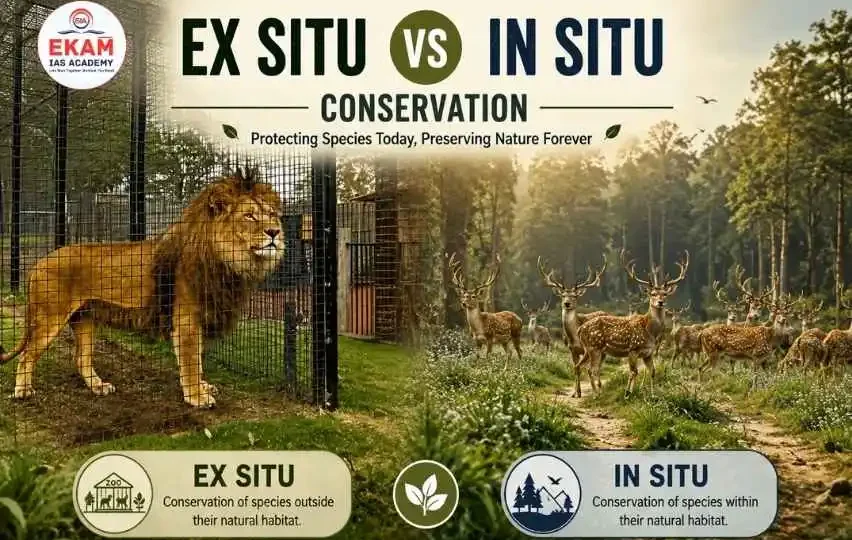
In-situ conservation is the conservation of genetic resources within their natural ecosystems and habitats. It focuses on maintaining the original environments where species have developed their unique evolutionary traits.
Core Types of In-situ Networks:
- National Parks and Wildlife Sanctuaries: Land patches under strict statutory protection where commercial exploitation, forestry, and grazing are highly regulated or prohibited.
- Biosphere Reserves: Large, multi-purpose protected ecosystems categorized into Core, Buffer, and Transition zones, designed to balance nature conservation with sustainable human development.
- Sacred Groves: Communal forest patches protected by indigenous communities through traditional religious beliefs, acting as vital repositories for rare local plants.
Ex-situ Conservation: Safeguarding Outside Nature
Ex-situ conservation is the preservation of components of biological diversity outside their natural habitats. This approach acts as an essential emergency backup strategy when a species’ population in the wild drops so low that it faces immediate extinction.
Key Ex-situ Methods:
- Zoological Parks and Botanical Gardens: Managed facilities used to breed rare animals and cultivate threatened plant varieties for public education and scientific research.
- Gene Banks and Seed Banks: High-tech facilities that preserve seeds, pollen, or tissue samples under sub-zero temperatures (cryopreservation) to maintain genetic diversity for decades.
Ex-situ Conservation Aiding In-situ Conservation
Modern conservation biology no longer views these two approaches as separate methods. Instead, ex-situ measures directly support and rebuild in-situ wildlife populations through a structured loop:
- Captive Breeding for Wild Reintroduction: When an in-situ population collapses, individuals are brought into specialized ex-situ centers to breed safely away from natural predators and diseases.
- Genetic Rescue: Seed and gene banks provide fresh, diverse genetic material to wild habitats that have been decimated by disease outbreaks or severe inbreeding depression, building long-term climate resilience.
Success Stories and Examples from India
Using precise ex-situ conservation examples from India is an excellent way to score higher marks in the UPSC Mains examination:
- The Pygmy Hog: The Pygmy Hog Conservation Programme successfully bred the world’s smallest wild pig in specialized ex-situ centers in Assam, gradually reintroducing them back into the wild tall-grasslands of Manas National Park (in-situ).
- Vulture Conservation Breeding Centres (VCBC): To counter the catastrophic drop in vulture populations caused by veterinary diclofenac poisoning, centers in Pinjore and Rajabhatkhawa successfully bred three critically endangered Gyps vulture species for controlled reintroduction into safe, drug-free wild zones.
- The Asiatic Cheetah Reintroduction: After being declared extinct in India in 1952, cheetahs were relocated from Africa to Kuno National Park. This historical project highlights a complex, cross-continental effort to rebuild a large carnivore population in its historical landscape.
In-situ vs. Ex-situ Conservation
| Feature | In-situ Conservation | Ex-situ Conservation |
| Location | Inside the species’ natural, native habitat. | Outside the natural habitat in a controlled, artificial facility. |
| Primary Focus | Protecting the wider ecosystem, food web, and ongoing evolutionary processes. | Ensuring the immediate survival and reproductive success of target species. |
| Cost & Scale | Highly cost-effective over large areas but vulnerable to local target poaching. | Expensive and labor-intensive, limited to smaller, select populations. |
| Examples | Biosphere Reserves, National Parks, Sacred Groves. | Seed Banks, Cryopreservation, Zoos, Botanical Gardens. |
Government and International Initiatives
- The Convention on Biological Diversity (CBD): Article 8 and Article 9 of the CBD lay out explicit international guidelines balancing both in-situ and ex-situ obligations for member states.
- The Wildlife (Protection) Act, 1972: Provides the primary legal architecture for India’s national parks and sanctuaries, while regulating the collection of wild species for ex-situ scientific breeding.
- Central Zoo Authority (CZA): The apex statutory body in India that regulates all zoological parks, ensuring they maintain high scientific standards for captive breeding programs.
Conclusion
For a high-scoring perspective in the biodiversity conservation UPSC curriculum, candidates must emphasize that ex-situ and in-situ methods are complementary parts of a unified strategy. Ex-situ initiatives act as our planet’s ultimate biological lifeboats, while in-situ reserves remain the permanent destination where those species must return to fulfill their ecological roles. Integrating these two strategies into national infrastructure blueprints and local development projects is essential for securing a sustainable, bio-secure future for India’s natural heritage.
UPSC Prelims: PYQs & Practice Questions
Previous Year Questions (Prelims)
UPSC CSE Prelims 2020
Q: Which of the following are the most likely places where one can find the crop gene banks?
1. Food and Agriculture Organization
2. International Agricultural Research Centres
3. National Bureau of Plant Genetic Resources
Select the correct answer using the code below:
(a) 1 and 2 only
(b) 2 and 3 only
(c) 1 and 3 only
(d) 1, 2 and 3
Answer: (b) 2 and 3 only
Explanation:
Gene banks are a form of ex-situ conservation. They preserve plant genetic material such as
seeds, tissues, pollen, and germplasm outside their natural habitat.
International Agricultural Research Centres and the National Bureau of Plant Genetic Resources (NBPGR) maintain such repositories. The Food and Agriculture Organization (FAO) mainly coordinates global food and agriculture policies, but it is not primarily a crop gene bank repository.
UPSC CSE Prelims 2019
Q: Consider the following statements:
1. Biodiversity hotspots are regions with high species richness and high degree of endemism.
2. Biodiversity hotspots must have at least 0.5% of the world’s endemic plant species.
Which of the statements given above is/are correct?
(a) 1 only
(b) 2 only
(c) Both 1 and 2
(d) Neither 1 nor 2
Answer: (c) Both 1 and 2
Explanation:
Biodiversity hotspots are important regions for
in-situ conservation because they contain exceptionally high biodiversity, especially
endemic species, while also facing severe habitat loss.
Under Norman Myers’ criteria, a biodiversity hotspot must contain at least 1,500 endemic vascular plant species, which is about 0.5% of the world’s total plant species. It must also have lost at least 70% of its original natural habitat.
Practice Questions
Q: Which of the following is/are examples of ex-situ conservation?
1. Seed banks
2. Botanical gardens
3. Biosphere reserves
4. Cryopreservation
Select the correct answer using the code below:
(a) 1, 2 and 4 only
(b) 2 and 3 only
(c) 1 and 3 only
(d) 1, 2, 3 and 4
Answer: (a) 1, 2 and 4 only
Explanation:
Ex-situ conservation means conservation of species outside their natural habitat.
Seed banks, botanical gardens, and
cryopreservation are examples of ex-situ conservation.
Biosphere reserves are examples of in-situ conservation because they conserve species within their natural ecosystems and landscapes.
Q: With reference to in-situ conservation, consider the following statements:
1. It conserves species in their natural habitat.
2. National parks are an example of in-situ conservation.
3. It completely eliminates human interference.
Which of the statements given above is/are correct?
(a) 1 and 2 only
(b) 2 and 3 only
(c) 1 only
(d) 1, 2 and 3
Answer: (a) 1 and 2 only
Explanation:
In-situ conservation protects species within their natural ecosystems.
National parks, wildlife sanctuaries, biosphere reserves, and community reserves are examples of this approach.
Statement 3 is incorrect. In-situ conservation does not always completely eliminate human interference. Human presence may continue through regulated eco-tourism, research, habitat management, anti-poaching operations, and community-based conservation activities.
UPSC Mains – Previous Year & Practice Questions
Mains Previous Year Questions
UPSC CSE Mains 2018 | GS-3
Question: Define biodiversity hotspot. Explain the criteria for determining hotspots and discuss their significance in conservation.
UPSC CSE Mains 2020 | GS-3
Question: How does biodiversity vary in India? Discuss the role of biosphere reserves in biodiversity conservation.
UPSC CSE Mains 2016 | GS-3
Question: Discuss the methods of conserving biodiversity with special reference to India.
UPSC CSE Mains 2014 | GS-3
Question: Environmental Impact Assessment studies are increasingly undertaken before a project is cleared by the Government. Discuss the environmental impacts of mining and conservation measures.
UPSC CSE Mains 2013 | GS-3
Question: What are the different categories of protected areas in India? How are they important for biodiversity conservation?
Mains Practice Questions
[15 Marks | 250 Words]
Question: “Ex-situ conservation is a supplementary strategy and cannot replace in-situ conservation.” Critically examine.
[15 Marks | 250 Words]
Question: Discuss the role of biosphere reserves, gene banks and zoological parks in biodiversity conservation in India.
[10 Marks | 150 Words]
Question: Compare and contrast in-situ and ex-situ conservation methods. Which one is more effective in the Indian context?



In-situ and Ex-situ Conservation-FAQs
What is the difference between in-situ and ex-situ conservation?
- In-situ: Conservation within natural habitat.
- Ex-situ: Conservation outside natural habitat.
Which is better: in-situ or ex-situ conservation?
In-situ conservation is generally preferred because it preserves:
- Ecosystems
- Natural evolutionary processes
- Species interactions
Ex-situ is used when species are critically endangered.
What are examples of in-situ conservation in India?
- Jim Corbett National Park
- Gir National Park
- Periyar Wildlife Sanctuary
What are examples of ex-situ conservation?
- Seed Banks
- Cryopreservation
- Zoos
- Botanical Gardens
Why is ex-situ conservation important?
It helps:
- Protect critically endangered species
- Preserve genetic material
- Support captive breeding and reintroduction programs