
Table of Contents
ToggleAs industrial development, urban sprawl, and climate change put immense strain on the biosphere, wild species are losing their natural habitats at an alarming rate. To prevent terminal extinctions, governments establish specialized legal zones. These areas act as ecological refuges where human activities are strictly regulated to preserve natural ecosystems.
Defining Protected Areas and Their Objectives
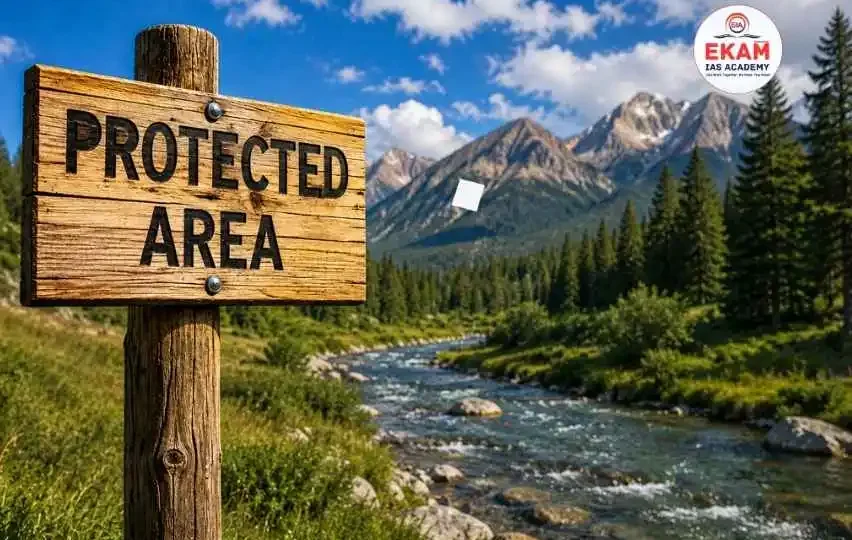
A protected area is a clearly defined geographical space that is recognized, dedicated, and managed through legal or other effective means to achieve the long-term conservation of nature, associated ecosystem services, and cultural values.
Core Objectives:
- To safeguard critically endangered flora and fauna from poaching and habitat destruction.
- To preserve distinct ecological habitats, pristine watersheds, and natural carbon sinks.
- To promote scientific research, environmental monitoring, and sustainable eco-tourism.
Characteristics and Types of Protected Areas
Protected areas vary based on their size, management goals, and the level of human activity permitted within their boundaries. The International Union for Conservation of Nature (IUCN) classifies these regions into six distinct management categories, ranging from strict nature reserves to protected landscapes with sustainable resource use.
tatutory Types of Protected Areas in India
Understanding the specific types of protected areas in India is a high-yield requirement for both the Prelims mapping and Mains policy segments. Under the Wild Life (Protection) Act, 1972 (WLPA), India establishes four distinct categories of statutory protected areas:
National Parks (Category II)
- Protection Level: Highest level of statutory protection.
- Key Restriction: No human activity is permitted inside a National Park unless explicitly sanctioned by the Chief Wildlife Warden under highly exceptional scientific circumstances. Activities like grazing, forestry, and private land ownership are completely prohibited.
- Declaration: Can be notified by both the Central and State Governments.
Wildlife Sanctuaries (Category IV)
- Protection Level: Moderate level of protection compared to National Parks.
- Key Restriction: Certain traditional human rights, such as regulated cattle grazing, collecting minor forest produce (MFP), and private land ownership, can be permitted as long as they do not harm wildlife conservation.
- Flexibility: A Wildlife Sanctuary can be upgraded to a National Park, but a National Park can never be downgraded to a sanctuary.
Conservation Reserves
- Context: Typically act as buffer zones, migration corridors, or ecological links between established National Parks and Wildlife Sanctuaries.
- Ownership: Declared on land owned entirely by the government, following consultations with local village communities.
Community Reserves
- Context: Established on private or community-owned lands where local individuals or community groups have volunteered to conserve native flora, fauna, and traditional cultural values.
- Significance: Represents a decentralized, community-led model of biodiversity conservation.
Global and National Importance
- In-situ Conservation Hubs: They form the backbone of landscape-level protection, allowing natural food webs and evolutionary processes to continue undisturbed.
- Climate Mitigation: Massive protected forests and marine reserves sequester billions of tons of carbon dioxide, helping to stabilize the global climate.
- Economic Safeguards: They protect the headwaters of major rivers, ensuring steady freshwater supplies for downstream agriculture and urban centers.
Threats and Challenges in Species Conservation
- Habitat Fragmentation: Linear infrastructure projects like highways, railways, and power lines cut through contiguous forests, isolating animal populations and causing inbreeding depression.
- Human-Wildlife Conflict: As wild animals venture outside degraded buffer zones into nearby villages for food, it leads to crop damage, livestock loss, and retaliatory animal killings.
- Poaching and Illegal Wildlife Trade: Organized criminal networks target apex predators and megafauna (e.g., tigers, rhinos) for their skin, bones, and horns.
- Invasive Alien Species: Exotic weeds like Lantana camara choke out native plants, causing a severe shortage of forage for wild herbivores.
Legal and Institutional Framework in India
- The Wild Life (Protection) Act, 1972: Provides the baseline legal architecture for declaring and managing national parks and wildlife sanctuaries UPSC modules focus on.
- National Board for Wildlife (NBWL): The apex statutory body chaired by the Prime Minister of India. It serves as the ultimate clearinghouse for all development projects proposed within or around protected areas.
- National Tiger Conservation Authority (NTCA): A statutory body under the Ministry of Environment, Forest and Climate Change (MoEFCC) that oversees the management of India’s designated Tiger Reserves using a strict, scientifically monitored core-buffer framework.
International Conservation Initiatives
- The Convention on Biological Diversity (CBD): Set the international target (expanded under the Kunming-Montreal Global Biodiversity Framework’s “30 by 30” target) to bring 30% of the world’s terrestrial and marine environments under effective protected area networks by 2030.
- UNESCO Man and the Biosphere (MAB) Programme: Coordinates an international network of Biosphere Reserves to harmonize nature conservation with sustainable human development.
Protected Areas vs. Biosphere Reserves
It is essential to distinguish these two common conservation terms clearly:
| Parameter | National Parks / Sanctuaries | Biosphere Reserves |
| Statutory Base | Declared under the domestic Wild Life (Protection) Act, 1972. | Notified under UNESCO’s international framework and recognized nationally. |
| Scale & Scope | Smaller focus, typically designed to protect specific species or habitats (e.g., Tiger or Rhino). | Massive, landscape-level ecosystems that include multiple protected areas, human settlements, and agricultural lands. |
| Zonal Management | Do not follow a rigid three-tier geometric layout. | Strictly divided into Core (no human activity), Buffer (limited research/tourism), and Transition zones (local settlements). |
Conclusion
Protected areas are our planet’s ultimate biological lifeboats. However, maintaining them as isolated green islands amid a sea of industrial development is no longer enough to halt species declines. Environmental governance must focus on protecting migratory corridors, integrating local communities into conservation management, and subjecting all nearby development to strict environmental impact assessments. Ensuring these spaces are well-managed is vital to safeguarding India’s unique natural heritage for future generations.
UPSC Prelims: PYQs & Practice Questions
Previous Year Questions (Prelims)
UPSC CSE Prelims 2018
Q: In which of the following areas are human activities like grazing, forestry, and private land ownership completely prohibited by law?
(a) Wildlife Sanctuaries
(b) National Parks
(c) Biosphere Reserves
(d) Conservation Reserves
Answer: (b) National Parks
Explanation:
Under Section 35 of the Wild Life (Protection) Act, 1972,
National Parks enjoy the highest tier of statutory protection in India. Once a National Park is notified, no private rights can be granted inside its boundaries.
Activities such as timber harvesting, private land ownership, and livestock grazing are completely prohibited. In contrast, in Wildlife Sanctuaries, limited traditional rights such as regulated grazing or collection of minor forest produce may be allowed if they do not harm wildlife conservation.
UPSC CSE Prelims 2020
Q: According to the Wildlife (Protection) Act, 1972, which of the following animals cannot be hunted by any person except under some provisions provided by law?
1. Gharial
2. Indian Wild Ass
3. Wild Buffalo
Select the correct answer using the code given below:
(a) 1 only
(b) 2 and 3 only
(c) 1 and 3 only
(d) 1, 2 and 3
Answer: (d) 1, 2 and 3
Explanation:
All three animals — Gharial, Indian Wild Ass, and
Wild Buffalo — are highly protected species under India’s wildlife protection framework.
Such species receive strict legal protection, and hunting them is a serious offence. It may be permitted only in exceptional cases, such as when an individual animal becomes dangerous to human life or is disabled beyond recovery, and only with written permission from the competent authority such as the Chief Wildlife Warden.
Practice Questions
Q: With reference to Community Reserves and Conservation Reserves established under the Wild Life (Protection) Act, 1972, consider the following statements:
1. A Conservation Reserve can be declared on land owned entirely by the government, whereas a
Community Reserve is declared on private or community-owned lands.
2. The management of both categories is decentralized and overseen by local committees, bypassing the standard authority of the
State Forest Department entirely.
Which of the statements given above is/are correct?
(a) 1 only
(b) 2 only
(c) Both 1 and 2
(d) Neither 1 nor 2
Answer: (a) 1 only
Explanation:
Statement 1 is correct. The core legal difference lies in land ownership. A
Conservation Reserve is generally declared on government-owned land, especially areas adjoining national parks, sanctuaries, or corridors. A
Community Reserve is declared on private or community-owned land where local communities voluntarily participate in conservation.
Statement 2 is incorrect. Although both categories encourage decentralized management through local committees, they do not bypass the State Forest Department entirely. These committees function under the broader statutory supervision of the State Government, State Forest Department, and Chief Wildlife Warden to ensure compliance with the Wild Life (Protection) Act.
Q: Consider the following statements regarding the structural differences between National Parks and Wildlife Sanctuaries:
1. A Wildlife Sanctuary can be converted and upgraded into a
National Park by a state notification.
2. A National Park can be downgraded into a Wildlife Sanctuary if the population of its target endangered species fully recovers.
Which of the statements given above is/are correct?
(a) 1 only
(b) 2 only
(c) Both 1 and 2
(d) Neither 1 nor 2
Answer: (a) 1 only
Explanation:
Statement 1 is correct. A Wildlife Sanctuary may be upgraded into a
National Park to provide stricter legal protection, especially when the area has high ecological value or supports endangered species.
Statement 2 is incorrect. The legal framework under the Wild Life (Protection) Act, 1972 acts as a protective one-way safety valve. Once an area is declared a National Park, its boundaries or protection status cannot be easily reduced. Any alteration requires a resolution by the State Legislature and approval from the National Board for Wildlife (NBWL). Recovery of a species population does not automatically justify downgrading the protected area.
UPSC Mains – Previous Year & Practice Questions
Mains Previous Year Questions
Mains 2023
Question: Identify the main causes of the loss of
biodiversity in India.
(Requires explaining how human encroachment and linear infrastructure fragment core habitats within protected areas.)
Mains 2018
Question: How does biodiversity vary in India?
How is the Biological Diversity Act, 2002 helpful in conservation of flora and fauna?
(Tests how decentralized local committees complement the top-down protection enforced within National Parks.)
Mains 2020
Question: How does the draft
Environment Impact Assessment (EIA) Notification differ from the existing
EIA Notification, 2006?
(Crucial for discussing how relaxing clearance norms impacts the Eco-Sensitive Zones surrounding protected networks.)
Mains 2021
Question: Differentiate the causes of
landslides in the Himalayan region and
Western Ghats.
(Important because landslides disrupt contiguous protected mountain reserves.)
Mains 2019
Question: Coastal regions of India are prone to cyclones.
Discuss the role of mangroves in reducing the impact of such disasters.
(Ties directly into the protective value of Marine Protected Areas like Bhitarkanika and the Sundarbans.)
Mains Practice Questions
[15 Marks | 250 Words]
Question: The National Board for Wildlife (NBWL) is often critiqued as a clearinghouse for industrial projects rather than a guardian of ecosystems. Critically evaluate its statutory role in protecting India’s fragile wilderness corridors.
[15 Marks | 250 Words]
Question: Protected areas in India are increasingly turning into isolated “ecological islands” surrounded by hostile commercial landscapes. Discuss the significance of Eco-Sensitive Zones (ESZs) in mitigating this structural fragmentation.
[10 Marks | 150 Words]
Question: Analyze how the Scheduled Tribes and Other Traditional Forest Dwellers (Recognition of Forest Rights) Act, 2006 interacts with the Wild Life (Protection) Act, 1972 inside Critical Tiger Habitats.



Protected Areas-FAQs
Difference between National Park and Wildlife Sanctuary?
A National Park has stricter protection, with no grazing, private rights, or resource use allowed. In a Wildlife Sanctuary, limited traditional rights may be permitted if they do not harm wildlife.
Who can alter National Park or Sanctuary boundaries?
Any boundary change needs clearance from the National Board for Wildlife (NBWL). After this, the respective State Government must approve it through the State Legislature.
What are Eco-Sensitive Zones?
Eco-Sensitive Zones are buffer areas around National Parks and Sanctuaries notified by MoEFCC. They usually extend up to 10 km and regulate harmful activities like mining, quarrying, and large industries.
How are Marine Protected Areas different?
Marine Protected Areas conserve coastal and marine ecosystems like coral reefs, mangroves, and seagrass beds. Their focus is on controlling destructive fishing, coral damage, and marine pollution.
What is Critical Tiger Habitat?
Critical Tiger Habitat is the core area of a Tiger Reserve notified under the Wildlife Protection Act. It may overlap with National Parks or Sanctuaries and is kept inviolate for tiger conservation.