

Table of Contents
ToggleINDIA’S PROGRESS IN MATERNAL AND CHILD HEALTH
TOPIC: (GS2) POLITY: THE HINDU
The National Family Health Survey-6 (2023–24) was released by the Ministry of Health and Family Welfare, covering 6.79 lakh households across 715 districts.
What is NFHS?
- NFHS: A large-scale, multi-round survey conducted across India to collect data on population, health, and nutrition indicators.
- Conducting Agency: Coordinated by the International Institute for Population Sciences (IIPS), Mumbai, under the Ministry of Health and Family Welfare (MoHFW).
- Objective: To provide reliable data for policymakers, researchers, and international organizations to design and monitor health and welfare programs.
Scope of NFHS
- Fertility & Family Planning: Tracks birth rates, contraceptive use, and spacing between children.
- Maternal Health: Monitors antenatal care, institutional deliveries, cesarean sections, and maternal nutrition.
- Child Health: Records immunization coverage, infant mortality, stunting, wasting, and underweight prevalence.
- Nutrition & Anemia: Assesses dietary diversity, malnutrition, and anemia among women and children.
- Social Indicators: Includes women’s empowerment, domestic violence, digital access, and household decision-making.
Maternal Health Improvements
- Institutional Deliveries: Increased from 88.6% to 90.6%, showing near-universal coverage.
- Skilled Birth Attendance: Rose to 91.3%, ensuring safer deliveries.
- Antenatal Care: Early ANC (first trimester) improved from 70% to 76.2%. At least four ANC visits rose from 58.5% to 65.2%.
- Maternal Nutrition: Women consuming iron-folic acid (IFA) supplements for 100+ days increased from 44.1% to 54.9%. IFA intake for 180+ days rose from 26% to 37.8%.
Child Health & Nutrition
- Immunization Coverage: Full immunization among children (12–23 months) rose to 87.1%, with 95.6% vaccinations delivered via public facilities.
- Stunting: Declined from 35.5% to 33%, showing better nutrition outcomes.
- Severe Wasting: Reduced by 32%, reflecting improved child care.
- Underweight Children: Decline continues, though challenges remain in rural and marginalized areas.
Social & Policy Gains
- Health Insurance Coverage: Expanded under Ayushman Bharat–PMJAY, improving financial protection.
- Women’s Empowerment: Gains in digital access, financial inclusion, and decision-making reflect broader social progress.
- SDG Alignment: NFHS-6 supports India’s trajectory towards SDGs on health, nutrition, and gender equality.
Conclusion
NFHS-6 demonstrates India’s steady progress in maternal and child health, with better healthcare access, nutrition, and social empowerment.
SUPREME COURT GUIDELINES ON RESERVED JUDGMENTS AND BAIL ORDERS
TOPIC: (GS2) POLITY: THE HINDU
The Supreme Court of India has issued binding directions to all High Courts, mandating that reserved judgments be delivered within three months and bail orders be uploaded the same day.
Supreme Court’s Recognition
- The Court treated this not as an isolated lapse but as a systemic problem across High Courts, affecting thousands of litigants.
- It emphasized that justice delayed is justice denied, and delay in pronouncing judgments amounts to a constitutional violation.
- The issue was linked directly to Article 21 protections, making timely delivery of judgments a matter of fundamental rights rather than mere administrative efficiency.
- The guidelines aim to ensure accountability, transparency, and timely relief for litigants.
Directions of the Supreme Court
- Reserved Judgments: Must be delivered within three months of reserving.
- Bail Orders: Pronounced and uploaded the same day; if reserved, uploaded the next working day.
- Immediate Communication: Bail/suspension orders must reach jail authorities immediately to ensure release.
- Operative Part Upload: If only the decision is pronounced, the reasoned judgment must be uploaded within 7 days, extendable to 15 days.
- Full Judgments: Pronounced judgments must be uploaded within 24 hours.
- Clarifications: Bench must seek clarifications within 7 days in criminal custody cases, and within one month in other cases.
- Monthly Monitoring: Automated reports to Chief Justice listing pending reserved cases.
- Escalation Mechanism: Stepwise accountability if deadlines are missed, including reassignment to another bench.
- Litigant Rights: Parties can file for early pronouncement after 3 months and seek reassignment after 4 months.
Core Principles
- Speedy Justice Principle: The Supreme Court reaffirmed that the right to a speedy trial extends to appellate proceedings, not just trials.
- Past Precedent: Earlier, in Anil Rai v. State of Bihar (2001), the Court had issued directions to monitor reserved judgments, but weak implementation led to recurring delays.
- Institutional Accountability: The 2026 guidelines introduced binding timelines, escalation mechanisms, and litigant rights, making accountability enforceable.
Significance
- Article 21 Reinforced: Judicial delay is now explicitly recognized as a direct violation of the fundamental right to personal liberty, strengthening constitutional protections.
- Litigant Empowerment: For the first time, litigants have enforceable rights to demand timely pronouncement of judgments and bail orders, shifting power from internal court administration to the people.
- Accountability Framework: A structured escalation mechanism ensures High Courts and benches are held responsible for delays, with reassignment of cases if deadlines are breached.
- Stricter Precedent: Builds upon Anil Rai v. State of Bihar (2001) but introduces tighter timelines and binding directions, transforming earlier advisory measures into enforceable judicial mandates.
Conclusion
The Supreme Court’s directions mark a historic step in judicial accountability, ensuring that justice delayed is not justice denied.
INDIA’S CLIMATE AND THE SOUTHWEST MONSOON
TOPIC: (GS1) GEOGRAPHY: THE HINDU
The Indian Meteorological Department (IMD) has forecasted that southwest monsoon is expected to be weaker and later than usual this year.
IMD Findings
- Reduced Rainfall Forecast: IMD lowered its estimate to 90% of the Long Period Average (LPA), signaling below-normal rainfall.
- Delayed Onset: Monsoon arrival in Kerala postponed to early June, later than the usual May 31 onset.
- Regional Impact: Below-normal rainfall expected in Northwest, Central, and Southern India, with higher-than-normal temperatures during the season.
What is the Southwest Monsoon?
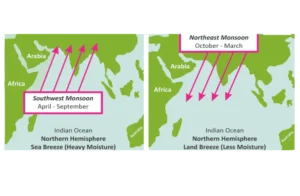
- Definition: A seasonal wind system bringing heavy rainfall to India from June to September.
- Contribution: Accounts for 75–80% of India’s annual rainfall, crucial for agriculture, water supply, and rural livelihoods.
- Branches:
- Arabian Sea Branch: Hits Kerala, Karnataka, Goa, Maharashtra, moving inland to Gujarat and Rajasthan.
- Bay of Bengal Branch: Moves northeast to Assam, West Bengal, Bihar, and spreads to the Indo-Gangetic plains.
Formation of the Southwest Monsoon
Differential Heating of Land and Sea
- Land Heating: During summer, the Indian subcontinent heats up faster than the surrounding oceans.
- This creates a low-pressure zone (relatively high temperature) over northwestern India.
- Meanwhile, the Indian Ocean remains relatively cooler,(cooler= high pressure) maintaining a high-pressure zone.
- The pressure difference pulls moisture-laden winds from the ocean toward the land.
Cross-Equatorial Winds
- Trade Winds: Winds from the southern hemisphere cross the equator.
- Due to the Coriolis effect, they get deflected to the right, becoming the southwest monsoon winds.
- The Somali Jet (a strong low-level wind current near East Africa) carries huge amounts of moisture toward India.
Shift of ITCZ (Inter-Tropical Convergence Zone)
- ITCZ Movement: The ITCZ is a belt of low pressure near the equator where trade winds converge.
- In summer, it shifts northwards over the Indian subcontinent.
- This shift acts like a magnet, drawing moist winds deep into India.
- The ITCZ also forms the monsoon trough, guiding rainfall distribution across the Indo-Gangetic plains.
Role of Jet Streams
- Tropical Easterly Jet: Strengthens monsoon currents, pushing moist winds into India.
- Subtropical Westerly Jet: Retreats northwards, allowing monsoon winds to dominate.
These upper-air circulations regulate the timing and intensity of rainfall.
Conditions Necessary for Monsoon Formation
- Strong summer heating of landmass (India, Tibet plateau).
- Presence of Mascarene High (high-pressure system in the southern Indian Ocean).
- Cross-equatorial moisture-laden winds from the Indian Ocean.
- Northward migration of ITCZ during summer.
- Supportive jet streams (Tropical Easterly Jet).
- Absence of strong El Niño (which weakens monsoon rainfall).
Conclusion
The southwest monsoon is vital for India’s agriculture, economy, and water security, but its variability due to global climate factors like El Niño and Indian Ocean Dipole makes it unpredictable.
INDIA’S BALANCE OF PAYMENTS DEFICIT
TOPIC: (GS3) ECONOMY: THE HINDU
The Reserve Bank of India (RBI) reported that India’s Balance of Payments (BoP) slipped into a deficit due to higher dollar outflows from trade and investments.
What is Balance of Payments (BOP)
- A record of all economic transactions between residents of a country and the rest of the world.
- Components:
- Current Account: Trade in goods & services, remittances, income.
- Capital Account: Investments, loans, foreign assets.
- Example: If India imports more oil than it exports IT services, the current account deficit widens.
RBI Findings (2025–26)
- BoP Deficit: $30.8 billion, reversing last year’s surplus.
- Outflows: Trade and investment outflows exceeded inflows sixfold.
- CAD Widening: Driven by oil imports, global slowdown, and weak exports.
What are Forex Reserves?
- Definition: Foreign Exchange Reserves are assets held by a country’s central bank (in India, the RBI) in foreign currencies, gold, SDRs (Special Drawing Rights), and IMF reserve positions.
- Purpose: They act as a buffer against external shocks, ensuring stability in international trade and finance.
- India’s Status: As of 2026, India’s forex reserves stand at around $640 billion, among the highest globally.
Components of Forex Reserves
- Foreign Currency Assets (FCA): Mainly US dollars, euros, pounds, yen.
- Gold Reserves: Physical gold held by RBI.
- SDRs (Special Drawing Rights): Allocated by the IMF.
- IMF Reserve Position: India’s share with the IMF.
How are Forex Reserves Useful?
- Currency Stability: RBI uses reserves to stabilize the rupee during volatility. If foreign investors pull out funds, RBI sells dollars to prevent rupee depreciation.
- Import Security: Reserves ensure India can pay for essential imports like crude oil, fertilizers, and machinery, even during crises. Acts as a safety net for 8–10 months of imports.
- Investor Confidence: High reserves signal economic strength, attracting FDI and portfolio investments.
- Crisis Management: During global shocks (like COVID-19 or oil price spikes), reserves help maintain financial stability. In 1991, India had only $1.2 billion reserves, forcing gold pledging. Today’s reserves prevent such crises.
- External Debt Servicing: Reserves are used to repay foreign loans and interest, ensuring India’s credibility in global markets.
Impacts of BoP Deficit
Climate & Energy
- Oil Imports: Higher crude prices worsen CAD, increasing vulnerability to global shocks.
- Electricity Demand: Rising power consumption (especially cooling needs) adds to import bills for energy equipment.
Agriculture
- Fertilizer Imports: Dollar outflows raise costs of imported fertilizers, impacting farmers.
- Food Inflation: Weak rupee makes imports costlier, pushing up food prices.
Economy
- Rupee Pressure: Deficit weakens the rupee, raising inflation.
- Investment Concerns: Capital flight reduces liquidity in markets.
- Growth Impact: Slower exports and higher import costs drag GDP growth.
Way Forward
- Boost Exports: Diversify into high-value sectors like electronics, pharmaceuticals, and green tech.
- Attract FDI: Strengthen ease of doing business and investor confidence.
- Energy Security: Expand renewables and domestic oil exploration.
- Fiscal Prudence: Control subsidies and maintain macroeconomic stability.
What is a Currency Swap?
A currency swap is an agreement between two countries’ central banks to exchange currencies at a fixed rate for a specified period.
- Purpose: It allows countries to access foreign currency liquidity without depleting their forex reserves.
- Example: If India faces a dollar shortage, the RBI can swap rupees with the US Federal Reserve or another central bank to obtain dollars temporarily.
How Does Currency Swap Work?
- Agreement: Two central banks agree to exchange a set amount of their currencies.
- Immediate Exchange: One country provides foreign currency (say USD) in return for local currency (say INR).
- Repayment: After the agreed period, the currencies are swapped back at the pre-decided rate.
- Benefit: Provides short-term liquidity support without affecting reserves permanently.
How Currency Swap Helps in BoP Crisis
- Dollar Liquidity: Helps countries like India access US dollars when outflows exceed inflows, easing BoP stress.
- Rupee Stability: Prevents sharp depreciation of the rupee by ensuring dollar availability.
- Import Security: Ensures payments for essential imports like crude oil and fertilizers even during crises.
- Confidence Boost: Signals strong international cooperation, reassuring investors and markets.
- Alternative to IMF Loans: Provides liquidity without conditionalities often attached to IMF assistance.
Examples
- India-Japan Currency Swap (2018): Agreement worth $75 billion, aimed at stabilizing India’s external sector.
- China’s Swap Agreements: China has over 30 currency swap deals globally to strengthen trade and financial stability.
India’s Forex Reserves (2026): Around $640 billion, but swaps act as an extra cushion during volatility.
Conclusion
India’s BoP deficit signals rising external vulnerability, demanding stronger export promotion, energy security, and capital inflow management.
SANCHI STUPA
TOPIC: (GS1) ART AND CULTURE: THE HINDU
Recently, sacred relics of Lord Buddha’s disciples Sariputra and Maudgalyayana from Sanchi Stupa were sent to Mongolia, strengthening cultural and spiritual ties between India and Mongolia.
Sanchi Stupa
- The Sanchi Stupa, located in Madhya Pradesh, is one of the oldest surviving stone structures in India.
- Built by Mauryan Emperor Ashoka in the 3rd century BCE, it enshrines relics of the Buddha and his revered disciples.
- Over centuries, it became a symbol of Buddhist art, architecture, and faith, supported by royal patronage and merchant communities.
- Historical Background: First formal survey by Alexander Cunningham in 1851. Found in ruins by British officer Henry Taylor in 1818.
What are Relics
- Religious Relics: Objects or body parts associated with saints, martyrs, or spiritual leaders, preserved and worshipped as holy. Example: Bones of Buddha’s disciples at Sanchi Stupa.
Types of Relics
- Physical Remains: Bones, ashes, or body parts of saints or revered figures.
- Personal Belongings: Clothing, tools, or items used by holy or historic personalities.
- Cultural Artifacts: Objects from ancient societies, such as pottery, weapons, or inscriptions.
- Symbolic Practices: Customs or beliefs that continue as remnants of earlier times.
Architectural Features
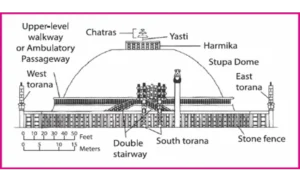
- Massive Stone Railings: Enclosing the stupa with four gateways (toranas) richly carved with scenes from Buddha’s life.
- Hemispherical Dome (Anda): Symbolizes the dome of heaven enclosing the earth.
- Harmika (Square Rail): Represents the world mountain.
- Yashti (Mast): Cosmic axis rising from the dome.
Chatras (Umbrellas): Symbolize different heavenly realms (devaloka).

Who Developed It
- Shunga King Pushyamitra Shunga: Enlarged the stupa and added stone railings.
- Satavahana Kings: Expanded the complex and supported Buddhist art.
- Merchant Guilds of Vidisha: Provided funds and patronage for further development.
Who Built the Toranas (Gateways)
- Satavahana Rulers like Satakarni: Commissioned the four elaborately carved gateways.
Depict Jataka tales, Buddha’s life events, and symbolic motifs such as lotus, wheel, and animals.Regarded as masterpieces of early Buddhist sculpture.
Significance
- Religious Importance: Houses relics of Buddha and disciples, making it a sacred pilgrimage site.
- Artistic Value: Gateway carvings are masterpieces of early Buddhist sculpture.
- Cultural Diplomacy: Relics sent abroad strengthen India’s soft power and Buddhist heritage diplomacy.
- UNESCO Recognition: Declared a World Heritage Site in 1989.
Way Forward
- Promote heritage tourism around Sanchi to boost local economy.
- Strengthen international Buddhist networks through relic exchanges.
- Enhance conservation efforts to preserve carvings and structures.
Conclusion
The Sanchi Stupa stands as a timeless monument of Buddhist faith and Mauryan architecture, symbolizing India’s cultural heritage and global spiritual ties.
MISSION QUEEN PINEAPPLE
TOPIC: (GS3) ECONOMY: THE HINDU
The Union Minister for Development of North Eastern Region (MDoNER) recently launched Mission Queen Pineapple to promote Tripura’s GI-tagged Queen Pineapple and build a value-chain ecosystem.
What is Mission Queen Pineapple
- Objective: Establish an integrated pineapple value-chain ecosystem in Tripura.
- Focus: Address structural gaps, improve farmer income, and unlock premium markets.
- Innovation: Transform discarded leaves into value-added products.
- Timeline: Three-year roadmap (FY2026–FY2028).
- Nodal Ministry: Ministry of Development of North Eastern Region (MDoNER).
Queen Pineapple
- Tripura’s Queen Pineapple, known for its sweet taste, aroma, and nutritional richness, is the state fruit and received a GI tag in 2015.
- Taste & Aroma: Spiny, golden-yellow fruit with balanced sweet-tart flavor (13–17.2° Brix sweetness, 0.6–0.8% acidity).
- Nutritional Value: Rich in vitamins A, B, C and minerals like calcium, magnesium, potassium, iron.
- State Symbol: Declared the state fruit of Tripura.
Significance of the Mission
- Agriculture: Enhances farmer income through better market access.
- Economy: Promotes exports, branding Tripura globally.
- Innovation: Encourages waste-to-wealth initiatives.
- Regional Development: Strengthens North East’s role in India’s agri-value chains.
FOREST ADVISORY COMMITTEE (FAC)
TOPIC: (GS3) ENVIRONMENT: THE HINDU
The Forest Advisory Committee (FAC) has recently granted in-principle approval for diversion of over 3,000 hectares of forest land across multiple states for major infrastructure projects.
Forest Advisory Committee
- The Forest Advisory Committee (FAC) is a statutory body under the Forest Conservation Act, 1980.
- It plays a crucial role in balancing development needs with forest conservation, ensuring that projects requiring forest land comply with environmental and social safeguards.
Process of Transferring Forest Land
- Land Diversion FAC Approval: The Forest Advisory Committee (FAC) examines the proposal. If satisfied, it gives in-principle clearance for diversion of forest land.
- State Government Role: The concerned State government must ensure compliance with the Forest Rights Act, 2006, protecting the rights of tribals and forest dwellers before land is diverted.
- Compensatory Afforestation: The project developer must provide alternative land for afforestation and pay the Net Present Value (NPV) of the diverted forest land to offset ecological loss.
Significance
- Development: Enables critical infrastructure projects like highways, power plants, and mining.
- Conservation: Ensures ecological safeguards through compensatory afforestation.
- Social Justice: Protects rights of tribal and forest communities before diversion.
Conclusion
The Forest Advisory Committee acts as a balancing mechanism between ecological protection and developmental needs, ensuring that forest clearances are granted with strict safeguards.
CENTRAL CONSUMER PROTECTION AUTHORITY (CCPA)
TOPIC: (GS2) POLITY: THE HINDU
The Central Consumer Protection Authority (CCPA) has recently taken action against several e-commerce platforms for violating consumer rights and indulging in unfair trade practices.
Central Consumer Protection Authority (CCPA)
- Legal Foundation: Established under Section 10 of the Consumer Protection Act, 2019, which replaced the 1986 Act.
- Objective: To protect, promote, and enforce consumer rights as a class, ensuring fair trade practices in goods and services.
- Nodal Ministry: Functions under the Ministry of Consumer Affairs, Food & Public Distribution.
Composition
- Chief Commissioner: Heads the authority.
- Two Commissioners:
- One for goods-related issues.
- One for service-related complaints.
Functions and Powers
- Consumer Rights Protection: Safeguards and enforces rights of consumers as a class.
- Unfair Trade Practices: Prevents deceptive practices and ensures fair competition.
- Misleading Advertisements: Can order discontinuation of false or misleading ads.
- Class-Action Suits: Can initiate recalls, refunds, or cancellation of licenses.
- Investigations: Conducted through its Director-General headed Investigation Wing.
- Penalties: Can impose fines and enforce consumer welfare measures.
Significance
- Strengthens consumer confidence in markets.
- Ensures accountability of businesses, especially in digital commerce.
- Promotes ethical advertising and fair trade practices.
- Provides a legal remedy for collective consumer grievances.
Conclusion
The CCPA is a vital institution ensuring consumer rights, fair trade, and accountability in India’s growing digital economy.