

Why in News?
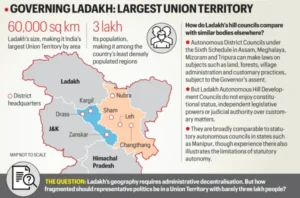
The Ladakh Administration has decided to establish Autonomous Hill Development Councils (AHDCs) in all seven districts following an in-principle agreement between the Ministry of Home Affairs (MHA) and Ladakh leaders.
Background
- Ladakh became a Union Territory on 31 October 2019 after the implementation of the Jammu and Kashmir Reorganisation Act, 2019.
- Unlike Delhi and Puducherry, Ladakh does not have a Legislative Assembly and is directly administered by the Lieutenant Governor.
- Earlier, elected Hill Councils existed only in Leh and Kargil districts.
- After the creation of five new districts, Ladakh now has seven districts: Leh, Kargil, Sham, Nubra, Zanskar, Drass and Changthang.
- The government has now proposed to establish AHDCs in all seven districts.
What are Autonomous Hill Development Councils (AHDCs)?
- AHDCs are elected district-level bodies responsible for local administration, planning and development.
- They function under the Ladakh Autonomous Hill Development Council (LAHDC) Act.
- Section 3(1) of the Act empowers the government to establish a council in every district through a notification in the Official Gazette.
- These councils serve as an important bridge between the Union Territory Administration and local communities.
Powers and Functions of AHDCs
The proposed councils are expected to enjoy wide administrative and developmental powers, including:
- Land administration, including matters related to land ownership and land allotment.
- Recruitment, transfer and promotion of district cadre employees.
- Preparation and implementation of District Development Plans based on local requirements.
- Administration of sectors such as health, education, tourism, agriculture, rural development, local infrastructure, social welfare and allied services.
- Management of a dedicated Council Fund and authority to levy taxes, fees, user charges and other legally permitted revenues.
- Monitoring implementation of welfare schemes and coordinating with government departments for effective service delivery.
Difference Between AHDCs and Sixth Schedule Autonomous District Councils
Basis | Autonomous Hill Development Councils (AHDCs) | Sixth Schedule Autonomous District Councils (ADCs) |
Legal Status | Created through an Act | Constitutional status under Articles 244(2) and 275(1) |
Area of Application | Applicable only in Ladakh | Applicable in notified tribal areas of Assam, Meghalaya, Mizoram and Tripura |
Nature of Powers | Mainly administrative and developmental | Legislative, executive, judicial and financial powers |
Judicial Powers | No judicial authority | Can establish Village Courts based on customary tribal laws |
Constitutional Protection | Statutory protection | Constitutional protection under the Sixth Schedule |
Significance of Expanding AHDCs
1. Strengthening Border Governance
- Several districts of Ladakh share borders with China (Tibet Autonomous Region) and areas under Pakistan’s control. Strong local institutions can improve governance, infrastructure development and public services in these strategically important border regions.
2. Region-Specific Development Planning
- Ladakh consists of cold deserts, high-altitude grazing pastures, glacier-fed river valleys and remote border villages. District-level planning allows development policies to reflect local geographical and climatic conditions.
3. Strengthening Grassroots Democracy
- Local representatives understand the needs of the people better and can ensure faster implementation of development projects through greater public participation.
4. Better Delivery of Public Services
- Decentralised administration can improve the quality of education, healthcare, tourism, agriculture, drinking water supply, road connectivity and social welfare programmes.
5. Protection of Indigenous Communities
- Greater local participation helps preserve traditional culture, tribal identity, sustainable pastoral practices and natural resources, while encouraging inclusive development.
Challenges
- The proposal does not completely address the long-standing demands for Sixth Schedule status, statehood and a Legislative Assembly, which continue to be raised by several organisations in Ladakh.
- The functions of AHDCs, Panchayati Raj Institutions and the Union Territory Administration may overlap unless their respective responsibilities are clearly defined.
- Newly created councils will require adequate financial resources, trained administrative staff and technical expertise for effective functioning.
- Balancing rapid infrastructure development with the protection of Ladakh’s fragile Himalayan ecosystem will remain a major challenge.
Way Forward
- Clearly define the powers of AHDCs, Panchayati Raj Institutions and the UT Administration to avoid administrative conflicts.
- Ensure adequate financial devolution and timely release of funds to strengthen local governance.
- Build institutional capacity through training, digital governance and transparent administrative systems.
- Continue dialogue with stakeholders regarding broader constitutional demands while ensuring sustainable and inclusive development.
Conclusion
The expansion of AHDCs will strengthen decentralised governance, balanced regional development and local participation while safeguarding Ladakh’s unique strategic and cultural interests.
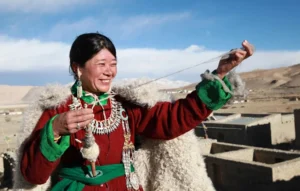
The Changpa are a semi-nomadic pastoral community living in the Changthang Plateau of eastern Ladakh. They are famous for rearing Changthangi (Pashmina) goats, which produce one of the finest natural fibres in the world.
Location
- Found mainly in the Changthang region of Ladakh.
- Some Changpa families are also found in nearby parts of Tibet (China).
- The region is situated at an altitude of 4,000–5,500 metres above sea level.
- It is characterised by:
- Cold desert climate
- Sparse vegetation
- High-altitude grasslands
- Long and severe winters
Social and Cultural Features
- The Changpas are traditionally semi-nomadic pastoralists.
- They mainly rear Pashmina goats, Yaks and Sheep
- They follow Tibetan Buddhism and maintain strong religious traditions.
- Their portable yak-hair tents are called Rebo (Reboo), allowing them to move with their livestock.
- Most families keep a household shrine dedicated to Buddhist deities.
Classification
- Phalpa – Changpas who continue the nomadic lifestyle.
- Fangpa – Changpas who have settled permanently in villages.
Livelihood
- Pashmina wool production is their primary source of income.
- The wool obtained from Changthangi goats is considered among the finest cashmere fibres globally.
- They also earn income through Livestock breeding, Dairy products and Wool trade
- Seasonal migration helps them find fresh grazing land for animals.
Festivals and Religious Practices
- Jyabten
- A purification ritual.
- Special food offerings are made to Guru Padmasambhava for blessings.
- Tangpe Chona
- Celebrated on the 15th day of the first month of the Tibetan lunar calendar.
- Marks community prayers and cultural celebrations.
Government Initiatives
- The Changpa community is recognised as a Scheduled Tribe (ST).
- Support is provided through:
- Pashmina promotion programmes
- Veterinary healthcare services
- Mobile schools and healthcare camps
- Livelihood development schemes
- Efforts are also being made to improve market access for high-quality Pashmina wool.
Why in News?
Sirsa Kinnow from Haryana has recently been granted the prestigious Geographical Indication (GI) Tag.

About Sirsa Kinnow
- Sirsa Kinnow is a premium variety of Kinnow mandarin cultivated mainly in the Sirsa district of Haryana.
- It is valued for its high juice content, rich taste, and excellent fruit quality, making it one of North India’s important commercial fruit crops.
About Kinnow
- Kinnow is a hybrid citrus fruit.
- It was developed by crossing:
- King Mandarin (Citrus nobilis)
- Willow Leaf Mandarin (Citrus deliciosa)
- The hybrid was developed by H.B. Frost in 1915 at the University of California Citrus Experiment Station.
Characteristics
- Medium to large-sized fruit.
- Bright orange-coloured peel.
- Sweet taste with mild acidity.
- Rich in juice, making it suitable for juice processing.
- Contains Vitamin C, Calcium, Potassium and Natural antioxidants
- The peel contains essential oils used in perfumes, cosmetics and food products.
- Rich in pectin, which is widely used in the food industry.
Growing Conditions
- Performs well in:
- Sub-tropical climate
- Well-drained sandy loam soils
- Can tolerate:
- Summer temperatures up to 40°C
- Winter temperatures close to 0°C
- Requires moderate irrigation and proper orchard management.
Importance of GI Tag
- A Geographical Indication (GI) identifies products whose quality or reputation is linked to a particular geographical region.
- It provides:
- Legal protection against imitation.
- Better market recognition.
- Higher income opportunities for farmers.
- Promotion of exports.
- Preservation of regional agricultural heritage.
Why in News?
The Union Cabinet has approved a draft notification to bring the iron and steel sector under India’s Carbon Credit Trading Scheme (CCTS).
What is the Carbon Credit Trading Scheme (CCTS)?
- The CCTS was notified by the Government of India in 2023 under the Energy Conservation Act, 2001, as amended by the Energy Conservation (Amendment) Act, 2022.
- It provides the regulatory framework for the functioning of the Indian Carbon Market (ICM).
- The scheme encourages industries to reduce Greenhouse Gas Emission Intensity (GEI) rather than absolute emissions.
- The baseline year for the current compliance cycle is 2023–24, while industries are required to achieve their assigned targets during the compliance year 2026–27.
How Does CCTS Work?
The scheme operates through two mechanisms:
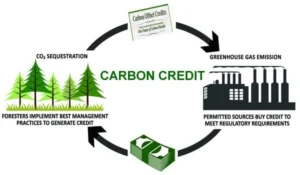
1. Compliance Mechanism
- It applies to Obligated Entities, which are energy- and emission-intensive industries.
- Each industry is assigned a Greenhouse Gas Emission Intensity (GEI) target based on emissions per unit of production.
- Industries that perform better than their targets receive Carbon Credit Certificates (CCCs), which can be traded in the carbon market.
- Industries that fail to meet their targets must either purchase carbon credits or pay environmental compensation, calculated as twice the average market price of carbon credits.
2. Offset Mechanism
- Organisations can voluntarily undertake approved projects that reduce or remove carbon emissions.
- Verified emission reductions are converted into carbon credits, which can be sold in the carbon market.
Coverage of the Scheme
- The CCTS currently covers sectors such as aluminium, cement, petroleum refineries, petrochemicals, pulp and paper, chlor-alkali and textiles.
- With the latest expansion, the iron and steel sector has also been included because of its significant contribution to national carbon emissions.
Why is the Steel Sector Important?
- India is the second-largest producer of crude steel in the world.
- The country produced approximately 151 million tonnes of crude steel during FY 2024–25.
- The steel sector contributes nearly 10–12% of India’s total carbon dioxide (CO₂) emissions.
- The National Steel Policy, 2017 targets 300 million tonnes of steel-making capacity and 255 million tonnes of production by 2030–31, making sustainable production essential.
Green Steel
- Green Steel refers to steel manufactured with minimal or zero fossil fuel emissions.
- It promotes the use of green hydrogen, renewable energy, electric arc furnaces and energy-efficient technologies to reduce the carbon footprint of steel production.
Major Steel Producing Regions in India
- The major steel clusters are located in Kalinganagar, Angul, Rourkela, Jharsuguda, Nagarnar, Bhilai, Raipur, Jamshedpur, Bokaro, Durgapur, Kolkata and Visakhapatnam.
Significance of CCTS
- Encourages industries to adopt clean technologies and improve energy efficiency.
- Helps India achieve its Nationally Determined Contributions (NDCs) under the Paris Agreement.
- Promotes the growth of a transparent carbon market.
- Creates financial incentives for industries that reduce emissions.
- Improves India’s competitiveness in the emerging green economy.