

Table of Contents
ToggleGLOBAL CAPABILITY CENTRES
TOPIC: (GS3) ECONOMY: THE HINDU
At the CII GCC Business Summit (2026), the Chief Economic Advisor (CEA) and the Union Finance Minister highlighted that India’s Global Capability Centres (GCCs) must move beyond cost advantage and become hubs of innovation and leadership.
What Are GCCs?
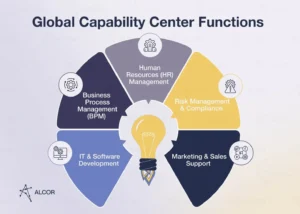
- Definition: Offshore units of multinational firms handling IT, R&D, finance, analytics, and AI.
- India’s role: Hosts 2,000+ GCCs, employing 2 million people, generating ~$100 billion revenue (~2% of GDP).
- Global standing: India is the secondlargest base of enterprise AI talent worldwide.
CEA’s Perspective
- Challenges: Rising domestic costs, global competition, and talent scarcity.
- AI impact: Routine lowcost tasks may be replaced, but AI governance and deployment need human expertise.
- Message: India must earn indispensability repeatedly by moving up the value chain.
Government’s Role
- Budget 202627 measures:
- Greater tax certainty.
- Expanded transferpricing safe harbour.
- Higher thresholds for compliance.
- Government provides the runway, but industry must fly the plane by driving innovation.
Finance Minister’s Vision
- Move beyond hosting to leading global innovation.
- Focus on:
- Intellectual property creation.
- Frontier research & AI applications.
- Product architecture and patents.
- Strengthen industry–academia linkages for seamless innovation transfer.
Geographical Diversification
- Tier2 and Tier3 cities emerging as GCC hubs.
- GCCs create multiplier effects: skill demand, startup growth, housing, and infrastructure.
- States urged to build specialised ecosystems aligned to local strengths.
Broader Significance
- GCCs support India’s Act East policy and digital economy goals.
- Enhance supply chain resilience and balanced regional development.
- Success stories act as ambassadors of India’s innovation ecosystem.
Conclusion
India’s GCC journey must evolve from cost advantage to innovation leadership, ensuring resilience, inclusivity, and global competitiveness in the next decade.
TRANSNATIONAL CRIME AND GLOBAL CRACKDOWN
TOPIC: (GS2) INTERNATIONAL RELATIONS: THE HINDU
Canadian authorities have clarified that no evidence links India to the killing of Khalistani separatist Hardeep Singh Nijjar (2023), while the US indicted Lawrence Bishnoi and Goldy Brar under Operation Hard Ball, targeting Indianorigin transnational criminal syndicates.
Understanding Transnational Organised Crime
- Criminal activities by networks operating across multiple countries, often involving violence, corruption, and illicit trade.
- Includes drug trafficking, extortion, targeted killings, smuggling, and cyberenabled crime.
Canada’s Revised Position
- Investigations found no evidence implicating Indian officials in Nijjar’s murder.
- Marks a shift from Trudeau’s 2023 allegation of a “potential link.”
- India had rejected the charges; ties began normalising in 2025 with restored diplomatic engagement.
Nijjar Case
- Resident in Canada since 1997, chief of Khalistan Tiger Force (KTF) – banned under UAPA (2023).
- Accused of financing extremist activities, links to attacks (e.g., Jalandhar priest assault, 2021).
- His killing outside a Sikh temple in British Columbia (June 2023) triggered a major diplomatic fallout.
US Charges – Bishnoi & Brar
- Lawrence Bishnoi: Directed murder from prison using smuggled phones.
- Goldy Brar: Coordinated operations from North America.
- Part of Operation Hard Ball – US crackdown on racketeering, extortion, narcotics, and targeted killings.
- FBI announced $50,000 reward for Brar’s arrest.
India–US Security Cooperation
- Enhanced intelligence sharing via MEA.
- India provided evidence on overseas gangsters and smuggling networks.
- Cooperation intensified after Anmol Bishnoi’s deportation (2025).
Emerging Dimensions
- Crossborder links: Indian gangs tied to Pakistanbased narcotics smugglers.
- Funding: Drug trade financing targeted killings.
- Technology: VPNs, encrypted apps, drones, maritime smuggling routes.
- Reflects convergence of organised crime and national security threats.
Broader Implications
- International relations: India–Canada reset; India–US law enforcement synergy.
- Internal security: Tackling prisonbased gangs, cyberenabled crime, and narcotics trafficking.
- Governance: Role of UAPA, extradition challenges, and need for stronger global policing.
- Global efforts: UNTOC, FATF, Interpol, UNODC, and BRICS Guwahati Declaration (2026) against drug trafficking.
Conclusion
The Nijjar case and Operation Hard Ball show that transnational crime is now a global security challenge, requiring evidencebased diplomacy and coordinated crackdowns to safeguard stability.
JUDICIAL ACCOUNTABILITY AND THE LIMITS OF IMPEACHMENT
TOPIC: (GS2) POLITY: THE HINDU
Lok Sabha Speaker Om Birla has decided to table the investigative committee’s report against former Allahabad High Court judge Yashwant Varma, even though he resigned in April 2026.
Justice Varma Case
- 2025 Incident: Burnt currency notes discovered at Justice Varma’s official residence in New Delhi.
- Supreme Court Inquiry: Inhouse probe found him culpable of misconduct.
- Parliamentary Motion: 146 Lok Sabha MPs submitted a removal motion.
- Committee Formation: Speaker constituted a threemember panel under the Judges (Inquiry) Act, 1968.
- Resignation: Before hearings concluded, Justice Varma resigned by writing to the President (as per Article 217).
Legal Position on Resignation
- Article 217: High Court judge may resign by writing to the President.
- 1978 SC ruling: Resignation is unilateral, effective immediately.
- However, law does not explicitly state that misconduct inquiries must lapse after resignation.
Precedents in India
- Justice P.D. Dinakaran (2011): Resigned during probe; Rajya Sabha dropped proceedings.
- Justice Soumitra Sen (2011): Resigned after Rajya Sabha passed impeachment motion; Lok Sabha dropped vote.
- Practice evolved that resignation ended accountability, though not mandated by law.
Dissenting View
- Jurist G. Mohan Gopal (Dinakaran case) argued:
- Two stages under Judges (Inquiry) Act – proving misbehaviour vs. removal.
- Inquiry should continue to establish truth, even if removal becomes redundant.
- Warning: Allowing resignation to halt probes erodes public trust.
Why Tabling the Report Matters
- Public accountability: Inquiry was taxpayerfunded; findings must be disclosed.
- Financial/legal consequences: Judges who resign usually get pension benefits. If misconduct is proven, removal could be backdated → pensions stopped, criminal action possible.
- Precedent shift: Would overturn past practice and ensure resignation does not shield judges.
Broader Implications
- Strengthens judicial accountability framework.
- Aligns with global practices where resignation does not end misconduct inquiries (e.g., UK judicial discipline system).
- Reinforces Parliament’s oversight role under constitutional checks and balances.
- Encourages reforms for transparent judicial ethics and public confidence in the judiciary.
Conclusion
The Varma case could redefine judicial accountability in India, proving that resignation cannot be a safe exit from misconduct inquiries and reinforcing the principle that truth and public trust must prevail over technicalities.
INDIA–AUSTRALIA RELATIONS AND STRATEGIC PARTNERSHIP
TOPIC: (GS2) INTERNATIONAL RELATIONS: THE HINDU
At the 3rd India–Australia Annual Summit (2026) in Melbourne, both nations signed landmark agreements covering defence, civil nuclear cooperation, trade, technology, and education, marking a new phase in their Comprehensive Strategic Partnership.
Strategic Significance
- Commitment to a free, open, rulesbased IndoPacific.
- Support for UNCLOS and freedom of navigation.
- Strengthened Quad cooperation with U.S. and Japan.
- Joint stand against crossborder terrorism.
- Partnership described as one between vibrant democracies and maritime powers.
Defence & Maritime Cooperation
- Defence Declaration: Enhanced consultations, interoperability, and joint exercises.
- Innovation Corridor: Connects defence startups, promotes codevelopment of technologies.
- Maritime Roadmap: Cooperation in shipbuilding, repair, and IndoPacific security.
Civil Nuclear Cooperation
- Operationalisation of 2014 Civil Nuclear Agreement.
- Enables Australian uranium exports for India’s peaceful energy use.
- Supports India’s clean energy transition and longterm energy security.
Economic & Trade Outcomes
- CECA fasttracking: Accelerate talks on trade and investment treaty.
- ECTA review: Reduce nontariff barriers, improve financing, encourage private investment.
- Bilateral trade ~US$32.6 billion, with India facing a deficit.
Energy, Technology & Skills
- Cooperation in critical minerals and renewable energy.
- Solar training academy in Gujarat under PM Surya Ghar Yojana.
- PACTS initiative: Cybersecurity, semiconductors, supply chain resilience.
- ACITI trilateral MoU: Tech partnership with Canada.
- Education links: Flinders University (Bengaluru), Victoria University (Gurgaon), mining skilling centre in Bhubaneswar.
Cultural Diplomacy
- Australia to return three antiquities from Tamil Nadu (Nandi, Bhadrakali Trident, Skanda sculpture).
- India to repatriate remains of an Australian First Nations ancestor.
Broader Context
- Both nations share Commonwealth heritage and strong ties in education, migration, sports, and language.
- Defence ties include AUSINDEX (Navy) and AUSTRAHIND (Army) exercises.
- Supported by the Centre for Australia–India Relations in Canberra.
Conclusion
The summit marks a transformative phase in India–Australia ties, reinforcing their role as key partners in a stable IndoPacific and resilient global economy.
PROTECTING INDIA’S SOUTHERNMOST LANDMARK
TOPIC: (GS1) GEOGRAPHY: THE HINDU
The Ministry of Ports, Shipping and Waterways has proposed structural protection and tourism development works at Indira Point lighthouse, located on Great Nicobar Island, India’s southernmost tip.
Indira Point
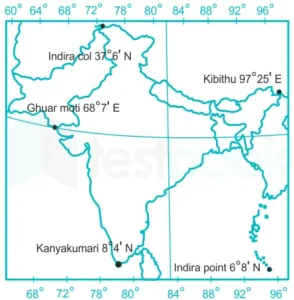
- Location: Southernmost point of India, in the Andaman & Nicobar Islands.
- Lies south of Galathea Bay, where a transshipment port is planned.
- History: Earlier called Pygmalion Point, renamed in 1985 after PM Indira Gandhi’s death.
- Lighthouse: Commissioned in 1972, 35 m tall, redwhite cast iron tower.
- Serves as a navigational aid on the Singapore–Colombo maritime route.
Protection & Development Proposal
- Structural repair and strengthening of lighthouse foundation.
- Construction of allweather approach road.
- Shore protection works (breakwaters).
- Development of powerhouse, inspection facility, staff quarters.
- Tourism initiatives: ecotourism, viewing tower, cycle tracks, museum, convention centre, memorial structure.
Coastal Regulation Framework
- Works fall under Island Coastal Regulation Zone (ICRZ) Notification, 2019.
- Requires clearance from UT Coastal Zone Authority and Union Environment Ministry.
- ICRZIA: Most sensitive zones – mangroves, coral reefs, turtle nesting grounds.
- ICRZIVA: Seaward areas up to 12 nautical miles.
Why Protection is Needed
- 2004 Tsunami & Earthquake: Caused land subsidence (~2.04 m) at Nicobar Islands.
- Lighthouse base submerged; nearby structures destroyed.
- IITMadras assessment: Foundation exposed to seawater, erosion, and wave action.
- Current tilt of 3.86°, though structurally stable, requires urgent strengthening.
Broader Significance
- Maritime security: Key navigational landmark for IndoPacific shipping routes.
- Tourism potential: Can be developed as a sustainable hub at India’s southernmost point.
- Environmental concerns: Balancing infrastructure with fragile coastal ecosystems.
- Strategic context: Linked to Great Nicobar Island mega project, part of India’s Act East and IndoPacific strategy.
Conclusion
The Indira Point initiative reflects India’s effort to preserve a vital maritime landmark while promoting ecotourism, highlighting the challenge of balancing development with ecological protection in sensitive island zones.
ASTRA MK 1
TOPIC: (GS3) SEQURITY: THE HINDU
India and Indonesia have signed a defence deal for the supply of Astra Mk 1 missiles, marking a new step in India’s defence exports and strategic cooperation in the IndoPacific.
About Astra Mk 1
- Indigenous origin: Developed by DRDO.
- Type: Beyond Visual Range AirtoAir Missile (BVRAAM).
- Users: Integrated with the Indian Air Force (IAF) and Indian Navy.
Features
- Range: 80–110 km; altitude up to 20 km.
- Speed: Mach 4.5 (4.5 times speed of sound).
- Guidance: Inertial navigation, midcourse updates, terminal active radar homing.
- Propulsion: Singlepulse smokeless solidfuel motor.
- Variants: Astra Mk 2 with extended range of ~200 km under development.
Integration with Platforms
- Already deployed on Sukhoi30 MKI fighters.
- Planned integration with Tejas Mk 1 (LCA) and Rafale jets.
- Enhances India’s air dominance capability in contested airspaces.
Strategic Importance
- Strengthens selfreliance in defence technology under Atmanirbhar Bharat.
- Boosts India’s defence exports, aligning with Make in India policy.
- Enhances regional security cooperation with partners like Indonesia.
- Provides India with a credible deterrent against adversaries in the IndoPacific.
- Comparable to global BVRAAMs like AMRAAM (USA) and Meteor (Europe).
Conclusion
The Astra Mk 1 exemplifies India’s progress in indigenous missile technology, reinforcing both national security and defence diplomacy in the IndoPacific.
PRAMBANAN TEMPLE
TOPIC: (GS1) INDIAN ART AND CULTURE: THE HINDU
The Prime Minister of India recently visited the Prambanan Temple in Yogyakarta along with the Indonesian President, highlighting shared civilizational ties and cultural diplomacy.
About Prambanan
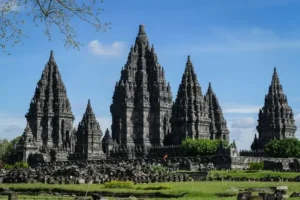
- Location: Sleman, Yogyakarta, Southern Java – largest Hindu temple complex in Indonesia.
- Built by: Sanjaya dynasty in the 9th century.
- Dedication: Dedicated to the Trimurti – Shiva, Vishnu, Brahma.
- Locally called Roro Jonggrang (Temple of the Slender Virgin).
- Declared a UNESCO World Heritage Site in 1991.
Architectural Features
- Blend of Javanese traditions and South Indian Pallava style.
- Basreliefs depict episodes from the Ramayana, showing cultural exchange.
- Complex has 240 temples, with central compound hosting 16 shrines.
- Shiva temple is the tallest at 47 m, among the highest in Southeast Asia.
- Surrounding area also has Buddhist shrines, reflecting religious coexistence.
Significance
- Symbol of India–Indonesia cultural diplomacy and shared heritage.
- Reinforces soft power through civilizational links in the IndoPacific.
- Example of syncretic traditions where Hinduism and Buddhism coexisted.
- Important for tourism, heritage preservation, and global recognition.
- Connects with India’s Act East Policy and UNESCO’s emphasis on safeguarding cultural monuments.
Conclusion
The Prambanan Temple visit underscores that shared heritage strengthens modern partnerships, making culture a vital pillar of India–Indonesia relations.