

Daily Current Affairs 25-July-2026

Share this Post

REFORMS IN NTA AND ACCOUNTABILITY

TOPIC: (GS2) POLITY: INDIAN EXPRESS

The National Testing Agency (NTA) has terminated the services of 47 officials after controversies like the NEETUG paper leak. The Ministry of Education has begun recruitment of General Managers and young professionals to overhaul the agency’s functioning.

Background

  • Scale of Unrest: According to NCRB (2024) data, there were over 1,200 protest-related incidents recorded nationwide, with Delhi accounting for nearly 15% of these occurrences.
  • Violation of Police Protocols: Despite Standing Orders 309 and 152 mandating the use of “minimum force” and “proportionality,” the deployment of pellet guns, lathi charges, and tear gas against students indicates a non-compliance with established police guidelines.
  • Judicial Precedents: In the Ramlila Maidan Case (2012), the Supreme Court emphasized that the state must use the “least invasive methods” for crowd control, yet recent judicial comments suggest a reluctance to engage with real-time video evidence of alleged brutality.
  • Democratic and International Standards: Excessive policing is seen as a threat to Article 19 rights (freedom of speech and assembly) and violates the UN Basic Principles on Use of Force (199

NTA Reforms and Examination Integrity

1. Accountability and Deterrence Measures The government has adopted a “zero-tolerance” approach toward negligence and malpractice to bridge the growing trust deficit between citizens and state institutions.

  • Personnel Accountability: Termination of 47 staff members for misconduct and the initiation of criminal proceedings against those involved in malpractices.
  • Legislative Teeth: Implementation of the Public Examinations (Prevention of Unfair Means) Act, 2024, which provides for stringent penalties and is designed to curb organized paper leaks.
  • Judicial Expediency: The proposal for Fast Track Courts to ensure the speedy trial of exam-related crimes, preventing the “judicial time” concerns often raised in high-profile cases.

2. Functional Specialization: The Four-Pillar Management Model To modernize examination governance, four new General Manager (GM) roles have been created to address specific systemic vulnerabilities:

  • Information Security: Tasked with strengthening cybersecurity protocols to prevent digital leaks and protect the sanctity of the examination process.
  • Vigilance & Forensics: Focused on investigating irregularities and establishing internal review mechanisms, addressing the “accountability gap” often seen in large-scale public institutions.
  • Assessment & Psychometrics: A specialized role to improve exam design and reliability, ensuring that the assessment remains fair and scientifically sound.
  • Network & Operations: Responsible for the logistical oversight of test centers to eliminate local-level tampering.

3. Infusing Fresh Expertise

  • Pratibha Setu Portal: In collaboration with the UPSC, 16 “Young Professionals” are being engaged to bring modern technological perspectives and innovative solutions to the NTA.
  • Historical Precedent: These reforms draw a parallel to the Railway Recruitment Board (2011) overhaul, highlighting that periodic institutional “cleaning” is necessary after systemic irregularities.

Way Forward

  • Independent Probes: Moving beyond internal reviews to include independent oversight, as called for by civil society groups.
  • Global Best Practices: Adopting “Dialogue-based Governance” (similar to the UK’s Dialogue Policing model) where stakeholders—students and educators—are consulted during the reform process to reduce friction.
  • Transparency: Ensuring that the recruitment for these new GM roles remains open and merit-based to uphold public trust.

Broader Implications

  • Student Trust: Restoring confidence in national exams is crucial for education equity.
  • Technology Integration: Use of AIbased monitoring and secure digital platforms can reduce risks.
  • Global Benchmarking: Countries like the US (ETS for SAT/TOEFL) adopt strong psychometric and security standards, offering models for India.
  • Accountability Culture: Signals a shift towards stricter governance in education institutions.

Conclusion:

The NTA overhaul shows that credible exams require strong institutions, transparent processes, and strict accountability to uphold fairness in education.

CJI CLARIFIES REMARKS

TOPIC: (GS2) POLITY: INDIAN EXPRESS

Chief Justice of India Surya Kant clarified that his earlier “cockroach” remark was directed only at fake law degree holders, not at the youth in general. He emphasized that the Supreme Court remains open to genuine grievances of young citizens, reaffirming respect for law graduates.

Background

  • Judicial Integrity and Media Accountability: Misinterpretation of the CJI’s remarks by media highlights the critical need for accurate reporting to maintain the sanctity of judicial discourse and prevent a “trust deficit” between the judiciary and the public.
  • Professional Standards and the Rule of Law: Addressing concerns regarding fake law degrees is vital for ensuring that only qualified practitioners enter the legal system, thereby upholding the “rule of law” and the quality of justice delivery.
  • Institutional Clarification for Public Trust: The Supreme Court’s proactive clarification serves to protect the professional dignity of genuine practitioners and bridges the gap between citizens and state institutions by dispelling systemic misunderstandings.
  • Regulatory Oversight and Reform: Much like the need for “independent probes” and “standing orders” in policing, the legal system requires robust internal review mechanisms to filter out unqualified individuals and maintain democratic integrity

Judicial Perspective

  • Judicial Integrity and Public Trust: Ensuring authentic qualifications in the legal profession is essential to prevent an “accountability gap” and maintain the credibility of courts in the eyes of the public.
  • Regulatory Reform and Rule of Law: Just as Standing Orders regulate police conduct to protect democratic rights, strict oversight by the Bar Council ensures that the legal system is not undermined by unqualified practitioners.
  • Institutional Accessibility for Youth: The CJI’s message that the Supreme Court remains accessible to the youth reinforces the constitutional vision of “access to justice for all.” This encourages the use of judicial forums for the substantive addressing of grievances, providing a legal alternative to mass demonstrations.
  • Strengthening Democratic Participation: Facilitating young professionals’ engagement with the judiciary protects Article 19 rights (freedom of speech and assembly) by channeling grievances through constitutional mechanisms.
  • This approach mirrors “dialogue-based” governance, focusing on communication and redressal rather than institutional friction or coercion

Governance & Policy Dimensions

  • University Grants Commission (UGC) and Bar Council of India (BCI) regulate law education standards.
  • Fake degree cases highlight the need for stronger monitoring of higher education institutions.
  • Data: UGC has identified over 20 fake universities in India in recent years, showing the scale of the problem.
  • Strengthening digital verification systems for degrees can prevent fraudulent practices.

Broader Implications

  • The clarification reinforces judicial accountability and sensitivity towards youth.
  • It also signals the judiciary’s commitment to upholding professional ethics in law.
  • Misinterpretations of judicial remarks can distort public perception, hence timely clarifications are vital.

CHIEF JUSTICE OF INDIA

The CJI is the head of the Supreme Court of India, the highest judicial authority under Article 124 of the Constitution. Serves as the guardian of the Constitution and protector of fundamental rights.

Appointment

    • Appointed by the President of India under Article 124(2).
    • Follows the seniority convention, where the seniormost judge of the Supreme Court is elevated.
    • The process is guided by the Memorandum of Procedure (MoP).

Tenure & Retirement

    • The CJI holds office until the age of 65 years.
    • Tenure is usually short due to age limits, but crucial for judicial continuity.

Powers & Functions

    • Judicial Role: Presides over Constitution Benches and important cases.
    • Administrative Role: Allocates cases, forms benches, and manages Supreme Court functioning.
    • Advisory Role: Represents judiciary in interactions with the executive and legislature.
    • Institutional Role: Exofficio head of bodies like National Legal Services Authority (NALSA) and Indian Law Institute.

Checks & Balances

    • Ensures judicial independence from executive interference.
    • Plays a role in maintaining separation of powers.
    • Example: In Kesavananda Bharati case (1973), the Supreme Court upheld the Basic Structure Doctrine, reinforcing judicial authority.

Conclusion:

The CJI’s statement underscores that India’s judiciary values genuine youth participation while firmly rejecting fake qualifications that threaten justice delivery.

INDIA’S EMERGING GEOPOLITICAL CHALLENGE

TOPIC: (GS2) INTERNATIONAL RELATIONS: INDIAN EXPRESS

India has managed past crises like the Iran war and Cold War pressures, but faces new challenges in 2026 involving trade, oil imports, and global power rivalries. The US, China, and Russia are exerting economic and strategic pressures, testing India’s foreign policy resilience.

Background

  • In 1991, India faced US pressure on nuclear proliferation, human rights, and economic reforms, coinciding with its financial crisis.
  • Today, India is under scrutiny for exports, labour standards, and Russian oil imports amidst global geopolitical tensions.
  • The situation reflects a shift from securitycentric issues to trade and economic compliance pressures.

Current Challenges

  • Trade Standards: US demands stricter compliance with labour and environmental norms in exports.
  • Russian Oil Imports: India’s purchase of discounted Russian crude faces criticism from Western allies.
  • China Factor: Border tensions and competition in global supply chains continue to strain relations.
  • Global Multipolarity: Balancing ties with US, Russia, and China while safeguarding national interests.

Economic Dimensions

  • India’s dependence on energy imports makes it vulnerable to global oil politics.
  • Pressure to diversify trade partners and reduce reliance on singlesource imports.
  • Data: India imports nearly 85% of its crude oil needs (Ministry of Petroleum, 2025).
  • WTO and global trade rules increasingly demand sustainable and ethical production standards.

Strategic & Policy Dimensions

  • Foreign Policy Balancing: India continues its multialignment strategy, engaging with QUAD, BRICS, and SCO simultaneously.
  • Energy Security: Need for longterm agreements with Middle Eastern and African nations.
  • Defence Cooperation: Strengthening ties with the US for technology, while maintaining Russian defence imports.
  • Example: India’s S400 missile deal with Russia despite US sanctions pressure shows balancing diplomacy.

Way Forward

  • Diversify energy sources and invest in renewables to reduce oil dependency.
  • Strengthen domestic manufacturing and labour standards to meet global trade expectations.
  • Enhance regional diplomacy in South Asia and the Indian Ocean to counter Chinese influence.
  • Use platforms like G20 and WTO to push for fairer global trade rules.

Conclusion:

India’s future challenge lies in balancing economic growth with strategic autonomy, ensuring resilience.

YOUTH ACTIVISM AND EXAMINATION REFORMS

TOPIC: (GS2) POLITY: INDIAN EXPRESS

Innovator and activist Sonam Wangchuk completed a 26day hunger strike demanding reforms in India’s public examination system. The government responded by announcing fasttrack courts and stronger measures to ensure integrity in exams like NEET.

Background

  • India’s examination system has faced repeated controversies, including paper leaks, corruption, and inefficiency.
  • Youth groups and the Citizens’ Front of Public Examinations (CFPE) raised concerns about fairness and transparency.
  • Wangchuk’s protest highlighted the urgency of reforms, linking education integrity to national accountability goals for 2034.

Key Concerns

  • Paper Leaks: NEET and other exams have been compromised, affecting lakhs of students.
  • Corruption: Allegations of bribery and malpractice undermine trust in institutions.
  • Skill Development Gap: Weak examination systems fail to reflect true merit, impacting workforce quality.
  • Youth Discontent: Protests show growing frustration among students over lack of accountability.

Government Response

  • FastTrack Courts: To conclude paper leak cases within five months (two months investigation, three months trial).
  • Stricter Penalties: Under the Public Examinations Act, 2024, fines up to ₹10 crore and imprisonment up to 10 years for organized exam crimes.
  • Recruitment Reforms: NTA restructuring with new professionals in information security, vigilance, and psychometrics.
  • Example: Similar fasttrack mechanisms were used in Lok Adalats to reduce pendency in civil disputes.

Broader Implications

  • Education Integrity: Strong systems ensure meritbased selection, vital for UPSC, SSC, and NEET aspirants.
  • Youth Empowerment: Protests reflect democratic participation and demand for accountability.
  • Governance Dimension: Aligns with Digital India and Skill India missions, ensuring transparent and efficient processes.
  • Global Benchmarking: Countries like South Korea and Singapore maintain strict exam integrity, offering models for India.

Way Forward

  • Strengthen digital security with AIbased monitoring of exam centres.
  • Ensure community oversight and transparency in recruitment agencies.
  • Expand skillbased assessments beyond rote learning to match global standards.
  • Integrate reforms with National Education Policy (NEP 2020) for holistic change.

RIGHT TO SPEECH

  • Constitutional Basis: Guaranteed under Article 19(1)(a) of the Indian Constitution.
  • Scope: Citizens can freely express opinions, criticize policies, and share ideas through speech, writing, art, or digital platforms.
  • Reasonable Restrictions: Article 19(2) allows limits in the interest of sovereignty, public order, morality, defamation, contempt of court, and national security.
  • Judicial Safeguards: Courts have upheld free speech as essential for democracy.
    • Example: In Shreya Singhal v. Union of India (2015), the Supreme Court struck down Section 66A of the IT Act for curbing online speech.
  • Global Context: Free speech is also protected under Article 19 of the Universal Declaration of Human Rights (UDHR).

RIGHT TO PROTEST

  • Constitutional Basis: Protected under Article 19(1)(b) – right to assemble peacefully without arms.
  • Purpose: Allows citizens to raise grievances, demand accountability, and influence policy decisions.
  • Restrictions: Subject to Article 19(3) – reasonable limits for public order, sovereignty, and morality.
  • Judicial View: Peaceful protest is a fundamental right.
    • Example: In Ramlila Maidan Case (2012), the Supreme Court ruled excessive police force against protestors unconstitutional.
  • Democratic Significance: Protests act as a check on government power and give marginalized groups a platform.
  • Global Examples:
    • Hong Kong (2019): Mass protests against extradition law.
    • Arab Spring (2011): Demonstrations across 17 countries reshaped governance.

INTERRELATION OF SPEECH & PROTEST

  • Free speech enables citizens to voice dissent, while the right to protest provides a collective platform to act on that dissent.
  • Both rights are cornerstones of democracy, ensuring accountability and participation.
  • Misuse (violent protests or hate speech) can invite restrictions, but genuine exercise strengthens democratic values.

Conclusion:

Sonam Wangchuk’s protest shows that youth activism can drive systemic reforms, making examinations fair, transparent, and futureready for India’s democracy.

US TARIFFS AND POLITICAL NARRATIVE

TOPIC: (GS2) INTERNATIONAL RELATIONS: INDIAN EXPRESS

The US trade tariffs imposed during Donald Trump’s administration continue to be debated for their economic impact and political strategy. Analysts highlight how tariffs were used to protect domestic industries while shaping a strong political narrative.

Background

  • Tariffs are taxes on imports, aimed at shielding local manufacturers from foreign competition.
  • Under Trump, tariffs targeted steel, aluminum, and Chinese goods, sparking trade tensions.
  • The policy was framed as defending American jobs and industries against unfair global practices.
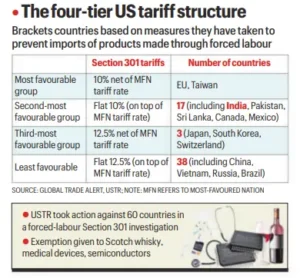
Us Tariffs and Political Narrative

Economic Rationale

  • Domestic Protection: Tariffs raised import costs, encouraging reliance on local production.
  • Manufacturing Boost: Sought to revive industries like steel and automobile manufacturing.
  • Revenue Generation: Tariffs added billions to US government revenue.
  • Example: US tariffs on Chinese goods in 2018 covered imports worth $250 billion, reshaping trade flows.

Political Narrative

  • Blame Factor: China was portrayed as the main culprit for trade imbalances.
  • Protection Factor: American workers and industries were shown as beneficiaries.
  • Visible Action: Tariffs acted as a symbol of resolve, signaling strong leadership.
  • This narrative resonated with domestic voters, linking economic policy with nationalism.

Global Implications

  • Trade Wars: Escalated tensions with China, leading to retaliatory tariffs.
  • Supply Chain Disruptions: Global businesses faced higher costs and uncertainty.
  • Impact on Allies: Even EU and Canada were affected, straining diplomatic ties.
  • Data: WTO reported a rise in global trade restrictions by 40% during 2018–19.

Lessons for India

  • India must balance protection of domestic industries with global trade commitments.
  • Policies like Make in India and ProductionLinked Incentives (PLI) echo similar goals of boosting local manufacturing.
  • India should avoid excessive protectionism to maintain export competitiveness.
  • Example: India’s tariff hikes on electronics and solar panels drew WTO scrutiny, showing the fine line between protection and compliance.

Way Forward

  • Strengthen domestic competitiveness through innovation and skill development.
  • Use targeted tariffs only where necessary, avoiding blanket restrictions.
  • Engage in multilateral trade negotiations to safeguard national interests.
  • Align trade policy with sustainable development goals (SDGs) and WTO norms.

TARIFFS

A tariff is a duty or tax levied on imported goods by the government of the importing country. It can also apply to exports in certain cases, though import tariffs are more common.

  • Tariffs are part of trade policy tools used to regulate international commerce.

Types of Tariffs

  • Specific Tariff: Fixed fee per unit of a product (e.g., ₹500 per imported car).
  • AdValorem Tariff: Percentage of the product’s value (e.g., 5% of the import price).
  • Protective Tariff: Designed to shield domestic industries from cheaper imports.
  • Revenue Tariff: Primarily aimed at raising government income.

Objectives of Tariffs

  • Protect Domestic Industries: By making imports costlier, tariffs encourage local production.
  • Generate Revenue: Customs duties contribute to government finances.
  • Political Leverage: Tariffs can be used to pressure other countries in disputes.
  • Consumer Safety: Sometimes imposed to restrict unsafe or substandard imports.

Global Examples

  • US Tariffs on China (2018): Covered imports worth $250 billion, aimed at reducing trade imbalance.
  • India’s Tariff on Solar Panels: Raised duties to promote domestic manufacturing under Make in India.

Conclusion:

The US tariff experience shows that trade policy is not just economics but also politics, requiring balance between domestic protection and global cooperation.

DEPRECIATION OF INDIAN RUPEE

TOPIC: (GS3) ECONOMY: THE HINDU

The Indian rupee has fallen to record lows against the US dollar, raising concerns about trade balance and import costs. The Reserve Bank of India (RBI) released data highlighting the impact on imports, especially crude oil from Russia, and overall foreign exchange trends.

Background

  • Currency depreciation occurs when the value of the rupee declines compared to foreign currencies, mainly the US dollar.
  • India’s dependence on imports, particularly oil and gold, makes the economy sensitive to exchange rate fluctuations.
  • Past episodes like the 1991 Balance of Payments crisis and 2013 taper tantrum showed similar vulnerabilities.
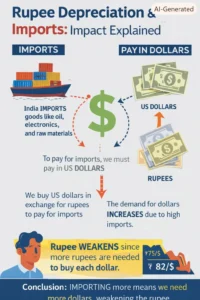
Deprecation of indian Rupee

Economic Impact

  • Import Costs Rise: Oil, machinery, and electronics become more expensive, widening the current account deficit.
  • Inflationary Pressure: Higher import bills push up domestic prices, affecting households.
  • Trade Balance: Exporters may benefit from cheaper rupee, but gains are offset by rising import costs.
  • Corporate Debt: Firms with foreign borrowings face higher repayment burdens.
  • Data: India imports nearly 85% of crude oil needs, making rupee weakness a direct inflation driver (Ministry of Petroleum, 2025).

Policy Response

  • RBI Intervention: Uses foreign exchange reserves to stabilize the rupee.
  • Monetary Measures: Adjusts interest rates to control inflation and capital flows.
  • Government Strategy: Encourages local manufacturing under Make in India and PLI schemes to reduce import dependence.
  • Example: RBI’s forex reserves of $650 billion (2026) act as a buffer against volatility.

Global Dimensions

  • US Dollar Strength: Global investors shift to dollar assets during uncertainty, weakening emerging market currencies.
  • Russia Factor: India’s discounted oil imports from Russia face payment challenges due to exchange rate volatility.
  • China & Trade: Competition with China in exports adds pressure on India’s trade competitiveness.
  • WTO Note: Global trade tensions and tariff wars have increased currency volatility worldwide.

Way Forward

  • Diversify energy sources and invest in renewables to reduce oil dependency.
  • Strengthen domestic manufacturing to cut reliance on imports.
  • Enhance export competitiveness through technology and skill development.
  • Build stronger regional currency cooperation in South Asia to reduce dollar reliance.

Conclusion:

The rupee’s depreciation highlights India’s need for resilient economic policies, reduced import dependence, and stronger global trade positioning to safeguard stability.

TRADEMARKING JAGANNATH HERITAGE

TOPIC: (GS1) INDIAN ART AND CULTURE: THE HINDU

The Shree Jagannath Temple Administration (SJTA) in Odisha has filed trademark applications for sacred names like Jagannath Dham, Shree Kshetra, Mahaprasad, Nilachakra, and Koili Vaikuntha.

Background

  • The Jagannath Temple in Puri, a 12thcentury shrine, is one of India’s most revered pilgrimage sites.
  • SJTA aims to protect the temple’s unique cultural and spiritual symbols from unauthorized commercial or institutional use.
  • The initiative is based on the Trade Marks Act, 1999 and Trade Marks Rules, 2017, which allow organizations to register names and emblems for exclusive use.

Cultural and Religious Dimensions

  • Jagannath Dham represents the divine abode of Lord Jagannath, central to Odisha’s spiritual identity.
  • Shree Kshetra and Koili Vaikuntha are sacred terms deeply rooted in temple rituals and local tradition.
  • Protecting these names ensures authenticity of Jagannath culture and prevents misuse for political or commercial gain.
  • Example: Similar protection exists for Tirumala Tirupati Devasthanams (TTD), which trademarked its symbols and names to prevent imitation.

Political and Administrative Context

  • The trademark move led to a political confrontation between Odisha and West Bengal governments.
  • Odisha’s leadership emphasized cultural ownership, while Bengal defended its temple project as a regional devotional initiative.
  • The issue reflects how religious heritage intersects with federal governance and identity politics.

Legal and Policy Dimensions

  • Under the Trade Marks Act, registration grants exclusive rights to use names and symbols for religious or cultural institutions.
  • It prevents unauthorized replication and ensures legal protection against misuse.
  • The move aligns with India’s broader efforts to preserve intangible cultural heritage, as recognized by the Ministry of Culture and UNESCO conventions.

Conclusion:

The trademarking of Jagannath heritage marks a vital step in protecting India’s sacred traditions from commercialization while reinforcing cultural pride and legal accountability.

DECLINE IN EDUCATION EXPENDITURE

TOPIC: (GS2) POLITY: INDIAN EXPRESS

Both the Central and State Governments have reduced their education spending over the past 12 years, as per recent fiscal data. The trend raises concerns about India’s commitment to achieving quality education and equitable access, especially under the National Education Policy (NEP 2020).

Background

  • Education expenditure is a key indicator of government priority in human capital development.
  • The Kothari Commission (1966) recommended spending 6% of GDP on education — a target still unmet.
  • Over time, both Centre and States have shifted focus toward infrastructure and welfare schemes, reducing direct investment in education.
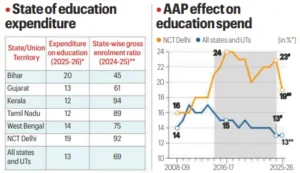
Decline in Education Expenditure

Current Trends

  • All States and UTs combined: Education spending fell from 12% (2008–09) to 6% (2023–24) of total expenditure.
  • Delhi Exception: Increased allocation from 26% to 29%, reflecting policy focus under its education reforms.
  • State Variations:
    • Kerala – 15% (highest)
    • Tamil Nadu – 13%
    • Bihar – 9%
    • Gujarat – 4%
    • UTs – 19% (average)
  • The decline is visible even in states with strong literacy programs, showing a nationwide fiscal contraction in education.

Policy and Governance Dimensions

  • Central Schemes: Programs like Samagra Shiksha Abhiyan and PM SHRI Schools face fund constraints.
  • State Responsibility: Education is a Concurrent List subject, requiring joint funding and coordination.
  • Fiscal Priorities: Rising expenditure on subsidies and infrastructure has reduced education’s share.
  • Example: The Economic Survey 2025–26 noted that India spends only 2.9% of GDP on education, below global averages (OECD ~5%).

Implications

  • Quality Gap: Reduced funding affects teacher training, digital infrastructure, and learning outcomes.
  • Equity Issues: Rural and marginalized students face widening disparities.
  • LongTerm Impact: Weak human capital limits productivity and innovation potential.
  • Global Comparison: Countries like Finland and South Korea maintain high education spending to sustain growth.

Way Forward

  • Increase budgetary allocation to meet NEP 2020 goals.
  • Encourage publicprivate partnerships for skill and vocational education.
  • Strengthen outcomebased monitoring of education schemes.
  • Promote digital learning infrastructure under Digital India and Skill India missions.

NATIONAL EDUCATION POLICY 2020

School Education Reforms

    • Introduced 5+3+3+4 structure replacing the old 10+2 system.
    • Focus on foundational literacy and numeracy by Grade 3.
    • Emphasis on mothertongue/local language as medium of instruction till Grade 5.

Higher Education Transformation

    • Aim to achieve 50% Gross Enrollment Ratio (GER) by 2035.
    • Multidisciplinary universities and flexible curricula with multiple exit options.
    • Establishment of Higher Education Commission of India (HECI) for regulation.

Skill Development & Vocational Training

    • Integration of vocational education from Grade 6 onwards.
    • Promotion of coding, digital literacy, and experiential learning.
    • Alignment with Skill India Mission to prepare students for future jobs.

Governance & Equity Measures

    • Special focus on socially and economically disadvantaged groups (SEDGs).
    • Expansion of open and distance learning to improve access.
    • Use of technology platforms like DIKSHA for teacher training and econtent.

Conclusion:

The steady fall in education expenditure signals an urgent need for renewed fiscal commitment to human development  the foundation of India’s longterm growth and social equity.

Write a Review

Your email address will not be published. Required fields are marked *